Only fragments of historical text from China's middle period have been translated into English, until now. Here at last is the first major Chinese historical work from the Song dynasty. Written by Ouyang Xiu, an intellectual giant of the eleventh century, this is a history of the preceding century (907–979), a period known as the Five Dynasties.
The historical and literary significance of Ouyang's achievement cannot be underestimated. In rewriting the existing official history of the Five Dynasties, Ouyang—whose own time was characterized by extraordinary intellectual and political innovation—made several notable decisions. He rewrote the history in the "ancient" style preferred by forward-thinking literati; he even rewrote the original documents quoted within biographies. He also relied on his own moral categories, reevaluating the worth of the historical figures in light of his own convictions that individuals should take personal responsibility for the fate of society. Ouyang's history would eventually become the official version—the last state-sanctioned dynastic history of imperial China to be written by an individual in a private capacity. In addition to its provocative insights and lucid presentation, Historical Records of the Five Dynasties is an eloquent statement on the art of historical writing in the eleventh century.
A preeminent scholar of Chinese history, Richard L. Davis has provided a thorough introduction and rendered nearly two-thirds of the Chinese original into English, including complete sections critical to understanding the politics and personalities of the time. Biographical clusters based on Ouyang's moral categories also appear in full, helping readers to appreciate the Confucian agenda that informs the work.
- English
- ePUB (mobile friendly)
- Available on iOS & Android
eBook - ePub
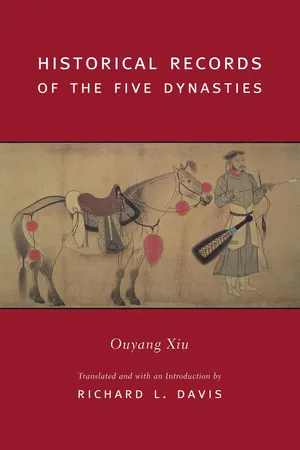
Historical Records of the Five Dynasties
About this book
Information
Subtopic
Asian HistoryIndex
HistoryCHAPTER 1
••••••••
ANNALS I:
BASIC ANNALS OF LIANGi
Taizu [Zhu Wen, Quanzhong, C.E. 852–911], the Divinely Martial, the Originally Sagacious, and the Filial Emperor, surnamed Zhu, was native to Wugou hamlet, Dangshan County, Songzhou. His father, Zhu Cheng, an instructor in the Five Classics, sired three sons: Quanyu, Cun, and Wen.ii Cheng died, leaving the three boys in poverty with no means to support themselves, so they joined their mother in laboring for board in the household of Liu Chong of Xiao County [Xuzhou¶]. Quanyu had few other talents, although he was modestly more mature in character. Cun and Wen proved brave and burly, and the latter particularly savage.
In the fourth year of Qianfu, under the Tang ruler Xizong [C.E. 877], as Huang Chao rose in rebellion at Cao and Pu prefectures, Cun and Wen cast their lot with the rebels. It was during Chao’s assault against Lingnan that Cun died in battle. Chao later overran the capital [Changan] and appointed Wen vanguard for at-large armies on the southeastern front. Wen raided and felled Tongzhou, becoming defense commissioner of the prefecture. At the time, the Son of Heaven was sheltered at Shu [Sichuan], as assorted governors combined forces to suppress the bandits.iii After successive defeats by Wang Chongrong of Hezhong, Wen pleaded with Chao for reinforcements, requests suppressed by deputy commandant Meng Kai and never communicated to Chao. His own attendant, Xie Tong, now addressed Wen, stating,
The house of Huang Chao arose from grass and marsh lands when the Tang happened to be vulnerable and chaotic—his feat one of simply exploiting internal rifts to seize Tang lands. He has no promise as an accomplished and rising King. How does such a man merit our collaboration? With the Son of Heaven now in Shu, the various governors daily converge in colluding to revive dynasty—a sign that humanity has not yet spurned the Tang legacy. Moreover, commanders like you fight vigorously beyond the capital, but lackeys control matters within. This was why Zhang Han once repudiated Qin to revert to Chu [in B.C.E. 207].
Wen concurred, so he assassinated military overseer Yan Shi and returned personally to Hezhong, where he surrendered to Wang Chongrong. General commander Wang Duo conveyed the imperial writ confirming Wen as commandant of the Imperial Insignia Left Guard and deputy commissioner of bandit suppression for at-large forces at Hezhong. The Son of Heaven further conferred the personal name of Quanzhong.
In the third month of the third year of Zhonghe [C.E. 883], Quanzhong was named prefect of Bianzhou [Kaifeng] and governor of its Xuanwu command. The governors’ combined armies crushed Chao and restored the capital, in the fourth month, forcing Chao to flee to nearby Lantian. Quanzhong returned to Xuanwu on the third day of the seventh month. The following events occurred this year: via Lantian Pass, Huang Chao overpowered Caizhou, where governor Qin Zongquan defected to Chao before besieging Chenzhou‡. Shi Pu of Xuzhou,¶iv as general commander of infantry and cavalry at large on the southeastern front, allied with the eastern governors to rescue Chenzhou‡. The prefect of Chen‡, Zhao Chou, further sought relief from Quanzhong. Shi Pu refused to direct armies in person, despite his duties as general commander.
In the fourth year [C.E. 884], Zhu Quanzhong personally commanded the relief of Zhao Chou, leading the combined armies of the governors in a successful raid on Huang Ye, Shang Rang, and other lieutenants of Huang Chao. In this way, Zhao Chou felt obliged to Quanzhong and began submitting to him. At the time Li Keyong of Hedong had led troops down the Taihang Mountains, crossed the Yellow River, and from Luoyang assisted armies of the east in pummeling Huang Chao. A beleaguered Chao was already in retreat when pursuers, Quanzhong and Keyong, defeated him at Yancheng. Chao fled to Zhongmou, only to be defeated once more at Wangman. He fled to Fengqiu to face a decisive defeat. Then, barely managing to break away, he proceeded eastward as far as Langhu gorge, at Mount Tai, where troops of Shi Pu in hot pursuit killed him.
In the ninth month, the Son of Heaven bestowed titles on Zhu Quanzhong as honorary dignitary for education with ministerial standing, his noble status advanced to Marquis of Pei. In the third month of the second year of Guangqi [C.E. 886], his noble status was advanced to “Prince.” Mutineers at the Yicheng command had purged governor An Shiru and elevated governor’s guard commander Zhang Xiao to interim regent. Shiru sought sanctuary with Quanzhong, who killed him before sending Zhu Zhen and Li Tangbin to subdue Huazhou; he named Hu Zhen interim regent there. A new investiture as Prince of Wuxing occurred in the twelfth month.
With Huang Chao dead, Qin Zongquan proclaimed himself emperor and overran the prefectures of Shan, Luo, Huai‡, Meng, Tang, Xu‡, Ru, and Zheng. He further dispatched commanders Qin Xian, Lu Tang, and Zhang Zhi to attack Bianzhou. Xian forted his men at Banqiao, Zhi at its northern suburbs, and Tang at Wansheng, as thirty-six palisades encircled Bianzhou. The Princev appraised his armies as inadequate and dared not leave, sending Zhu Zhen to enlist soldiers to the east while soliciting relief from Yan and Yun prefectures. In the spring of the third year [C.E. 887], Zhen returned with ten thousand fresh troops and several hundred horses. An assault on Qin Xian of Banqiao ensued, his four fortifications decimated. Another assault occurred, this time on Lu Tang of Wansheng, as a vanquished Tang leaped into the water to drown.
Learning of the defeat of Lu Tang and cohort, Qin Zongquan personally led several thousand elite warriors in placing fortifications in the northern suburbs of Kaifeng. In the fifth month, Zhu Jin of Yan Prefecture and Zhu Xuanvi of Yun came to lend assistance to the Prince. Halfway through a banquet for them in his barracks, the Prince stood as if to use the toilet, then exited through the northern gate with light infantry to raid Zhang Zhi, the sound of music continuing inside with no interruption. Zhi remained unaware of the Prince’s arrival when contingents from Yan and Yun joined the Prince in an attack that devastated Zhi and yielded more than twenty thousand enemy heads. Zongquan and Zhi now fled by night: passing through Zhengzhou, they massacred its people before absconding.
Upon reaching Cai Prefecture, Qin Zongquan again dispatched Zhang Zhi to attack Bian. When the Prince learned of Zhi’s return, he climbed a mound behind Fengchan Monastery to survey the passing of his troops. The Prince instructed Zhu Zhen to trail him, but with a stipulation: “Zhi will surely stop after sighting our men. Once he stops, return promptly without engaging him.” Zhi did, indeed, halt upon detecting Zhen to his rear, Zhen returning immediately. The Prince now had Zhen lead soldiers to a vast forest to hide; he personally headed eastward with crack cavalry, using large grave mounds as cover. Zhi stopped to eat. After finishing, he clutched his banners for a sally against Zhen, whose men offered only modest resistance. The Prince now led a coordinated rally of troops in ambush, splitting the army of Zhi into three. Joined in battle, Zhi was defeated resoundingly and fled for his life, only for a furious Zongquan to behead him.
Meanwhile, the forces loyal to Qin Zongquan at Heyang, Shan, and Luoyang prefectures scattered randomly upon learning that crack troops from Cai had been exterminated at Bian. This permitted Li Hanzhi to seize Heyang, as Zhang Quanyi, a commander under Zhuge Shuang, seized Luoyang in surrender to the Prince. In the tenth month, the Son of Heaven’s emissaries presented the Prince with a stone tablet called “Commemorative Record of Achievements.”
The armies of Zhu Xuan and Zhu Jin, having assisted in reclaiming Bianzhou, returned eastward after crushing Qin Zongquan. The Prince had a notice delivered to Yan and Yun prefectures: maligning its leadership for luring eastward the fugitive soldiers from Bian, he sent a contingent to punish them, thereby claiming Cao and Pu prefectures. He now orchestrated a raid on Yunzhou by Zhu Zhen, who returned after a rout. In the twelfth month, the Son of Heaven’s emissaries arrived to present the Prince with an iron writ of immunity and a stone tablet for virtuous governance.
The death of Gao Pian, governor of Huainan circuit, had enabled Yang Xingmi to occupy Yangzhou. The Son of Heaven thus conferred on the Prince concurrent powers as governor of Huainan. The Prince proposed Xingmi’s accommodation as deputy governor while naming manager-adjutant Li Fan as interim regent to Yangzhou. Xingmi rejected Fan upon his arrival.
In the inaugural month of the first year of Wende [C.E. 888], the Prince departed for Huainan, returning after reaching Songzhou. Qin Zongquan, at the time, had recently seized Xiang Prefecture and installed Zhao Deyin as governor. Deyin rebelled against him and reverted to the Prince, however. The Son of Heaven hence confirmed the Prince as general commander of at-large forces for the four fronts at Caizhou with Deyin as his deputy.
On the third day of the third month [April 171], Emperor Xizong expired. A mutiny erupting at the Tianxiong command [Weizhou] had reduced governor Le Yanzhen to a captive. His son Congxun, prefect of Xiang‡ Prefecture, attacked the Wei insurgents and requested military assistance of the Prince, who sent Zhu Zhen for a raid on Wei. Wei upstarts assassinated Yanzhen, while Congxun perished in battle. They now installed Luo Hongxin as successor to Yanzhen, as Zhen returned to home base. Zhang Quanyi soon swept Heyang and ran off Li Hanzhi, who fled westward to Hedong circuit. Li Keyong had already dispatched troops to besiege Heyang when pleas for assistance arrived from Quanyi. The Prince charged Ding Hui and Niu Cunjie with the relief. They defeated the Hedong armies at Yanhe.
In the fifth month, at-large armies campaigning at Cai Prefecture, despite a blockade of more than a hundred days, could not prevail. Shi Pu was already general commander of the southeastern front when the Prince also received command of at-large armies, with Shi Pu still acknowledged as general commander. So, the Prince submitted a memorial censuring Pu for lack of distinction in the Caizhou suppression, while rebuking the court for failure to remove him as general commander. He thereby instigated Pu’s taking up arms.
Some time earlier, the death of Gao Pian having wreaked havoc on the southern Huai, Chuzhou prefect Liu Zan fled westward, where the Prince extended sanctuary to him. Once the armies of the Prince failed to take Cai Prefecture by force and returned, he wanted to attack Xu¶, and he ordered Zhu Zhen to lead several thousand men eastward, purportedly to escort Zan back to Chuzhou. Shi Pu, already angered by the Prince’s criticisms and further incensed by news of the impending arrival of Zhen’s men, ultimately unleashed his own men to intercept them. But Zhen battled them at Wukang to deliver a devastating blow, claiming the two counties of Feng and Xiao. Zhen hence attacked Suzhou to the south, which also fell. Garrisoned at Xiao County, he commissioned Pang Shigu to advance against another target: Xuzhou¶. In the inaugural month of the inaugural year of Longji [C.E. 889], Pang Shigu crushed Shi Pu at Lüliang.
Shen Cong, military attaché of the western Huai governor, managed to capture Qin Zongquan, lop off his feet, and convey him by cage to the capital. But Cong was assassinated by Guo Fan, a detachment commander who abducted Zongquan in order to deliver the prisoner in person. The Prince decided to entrust the prisoner’s delivery to Li Fan, his own manager-adjutant, asking the court to confirm Guo Fan as interim regent for the western Huai as well. The Son of Heaven elevated the Prince’s noble status to Prince of Dongping in the third month. Zhu Zhen assassinated Li Tangbin, in the seventh month. The Prince reacted by proceeding to Xiao County to seize and murder Zhen before launching a raid on Xuzhou¶. Heavy rains and flooding that winter impeded the further deployment of troops, so he returned.
Some time earlier, the rebel Qin Zongquan had unleashed his younger brother Zongheng to plunder the southern Huai region. Zongheng was murdered this year by one of his own commanders, Sun Ru, who now attacked Yang Xingmi at Yangzhou. With the lower Huai in utter tumult, Xingmi fled southward to Xuan Prefecture, permitting Ru to take Yangzhou.
In the spring of the first year of Dashun [C.E. 890], the Prince directed Pang Shigu’s strike against Sun Ru in Huainan. He returned after a rout. A local commander, Zhang Yun, recaptured Suzhou for Shi Pu, in the fourth month. The Prince assumed personal command of an offensive against Suzhou in retaliation, without prevailing.
Previously, in the wake of Huang Chao’s defeat and flight, Li Keyong had pursued him as far as Yuanqu, but regrouped after failing to catch up.2 Passing through Bianzhou, he rested troops at the northern suburbs when the Prince invited him to a banquet at Shangyuan Post, only to raid him by night. Keyong eluded his would-be assailants by leaping over a wall, then lodged a complaint in the capital over the incident. The Son of Heaven fully appraised the Prince at Bian as culpable but mediated the matter. By this time, chief minister Zhang Jun was secretly conspiring with Bian authorities, the Prince bribing him lavishly. Jun thus proposed a campaign against Hedong at the behest of Bianzhou. The high officials of Tang uniformly opposed the opening of hostilities, but Jun grew ever adamant under pressure from Bian, the Son of Heaven only able to concede.
During the fifth month, the court appointed Zhang Jun general commander of at-large forces along the four fronts at Taiyuan, with the Prince named commissioner of bandit suppression for the southeastern theater. The Prince refused to preside personally over the relevant armies, assigning only two thousand men to Jun, then garrisoned at Yindi. A mutinous commander of Hedong, Feng Ba, assassinated the defending commander of Luzhou, Li Kegong, to surrender to the Prince. Ge Congzhou subsequently received orders to occupy Luzhou. Li Keyong thereby deployed Kang Junli to attack Congzhou and precipitate his flight to Heyang.
The Prince departed for Heyang in the ninth month, the Son of Heaven conferring concurrent powers over the Xuanyi command in the next month. He later left for Huazhou, where he sought passage through Wei [to the north] in advance of a strike against Hedong [to the west] and even demanded provisions for his men. Again, he wanted to anger the Wei military and incite war. Wei leaders did, indeed, reject both requests, noting the inappropriateness of issuing troops from their direction and declining provisions due to scarcity. Thus began the invasion of Wei. During the eleventh month, the forces of Zhang Jun met resounding defeat at Yindi. In the inaugural month of the second year [C.E. 891], the Prince engaged Wei troops at Neihuang, routing them and conducting a massacre at the old Yuancheng. Gestures of goodwill arrived from local magnate Luo Hongxin. Suzhou was conquered in the tenth month. A commander at Caozhou, Guo Shaobin, assassinated prefect Guo Rao to surrender the prefecture during the eleventh month. Ding Hui vanquished Zhu Jin at Jinxiang in the twelfth.
A drive against Yunzhou began in the inaugural year of Jingfu, the second month [C.E. 892], the forward divisions of Zhu Youyu suffering defeat at Doumen. Troops of the Prince, arriving late, retreated after a similar defeat. Youyu seized neighboring Puzhou sometime that winter, his assault on Xu¶ Prefecture ensuing. During the fourth month of the second year [C.E. 893], Pang Shigu overran Xu¶ and killed Shi Pu. As the Prince departed for Xu¶, Shigu became interim regent and proceeded to conduct operations against Yan and Yun prefectures.
In the inaugural year of Qianning, the second month [C.E. 894], the Prince engaged Zhu Xuan at Yushan and routed him. In the second year, the eighth month [C.E. 895], he again defeated Xuan at Liangshan, and once more at Juye during the eleventh month. The prefectures of Yan and Yun turned to Hedong for relief. Li Keyong dispatched relief troops to assist them, troops that later trespassed upon Wei territory and were harassed by Wei patrols. An angry Keyong thus unleashed a mass of men against Wei. Luo Hongxin begged the Prince for aid, and he committed Ge Congzhou to the effort. Li Keyong was invested Prince of Jin during this year.
In the third year, the fifth month [C.E. 896], the son of Li Keyong, Luoluo, was captured amid combat at Huanshui [Xiangzhou‡] and sent to Weizhou, where authorities killed him. In the seventh month, Li Maozhen of Fengxiang raided the capital, and the Son of Heaven took sanctuary at Huazhou‡. The Prince offered military assistance to the beleaguered monarch, but the Son of Heaven politely enjoined him to stay away. The Prince proposed relocation of the capital to Luoyang as well, an idea spurned by the throne.
With Pang Shigu triumphant at Yun Prefecture, in the inaugural month of the fourth year [C.E. 897], the Prince departed for Yun and designated Zhu Youyu interim regent. The Prince then attacked Yan Prefecture. Zhu Jin had absconded for Huainan by now, so Ge Congzhou became interim regent for Yan. The drive on Huainan began during the ninth month: Pang Shigu set forth from Qingkou and Ge Congzhou from Anfeng, while the Prince’s men quartered at Suzhou. Yang Xingmi had unleashed Zhu Jin for a preemptive strike against Qingkou, however, defeating and killing Shigu. Returning in haste with his men, Congzhou was again defeated along the Pi River, by Zhu Jin. The Prince, a...
Table of contents
- Cover
- Half title
- Title
- Copyright
- Dedication
- Contents
- Acknowledgments
- List of Maps
- Rulers of the Five Dynasties and Ten Kingdoms
- Chronology of Events in the Five Dynasties
- Major District Commands of the Five Dynasties
- Introduction
- Chapter 1. Annals I: Basic Annals of Liang
- Chapter 2. Annals II: Basic Annals of Liang
- Chapter 3. Annals III: Basic Annals of Liang
- Chapter 4. Annals IV: Basic Annals of Tang
- Chapter 5. Annals V: Basic Annals of Tang
- Chapter 6. Annals VI: Basic Annals of Tang
- Chapter 7. Annals VII: Basic Annals of Tang
- Chapter 8. Annals VIII: Basic Annals of Jin
- Chapter 9. Annals IX: Basic Annals of Jin
- Chapter 10. Annals X: Basic Annals of Han
- Chapter 11. Annals XI: Basic Annals of Zhou
- Chapter 12. Annals XII: Basic Annals of Zhou
- Chapter 13. Biographies of the Royal Families: Liang
- Chapter 14. Biographies of the Royal Families: Taizu of Tang
- Chapter 15. Biographies of the Royal Families: Mingzong of Tang
- Chapter 16. Biographies of the Royal Families: Emperor Fei of Tang
- Chapter 17. Biographies of the Royal Families: Jin
- Chapter 18. Biographies of the Royal Families: Han
- Chapter 19. Biographies of the Royal Families: Taizu of Zhou
- Chapter 20. Biographies of the Royal Families: Shizong of Zhou
- Chapters 21–23. Biographies of Liang Subjects
- Chapters 24–28. Biographies of Tang Subjects
- Chapter 29. Biographies of Jin Subjects
- Chapter 30. Biographies of Han Subjects
- Chapter 31. Biographies of Zhou Subjects
- Chapter 32. Biographies of Martyrs to Virtue
- Chapter 33. Biographies of Martyrs in Service
- Chapter 35. Biographies of Six Courtiers of Tang
- Chapter 36. Biographies of Righteous Sons
- Chapter 37. Biographies of Court Musicians and Actors
- Chapter 38. Biographies of Eunuchs
- Chapter 39. Miscellaneous Biographies
- Chapters 40–41. Miscellaneous Biographies
- Chapters 42–43. Miscellaneous Biographies
- Chapters 44–45. Miscellaneous Biographies
- Chapters 46–47. Miscellaneous Biographies
- Chapters 48–50. Miscellaneous Biographies
- Chapters 51–53. Miscellaneous Biographies
- Chapters 54–55. Miscellaneous Biographies
- Chapters 56–57. Miscellaneous Biographies
- Chapter 61. Hereditary House of Wu
- Chapter 62. Hereditary House of Southern Tang
- Chapter 63. Hereditary House of Former Shu
- Chapter 64. Hereditary House of Later Shu
- Chapter 65. Hereditary House of Southern Han
- Chapter 66. Hereditary House of Chu
- Chapter 67. Hereditary House of Wu/Yue
- Chapter 68. Hereditary House of Min
- Chapter 69. Hereditary House of Nanping
- Chapter 70. Hereditary House of Eastern Han
- Notes
- Offices the Five Dynasties
- Prefectures Cited
- Biographical Entries
- Works Cited
- Index
Trusted by 375,005 students
Access to over 1.5 million titles for a fair monthly price.
Study more efficiently using our study tools.
Frequently asked questions
Yes, you can cancel anytime from the Subscription tab in your account settings on the Perlego website. Your subscription will stay active until the end of your current billing period. Learn how to cancel your subscription
No, books cannot be downloaded as external files, such as PDFs, for use outside of Perlego. However, you can download books within the Perlego app for offline reading on mobile or tablet. Learn how to download books offline
Perlego offers two plans: Essential and Complete
- Essential is ideal for learners and professionals who enjoy exploring a wide range of subjects. Access the Essential Library with 800,000+ trusted titles and best-sellers across business, personal growth, and the humanities. Includes unlimited reading time and Standard Read Aloud voice.
- Complete: Perfect for advanced learners and researchers needing full, unrestricted access. Unlock 1.5M+ books across hundreds of subjects, including academic and specialized titles. The Complete Plan also includes advanced features like Premium Read Aloud and Research Assistant.
We are an online textbook subscription service, where you can get access to an entire online library for less than the price of a single book per month. With over 1.5 million books across 990+ topics, we’ve got you covered! Learn about our mission
Look out for the read-aloud symbol on your next book to see if you can listen to it. The read-aloud tool reads text aloud for you, highlighting the text as it is being read. You can pause it, speed it up and slow it down. Learn more about Read Aloud
Yes! You can use the Perlego app on both iOS and Android devices to read anytime, anywhere — even offline. Perfect for commutes or when you’re on the go.
Please note we cannot support devices running on iOS 13 and Android 7 or earlier. Learn more about using the app
Please note we cannot support devices running on iOS 13 and Android 7 or earlier. Learn more about using the app
Yes, you can access Historical Records of the Five Dynasties by Xiu Ouyang, Richard Davis, Richard L. Davis in PDF and/or ePUB format, as well as other popular books in History & Asian History. We have over 1.5 million books available in our catalogue for you to explore.