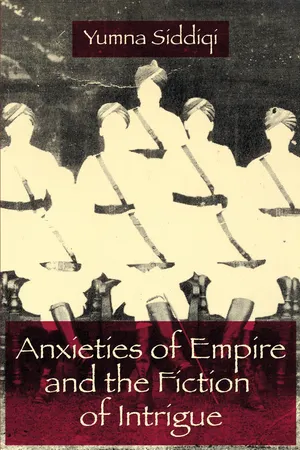
Focusing on late nineteenth- and twentieth-century stories of detection, policing, and espionage by British and South Asian writers, Yumna Siddiqi presents an original and compelling exploration of the cultural anxieties created by imperialism. She suggests that while colonial writers use narratives of intrigue to endorse imperial rule, postcolonial writers turn the generic conventions and topography of the fiction of intrigue on its head, launching a critique of imperial power that makes the repressive and emancipatory impulses of postcolonial modernity visible.
Siddiqi devotes the first part of her book to the colonial fiction of Arthur Conan Doyle and John Buchan, in which the British regime's preoccupation with maintaining power found its voice. The rationalization of difference, pronouncedly expressed through the genre's strategies of representation and narrative resolution, helped to reinforce domination and, in some cases, allay fears concerning the loss of colonial power.
In the second part, Siddiqi argues that late twentieth-century South Asian writers also underscore the state's insecurities, but unlike British imperial writers, they take a critical view of the state's authoritarian tendencies. Such writers as Amitav Ghosh, Michael Ondaatje, Arundhati Roy, and Salman Rushdie use the conventions of detective and spy fiction in creative ways to explore the coercive actions of the postcolonial state and the power dynamics of a postcolonial New Empire.
Drawing on the work of leading theorists of imperialism such as Edward Said, Frantz Fanon, and the Subaltern Studies historians, Siddiqi reveals how British writers express the anxious workings of a will to maintain imperial power in their writing. She also illuminates the ways South Asian writers portray the paradoxes of postcolonial modernity and trace the ruses and uses of reason in a world where the modern marks a horizon not only of hope but also of economic, military, and ecological disaster.
- English
- ePUB (mobile friendly)
- Available on iOS & Android
eBook - ePub
Anxieties of Empire and the Fiction of Intrigue
About this book
Information
Subtopic
Indian & South Asian HistoryIndex
LiteratureTable of contents
- Cover
- Half title
- Title
- Copyright
- Dedication
- Contents
- Acknowledgments
- Introduction
- 1. Colonial Anxieties and the Fiction of Intrigue
- 2. Imperial Intrigue in an English Country House
- 3. Sherlock Holmes and “the Cesspool of Empire”: The Return of the Repressed
- 4. The Fiction of Counterinsurgency
- 5. Intermezzo: Postcolonial Modernity and the Fiction of Intrigue
- 6. Police and Postcolonial Rationality in Amitav Ghosh’s The Circle of Reason
- 7. “Deep in Blood”: Roy, Rushdie, and the Representation of State Violence in India
- 8. “The Unhistorical Dead”: Violence, History, and Narrative in Michael Ondaatje’s Anil’s Ghost
- Conclusion. “Power Smashes Into Private Lives”: Cultural Politics in the New Empire
- Notes
- Index
Trusted by 375,005 students
Access to over 1.5 million titles for a fair monthly price.
Study more efficiently using our study tools.
Frequently asked questions
Yes, you can cancel anytime from the Subscription tab in your account settings on the Perlego website. Your subscription will stay active until the end of your current billing period. Learn how to cancel your subscription
No, books cannot be downloaded as external files, such as PDFs, for use outside of Perlego. However, you can download books within the Perlego app for offline reading on mobile or tablet. Learn how to download books offline
Perlego offers two plans: Essential and Complete
- Essential is ideal for learners and professionals who enjoy exploring a wide range of subjects. Access the Essential Library with 800,000+ trusted titles and best-sellers across business, personal growth, and the humanities. Includes unlimited reading time and Standard Read Aloud voice.
- Complete: Perfect for advanced learners and researchers needing full, unrestricted access. Unlock 1.5M+ books across hundreds of subjects, including academic and specialized titles. The Complete Plan also includes advanced features like Premium Read Aloud and Research Assistant.
We are an online textbook subscription service, where you can get access to an entire online library for less than the price of a single book per month. With over 1.5 million books across 990+ topics, we’ve got you covered! Learn about our mission
Look out for the read-aloud symbol on your next book to see if you can listen to it. The read-aloud tool reads text aloud for you, highlighting the text as it is being read. You can pause it, speed it up and slow it down. Learn more about Read Aloud
Yes! You can use the Perlego app on both iOS and Android devices to read anytime, anywhere — even offline. Perfect for commutes or when you’re on the go.
Please note we cannot support devices running on iOS 13 and Android 7 or earlier. Learn more about using the app
Please note we cannot support devices running on iOS 13 and Android 7 or earlier. Learn more about using the app
Yes, you can access Anxieties of Empire and the Fiction of Intrigue by Yumna Siddiqi in PDF and/or ePUB format, as well as other popular books in Literature & Indian & South Asian History. We have over 1.5 million books available in our catalogue for you to explore.