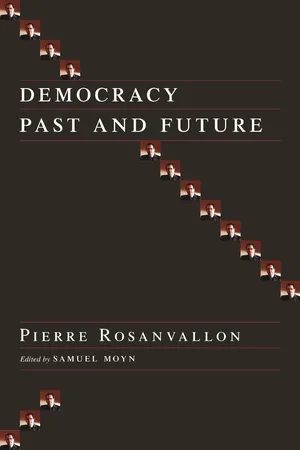
Democracy Past and Future is the first English-language collection of Pierre Rosanvallon's most important essays on the historical origins, contemporary difficulties, and future prospects of democratic life.
One of Europe's leading political thinkers, Rosanvallon proposes in these essays new readings of the history, aims, and possibilities of democratic theory and practice, and provides unique theoretical understandings of key moments in democracy's trajectory, from the French Revolution and the struggles for universal suffrage to European unification and the crises of the present. In so doing, he lays out an influential new theory of how to write the history of politics. Rosanvallon's historical and philosophical approach examines the "pathologies" that have curtailed democracy's potential and challenges the antitotalitarian liberalism that has dominated recent political thought. All in all, he adroitly combines historical and theoretical analysis with an insistence on the need for a new form of democracy. Above all, he asks what democracy means when the people rule but are nowhere to be found.
Throughout his career, Rosanvallon has resisted simple categorization. Rosanvallon was originally known as a primary theorist of the "second left", which hoped to stake out a non-Marxist progressive alternative to the irresistible appeal of revolutionary politics. In fact, Rosanvallon revived the theory of "civil society" even before its usage by East European dissidents made it globally popular as a non-statist politics of freedom and pluralism. His ideas have been shaped by a variety of influences, ranging from his work with an influential French union to his teachers François Furet and Claude Lefort.
Well known throughout Europe as a historian, political theorist, social critic, and public intellectual, Pierre Rosanvallon was recently elected to a professorship at the Collège de France, Paris, a position held at various times by Claude Lévi-Strauss, Michel Foucault, and Pierre Bourdieu. Democracy Past and Future begins with Rosanvallon's groundbreaking and synthetic lecture that he delivered upon joining this institution. Throughout the volume, Rosanvallon illuminates and invigorates contemporary political and democratic thought.
- English
- ePUB (mobile friendly)
- Available on iOS & Android
eBook - ePub
Democracy Past and Future
About this book
Information
Topic
PhilosophySubtopic
Political Philosophy | PART I The Study of Politics in History |
CHAPTER 1
Inaugural Lecture, Collège de France
MONSIEUR L’ADMINISTRATEUR,
MES CHERS COLLÈGUES,
I thank you for receiving me in your midst. At this inaugural moment today, I am first of all aware of the responsibility that falls on me as a result of your decision to open your courses of instruction to the most living of the problems of contemporary politics. But I am most conscious of the wonderful opportunity that you have accorded me. It is an opportunity, at a moment I hope to be the midpoint of my career, to invigorate my researches with a new energy, by relocating them in an intellectual milieu unique thanks to the radical freedom it provides—shielded, as one is at the Collège de France, from the pressures of any agenda, freed from any obligation to evaluate and train students, and liberated from the need to present one’s credentials in the face of the usual disciplinary barriers. This chance for a new departure therefore has nothing of the ambiguous and melancholy air of summation so inevitably associated with what are called “academic honors,” signaling—as they so frequently do—that a work is considered essentially complete. For this reason I can make my own the words of Roland Barthes: “My entry into the Collège de France is a joy more than an honor: an honor is sometimes undeserved, but a joy never is.”1 And it is unquestionably a joy for me to be able to speak with you today about a project at the moment of its continued elaboration, the joy of an activating obligation and a productive duty.
The expression of my acknowledgments must begin with Professor Marc Fumaroli, who presented you with the project of a chair in the modern and contemporary history of the political. It is first of all thanks to the breadth of his interests and the force of his eloquence that I am able to be in your midst this evening.
I must also, without further delay, let one share in these thanks who is no longer here to receive them this evening: François Furet. It was he who, by inviting me to join the École des Hautes Études en Sciences Sociales at the beginning of the 1980s, helped me make the decisive leap at time when, as a young academic, I remained between two worlds, at the margins of the university system, in the rather precarious position of an intellectual maverick. He put me in a position to give a certain unity to my life and realize the dream of every man and woman: to make a profession of his passion. It was under his guidance and that of Claude Lefort, the one a historian and the other a philosopher, that I learned to work beyond academic routines and intellectual fashions. They were for me, both of them, masters and, indissociably, friends and colleagues. The other members of the Centre de Recherches Politiques Raymond Aron, together with whom we undertook to renovate the long decrepit study of the political, know well what I owe each one of them. It gladdens me that this small community of historians, sociologists, and philosophers are able to see the originality of its work recognized through my election. Finally, though the list of those to whom I ought to express my gratitude could be lengthened further, I will limit myself to thanking the great late medievalist Paul Vignaux. In fact it is probably because of the bonds of friendship that were forged at the very beginning of the 1970s with Vignaux, one of the founders of democratic trade-unionism in France, that as a young militant I could have slowly realized as I did, unlike an important part of the generation of 1968, that a life rigorously dedicated to the comprehension of the world fully participates in creating the conditions for its change: that there is a total complementarity between the vita activa and the vita contemplativa.

The modern and contemporary history of the political, then. The study of the political sometimes has taken place at the Collège de France, tangentially, under more oblique headings. I must, of course, make special mention of André Siegfried, author of Le Tableau politique de la France et de l’Ouest; holder of a chair in “economic and political geography,” he was one of the pioneers of electoral analysis in this country.2 The question of power and its genesis, more generally, has figured in the courses of professors who officially taught sociology or philosophy; one thinks simply of Raymond Aron or Michel Foucault, who each, if in quite different ways, meant so much for my generation. And the decisive role that Maurice Agulhon has played more recently in the study of political mentalities and political culture in nineteenth-century France is well known.
This new chair that I occupy today joins this tradition, even if these various antecedents do not constitute a true genealogy. But there are also certain curricula of the nineteenth century at the Collège de France that approach the spirit, if not the content, of the present chair. I think, especially, of Jules Michelet’s concern to illuminate the vicissitudes of the present by retracing the genesis of the French state and nation. And one must likewise make reference to Ernest Renan. While he held a highly specialized chair in Hebraic, Chaldaic, and Syriac languages, the great academic at the same time wanted to reflect on collective life in the long term, to enlighten his contemporaries and to challenge them for their blind spots and oversimplifications. The intent of my enterprise is not terribly different, in many respects, from that “philosophy of contemporary history” to which he aspired.
Edgar Quinet, lastly. He, too, entered the Collège de France in 1841 charged with a traditional study. But in his actual courses, that ardent republican moved very quickly onto more dangerous terrain, successively dealing with the Jesuits (together with Michelet), ultramontanism, and then the relationship between Christianity and the French Revolution. I can recognize myself quite well in one of the more famous expressions of this author of The Revolution: “French democracy has exhausted its storehouse of ideas, which has to be stocked up again.”3 I eagerly adopt Quinet’s program myself, and I feel myself close to his concern to help prepare for the future by rooting reflection on the present in the comprehension of the ordeals of the past. With one appreciable difference, however, which is that such a project can retain its meaning only through being placed in a much larger comparative framework.
This is not the first time, stricto sensu, that the word “political” figures in the title of a Collège de France chair. And yet, the object of modern and comporary politics is now taken explicitly as a subject matter and placed at the center of a teaching plan. Notwithstanding the continuities with the past I have just mentioned, the project of a history of “the political” is, for this reason alone, something original. Accordingly, it is best to start with a definition of the object of study.
As I understand it, “the political” is at once a field and a project. As a field, it designates the site where the multiple threads of the lives of men and women come together, what allows all of their activities and discourses to be understood in an overall framework. It exists in virtue of the fact that there exists a “society” acknowledged by its members as a whole that affords meaningfulness to its constituent parts. As a project, the political means the process whereby a human collectivity, which is never to be understood as a simple “population,” progressively takes on the face of an actual community. It is, rather, constituted by an always contentious process whereby the explicit or implicit rules of what they can share and accomplish in common—rules which give a form to the life of the polity—are elaborated.
One cannot make sense of the world without making room for the synthetic order of the political, except at the price of an exasperatingly reductive vision. The understanding of society, in fact, can never be limited to adding up and connecting together the various subsystems of action (economic, social, cultural, and so forth). These latter are, for their part, far from being easily intelligible by themselves, and only become so as part of a more general interpretive framework. Whatever the catalogue of cultural and social facts, economic variables, and institutional logics, it is impossible to decipher society at its most essential level without bringing to light the nerve center from which the very fact of its institution originates. An example or two will suffice to persuade of this fact.
To understand the specificity of a phenomenon like Nazism, it is easy to say that the dissection of the different tensions and the multiple stalemates of German society in the 1930s is not enough—unless one wants to limit oneself to a banal analysis of its origins as simply an exacerbated response to the crisis of the Weimar regime. The truth of Nazism as a pathological attempt to bring about a unified and homogenous people is understandable only if it is related to the conditions of the perverse resymbolization and recomposition of the global order of the political in which it took place. To take another example, closer to the present, the crisis that today is wracking a country like Argentina is not be interpreted simply according to economic and financial factors that immediately present themselves. It takes on meaning only when resituated in a long history of decline linked to the recurrent difficulty of forging a nation founded on the recognition of shared obligations.
At this level, therefore, which one could call “global,” is where matters have to be studied in order to usefully approach a good number of questions that haunt the contemporary world. Whether it is a matter of contemplating the possible future forms of Europe, analyzing the transformations of democracy in an age of globalization, guessing the destiny of the nation-state, evaluating the transformations of the welfare state, or discovering the conditions in which the long term in societies so often governed by the dictatorship of the present would be taken seriously, it is always to the key question of the political that the perplexities and disquietudes of today lead back.
In speaking of “the political” as a noun, I thus mean as much a modality of existence of life in common as a form of collective action that is implicitly distinct from the functioning of politics.4 To refer to “the political” rather than to “politics” is to speak of power and law, state and nation, equality and justice, identity and difference, citizenship and civility—in sum, of everything that constitutes political life beyond the immediate field of partisan competition for political power, everyday governmental action, and the ordinary function of institutions.
The question is thrown into the relief it deserves in democratic societies, that is to say, in those societies in which the conditions of life in common are not defined a priori, engraved in a tradition, or imposed by an authority. Democracy, in fact, constitutes the political in a field largely open to the very fact of the tensions and uncertainties that underlay it. If it has seemed for two centuries now to be the unsurpassable principle of organization of any modern political order, the imperative that spread this assured belief has always been both ardently felt and ambiguous in its implications. Since it is at bottom an experiment in freedom, democracy has never been other than a problematic solution for the institution of a polity of free beings. The dream of the good and the reality of indeterminacy have combined in it over the long term. This coexistence is specific to the extent that it is due principally to the fact that democracy is not simply a distant ideal on whose content everyone already agrees, with debate remaining simply as to the means for realizing it. The history of democracy is, for this reason, not simply one of a blocked experiment or a betrayed utopia.
Far from corresponding, then, to a simple practical uncertainty as to how to bring it about, democracy’s unmoored meaning is due quite fundamentally to its essence. It implies a type of regime that resists any attempt at unequivocal classification. The specificity of the malaise that has dogged its history stems from this fact too. The train of disappointments and the perpetual feelings of its betrayal that have always accompanied it have stung just as much as the debate over its definition has resisted closure. From democracy’s unmoored wandering has followed both a quest and a nagging absence of destination. One must begin with this fact in order to understand what democracy is: the history of a disenchantment and the history of an indeterminacy are bound up with one another.
The indeterminacy is rooted in a complex network of equivocations and tensions that have structured political modernity since its inception, as study of the English, American, and French revolutions shows. There is equivocation, first of all, about the very subject of this democracy, for the people do not exist except through approximate successive representations of itself. The people is a master at once imperious and impossible to find. “We the people” can take only debatable form. Its definition is at once a problem and a challenge. There is a tension, too, between number and reason, between opinion and expertise, for the modern regime instituted political equality through universal suffrage at the same time that it has often called for a rational authority to arise whose objectivity implies impersonality. There is an uncertainty, next, about the adequate forms of social power—popular sovereignty struggling to express itself through representative institutions that will not lead to its limitation in one way or another. There is a duality, finally, of the modern notion of emancipation that gives rise to a desire for individual autonomy (privileging law) at the same moment as it prompts participation in the exercise of social power (replacing authority with politics). The duality is one between liberty and power or, put differently, between liberalism and democracy.
Such a conception of the political makes a historical approach the condition of its thorough study. In fact, one cannot make sense of the political as I have just defined it except in recalling, in some tangible way, the breadth and density of the contradictions and ambiguities that run through it. It has been my ambition, therefore, to rethink democracy by following the thread of its history as it has been spun. But note that it is not simply a matter of saying that democracy has a history. More radically, one must see that democracy is a history. It has been a work irreducibly involving exploration and experimentation, in its attempt to understand and elaborate itself.
The goal is thus to retrace the long genealogy of contemporary political questions in order to make them more thoroughly intelligible. History enters the project not only out of the interest in recognizing the weight of tradition, in order to provide banal “enlightenment” of the present through the study of the past. Rather, the point is to make the succession of presents live again as trials of experience that can inform our own. It is a matter of reconstructing the manner in which individuals and groups forged their understanding of their situations, to make sense of the challenges and aspirations that led them to formulate their objectives, to retrace, in a sense, the manner in which their vision of the world organized and limited the field of their activity. The object of such a history, to put it yet another way, is to follow the thread of trial and error, of conflict and controversy, through which the polity sought to achieve legitimate form. It consists, in a metaphor, in the publication of the script of the play in which different acts of the attempt to live together have been performed. In attempting to take up this red thread, I have been led to return, in part, to follow in the footsteps of the publicists and historians of the nineteenth century—such as Quinet, François Guizot, or Alexis de Tocqueville—who wanted to enlighten their contemporaries in developing what they defined as a history of civilization. I share with them the selfsame preoccupation with writing what one could call a global history.
History conceived in this way is the active laboratory that created our present and not simply its background. Attention to the most burning and urgent of contemporary problems can therefore not be dissociated from the meticulous reconstruction of their origins. To start with a contemporary question, to trace its genealogy before facing it anew at the end of the inquiry, enriched by the lessons of the past, has to be the method developed to give indispensable depth to political analysis. It is thanks to such a permanent dialogue between present and past that the process whereby societies are instituted can become legible and from which a synthetic understanding of the world can emerge. The project is identical to envisioning a history that one might call comprehensive, so that intellection of the past and interrogation of the present participate in the same task through being placed in a common framework. It reveals the resonances between our experience of the political and that of the men and women who were our predecessors, giving Marc Bloch’s formula its strongest possible meaning: “Misunderstanding of the present is the inevitable consequence of ignorance of the past.”5 It makes structural partners of the passionate concern for relevance and a scrupulous attention to history. It is for this reason a history whose purpose is to recover problems more than to describe models. Its enterprise ends up, in this manner, intersecting that of political philosophy.
The history of the political as practiced in this spirit is distinct in the first place, and by its very object of study, from the history of politics. The latter, beyond the recovery of the chronological unfolding of events, analyzes the functioning of institutions, unravels the mechanisms of public decisionmaking, illuminates the reasoning of actors and the way they interacted, and describes the rites and symbols that punctuate life. The history of the political draws on such sources, to be sure. With all of the subaltern battles, personal rivalries, intellectual confusions, and short-term calculations that it involves, political activity stricto sensu is in fact what circumscribes the political and allows it to be carried out. It is inseparably both an impediment and a means. Rational deliberation and philosophical reflections are not dissociable from passions and interest. The majestic theater of the general will is also the permanent stage for scenes borrowed from the more daily comedies of power. So it is not through taking refuge in the supposedly...
Table of contents
- Cover
- Half title
- Series Page
- Title
- Copyright
- Contents
- Acknowledgments and Permissions
- Introduction: Antitotalitarianism and After
- Part I. The Study of Politics in History
- Part II. The Voluntarist Drive to Unity
- Part III. The Allure of Rationalism
- Part IV. Civil Society
- Part V. The Future of Democracy
- Postscript: Democracy in an Era of Distrust
- Notes
- Bibliography of Pierre Rosanvallon’s Principal Publications
- Index
Trusted by 375,005 students
Access to over 1.5 million titles for a fair monthly price.
Study more efficiently using our study tools.
Frequently asked questions
Yes, you can cancel anytime from the Subscription tab in your account settings on the Perlego website. Your subscription will stay active until the end of your current billing period. Learn how to cancel your subscription
No, books cannot be downloaded as external files, such as PDFs, for use outside of Perlego. However, you can download books within the Perlego app for offline reading on mobile or tablet. Learn how to download books offline
Perlego offers two plans: Essential and Complete
- Essential is ideal for learners and professionals who enjoy exploring a wide range of subjects. Access the Essential Library with 800,000+ trusted titles and best-sellers across business, personal growth, and the humanities. Includes unlimited reading time and Standard Read Aloud voice.
- Complete: Perfect for advanced learners and researchers needing full, unrestricted access. Unlock 1.5M+ books across hundreds of subjects, including academic and specialized titles. The Complete Plan also includes advanced features like Premium Read Aloud and Research Assistant.
We are an online textbook subscription service, where you can get access to an entire online library for less than the price of a single book per month. With over 1.5 million books across 990+ topics, we’ve got you covered! Learn about our mission
Look out for the read-aloud symbol on your next book to see if you can listen to it. The read-aloud tool reads text aloud for you, highlighting the text as it is being read. You can pause it, speed it up and slow it down. Learn more about Read Aloud
Yes! You can use the Perlego app on both iOS and Android devices to read anytime, anywhere — even offline. Perfect for commutes or when you’re on the go.
Please note we cannot support devices running on iOS 13 and Android 7 or earlier. Learn more about using the app
Please note we cannot support devices running on iOS 13 and Android 7 or earlier. Learn more about using the app
Yes, you can access Democracy Past and Future by Pierre Rosanvallon, Samuel Moyn in PDF and/or ePUB format, as well as other popular books in Philosophy & Political Philosophy. We have over 1.5 million books available in our catalogue for you to explore.