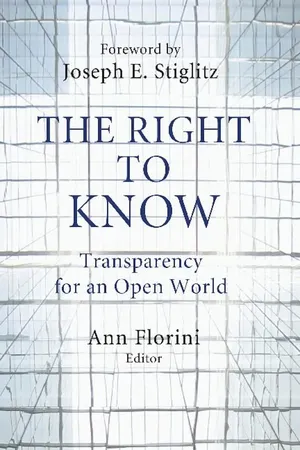
The Right to Know is a timely and compelling consideration of a vital question: What information should governments and other powerful organizations disclose? Excessive secrecy corrodes democracy, facilitates corruption, and undermines good public policymaking, but keeping a lid on military strategies, personal data, and trade secrets is crucial to the protection of the public interest.
Over the past several years, transparency has swept the world. India and South Africa have adopted groundbreaking national freedom of information laws. China is on the verge of promulgating new openness regulations that build on the successful experiments of such major municipalities as Shanghai. From Asia to Africa to Europe to Latin America, countries are struggling to overcome entrenched secrecy and establish effective disclosure policies. More than seventy now have or are developing major disclosure policies or laws. But most of the world's nearly 200 nations do not have coherent disclosure laws; implementation of existing rules often proves difficult; and there is no consensus about what disclosure standards should apply to the increasingly powerful private sector.
As governments and corporations battle with citizens and one another over the growing demand to submit their secrets to public scrutiny, they need new insights into whether, how, and when greater openness can serve the public interest, and how to bring about beneficial forms of greater disclosure. The Right to Know distills the lessons of many nations' often bitter experience and provides careful analysis of transparency's impact on governance, business regulation, environmental protection, and national security. Its powerful lessons make it a critical companion for policymakers, executives, and activists, as well as students and scholars seeking a better understanding of how to make information policy serve the public interest.
- English
- ePUB (mobile friendly)
- Available on iOS & Android
eBook - ePub
About this book
Information
Subtopic
Business EthicsIndex
BusinessPART ONE
National Stories
Chapter One
India
Grassroots Initiatives
Shekhar Singh
In India, as perhaps the world over, the battle for the right to information is a battle for political space. Many elements in the Indian society and system of governance make this a critical battle. For one, India is a robust democracy where political parties and candidates have to work very hard to influence voters. Increasingly, the people of India have been demanding better governance and are no longer willing to rely solely on elections to hold officials accountable. The right to information has given them an opportunity to call their government and its functionaries to account not only once every five years, when they cast their votes, but every day.
Also, transparency is an issue that cuts across all of the traditional areas of concern and action. The fact that the right to information (RTI) movement in India has recognized this and has consequently made a conscious effort to integrate with other movements has ensured that the campaign for increased transparency is diverse, creative, and strong.
Today many civil society groups are using the right to information in their struggles. The women’s movement in the state of Rajasthan, for example, has used it to demand that the women against whom atrocities have been committed are kept informed of the progress in their case and the details of various medico-legal and forensic reports. Many civil liberties and human rights groups across the country are now using the RTI to ensure transparency and accountability of the police and custodial institutions. Activists in the state of Maharashtra are exposing the use of influence in the transfer of government officials and in the leasing of public land to private parties.
The use of the RTI is becoming widespread among movements working with people displaced by dams and factories, those denied their share of food by the ration shop owner, communities affected by polluting industrial units, or forest dwellers evicted from their homes. In many cases, the information asked for is not provided appropriately, or at all. However, it is becoming increasingly difficult to outright deny to the people the information they seek. As movements and groups sharpen their questions and develop their skills, the government and other institutions are being forced to reveal more and more. Clearly, the notion of a right to information has become part of the language of sociopolitical discourse. The nature of the right is every day being defined by the actions of mass movements and of individuals, who are matching their own resolve to access information with the inherent hesitation of established systems of governance and influence to opening themselves for public scrutiny.
This chapter tells the story of how the common people of India, in villages and cities, have started demanding accountability of their bureaucracy and their elected representatives. The first part briefly traces the evolution of the notion of transparency in India. It then discusses in detail some of the various people’s movements that typify the Indian experience, including the pioneering movements in the Indian states of Rajasthan, Delhi, and Maharashtra, and the focus on transparency in the environmental movement and in the movement for cleaner elections. Then it goes on to describe the process of formulating the right to information laws in India and ends with a discussion on contemporary issues and debates relating to transparency, including possible future directions.
The Evolution of the Notion of Transparency in India
Initial demands for transparency in the 1950s, after the installation of an independent Indian government, were heard in relation to corruption, to reports regarding disasters (especially railway accidents), and increasingly about human rights. Also, debates about transparency in public life were part of the debates among political parties and even among the ruling Congress Party, as the following passage will illustrate.
Prime Minister Nehru has asked Congressmen not to close their eyes to the fact that a lot of “impurities” do exist in the Congress organisation from which even some of the “highest people in the party hierarchy are not immune.” At the Congress Subjects Committee meeting at Satyamurthinagar (Avadi) on January 20 [1955], Mr. Nehru was intervening in the debate on the resolution moved by Mr. Morarji Desai on purity and strengthening the organisation. Referring to the point made earlier by Mr. Algurai Shastri that the resolution should not publicise the malpractices that had crept into the Congress, Mr. Nehru said this approach was completely wrong. “I have heard the speeches made by delegates. Mr. Algurai Shastri has said that in one paragraph of the resolution we have criticised ourselves and thereby put the noose round our necks which other people might use to drag us with. But this has no relation to the resolution. I say that the resolution is appropriate, full sixteen annas in the rupee. I say, and say it with a challenge, that the atmosphere in the Congress is not good and pure. After all what is the yardstick with which we are going to measure our work and ourselves? I have been President of the Congress and I know from personal experience that there is a lot of impurity in the Congress and even some of the biggest Congressmen are a party to it. Why should we hide these things? Are we to live behind purdah and wear a veil?1
Concurrently, various factors were making the Indian public increasingly restless to be included in the process of governance. For one, the rhetoric about independence and democracy, let loose after the British left, had started working. The general public had begun to believe that the government was theirs and that they had rights in relation to it. Even though there was little genuine empowerment, there was an increasing sense of empowerment. Along with this, education and literacy were spreading and more and more people could read and write. A new generation was coming up that had never known imperial rule and had, as a consequence, a healthy irreverence for those in authority. Besides, the domination of a single political party, the Congress Party, was waning, and alternate political formations were emerging and raising questions.
Perhaps most important was the spread of media. Apart from newspapers, the radio network rapidly grew to cover almost the whole country by the 1960s. Though the government controlled all the radio channels, at least their existence ensured that the horizons of the Indian public were significantly widened and they started getting interested in things happening hundreds, sometimes thousands, of miles away.
Equally important was the rapid growth of the Indian cinema—in Hindi and in many of the regional languages—facilitated by the electrification of most of India. The fact that many of the movies depicted social themes and highlighted social injustice and corruption in government further fueled the interest of the Indian masses in the political process.
The Chinese invasion of 1961 and the resultant collapse of the Indian defenses led to an unprecedented, and often strident, demand for transparency. The whole nation wanted to know what had gone wrong and who was responsible. During the 1960s there was also the escalation of “insurgencies” or civil unrest and armed rebellion in different parts of India. In the next twenty to thirty years, northeast India, especially Mizoram and Nagaland, West Bengal and adjoining areas, Punjab, Jammu and Kashmir, and parts of Andhra Pradesh were all affected. These resulted in the unleashing of a new level of police and military action and a consequent outcry against the violation of human rights, and in a renewed demand for transparency. There was also a spate of habeas corpus litigations. The “internal emergency,” imposed in 1975, resulted in the suspension of many civil rights and liberties and the imposition of an oppressive regime with little scope for dissent. The formation of the People’s Union for Civil Liberties and Democratic Rights (PUCLDR), in 1976, gave impetus to demands for various types of civil liberties and rights, including those of transparency. In the elections of 1977 the regime was defeated and the new government once again reinstated democratic processes. However, this government did not last long.
Meanwhile, in 1975, the Supreme Court ruled (State of UP v. Raj Narain) that “In a government of responsibility like ours where the agents of the public must be responsible for their conduct there can be but a few secrets. The people of this country have a right to know every public act, everything that is done in a public way by their public functionaries. They are entitled to know the particulars of every public transaction in all its bearings.”
Then, again, in 1982 the Supreme Court of India, hearing a matter relating to the transfer of judges, held that the right to information was a fundamental right under the Indian Constitution. The judges stated that “The concept of an open Government is the direct emanation from the right to know which seems implicit in the right of free speech and expression guaranteed under Article 19(1)(a). Therefore, disclosures of information in regard to the functioning of Government must be the rule, and secrecy an exception justified only where the strictest requirement of public interest so demands. The approach of the Court must be to attenuate the area of secrecy as much as possible consistently with the requirement of public interest, bearing in mind all the time that disclosure also serves an important aspect of public interest” (SP Gupta & others vs. The President of India and others, 1982, AIR [SC] 149, 234). However, despite the progressive judgments and pronouncements by the Supreme Court of India, the government was unmoved and no serious effort was made to enact a transparency law.
In 1984, the disastrous gas leak in the Union Carbide plant in Bhopal led environmentalists to make renewed demands for transparency in environmental matters. Though at least two court cases were filed and some progressive judgments obtained (see section on the environment), not much else happened.
The year 1989 saw a change of government at the national level, as the ruling Congress Party once again lost the elections. The new ruling coalition promised to quickly bring in a right to information law, but the early collapse of this government and reported resistance by the bureaucracy resulted in status quo.
The early 1990s saw the emergence of a grassroots movement in the state of Rajasthan, spearheaded by the Mazdoor Kisan Shakti Sangathan (MKSS).2 This movement, described below, struggled to get a right to information law passed in Rajasthan and joined with other movements and activists to form a national platform called the National Campaign for People’s Right to Information (NCPRI) in 1996.
In the early 2000s, another strong grassroots movement for transparency was initiated in the state of Maharashtra, led by the noted social activist Anna Hazare. Using Gandhian tactics, he not only forced the Maharashtra state government to repeal an earlier weak act and pass a much stronger right to information act but also ensured that the President of India assented to this new act, in contradiction to the stated Government of India policy. Movements have sprung up both in rural Maharashtra and in the cities of Mumbai (Bombay) and Pune, using the new Mahrashtra RTI act to expose corruption and bad governance.
Much before the first national act was passed, in December 2002, many states had already passed similar, and often better and stronger, acts. The states that had their own right to information act included Delhi, Assam, Karnataka, Rajasthan, Goa, Tamil Nadu, Maharashtra, and Madhya Pradesh.
People’s Movements for Transparency
Perhaps the most critical component of the Indian journey toward operationalizing people’s right to information has been the grassroots struggles for transparency. The fact that this journey has not been abandoned, despite numerous hurdles and setbacks, owes much to its being fueled by the commitment and the energy of those for whom the right to information is essential to survival, and to a life with dignity. The fact that the demand for transparency in public affairs had come most vocally from the grassroots, in both rural and urban areas, also makes the Indian experience somewhat different from experiences in most other parts of the world.
Transparency and Rural Livelihoods: The Story of MKSS
In 1990, Aruna Roy, Nikhil Dey, and Shankar Singh, three people from diverse backgrounds, together with a number of peasants and workers from villages around Devdungri in Rajsamand District of Rajasthan, formed the Mazdoor Kisan Shakti Sangathan (MKSS). A nongovernmental organization, in fact more correctly a grassroots people’s movement, the MKSS consists of poor farmers and workers, men and women alike, many of whom have never been to school. Yet their organization raised the issue of RTI in such a potent manner that it changed the discourse on what had been seen for many years largely as an academic issue. When the MKSS was formed, its stated objective was to use modes of struggle and constructive action to change the lives of its primary constituents: the rural poor. In the period leading up to the formulation of this objective, the group had taken up issues of land redistribution and minimum wages, seen traditionally as the two basic issues of the rural landless poor.
During the hunger strikes organized by the MKSS in 1990 and 1991 to demand statutory minimum wages, the group began to realize the significance of the right to information. Workers demanding minimum wages were invariably told that there was no record of their having worked at all. The demand to examine the records was denied on the plea that these were secret government documents. But now the MKSS started demanding copies of the records of works done in the name of the people. This demand was accompanied by determined public action, which captured the imagination of the people and shocked a bureaucracy that had for years been using the cover of secrecy to avoid democratic accountability.
Thus, the real battle for transparency was destined to be fought in the villages of India, belying the expectations of many intellectuals. In retrospect, it was not, as many had thought, an issue too sophisticated to be grasped and operationalized by “illiterate” rural masses. It was not a concept that had to be refined in debates and seminars in the cities of India and then slowly disseminated to the rural areas. The energy for the full onslaught on political, bureaucratic, and other vested interests safeguarding the age-old tradition of secrecy finally came from the Indian “hinterland.”
A decision by the MKSS in late 1994 to use the mode of village-based public hearings (jansunwais) to conduct social audits based on information gathered from the government revolutionized the use of RTI in India and energized the rural people. Using dramatic slogans like “hamara paisa-hamara hisaab” (our money, our acc...
Table of contents
- Cover
- Half title
- Series Page
- Title
- Copyright
- Contents
- Foreword
- Introduction: The Battle Over Transparency
- Part 1: National Stories
- Part 2: Themes
- Conclusion: Whither Transparency?
- List of Contributors
- Index
Trusted by 375,005 students
Access to over 1.5 million titles for a fair monthly price.
Study more efficiently using our study tools.
Frequently asked questions
Yes, you can cancel anytime from the Subscription tab in your account settings on the Perlego website. Your subscription will stay active until the end of your current billing period. Learn how to cancel your subscription
No, books cannot be downloaded as external files, such as PDFs, for use outside of Perlego. However, you can download books within the Perlego app for offline reading on mobile or tablet. Learn how to download books offline
Perlego offers two plans: Essential and Complete
- Essential is ideal for learners and professionals who enjoy exploring a wide range of subjects. Access the Essential Library with 800,000+ trusted titles and best-sellers across business, personal growth, and the humanities. Includes unlimited reading time and Standard Read Aloud voice.
- Complete: Perfect for advanced learners and researchers needing full, unrestricted access. Unlock 1.5M+ books across hundreds of subjects, including academic and specialized titles. The Complete Plan also includes advanced features like Premium Read Aloud and Research Assistant.
We are an online textbook subscription service, where you can get access to an entire online library for less than the price of a single book per month. With over 1.5 million books across 990+ topics, we’ve got you covered! Learn about our mission
Look out for the read-aloud symbol on your next book to see if you can listen to it. The read-aloud tool reads text aloud for you, highlighting the text as it is being read. You can pause it, speed it up and slow it down. Learn more about Read Aloud
Yes! You can use the Perlego app on both iOS and Android devices to read anytime, anywhere — even offline. Perfect for commutes or when you’re on the go.
Please note we cannot support devices running on iOS 13 and Android 7 or earlier. Learn more about using the app
Please note we cannot support devices running on iOS 13 and Android 7 or earlier. Learn more about using the app
Yes, you can access The Right to Know by Ann Florini in PDF and/or ePUB format, as well as other popular books in Business & Business Ethics. We have over 1.5 million books available in our catalogue for you to explore.