The Second World War put an end to America's historical isolation from international power politics, and so also to the long-standing American defiance of the Realist ideology that shaped Old World affairs. The advent of transoceanic military technologies, now wielded by menacing states such as Nazi Germany and the Soviet Union, made Americans more receptive to the Realist idea that international relations is about fear and survival. The American Realists Reinhold Niebuhr, Hans Morgenthau, and Kenneth Waltz developed a modern strategic framework that sought to introduce American leaders and the educated public to these harsher realities of international politics. They emphasized a clear-eyed, cold approach to the play of interests, egotism, and the drive for power in world affairs—a struggle in which the threat of major war remained, in the end, the only legitimate currency.
Yet even as Americans began to accept this new Realism, thermonuclear weaponry threatened to make it absurd. A major war to defend the nation might result in its total destruction; a thermonuclear war leading to the death of hundreds of millions of citizens seemed an unusual way to preserve American survival. This dilemma became central to the Realist understanding of Niebuhr, Morgenthau, and Waltz. How could a Realist approach to international politics and war be sustained in the face of possible global annihilation?
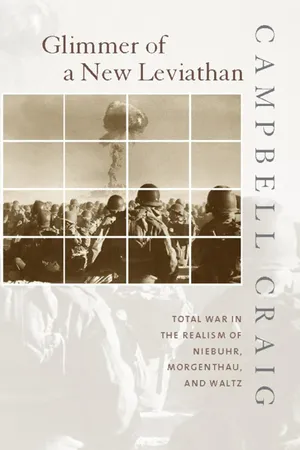
Glimmer of a New Leviathan is the engrossing story of how the three chief architects of an influential ideology struggled with the implications of their own creation. It offers crucial historical context for contemporary debates about weapons of mass destruction and the post-Cold War international order.
eBook - ePub
Glimmer of a New Leviathan
Total War in the Realism of Niebuhr, Morgenthau, and Waltz
- English
- ePUB (mobile friendly)
- Available on iOS & Android
eBook - ePub
About this book
Trusted by 375,005 students
Access to over 1.5 million titles for a fair monthly price.
Study more efficiently using our study tools.
Information
| 1 | The Historical Setting of Modern American Realism and the Thermonuclear Revolution |
The dilemma facing American Realists during the nuclear age finds its origins in three histories. The first is the history of the general idea, or ideology, of modern Realism, which was not invented by Cold War American thinkers but rather passed to them along a relay of Western political thought which, as this chapter suggests, spent its formative years in turn-of-the-century Germany. The second is the diplomatic history of the United States during the Second World War, when America underwent an extremely rapid transformation from an isolated, continental nation with no threats to its security to a global superpower contending with Nazi Germany, and then the Soviet Union. The third history is of the technology of modern warfare, of the development of long-range bombers, missiles, and fission and fusion bombs which, combined together in a modern arsenal, are capable of overcoming any known defense and destroying a nation beyond repair: a history, in other words, of the advent of the thermonuclear revolution. Because these three histories are far from uncontested, this introductory chapter puts forward a brief, interpretative overview of them.
1. The Pessimistic Turn of Twentieth Century Realism
As Jonathan Haslam has shown, European philosophers and statesmen from the medieval period to the industrial revolution developed concepts that would become central to the twentieth-century version of Realism, and hence to the thinking of American Cold War Realists. Haslam extracts from centuries of European diplomacy and writing three premises: the primacy of the state, the notion of the balance of power, and the widespread belief that the conduct of foreign policy “should be unconstricted by moral values.”1 It was according to these fundamental premises, he demonstrates, that European leaders fashioned the modern state system, and by so doing established the historical setting for contemporary Realist understanding.
One of the most important points Haslam makes in his account of the rise of Realism is to show that the thinkers and leaders responsible for its development came at their subject from varying political and philosophical perspectives, amidst an evolving historical setting. The pessimistic and even cynical writing of Machiavelli and Hobbes contributed essentially to the rise of Realist thought, but so did the more idealistic work of Kant and Rousseau, the legally oriented writings of Botero and Pufendorf, the political economy of Smith and List, and the contingent foreign-policy-making of Richelieu, Cavour, Metternich, and dozens of other lesser-known statesmen. It would be the height of ahistoricism to identify a Realist “school” of thought in pre-World War One Europe: what Haslam describes instead is a more organic, or at least unselfconscious, establishment of traditions and ideas that came to affect the way European leaders conceived of foreign policy and interacted with one another. There was no coherent theoretical argument, no scholarly consensus, because there was no “field” of international relations before the twentieth century.2
That being said, it is possible to place the development of these premises within that broader European philosophical tradition we call the Enlightenment. Taking a very wide view, we may regard the development of the modern, secular state, the idea of the balance of power, and the distinction between private and diplomatic affairs all as manifestations of the rise of rational, social scientific thought which began in Europe in the sixteenth and seventeenth centuries. European political leaders and philosophers since the time of Machiavelli came to subscribe to the notion that reason ought to prevail over superstition and arbitrary tradition in the political sphere, and that by applying reason to political and social problems, such as anarchy, conflict, and war, it would be possible to construct a better world. The modern secular state emerged as an alternative to the transnational domination of the church, on one hand, and the chaos of feuding principalities and fiefdoms, on the other. The idea of the balance of power derived directly from scientific notions of equilibrium, from the Newtonian vision of a world governed by a kind of mechanistic logic: indeed, the balance of power epitomizes the Enlightenment worldview, the “assumption,” E. H. Carr writes, “of the eighteenth century rationalists that man would infallibly conform to the moral law of nature once its content had been rationally determined.”3 Similarly, the distinction between private and public morality represents a blow to the premodern supposition that absolute moral commandments apply everywhere and to everyone: the overriding importance of the survival of the state—Raison d’Etat—allows statesmen to play by different rules, or, to put it more accurately, no rules at all.
The two coherent challenges to the traditional state system that arose in the nineteenth century, Liberal universalism and Marxism, fell also into this broad enlightenment tradition. The advent of industrial capitalism exacerbated and intensified the problems inherent in the old tradition of international relations: as industrial nations scrambled desperately for new markets and resources, the balance of European power became unstable. Liberals believed that international war stemmed from unenlightened restrictions upon international trade and upon the primitive anarchism of the balance of power. By establishing international forms of governance, under which the capitalist nations could resolve their disputes rationally and govern their empires peacefully, and by creating a system of free international capitalist trade, the sources of great war would be eliminated.4
Overtly, the Marxian view could not have differed more from the liberal idea. Karl Marx, Friedrich Engels, and their followers in the nineteenth and early twentieth centuries regarded the capitalist system as the cause, rather than the solution, of major war. Loathe to compel capitalist industries to distribute surplus goods to the masses, or to pay laborers higher wages, imperial governments insatiably sought new sources of cheap labor and materials in overseas colonies; their competition for these colonies pushed them inexorably into conflict. Marx and his successors called for the overthrow of capitalist regimes, for a global social revolution that they believed would usher in the age of international socialism. With the establishment of socialist regimes throughout Europe and the rest of the industrialized world, the imperial quest for overseas markets and resources would come to an end, and with it great-power war.5
The state of Western thinking about international relations at the end of the nineteenth century was, therefore, in flux. The centuries-old tradition of balance of power and state-centrism remained central to the worldviews of statesmen in Europe, but this tradition was coming under severe pressure from the new ideas of liberalism and Marxism. In their respective campaigns to defeat the old way of thinking, both the liberals and the Marxists possessed two important advantages. First, both schools incorporated the new economic realities of modern capitalism and the methodologies of social science to forge coherent ideologies, systematic approaches to contemporary international relations that the loose philosophical tradition of Realism could not hope to match. Second, and perhaps the more important, both the liberals and the Marxists contended with the old Realist tradition on the latter’s own terms. The idea of the Enlightenment, the thread that connects the disparate founders of Realism to one another, was the conviction that reason, conveyed to and then applied by enlightened rulers, could overcome the social and political miseries that had affected Western civilization. Yet the greatest misery of all, large-scale war, had not been overcome, despite the efforts of statesmen and thinkers over the previous four centuries. The secular logic of Enlightenment thinking—ideas are judged by how well they work—clearly revealed that the balance of power system was unsuccessful, that it was time to use reason to develop an alternative mode of international relations that which could foreseeably prevent wars that the “old false theories” could not. It was an unanswerable point, and the onrush of liberal and Marxian writing during the latter part of the nineteenth century and up to 1914 consistently hammered it home.6
Jonathan Haslam argues that the Realist answer to this challenge manifested itself in the rise of Geopolitics, and it is here that his story and the present one part ways.7 The Geopoliticians—including Mahan, Haushofer, and above all Mackinder—responded to the liberal and Marxian riposte by attempting to develop a more systematic approach to international politics, by trying, in other words, to develop a new Realist ideology that incorporated the old ideas into a more formal, and even scientific, study of global conflict and warfare. Geopolitics became, for a while, a major school within the nascent field of international relations, and it is true that geopolitical ideas influenced the thinking of some of the later American realists, including certainly that of Hans Morgenthau.8
But there was another intellectual response to the rise of liberalism and Marxism in the late nineteenth century that shaped American Realism in a considerably more profound way than did geopolitics. This was the more modern thinking of the German intellectuals Max Weber and Friedrich Nietzsche, whose response to these seemingly unanswerable claims of liberalism and Marxism was simply to reject the premise that reason could reliably apply to an understanding of international politics and warfare.
Max Weber
Weber’s writing about power politics is, perhaps, not as well known among scholars today as his sociological inquiries into modern society and capitalism, but the former may well have wielded a greater influence upon twentieth-century thought. For in addressing the international situation facing Wilhelmine Germany, Weber put forward two arguments that underlie contemporary Realism.9
International power politics, Weber believed, was a struggle among major powers to determine whose national culture would prevail over the rest. Nations could choose to withdraw from this struggle, by doing so resigning themselves to the domination of a larger power’s culture and interest. A nation that feared the domination of another state, that wished to preserve its culture from outside influence, would have to contend with other large powers in the international arena. To do so, it would have to accumulate military might and be prepared to wage great war.10
Like the earlier Realists, Weber directed his writing to his own nation. Power politics meant above all the means with which Germany must contend in the struggle to define European civilization. German disunity and weakness had allowed other powers to expand and impose their cultures throughout central Europe. If German culture were to survive in an increasingly powerful and contentious environment, the German nation would have to defend it from the advances of rival nations, particularly Russia.
To survive this Darwinian clash, Germany would have to cultivate its national power by enlarging its colonial empire, developing a professional bureaucracy, and preparing for great war against its enemies.11 This was how Weber defined the policy of Machtpolitik, or power politics: in a world of perennial struggle and conflict, the survival of nations and cultures depends ultimately and irreducibly upon traditional forms of national power.12 Weber, like many Europeans of his day, believed in the basic superiority of his nation’s culture, particularly when contrasted to Anglo-Saxon “conventionalism,” Latin (i.e. French) “raison,” and the “Russian knout.” Unless Germany wielded its power on an international scale, the lesser cultures to its west and (especially) east would prevail. Weber’s Machtpolitik thus combined a superior view of German culture with a defensive attitude toward international politics. Preventing the domination of central Europe by the Anglo-Saxons or the Russians required the subordination of politics to the general end of national power.13
Central to Weber’s understanding of national power—and this is where he departs from the enlightenment Realists—is the belief that a transnational discrimination between legitimate and illegitimate states cannot be achieved. The statesman or citizen cannot demonstrate to the satisfaction of some universal body that the objectives and culture of his state are superior to that of his neighbor, thus justifying a belligerent foreign policy. There is no such universal body, just as there is no universal agreement about what constitutes moral or immoral policy. Because of this, the statesman and citizens must have a faith in the superiority of their nation, a conviction that its culture must be preserved over those of its rivals, if their nation is to contend successfully in the realm of international conflict. Reason is impotent to adjudge various national claims of superiority: these claims are sorted out in the irrational and brutal arena of international politics and war, an arena in which charisma and passion prevail over reason and moderation.14
A second aspect of Weber’s body of writing relevant to the development of modern Realism was his rejection of economic interpretations of politics, and in particular Marxist ideology. Marxism was an especially dangerous rival to Weber’s Machtpolitik, because it purported to provide the kind of objective, critical interpretation of modern life that Weber, a sociologist himself, sought to develop. Unlike liberalism, which made its preferences for how politics ought to be quite clear, Marxism’s relentlessly materialist explanation of politics and culture provided an alternative sociological argument that Weber could not ignore. If modern Realism was to be a critical, objective ideology, rather than an ancienne idée whispered into the ears of princes, it had to deal forthrightly with the Marxist challenge.
In his inaugural Freiburg lecture of 1895, a manifesto for a new German Machtpolitik, Weber reserved his most withering criticism for the “economic way of looking at things.” “In every sphere,” Weber told his new university colleagues,
we find that the economic way of looking at things is on the advance. Social policy has superceded politics at the forefront of thinking, just as economic power-relations have replaced legal relations, and cultural and economic history have replaced political history. In the outstanding works of our colleagues in history we find that, where once they told us abou...
Table of contents
- Cover
- Half title
- Title
- Copyright
- Dedication
- Contents
- Preface
- Acknowledgments
- Epigraph
- 1. The Historical Setting of Modern American Realism and the Thermonuclear Revolution
- 2. Reinhold Niebuhr and the Emergence of American Realism
- 3. Hans Morgenthau’s Cold War
- 4. Niebuhr and the Thermonuclear Dilemma
- 5. Morgenthau and the Thermonuclear Dilemma
- 6. The Waltzian Turn
- 7. Retreat from Parsimony
- Conclusion
- Bibliography
- Index
Frequently asked questions
Yes, you can cancel anytime from the Subscription tab in your account settings on the Perlego website. Your subscription will stay active until the end of your current billing period. Learn how to cancel your subscription
No, books cannot be downloaded as external files, such as PDFs, for use outside of Perlego. However, you can download books within the Perlego app for offline reading on mobile or tablet. Learn how to download books offline
Perlego offers two plans: Essential and Complete
- Essential is ideal for learners and professionals who enjoy exploring a wide range of subjects. Access the Essential Library with 800,000+ trusted titles and best-sellers across business, personal growth, and the humanities. Includes unlimited reading time and Standard Read Aloud voice.
- Complete: Perfect for advanced learners and researchers needing full, unrestricted access. Unlock 1.5M+ books across hundreds of subjects, including academic and specialized titles. The Complete Plan also includes advanced features like Premium Read Aloud and Research Assistant.
We are an online textbook subscription service, where you can get access to an entire online library for less than the price of a single book per month. With over 1.5 million books across 990+ topics, we’ve got you covered! Learn about our mission
Look out for the read-aloud symbol on your next book to see if you can listen to it. The read-aloud tool reads text aloud for you, highlighting the text as it is being read. You can pause it, speed it up and slow it down. Learn more about Read Aloud
Yes! You can use the Perlego app on both iOS and Android devices to read anytime, anywhere — even offline. Perfect for commutes or when you’re on the go.
Please note we cannot support devices running on iOS 13 and Android 7 or earlier. Learn more about using the app
Please note we cannot support devices running on iOS 13 and Android 7 or earlier. Learn more about using the app
Yes, you can access Glimmer of a New Leviathan by Campbell Craig in PDF and/or ePUB format, as well as other popular books in Politica e relazioni internazionali & Storia nordamericana. We have over 1.5 million books available in our catalogue for you to explore.