As the twentieth century opened, American intellectuals grew increasingly sympathetic to Pragmatism and empirical methods in the social sciences. The Progressive program as a whole—in the form of Pragmatism, education, modern sociology, and nationalism—seemed to be in agreement on one thing: everything was in flux. The dogma and "absolute truth" of the Church were archaisms, unsuited to modern American citizenship and at odds with the new public philosophy being forged by such intellectuals as John Dewey, William James, and the New Republic magazine. Catholics saw this new public philosophy as at least partly an attack on them.
Focusing on the Catholic intellectual critique of modernity during the period immediately before and after the turn of the twentieth century, this provocative and original book examines how the Catholic Church attempted to retain its identity in an age of pluralism. It shows a Church fundamentally united on major issues—quite unlike the present-day Catholic Church, which has been the site of a low-intensity civil war since the close of the Second Vatican Council in 1965. Defenders of the faith opposed James, Dewey, and other representatives of Pragmatism as it played out in ethics, education, and nationalism. Their goals were to found an economic and political philosophy based on natural law, to appropriate what good they could find in Progressivism to the benefit of the Church, and to make America a Catholic country.
The Church Confronts Modernity explores how the decidedly nonpluralistic institution of Christianity responded to an increasingly pluralistic intellectual environment. In a culture whose chief value was pluralism, they insisted on the uniqueness of the Church and the need for making value judgments based on what they considered a sound philosophy of humanity. In neither capitulating to the new creed nor retreating into a self-righteous isolation, American Catholic intellectuals thus laid the groundwork for a half-century of intellectual vitality.
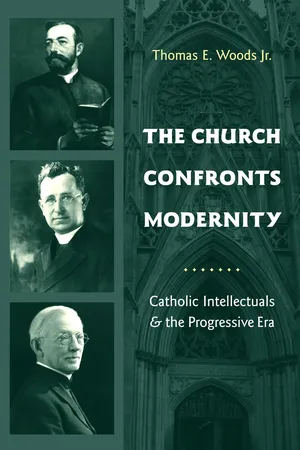
eBook - ePub
The Church Confronts Modernity
Catholic Intellectuals and the Progressive Era
- English
- ePUB (mobile friendly)
- Available on iOS & Android
eBook - ePub
About this book
Information
Topic
Teologia e religioneSubtopic
Denominazioni cristiane1 / THE STAGE IS SET
WHEN FATHER THOMAS J. GERRARD opened the July 1912 issue of the monthly Catholic World with a lengthy article titled “Modern Theories and Moral Disaster,” he conveyed the unease felt by American Catholic thinkers as they surveyed their intellectual milieu in the early twentieth century. From philosophy and economics to art and education, Gerrard explained, the modern world was growing increasingly antagonistic toward Christendom. The subjectivism that had begun with Descartes and that had become more pronounced over the following three centuries of philosophic thought was at last reaching its ultimate destination—not merely in atheism but also in radical individualism, self-indulgence, and even nihilism.1
Catholics were not alone, of course, in their alienation from modern developments; historians of American thought and culture have amply documented the apprehension and fear that many ordinary Americans felt when confronted with so much intellectual dislocation all at once.2 It was indeed a time of disorientation. Darwin’s theory of evolution, which according to one scientist “made it possible to be an intellectually fulfilled atheist,” only grew in influence in the decades following the publication of The Origin of Species (1859). In place of Christianity’s teleological understanding of an orderly universe created by a benevolent God, this new creed pointed to a cosmos born of chaos and chance, materialistic and purposeless. Pragmatism in philosophy not only subjected traditional metaphysics to attack and ridicule—and was not infrequently an explicit assault on medieval Scholasticism—but also seemed to strike at the very idea of fixed standards of right and wrong. Modernity’s assault was indeed unrelenting, for no sooner were principles of morality said to be relative to time and place than Einstein, in 1919, demonstrated with his General Theory that time and place were themselves relative. Catholics’ assessment of the age, writes historian Patrick Carey, “was not just a narrow-minded Catholic ghetto interpretation of events in the United States and Europe, but a reflection of post-Civil War realities.”3
Much of the unease with modernity that Jackson Lears describes in his well-known study involved a revulsion against consumerism, materialism, and other even less agreeable aspects of industrialization. The Southern Agrarians, for their part, who would emerge as a serious intellectual force in 1930 with the publication of I’ll Take My Stand, the celebrated agrarian manifesto, ranked among the most articulate critics; industrial society, they said, seemed to have forgotten where it was going. It was directed toward the production of more and more capital and consumer goods, but for what purpose? For the production of still more goods? Allen Tate, one of the contributors to I’ll Take My Stand, felt unsatisfied with a society that seemed, at least to him and to his fellow agrarian critics, to be directed toward no higher end than that. He considered his own conversion to Catholicism—which attracted him by its sharp condemnations of many modern developments—to be the logical culmination of beliefs and principles he had always held.4
The Catholic critique of modernity thus overlapped considerably with the assessments of other social and cultural observers of the late nineteenth and early twentieth centuries. But it was often deeper, more philosophical, and—naturally—more concerned with the effects of modern intellectual life on the well-being of the Church. As a visible, corporate body identified not unjustifiably in the public mind with stability and conservatism, whose Magisterium had over the centuries restrained rash intellectual innovation, the Catholic Church viewed these developments with a special acuteness. The Church had already railed against liberalism for more than a century by the time these new challenges were emerging; and as the modern world upped the ante, the papacy responded in kind. In 1864 Pope Pius IX issued his famous Syllabus of Errors, a collection of eighty of the “principal errors of our day” that the pontiff had condemned in his earlier letters and allocutions. Filled with denunciations of the secular “isms” that had engulfed the West, the Syllabus seemed to anathematize an entire age. Condemned Proposition 80 read: “The Roman Pontiff should reconcile himself to liberalism, progress, and modern civilization.”5
Yet the proper response of Catholic intellectuals, the popes of the period agreed, was not simply to denounce modern errors—although that was important—but also to hold out the splendor of the Catholic alternative. The Church had, for example, the riches of Scholastic philosophy, an approach that was both hallowed by tradition and easily adapted to address the issues occupying modern philosophy and the modern world as a whole. Pius IX had condemned in the Syllabus the proposition that “the method and principles according to which the ancient Scholastic Doctors cultivated theology are in no way suited to the necessities of our times and to the progress of the sciences.”6 His successor, Leo XIII, would take this theme much further, laying the groundwork of a full-scale Scholastic revival in his encyclical Aeterni Patris (1879). This seminal document urged Catholic teachers and philosophers to draw deeply from the riches of the Angelic Doctor, Saint Thomas Aquinas, whose doctrine and method were thought to be the surest path both to finding philosophic truth and to engaging the modern world with forthrightness and vigor. Leo’s program was greeted with enthusiasm, but it would take decades to become firmly established.
During those decades—the years that would become known as the Progressive Era—the Church in America found itself at a crossroads. Two major theological controversies had at last been settled. “Americanism,” a term that referred to an excessive eagerness to ease the Church’s discipline and present its doctrines in such a way as to appeal to modern man, was condemned in Leo XIII’s Testem Benevolentiae (1899). Modernism, the second of these, was a more complicated and less easily defined theological phenomenon, but under this designation Pope Pius X included such condemned ideas as dogmatic evolutionism, vital immanence, subjectivism, and historical relativism. In Pascendi Dominici Gregis (1907), the pope used what historian John Tracy Ellis has called “the harshest and most negative language employed by a papal encyclical in this century” to condemn Modernism as “the synthesis of all heresies.”7 By 1907, therefore, Catholic intellectuals could at last direct more of their attention to the American scene. By an interesting happenstance, it was during one of the most ideologically charged and intellectually vigorous periods of American history that Catholic thinkers at last became a presence, albeit a modest one, in the intellectual life of the United States.
To be sure, American Catholics did not encounter an intellectual monolith. The milieu was one in which intensely moralistic crusades for practical reforms coexisted with a desire on the part of some social scientists to speak in a value-free, “scientific” idiom. A variety of perspectives is evident within the Progressive movement, reflected most obviously in differences of opinion over some of the most contentious issues of the day (e.g., government policy vis-à-vis big business). All of this is true, and it should not be supposed that references to a single Progressive perspective are meant to suggest that all Progressive intellectuals were essentially interchangeable. They fought, sometimes bitterly, among themselves.
But it would be unreasonable not to acknowledge the existence among Progressive intellectuals—that is, thinkers who spoke about changes in American society much more far-reaching than this or that particular reform—of a considerable range of agreement at least on the basics of what the new America should look like. It is with this intellectual dimension of the Progressive Era that we will be concerned. And as historian Eldon Eisenach has demonstrated, a key aim of this aspect of the Progressive movement was to manufacture a kind of civic religion, a nondogmatic ethic that could serve as a national bond that would lift Americans out of the dual parochialism of geography and religion. The Progressive effort to remove ethics from the speculative field of moral philosophy and set it on a foundation of value-free, empirical science, a trend amply documented by Morton White, was emblematic of this effort.8 Even more so was the attempt by the Progressive sociologist Albion Small to persuade his fellow intellectuals of the need to “invent” a new American religion.9 As Eisenach explains, “By 1915, Small is really codifying the results of a longstanding theological-ethical enterprise when he concludes that the symbolic centerpiece of this ‘new’ national religion is the now historically recovered ‘Weltanschauung of Jesus’ excavated from barbarism, superstition, church, and dogma.”10 A corollary to such a national creed, so to speak, was the construction of a truly national community, of a social democracy in which the locus of people’s affections and loyalties would be transferred from local authorities and various subsidiary institutions to the central state. According to Eisenach, Progressives held that “all social knowledge deserving a hearing must be cosmopolitan in origin and national in import.” They “invented a conception of citizenship,” moreover, “that stipulated that the possession of social knowledge entailed the duty of reflecting on and articulating ideas of national public good unmediated by party, interest, region, or sectarian religion.”11 Social Gospel Christians could be considered allies by secular Progressives and could play an important role in the Progressive movement precisely because they portrayed Christ’s message in a naturalistic way that posed little threat to the new secular ethic that Eisenach describes. Gone was the cry “No salvation outside the church.” “The candid democrat,” stated the New Republic, insists that “no one has a monopoly in salvation.”12
The whole spirit of the new creed was positively hostile to any sectarian group claiming possession of absolute truth. What Eisenach does not mention, however, is that the Catholic Church was precisely such a “sectarian group.” Catholics considered their dogmas binding not merely on themselves—in which case they could have had less of a quarrel with Progressives—but ultimately on the entire human race. In such areas as education and sociology, they were prepared to employ modern findings where they were not repugnant to Church teaching and where they offered potential benefit to the Church. But Catholics could not accept a philosophy that they believed focused on means rather than ends, a theory of education that neglected the proper cultivation of the soul, or a practice of the social sciences that considered it possible to study man and to make recommendations for his happiness without any specific understanding of his nature and destiny. They were not prepared to be just another faction, with no more claim to men’s allegiance than any other.
During the Progressive Era, however, the Church in America found itself in the midst of an intellectual milieu in which a variety of disparate (though perhaps distantly related) trends in thought were tending to the conclusion that attachment to dogmatic and moral absolutes was inimical to the democratic ethos. I have already mentioned Pragmatism’s rejection of dogma in the sense that Catholics understood it. The Social Gospel movement in American Protestantism, while said to be an effort to bring Christian values to bear upon the social problems facing the United States in the late nineteenth and early twentieth centuries, was at some level also a rejection of the idea of Christianity as a system whose ultimate basis lay in dogma, creed, and ritual.13 Its chief theologians, Walter Rauschenbusch in particular, were known to argue, for example, that Saint Paul, by preaching and promoting so supernatural a vision of Christianity, had already departed from the simplicity of its founder. Indeed, Rauschenbusch rather explicitly accused the Catholic Church and some of the more conservative of the Reformed churches of having betrayed the original intent of Christianity by introducing the dead hand of dogma, ritual, and authoritarianism into what was supposed to have been a primarily ethical religion, concerned mostly not with theological hairsplitting but with men’s relations with other men. Philosophically distinct from and yet logically consonant with this critique were the effects on Christianity of the Enlightenment, which continued to be felt even at the beginning of the twentieth century. Those Enlightenment thinkers who were not altogether hostile to Christianity emphasized the urgency of retreating from aspects of the religion that were purely ritualistic or devotional and of stressing instead the rational and didactic. Immanuel Kant was the standard-bearer of this group.14 And beyond all this there was, very simply, the unmistakable Progressive instinct for efficiency, centralization, and simple practicality, none of which was thought to be aided by attachment to the outworn dogmas and moral teachings of an authoritarian institution out of step with modernity.
What is especially striking about the Catholic Church during this period, especially at a time when reigning philosophical presuppositions tended to be so antagonistic to its own, is its self-confidence. Its apologists truly believed that it was “the greatest, the grandest, and the most beautiful institution in the world.”15 The Catholic faith was “the one immutable thing in a universe of ceaseless mutations.”16 Catholic writers spoke with great affection of Pope Pius X, who reigned from 1903 to 1914 (and who became the first pope to be canonized since the sixteenth century). Time and again Catholic periodicals pointed with pride to Pius’s vigorous and uncompromising stance against modern political and intellectual trends, and indeed many authors considered the Church’s willingness to stand alone against modernity as an important testimony to its divine foundation.17
Pius is so often remembered simply as the anti-Modernist pope that his positive program—“to restore all things in Christ”—is frequently overlooked. The Jesuit writer John J. Wynne, for example, founded the weekly periodical America in response to the pope’s call.18 America would cover news in the Church and in the world at large for a Catholic audience, always with the good of Church and country in mind. American Catholics also undertook the staggering project of assembling an entire encyclopedia of their own. While no more tendentious than the French Encyclopédie, the Catholic Encyclopedia did serve more than a strictly academic purpose. In a world that seemed increasingly adrift from its Christian moorings, the publication sought to provide a reliable compendium of knowledge to the curious and intelligent Catholic. It also served the explicit purpose of countering the Encyclopaedia Britannica, many of whose articles churchmen considered anti-Catholic. The extensive Catholic campaign against the Britannica, all but unnoticed by historians, was a potent symbol of this sense of distinctiveness that American Catholics felt during the early twentieth century.19 It could come as no real surprise, therefore, when they declared themselves unwilling to go along with a philosophy that insisted that their faith was merely the result of subjective sentiment and not objectively demonstrable, or that the ideal for society was not the conversion of America to Catholicism but a toleration that encouraged only (in Dewey’s terms) individual self-realization. “We have a vision that they have not,” a Jesuit writer put it simply.20
Progressive education provides only the most obvious example of this conflict. Education in the Catholic sense, the educator Edward A. Pace wrote in the Catholic Encyclopedia, “aims at an ideal, and this in turn depends on the view that is taken of man and his destiny, of his relations to God, to his fellow men, and to the physical world.”21 John Dewey’s schools did inculcate values, but they were largely procedural: tolerance, respect for the democratic process, and the like. In an article critical of Catholicism, the New Republic—described by one scholar as given to “a continuing, though normally low-key anti-Catholicism”22—insisted that “freedom and tolerance mean the development of independent powers of judgment in the young, not the freedom of older people to impose their dogmas on the young.”23 More recently, Jacques Maritain wrote that Dewey’s philosophy “proposes no rules of conduct, but teaches rules and procedures of investigation to be used in determining the value of various possible modes of conduct in a given situation.”24
The philosophy of Pragmatism, which lay just beneath the surface of Progressive education, sociology, and the like, also contributed to an animosity toward dogma. William James and John Dewey, like many post-Kantian philosophers, were skeptical of the efforts of traditional philosophy to attain absolutely true knowledge. Pragmatism, based as it was on human experience, sought to render philosophy more democratic and individualistic; James even called it “philosophic Protestantism.” Here again, substantive content gave way to procedure: the ends to be pursued by man became less the object of philosophy than the means of achieving them. James stated explicitly that Pragmatism had no dogmas or doctrines save its method. This apparent retreat from a commitment to objective standards seemed to many Catholics to be at the root of the problems besetting the modern mind, and churchmen would strike at Pragmatism with particular vigor—whether they found it expressed in pure philosophy or saw it manifested in education, the social sciences, or elsewhere.
Standar...
Table of contents
- Cover
- Half title
- Series Page
- Title
- Copyright
- Dedication
- Contents
- Acknowledgments
- 1. The Stage Is Set
- 2. The Challenge of Pragmatism
- 3. Sociology and the Study of Man
- 4. Assimilation and Resistance: Catholics and Progressive Education
- 5. Economics and the Social Question
- 6. Against Syncretism
- Epilogue: Into the Future
- Notes
- Selected Bibliography
- Index
- Series List
Trusted by 375,005 students
Access to over 1.5 million titles for a fair monthly price.
Study more efficiently using our study tools.
Frequently asked questions
Yes, you can cancel anytime from the Subscription tab in your account settings on the Perlego website. Your subscription will stay active until the end of your current billing period. Learn how to cancel your subscription
No, books cannot be downloaded as external files, such as PDFs, for use outside of Perlego. However, you can download books within the Perlego app for offline reading on mobile or tablet. Learn how to download books offline
Perlego offers two plans: Essential and Complete
- Essential is ideal for learners and professionals who enjoy exploring a wide range of subjects. Access the Essential Library with 800,000+ trusted titles and best-sellers across business, personal growth, and the humanities. Includes unlimited reading time and Standard Read Aloud voice.
- Complete: Perfect for advanced learners and researchers needing full, unrestricted access. Unlock 1.5M+ books across hundreds of subjects, including academic and specialized titles. The Complete Plan also includes advanced features like Premium Read Aloud and Research Assistant.
We are an online textbook subscription service, where you can get access to an entire online library for less than the price of a single book per month. With over 1.5 million books across 990+ topics, we’ve got you covered! Learn about our mission
Look out for the read-aloud symbol on your next book to see if you can listen to it. The read-aloud tool reads text aloud for you, highlighting the text as it is being read. You can pause it, speed it up and slow it down. Learn more about Read Aloud
Yes! You can use the Perlego app on both iOS and Android devices to read anytime, anywhere — even offline. Perfect for commutes or when you’re on the go.
Please note we cannot support devices running on iOS 13 and Android 7 or earlier. Learn more about using the app
Please note we cannot support devices running on iOS 13 and Android 7 or earlier. Learn more about using the app
Yes, you can access The Church Confronts Modernity by Thomas E. Woods Jr. in PDF and/or ePUB format, as well as other popular books in Teologia e religione & Denominazioni cristiane. We have over 1.5 million books available in our catalogue for you to explore.