The Quakers in America is a multifaceted history of the Religious Society of Friends and a fascinating study of its culture and controversies today. Lively vignettes of Conservative, Evangelical, Friends General Conference, and Friends United meetings illuminate basic Quaker theology and reflect the group's diversity while also highlighting the fundamental unity within the religion. Quaker culture encompasses a rich tradition of practice even as believers continue to debate whether Quakerism is necessarily Christian, where religious authority should reside, how one transmits faith to children, and how gender and sexuality shape religious belief and behavior. Praised for its rich insight and wide-ranging perspective, The Quakers in America is a penetrating account of an influential, vibrant, and often misunderstood religious sect.
Known best for their long-standing commitment to social activism, pacifism, fair treatment for Native Americans, and equality for women, the Quakers have influenced American thought and society far out of proportion to their relatively small numbers. Whether in the foreign policy arena (the American Friends Service Committee), in education (the Friends schools), or in the arts (prominent Quakers profiled in this book include James Turrell, Bonnie Raitt, and James Michener), Quakers have left a lasting imprint on American life. This multifaceted book is a concise history of the Religious Society of Friends; an introduction to its beliefs and practices; and a vivid picture of the culture and controversies of the Friends today.
The book opens with lively vignettes of Conservative, Evangelical, Friends General Conference, and Friends United meetings that illuminate basic Quaker concepts and theology and reflect the group's diversity in the wake of the sectarian splintering of the nineteenth century. Yet the book also examines commonalities among American Friends that demonstrate a fundamental unity within the religion: their commitments to worship, the ministry of all believers, decision making based on seeking spiritual consensus rather than voting, a simple lifestyle, and education. Thomas Hamm shows that Quaker culture encompasses a rich tradition of practice even as believers continue to debate a number of central questions: Is Quakerism necessarily Christian? Where should religious authority reside? Is the self sacred? How does one transmit faith to children? How do gender and sexuality shape religious belief and behavior? Hamm's analysis of these debates reveals a vital religion that prizes both unity and diversity.
- English
- ePUB (mobile friendly)
- Available on iOS & Android
eBook - ePub
The Quakers in America
About this book
Information
Topic
Theology & ReligionSubtopic
North American HistoryCHAPTER ONE
Meeting for Worship and Meeting for Business
“Plain” is a word that resonates with many meanings for Quakers, but the Stillwater Meetinghouse near Barnesville, Ohio embodies most of them. Approaching it from the west, one might not immediately realize that it is used for religious purposes. Outwardly, it appears to be an unusually solid red-brick barn, or a small warehouse or Victorian factory. But coming closer, one notices the tombstones in the graveyard (none more than two feet high) alongside, and a sign that identifies this as the site of a Friends meeting.1
Inside, the lack of ornamentation, of anything that most visitors would perceive as denoting “sacred space,” is striking. Shades of gray paint set off the walls and woodwork. The only concessions to modernity are the electric lights and the plywood that lines the high ceiling. Across the center of the room, east to west, runs a divider, its middle part now open, remaining from the era when men and women Friends held separate business meetings and the shutters in this partition would have been closed. Three rows of tiered benches line the west side of the building. They have railings on top of the back, a reminder of the day when recorded ministers—not ordained pastors but congregants with a gift for speaking—would have sat on these “facing benches” and would have grasped the railings when they rose to speak. Now only the south end of the meeting house is in use. In the center of the aisle separating the facing benches is an antique table, with two people seated behind it. The man is in blue jeans; the woman beside him wears a white cap and a plainly cut dress such as Amish women might wear. They are, respectively, the reading and presiding clerks of Ohio Yearly Meeting of Conservative Friends. On the bench below them sit three other Friends.
As others come into the room, they greet and chat quietly with each other. Most are dressed casually, indistinguishable from any other group of white, middle-class Americans. But a few stand out, men in pants with suspenders and blue work shirts wearing straw hats that they do not remove, a woman in a cap and dress similar to the presiding clerk’s. Without any prearranged signal, the fifty or so people present settle into a long period of silence, broken only by the sounds of the breeze through the trees and the buzz of insects coming through the open doors. Then a few Friends rise to speak. Their themes are emphatically scriptural—the New Birth, the Wheat and the Tares, the Cross—with long passages of the New Testament recited from memory.
After half an hour or so, one of the three Friends on the middle facing benches rises and says, “If Friends are willing, perhaps we can attend to the business of the meeting.” Another calls on those present to move up from the back benches: “As we’re getting smaller, we need to get closer together.” Business does not begin with an invocational prayer; instead the presiding clerk reads a passage from the Bible. Then the meeting proceeds. It is considering answers to the queries, the questions on spiritual life and administrative matters that each monthly and quarterly meeting must address; for example, have new meetings been established, or is care taken for the education of children of members? Summaries of the answers have been proposed. As the clerk reads them, Friends respond with statements of approval, like, “I am glad for that summary.” Most of the business consists of committee reports. The clerk concludes the consideration of each by reading a minute indicating that the report has been considered and approved by the meeting. Never is a vote taken; it is for the clerk to discern the will of the meeting, which for Friends is the will of God.
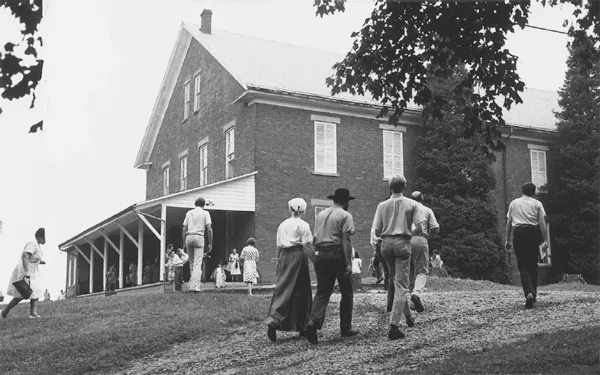
Stillwater Friends Meetinghouse. JAMES & BERTHA COOPER/COURTESY OF FRIENDS JOURNAL.
“Deliberate” is the method here, an intense desire to act, not according to human wisdom but instead in the confident expectation that God, through the Holy Spirit, will be present to guide Friends. One Friend tells how she felt led to visit another yearly meeting a few years earlier, but once she was there, God gave her nothing to say during its sessions. In one discussion, a Friend expresses a fear that the yearly meeting is moving too quickly toward a conclusion, “in our own wisdom,” rather than under God’s guidance. Ultimately, the matter is held over to the next day for further discussion, when a different course does strike the meeting as the correct one.
Ohio Yearly Meeting of Friends (Conservative) is aptly named. It represents the strand of American Quakerism that has been most resistant to change and has clung most tenaciously to the old ways. Friends of other bodies journey to Barnesville, Ohio to experience its unique atmosphere, aware that it retains something that virtually all other Friends have given up. Its customs and practices are, in large part, those that most Americans vaguely associate with Quakers. At least a few of its members see it as the last truly Quaker body left in the world, since the overwhelming majority of American Friends have chosen very different directions. One sees that clearly by traveling about one hundred miles north.
At first glance, one might not recognize the building as a church. It looks like a new suburban school, and entering it, if you take a wrong turn, you find yourself going down long corridors with classrooms and offices. The largest space would certainly do any junior high school credit as an auditorium or gymnasium—the stage, the sound system, the lines on the hardwood floors laying out basketball zones, the screen for projections and Power Point presentations, the long rows of moveable plastic seats. But the signs and posters on the bulletin boards are all religious, and the literature gives information on opportunities for various Sunday School classes, missionary activities, and sports ministries.2
The large auditoriumlike room is the “Multi-Ministries Center.” In one sense, it evokes the Stillwater Meetinghouse: little about it suggests a traditional church. But then the music begins. The master of ceremonies introduces the “Son Tones” from the Mount Gilead Evangelical Friends Church. Immediately the quartet launches into harmony, a bouncy gospel song. Many in the choir seated on the stage around them begin to clap, and many out in the audience join in. Applause comes at the end of each number. Now the quartet launches into an a capella “Swing Low, Sweet Chariot.” Then the harmony shifts to a medley of Christian songs, the four men trading lines and responding to one another and blending their voices. Midway through their performance, much as would any rock group, they introduce their keyboard player to the audience, inviting applause. There is nothing stiff here—the heartfelt joy of the certainty of salvation and eternal happiness through Jesus is almost overwhelming. Occasionally, someone among the hundreds of people in the audience punctuates the performance with a cry of “Praise God!” or a “Whoo!” just as one might hear in a more secular setting when the performers sweep up the audience with their rendition of some favorite number.
The Son Tones are the beginning of an hour of enthusiastic worship. Most of it is musical—singing choruses, the words of which are projected onto the large screen at the front of the room; numbers by the choir; a few solo performances; all interspersed with prayers. Marks of evangelical faith are everywhere—greetings of “brother”; spontaneous amens; the persistent use of the title “Pastor.” Most of those present carry Bibles. When the music stops, the main speaker of the evening, Dr. John Williams, Jr., takes charge. One part of the program is a service of dedication for new area superintendents. They kneel for prayer at a specially constructed rail at the front of the room, surrounded by the pastors of the yearly meeting. Williams’s address is tightly focused on the Bible, with the expectation that the audience will follow along in their own copies. The message is reiterated by the Scripture verses projected onto the screen. Williams urges his listeners to expect the impossible through their faith in Jesus. And that faith is apparent in every song, every prayer, every speaker. Even an evidently bored teenager’s doodling is an elaborate “Jesus Saves” design of the cross.
The place is the Canton, Ohio, First Friends Church. It is a new building, in use only about a month in July 2001. It proclaims itself “The Miracle on 55th Street.” The people present are members of the Evangelical Friends Church–Eastern Region, gathered for their yearly meeting. Although they usually do not call themselves Quakers (they prefer “Evangelical Friends” both because it is scriptural and because it distinguishes them from other groups of Friends), they represent an important and aggressive strand of American Quakerism today.
The McCoy Room on the campus of Wilmington College in Wilmington, Ohio would in many other places probably be called a chapel. The A-frame construction, the light fixtures, and the woodwork all bespeak popular models of church construction in 1962, when, a plaque indicates, the McCoy family made possible its construction. Yet this room lacks the paraphernalia we would usually associate with a church or chapel. There is no altar. The only musical instruments are pianos. A single decoration hangs on the walls, a banner from the United Society of Friends Women International (USFWI) Triennial recently held in nearby Cincinnati. A basket of flowers on an antique table at the front of the room provides the only other bit of color.3
At 8:40 on this Friday morning in July, sixteen people are present when a well-dressed, enthusiastic woman announces that she would like to lead the group in singing hymns. At first the grand piano drowns out the voices, but over the next few minutes others enter the room, until about forty people are present. Some of the hymns would be familiar to most Protestants: “Joyful, Joyful, We Adore Thee,” or “To God Be the Glory.” A touch of sectarianism is provided by “The George Fox Song”:
Walk in the light, wherever you may be
Walk in the light, wherever you may be!
In my old leather breeches and my shaggy shaggy locks
I am walking in the glory of the light, said Fox!
As the singing concludes, the group settles into a period of silence, the purpose of which is not explained; everyone understands. Then it proceeds to business. The presiding officer is a friendly, middle-aged man; in a reversal of common roles, however, his assistant is a woman while a man takes the minutes. The college president makes a long report, ranging from the achievements of outstanding students to the formation of a committee on the Quaker identity of the institution. Then those present stand and applaud the retiring superintendent of the yearly meeting, Rudy Haag, who has left the hospital to be present for his final report. Succeeding reports are dispatched briskly and indicate both happiness and concern. Statistics are worrisome; of the yearly meeting’s total membership, for example, only 43 percent attend worship any given Sunday. And while the yearly meeting has set up a fund to make grants to local congregations for special projects, little interest has been shown in making use of it.
The afternoon session opens with a presentation by a youth group. These young people, in their shorts and T-shirts, are indistinguishable from the teenagers seen at any mall across America, save perhaps that all are white. They stage a skit: one of the participants is stuck in the “Box of Sin.” Others—an alien from another galaxy, a greedy television evangelist, a tree-hugging hippie Quaker—appear to propose various solutions. Finally, the solution comes: to accept Christ.
The contrasts between the 110th annual session of Wilmington Yearly Meeting of Friends in Wilmington, Ohio and the Evangelical Friends meeting in Canton are obvious. The style is different, and so, if inquired into, are some points of doctrine and theology. The worship is more subdued. An “Amen!” does occasionally burst forth from someone present, but such affirmations are not the dominant motif. These sessions are, for the most part, implicitly rather than explicitly religious. Yet reading the written reports and hearing the prayers of those present leaves no doubt that these Friends share the Christian identity and commitments of their neighbors to the east. Wilmington Friends represent another important strand of contemporary American Quakerism.
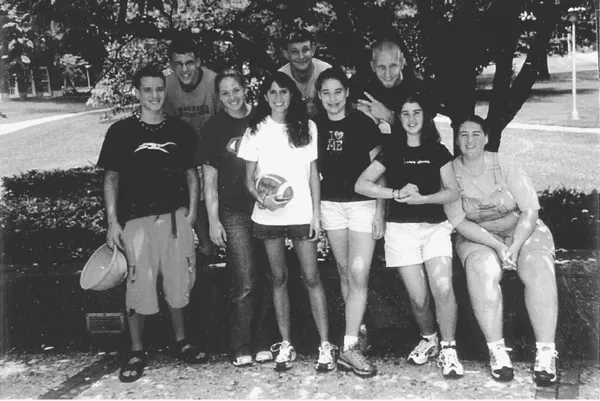
Young Friends at Wilmington Yearly Meeting, 2001. COURTESY OF WILMINGTON YEARLY MEETING.
Many of those present in the auditorium at Bluffton College in northwestern Ohio have the look of people familiar with a college campus. Dress is casual. The cars in the lots of the dormitory where many are housed bear bumper stickers for National Public Radio, peace, ecology, and feminism, along with not a few faded ones for Gore and Lieberman. Gay men and lesbians are present and are welcomed and affirmed in their identities, as informal conversations and the presence of the Friends for Lesbian and Gay Concerns group show. When the roll call is taken, it is striking how many answer from college towns in Ohio and Michigan: Ann Arbor, Athens, Granville, Kent, Kalamazoo, Oberlin, and Wooster. Bluffton is a Mennonite school, but these Quakers are comfortable with the hospitality of another of the historic peace churches.4
The meeting opens with worship, those present sitting in silence, speaking when they feel led to. The evening closes with silence but also with sadness. As the official record of the gathering puts it: “Our concluding worship has been touched by the knowledge that while we have been meeting this evening the state of Ohio has murdered Jay D. Scott,” referring to the execution of a convicted murderer. Such matters are on the minds of many of those present. Later in the sessions, the group will record its moral support for members who engage in “war tax resistance,” will denounce the death penalty, and will pointedly criticize President Bush’s “missile shield” program.5
This is a group that also values discussion, on every possible subject and involving people of all ages. The “Middle School Epistle” reports “a discussion about the Loch Ness monster, and green alien cats that built the pyramids. We talked about dinosaurs and how they became extinct, and evolution vs. Creation. We talked of ethics and politics. We discussed prayer and Meeting for Worship. The class discussed cults. We discussed what God is like.”6
But while these Friends may be intensely political, they are also intensely spiritual. A highlight of the five-day yearly meeting is an address by Marty Paxson Grundy, a Cleveland Friend and the yearly meeting’s recording clerk. Its point is simple: individuals must be in balance with their meetings, and they achieve that through their relationship with God. It seamlessly blends history, theology, and psychology, citing a variety of Friends from the seventeenth to the twentieth centuries as well as the Bible. As are the messages heard in the other yearly meetings, it is a call for people to come into a deeper, closer relationship with God. But in contrast to them, it is not definitely Christian. For many in Lake Erie Yearly Meeting, to be a Quaker is not necessarily to be a Christian.7
Barnesville, Canton, Wilmington, and Bluffton represent, in rough geography, four corners of the state of Ohio. The Quaker gatherings that they host also represent the four major divisions of American Quakerism. Ohio Yearly Meeting, the smallest, represents the three yearly meetings of Conservative Friends left in the United States. Eastern Region is part of the group that calls itself Evangelical Friends International. Wilmington Yearly Meeting was one of the founders of the largest international Quaker group, Friends United Meeting. Lake Erie Yearly Meeting, the youngest of the four, is part of Friends General Conference. All four yearly meetings, and all four groups, have roots in the Quaker movement that began in England in the 1640s. All claim to be anchored in that heritage. Yet the surface differences that the casual visitor observes reflect profound theological diversity with some common strands of understanding.
These Friends obviously worship in different ways. At first glance, those of Ohio and Lake Erie seem similar. For both bodies, worship is what Friends call “unprogrammed,” not having any preordained order, with no one person appointed or hired as the main speaker. Ohio Yearly Meeting, however, recognizes that some Friends have a gift for speaking in meeting, and has a process for recognizing this by “recording” it—making a record that the Friend, whether male or female, has “a gift in the ministry.” Such recorded ministers are simply people with a gift for preaching, not pastors. Lake Erie, on the other hand, like most yearly meetings in Friends General Conference, does not record ministers. Wilmington (although it contains a few unprogrammed meetings) and Eastern Region are “programmed” yearly meetings, meaning that the congregations have pastors, with orders of...
Table of contents
- Cover
- Half title
- Series Page
- Title
- Copyright
- Contents
- Preface
- Chapter 1. Meeting for Worship and Meeting for Business
- Chapter 2. The Origins of American Quakerism, 1640–1800
- Chapter 3. Their Separate Ways: American Friends Since 1800
- Chapter 4. Quaker Faiths and Practices
- Chapter 5. Contemporary Quaker Debates
- Chapter 6. Quakers and the World
- Chapter 7. “A quarterly meeting in herself”: Quaker Women, Marriage, and the Family
- Afterword
- Quaker Lives: Past and Contemporary
- Chronology
- Glossary
- Notes
- Resources for Further Study
- Index
Trusted by 375,005 students
Access to over 1.5 million titles for a fair monthly price.
Study more efficiently using our study tools.
Frequently asked questions
Yes, you can cancel anytime from the Subscription tab in your account settings on the Perlego website. Your subscription will stay active until the end of your current billing period. Learn how to cancel your subscription
No, books cannot be downloaded as external files, such as PDFs, for use outside of Perlego. However, you can download books within the Perlego app for offline reading on mobile or tablet. Learn how to download books offline
We are an online textbook subscription service, where you can get access to an entire online library for less than the price of a single book per month. With over 1.5 million books across 990+ topics, we’ve got you covered! Learn about our mission
Look out for the read-aloud symbol on your next book to see if you can listen to it. The read-aloud tool reads text aloud for you, highlighting the text as it is being read. You can pause it, speed it up and slow it down. Learn more about Read Aloud
Yes! You can use the Perlego app on both iOS and Android devices to read anytime, anywhere — even offline. Perfect for commutes or when you’re on the go.
Please note we cannot support devices running on iOS 13 and Android 7 or earlier. Learn more about using the app
Please note we cannot support devices running on iOS 13 and Android 7 or earlier. Learn more about using the app
Yes, you can access The Quakers in America by Thomas D. Hamm in PDF and/or ePUB format, as well as other popular books in Theology & Religion & North American History. We have over 1.5 million books available in our catalogue for you to explore.