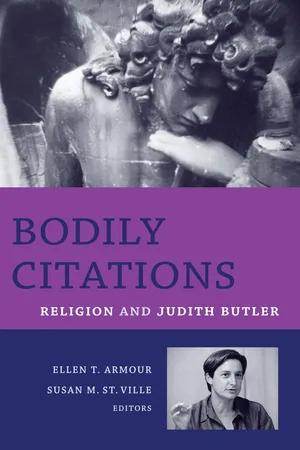
In such works as Gender Trouble and Bodies That Matter Judith Butler broke new ground in understanding the construction and performance of identities. While Butler's writings have been crucial and often controversial in the development of feminist and queer theory, Bodily Citations is the first anthology centered on applying her theories to religion. In this collection scholars in anthropology, biblical studies, theology, ethics, and ritual studies use Butler's work to investigate a variety of topics in biblical, Islamic, Buddhist, and Christian traditions. The authors shed new light on Butler's ideas and highlight their ethical and political import. They also broaden the scope of religious studies as they bring it into conversation with feminist and queer theory.
Subjects discussed include the woman's mosque movement in Cairo, the ordination of women in the Catholic Church, the possibility of queer ethics, religious ritual, and biblical constructions of sexuality.
Contributors include: Karen Trimble Alliaume, Lewis University; Teresa Hornsby, Drury University; Amy Hollywood, Harvard Divinity School; Christina Hutchins, Pacific School of Religion; Saba Mahmood, University of California, Berkeley; Susanne Mrozik, Mount Holyoke College; Claudia Schippert, University of Central Florida; Rebecca Schneider, Brown University; Ken Stone, Chicago Theological Seminary
eBook - ePub
Bodily Citations
Religion and Judith Butler
- English
- ePUB (mobile friendly)
- Available on iOS & Android
eBook - ePub
Bodily Citations
Religion and Judith Butler
About this book
Information
Subtopic
Sexuality & Gender in ReligionIndex
Social SciencesEMBODYING IDENTITIES
The incarnation of the Word took place according to the male sex: this is indeed a question of fact, and … while not implying an alleged natural superiority of man over woman, cannot be disassociated from the economy of salvation…. That is why we can never ignore the fact that Christ is a man.
—Sacred Congregation for the Doctrine of the Faith
Men are only sometimes men, but a woman is always a woman; everything reminds her of her sex.
—Jean Jacques Rousseau
I don’t think one can pretend to imitate adequately that to which one is bound.
—Gayatri Chakravorty Spivak
In the end, in the beginning, now as then, there is only the performance.
—John Dominic Crossan
4. DISTURBINGLY CATHOLIC: Thinking the Inordinate Body
KAREN TRIMBLE ALLIAUME
FOR CATHOLIC WOMEN gender matters theologically. It matters most peculiarly when it comes to the question of ordination to the priesthood, which, for Catholics obedient to the Church’s official teaching, has been “definitively” answered: “Women are not to be admitted to ordination.”1 The silence enjoined by the Church on this matter is constituted less by the absence of speech than by the inarticulability of bodies: to understand why Catholic women may not, according to Church teaching, be ordained, we must understand how and why gender comes to matter in the theology promulgated by the Catholic magisterium2 and in dissenting theologies by those theologians, feminist and otherwise, who question its conclusions. “Theologies are never sexually neutral. The Roman Catholic Church’s theology is a heavily sexual theology, obsessed with the regulation and control of sexual performances, roles and behavioural patterns of people…. Gender roles are not an extra element but a constitutive one of an understanding of being church.”3 For a Catholic woman gender identity and Catholic identity are not separable. Both the magisterium and those who contest its teachings with regard to ordination rely on certain understandings of women’s identities as members of the “Body of Christ.” Both also rely on certain construals of Jesus’s corporeal identity in arguing for what the identity of “his” corporate body, the Church, is and should be. Links between bodies, seen by the Catholic magisterium as naturally and primordially sexed, and the Body of Christ, the communal identity of the Church—in turn based on the physical and sexed body of the historical Jesus of Nazareth as well as on the “spiritual” body of the risen Jesus Christ—form a complex web of symbolism determinative of women’s inclusion and exclusion in the Catholic Church.
If you are not Catholic, why does this matter to you? Because the gender construction—and abjection—of women in official Catholic pronouncements on ordination may be helpfully analyzed as a case study illuminating both exclusion of and resistance by women in other institutions and communities. The body of Jesus is a potent trope, and tracing its shifting contours through a Butlerian lens illuminates not only the effects of the Church’s judgment of women as illegitimate subjects of ordination, and the constructive possibilities of feminist resistance to that judgment, but other exclusive cultural constructions of women that rely, overtly or covertly, on Christian underpinnings.
For instance, the ambiguities of Catholic women’s Church membership can be seen as analogous to the tensions attending women’s rights as citizens in the modern nation-state. Feminist political scientist Jan Jindy Pettman argues that, while in theory they are full citizens, in practice women are often denied full citizenship rights on various grounds of unsuitability (as not male, not reasonable; as emotional; as sexual and therefore disruptive or dangerous; or as having family attachments precluding the disinterested work of citizenship). Asymmetry between women’s claims to and full enjoyment of citizenship rights tends to rest on the grounds of motherhood: the maternal is located in the family, which is “private,” yet (certain) women are also claimed by the state to perform civic duties such as giving birth to, bringing up, and offering to the state future citizens, soldiers, and workers.4 Church defenses of the “dignity and vocation of women” with regard to their role in the Church strike a remarkably similar note:
By defending the dignity of women and their vocation, the Church has shown honor and gratitude for those women who—faithful to the Gospel—have shared in every age in the apostolic mission of the whole People of God. They are the holy martyrs, virgins and mothers of families, who bravely bore witness to their faith and passed on the Church’s faith and tradition by bringing up their children in the spirit of the Gospel.”5
The “Letter to the Bishops of the Catholic Church on the Collaboration of Men and Women in the Church and in the World,” issued by the Sacred Congregation for the Doctrine of the Faith on May 31, 2004, reaffirms this explicitly complementary view of sex and gender, finding “woman’s” dignity firmly rooted in her capacity for nurturing and existing “for the other.”6 It explains that men’s and women’s equal dignity as persons “is realized as physical, psychological and ontological complementarity” that only sin renders conflictual.7 The letter attempts to defend this understanding from charges of biological determinism by invoking virginity as a historical option for women, explaining that “although motherhood is a key element of women’s identity, this does not mean that women should be considered from the sole perspective of physical procreation,” and argues that “the existence of the Christian vocation of virginity … refutes any attempt to enclose women in mere biological destiny.”8 However, it is noteworthy that women’s options and status are still defined here as based on sexual status. And motherhood, far from disappearing as a defining characteristic of womanhood, is confirmed as an ontological quality of all women: The letter defends the role of women in the workplace by invoking their inherent “mothering” qualities, seen as the capacity to give life, to be attuned to the concrete rather than the abstract, and to value human life. While these are seen as “above all human values … it is only because women are more immediately attuned to these values that they are the reminder and the privileged sign of such values.”9
There is admittedly a disjunction between this language of rights and democratic citizenship and the language of faithfulness and discipleship used to characterize membership in the Catholic Church. The “Declaration on the Question of the Admission of Women to the Ministerial Priesthood” asserts that “priesthood does not form part of the rights of the individual, but stems from the economy of the mystery of Christ and the Church.”10 The writers distinguish the Church’s organizing and governing principles from modern democracy:
One must note the extent to which the Church is a society different from other societies, original in her nature and in her structures. The pastoral charge in the Church is normally linked to the sacrament of Order; it is not a simple government, comparable to the modes of authority found in the States. It is not granted by people’s spontaneous choice: even when it involves designation through election, it is the laying on of hands and the prayer of the successors of the Apostles which guarantee God’s choice; and it is the Holy Spirit, given by ordination, who grants participation in the ruling power of the Supreme Pastor, Christ (Acts 20:28). It is a charge of service and love: “If you love me, feed my sheep” (Jn. 21:15–17).
For this reason one cannot see how it is possible to propose the admission of women to the priesthood in virtue of the equality of rights of the human person.11
Yet the analogy to women’s rights as citizens remains salient, in view of Church capitulation to other “democratic values” of modernity. Mark Chaves argues that “sacramental” Christian denominations such as the Roman Catholic Church, as well as Protestant fundamentalist traditions, identify resisting women’s ordination with resisting modernity.12 Gene Burns demonstrates that the Catholic Church, having capitulated to other modern values such as church-state relations, capitalism, and freedom of conscience outside the Church, resists modernity most strenuously in the area of “faith and morals” read as (particularly women’s) sexuality.13 Marian Ronan argues that the Church has settled on issues surrounding women’s sexuality, including ordination, as the primary symbol of this resistance because “women as a class have less power to fight back than liberal states or the market do.”14
As in the case of citizenship, Catholic women’s (non)ordination demonstrates in ways pertinent to other arenas that identities are embodied and not abstract and that bodies are inscribed in ways that are read not only to grant or deny rights but also to create the subjectivity of the bodies to which they seem merely to refer. Women are constructed as separate but equal in their roles and responsibilities in the Church by the Church’s complementary understanding of gender, displayed in the theological “economy of salvation.” The declaration explains this economy, in which the priest must be male because Jesus Christ was male, as follows:
The unity which [Christ] re-established after sin is such that there are no more distinctions between Jew and Greek, slave and free, male and female, but all are one in Christ Jesus (Gal. 3:28). Nevertheless, the incarnation of the Word took place according to the male sex: this is indeed a question of fact, and this fact, while not implying an alleged natural superiority of man over woman, cannot be disassociated from the economy of salvation: it is indeed in harmony with the entirety of God’s plan as God himself has revealed it…. That is why we can never ignore the fact that Christ is a man. And therefore, unless one is to disregard the importance of this symbolism for the economy of Revelation, it must be admitted that, in actions which demand the character of ordination and in which Christ himself … is represented, exercising his ministry of salvation—which is in the highest degree the case of the Eucharist—his role (this is the original sense of the word “persona”) must be taken by a man. This does not stem from any personal superiority of the latter in the order of values, but only from a difference of fact on the level of functions and service.15
The problem inherent in this strong linkage between divinity and maleness has been most classically expressed by feminist theologian Rosemary Radford Ruether: “Women’s inability to represent Christ is sealed by … the male disclosure of a male God whose normative representation can only be male.”16 The language of “reminder and privileged sign” used of women’s putative and preeminent “nurturing” qualities, in the Church’s letter “On the Collaboration of Men and Women” discussed earlier, echoes the logic of that used in the declaration to uphold the male-only priesthood, in which men are seen as the reminder and privileged sign of divinity. The theological and theoretical “equality” posited by a complementary understanding of gender cannot and does not translate into practical equality. Women who do not wish to be restricted to the Church-sanctioned and gender-complementary roles of mother, virgin, and/or martyr, and who may not “represent” Jesus Christ as priests, need alternatives. Exploring those alternatives may prove to apply not only to the particular case of women’s ordination within Catholicism but to other situations where women’s access to certain rights or roles is controlled based on similar logical “economies of imitation.”
An Economy of Imitation
The problematic linkage of maleness and salvation may be traced back to the Council of Chalcedon’s affirmation of Christ’s humanity and divinity in 451, as expressed in Gregory of Nazianzus’s assertion that “what has not been assumed [by Christ] cannot be restored; it is what is united with God that is saved.”17 In other words, Jesus Christ can be understood as saving humanity from sin and death only if he “takes on” all it means to be human and unites it with the divine. In particular, the council wished to affirm Christ’s humanity through an emphasis on his corporeality: if Christ was really human, then he had a physical body that was truly capable of suffering and death.18 This Chalcedonian affirmation of Christ’s humanity and divinity was not meant to be an exhaustive account of Christ’s meaning and identity, but a rule determining what kinds of faithful accounts of Christ could be given in the future.19 In other words, orthodox Christian theology confirmed that belief in Jesus’ full humanity and full divinity had a crucial role in salvation. This “rule” is still operative, it seems to me, both in the problematic links between Christ’s maleness and salvation that feminists criticize as well as in feminists’ own remedial reconstructions. If Christ had to be physically like us in order to save us, logic suggests, then in order to be saved we must in turn have to be like him.
To the extent that feminist theologians continue to assert that women must resemble Christ (or that Christ must resemble them) in order to be saved, we remain indebted, I argue, to the same Christological economy of imitation espoused by official Church teaching, in which Jesus Christ is seen as the norm that individuals must resemble for the salvific economy to work and from which resemblance women are ultimately (in full or in part) precluded. Dissolving the intransigence of both poles of this imitative economy by employing theorist Judith Butler’s deconstruction of the sexed body, I argue for a shift in Christological discourse to a “performative” economy in which the meanings of both “Jesus Christ” and “women” are understood to be performed in community. I develop Butler’s understanding of performativity as citational to demonstrate that...
Table of contents
- Cover
- Half title
- Series Page
- Title
- Copyright
- Contents
- Preface and Acknowledgments
- Introduction
- Judith Butler—in Theory
- Textual Bodies
- Embodying Identities
- Theorizing Bodies
- Afterword
- Selected Bibliography
- List of Contributors
- Index
Trusted by 375,005 students
Access to over 1.5 million titles for a fair monthly price.
Study more efficiently using our study tools.
Frequently asked questions
Yes, you can cancel anytime from the Subscription tab in your account settings on the Perlego website. Your subscription will stay active until the end of your current billing period. Learn how to cancel your subscription
No, books cannot be downloaded as external files, such as PDFs, for use outside of Perlego. However, you can download books within the Perlego app for offline reading on mobile or tablet. Learn how to download books offline
Perlego offers two plans: Essential and Complete
- Essential is ideal for learners and professionals who enjoy exploring a wide range of subjects. Access the Essential Library with 800,000+ trusted titles and best-sellers across business, personal growth, and the humanities. Includes unlimited reading time and Standard Read Aloud voice.
- Complete: Perfect for advanced learners and researchers needing full, unrestricted access. Unlock 1.5M+ books across hundreds of subjects, including academic and specialized titles. The Complete Plan also includes advanced features like Premium Read Aloud and Research Assistant.
We are an online textbook subscription service, where you can get access to an entire online library for less than the price of a single book per month. With over 1.5 million books across 990+ topics, we’ve got you covered! Learn about our mission
Look out for the read-aloud symbol on your next book to see if you can listen to it. The read-aloud tool reads text aloud for you, highlighting the text as it is being read. You can pause it, speed it up and slow it down. Learn more about Read Aloud
Yes! You can use the Perlego app on both iOS and Android devices to read anytime, anywhere — even offline. Perfect for commutes or when you’re on the go.
Please note we cannot support devices running on iOS 13 and Android 7 or earlier. Learn more about using the app
Please note we cannot support devices running on iOS 13 and Android 7 or earlier. Learn more about using the app
Yes, you can access Bodily Citations by Ellen T. Armour,Susan M. St. Ville, Ellen Armour, Susan St. Ville in PDF and/or ePUB format, as well as other popular books in Social Sciences & Sexuality & Gender in Religion. We have over 1.5 million books available in our catalogue for you to explore.