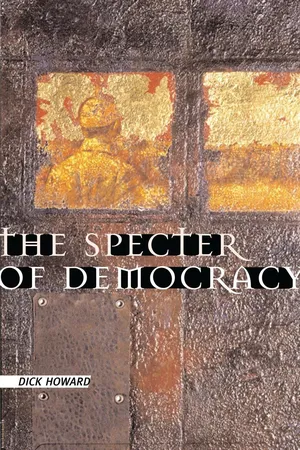
In this rethinking of Marxism and its blind spots, Dick Howard argues that the collapse of European communism in 1989 should not be identified with a victory for capitalism and makes possible a wholesale reevaluation of democratic politics in the U.S. and abroad. The author turns to the American and French Revolutions to uncover what was truly "revolutionary" about those events, arguing that two distinct styles of democratic life emerged, the implications of which were misinterpreted in light of the rise of communism.
Howard uses a critical rereading of Marx as a theorist of democracy to offer his audience a new way to think about this political ideal. He argues that it is democracy, rather than Marxism, that is radical and revolutionary, and that Marx could have seen this but did not. In Part I, Howard explores the attraction Marxism held for intellectuals, particularly French intellectuals, and he demonstrates how the critique of totalitarianism from a Marxist viewpoint allowed these intellectuals to see the radical nature of democracy. Part II examines two hundred years of democratic political life—comparing America's experience as a democracy to that of France. Part III offers a rethinking of Marx's contribution to democratic politics. Howard concludes that Marx was attempting a "philosophy by other means," and that paradoxically, just because he was such an astute philosopher, Marx was unable to see the radical political implications of his own analyses. The philosophically justified "revolution" turns out to be the basis of an anti-politics whose end was foreshadowed by the fall of European communism in 1989.
- English
- ePUB (mobile friendly)
- Available on iOS & Android
eBook - ePub
About this book
Information
Topic
PhilosophySubtopic
Modern HistoryPART I
Marxism and the Intellectuals
CHAPTER 1
Marxism in the Postcommunist World
If we could agree on what “Marxism” is—or was—then the task of evaluating its possible future in the post–cold war world would be relatively simple and noncontroversial. But there is no agreed definition of Marxism. There used to be something more or less official called Marxism-Leninism, and, as opposed to it, there was something called Western Marxism, which had its roots in the Hegelian and Weberian rereading of Marx that was initiated by Georg Lukács in History and Class Consciousness (1923), developed by the Frankfurt School’s program of critical theory, and thematized in Merleau-Ponty’s Adventures of the Dialectic (1955). There was also a related debate that peaked in the 1960s concerning the priority of the orientations of the young and the mature Marx, the humanist philosopher as opposed to the historical-materialist political economist. Although other distinctions and debates within the family could be introduced—for example, Austro-Marxism with its stress on the nationality question or Gramsci and his concern with culture and hegemony—it is best to begin from a simple dichotomy: on the one hand, there is the reading of Marx that can be generally put under the notion of historical materialism, and, on the other, there is a more philosophical and dialectical interpretation. Since 1989 the first form of Marxism has been rendered obsolete by the demise of Communism; it wagered on history, and it lost its bet. But where does this leave the other variant of Marxism? Can it, or must it be able to, provide the historical orientation that began as the strength but was ultimately the weakness of the deterministic model offered by historical materialism?
Philosophical-dialectical Marxism can be characterized by two interconnected methodological assumptions. The first is the notion of immanent critique. Many commentators have noted that nearly everything Marx wrote, at all periods of his life, was titled or subtitled “a critique.” For example, Marx discovered the revolutionary potential of the proletariat in his critique of Hegel’s Philosophy of Right. Later, Capital did not propose a theory of socialism—that misreading may have been a factor in the ill-advised practice of those who came to power claiming to introduce socialism by applying categories used in Marx’s critique of capitalism to build what they hoped would be a different future1—instead, Capital presents a critique of capitalist political economy whose radical implications were drawn by means of an immanent critique showing the rich potential created but not realized within that mode of production. This idea of immanent critique leads to the second methodological assumption. I just referred to capitalism as a “mode of production.” That, however, is the language of historical materialism. It would be more true to the philosophical-dialectical Marx to speak of forms of social relations. That is why Capital does not begin with an analysis of the process of production but with an analysis of the commodity form and its metamorphoses. I will return to Capital later. For the moment, I want to stress Marx’s method. Social relations are interpreted as the expression of practical relations among human beings. Although they don’t do it as they please, notes Marx in The 18th Brumaire, men do make their own history. The potential that the immanent critique uncovers is not of merely theoretical interest; it has practical applications and makes possible social change. This, rather than a politics of will or a voluntarism that ignores material constraints, is the implication of Marx’s demand, in the famous eleventh thesis on Feuerbach, that philosophers not restrict themselves to contemplating the world but seek instead to change it.
I propose to address the question of the place of Marxism in the postcommunist world in three steps. First, I consider some of the temptations that have arisen in the West, where many creative left-oriented thinkers have attempted to find alternative variants of Marxism, all of them more or less adopting the orientation developed by Western Marxism that I have called here philosophical-dialectical. I title this first section “Replacing Marxism … with Marxism” because all these attempts fail to develop the kind of practical-historical orientation that was at least attempted by the now discredited historical-materialist kind of Marxism. The extreme implications of this approach come with Adorno’s negative dialectics and Marcuse’s existential Great Refusal in One-Dimensional Man.2 Second, I propose a reconstruction of Marx’s work that takes into account the problems addressed by historical materialism. I call this section “Realizing Marxism … as Philosophy.” The Marx who emerges from this second step in the argument is a fascinating philosopher, but he remains a philosopher who, however self-critical, is unable to go beyond the mode of immanent critique to invest his philosophy in the historical world in which we live. Third, I attempt to sketch briefly a New Political Manifesto, suggesting that the “specter” haunting Marx’s Europe—and our own—was not the proletarian revolution that would finally put an end to a history of class struggle but the advent of democracy. If this intuition is plausible, it will suggest a way to reread Marx so that his contribution can be made fruitful in the contemporary world. The basic insight of the philosophical Marx was seen correctly by Lukács: Marx replaced the Hegelian idea of Spirit with the material proletariat understood as the subject-object of history—as a product of historical development that, because it is a subject and capable of autonomous action, can become the author of its own history. What I call the political, or democratic, Marx is neither so ambitious nor so Hegelian. To put it perhaps paradoxically, the political Marx seeks to maintain the conditions that make possible the immanent critique and practical engagement that characterized the philosophical Marx sketched in the second part of this discussion. Pace Leo Strauss, democracy is the condition of possibility of philosophy.
REPLACING MARXISM… WITH MARXISM
Marxism in the postcommunist world could be thought of as a theory happily rescued from the weight of a failed experiment. Many Western leftists found themselves caught in contortions, attempting to put the blame on Stalin—often less for Stalinism and its totalitarian domestic misdeeds than for its abandonment of world revolution in favor of creating Socialism in One Country. That approach made it possible to remain an anticapitalist, to accept something like the historical vision of The Communist Manifesto (and perhaps even the Economic and Philosophical Manuscripts of 1844) while jettisoning the baggage of the determinist breakdown theory attributed to Capital. Happy tomorrows could still be hoped for, while the exploitation of today could be condemned not for what it actually is but from a broader theoretical and historical perspective. It is, after all, quite satisfying to couch one’s criticism in an all-encompassing theoretical system. From this point of view, one can predict that since capitalism, its crises, its inequalities, its exploitation and alienation remain with us, Marxism in the postcommunist world—at least in the West, which had no experience of what was euphemistically called really existing socialism—may find itself on a far more solid terrain than was the case in the years following if not the invasion of Hungary in 1956 at least those following the invasion of Czechoslovakia in 1968 and the Brezhnev years of stagnation.
But the attempt to claim that the “essence” of Marxism was betrayed by its “appearing form” (to use the Hegelian language of Marx) does not explain why, 150 years after The Communist Manifesto, the revolution Marx was waiting for has not appeared. The essence of an essence is to appear, and if appearance betrays the essence, perhaps one has misunderstood the nature of that essence. It is no doubt true that the cold war was not so much won by capitalism as it was lost by the existing form of socialism.3 Meanwhile, capitalist crises recur, inequality increases glaringly, the third world remains marginalized. Capitalism has few grounds for satisfaction. And it is easy to find passages, chapters, articles, and books from Marx and Marxists to explain the miseries of the present. But what does that prove? If I appeal, for example, to “Wage Labor and Capital,” while you turn to the “Anti-Dühring” and someone else invokes Lenin’s “Imperialism,” while her friend prefers Hilferding’s “Finance Capital,” what has been gained? We have each adverted to holy text, but none of this explains the dynamics of the present. Each of our claims remains static, structural, and in the last resort antipolitical because it leaves no room for active intervention and no justification for action. At best, this kind of interpretation gives subjective satisfaction, encouraging the belief that one is on the right side of history, which, as Fidel Castro famously said at his 1953 trial after a failed revolt, eventually will absolve us and forgive our trespasses. Despite those who interpreted Marx as predicting a breakdown of capitalism (via the “law of the tendency of the rate of profit to fall” in volume 3 of Capital), Marx was concerned with the dynamics of capitalism as a new type of social relations. For The Communist Manifesto, all history, after all, is a history of class struggle.
Still, there will be those who will hold on to their Marx. The first among them will be (or will remain) the Trotskyists.4 Despite the greatness of Trotsky’s phenomenology of the Russian Revolution, he remained a structural dogmatist.5 In a memorable phrase, he asserted that when the artillery man misses his target, he doesn’t blame the laws of physics. But is Marxism a theory like those of the natural sciences? Was the basically good and justifiable revolution of 1917 deformed, isolated, and forced into a Stalinist Thermidor? Doesn’t Trotsky violate his own Marxist dogma when he blames the person of Stalin for the debacle of Soviet Marxism? Nonetheless, there is something comforting in the Trotskyist position, which will continue to find adherents after 1989 because it unites the reassuring claims of a structural account of capitalism with a criticism of the supposed Stalinist deformation of the promise of 1917.
The problem with attempts to save Marxism from the demise of “really existing socialism” is that they cannot reply to the objection from Karl Popper: that it is nonfalsifiable. It remains as a horizon, a framework or narrative that can internalize contradictions as simply stages in a presumably necessary historical development. This is the case even of Rosa Luxemburg, the spontaneist, who insisted that “only the working class can make the word flesh.” This most militant of activists was content to have refuted Eduard Bernstein when she showed that his reformist socialism contradicted the text of Marx. Rosa Luxemburg, the theorist of the Mass Strike, whose final article from the ruins of a failed revolution affirmed that “revolution is the only kind of war in which the final victory can be built only on a series of defeats,” could be perhaps even more than Trotsky the model of a post-1989 Marxist. Defeat in the class struggle was for her only a stage in the learning process that would necessarily lead to the final goal. How can she be proven wrong?6
The criticism of nonfalsifiability leads to another critique of Marxism, represented in the West by the often impressive textual accounts of Robert Tucker and many others: that it is a new religion. In the hands of a critical historian such as Jacob Talmon, this becomes the reproach that Marx belongs to a long millenarian tradition. At its best, this becomes a positive philosophical claim in Ernst Bloch’s Prinzip Hoffnung, a kind of wager that humanity cannot but constantly seek reconciliation with itself and with nature. It is not always clear what is Marxist in this honest and admirable utopian position. Marx, after all, claimed not to be a utopian (and his historical-materialist heirs took him literally). In the remarkable, and often neglected, third part of The Communist Manifesto, Marx tried to reconstruct the history of socialist utopias to show how they were logically and historically aufgehoben, united and made whole in his own position. If it is to be more than a pious wish, this kind of religious-utopian position—which, as such, will certainly remain present after 1989—has to show how the utopias that have come and gone over the 150 years since the Manifesto are part of a historical logic of the type that Marx presented in 1848. In this way, it would avoid the nonfalsifiability of the Luxemburgian “defeat as the basis of victory.” But then it becomes open to the reproach of being a totalizing historical metaphysics similar to the Young Hegelian theories whose overcoming—in The Holy Family and The German Ideology of 1845/6—led Marx to formulate his “science.”
In this case, however, the renewed Marxism has to refute the objections of Habermas: that it is economist and determinist in its orientation and neglects the other domains of human social interaction. Habermas’s Knowledge and Human Interests (1968) showed clearly that the materialist philosophy of history that expects social (and human) transformation to follow directly from the material-technical advances of capitalism is one-sided. It is guided by a type of cognitive interest that stresses technological progress and necessarily neglects the spheres of social interaction and human self-liberation. Habermas’s Theory of Communicative Action (1981) takes his argument beyond the model of the individual social actor to integrate the linguistic turn that points to the primacy of dialogical relations in the development of social rationality. But the upshot of Habermas’s theory is that the Marxian project is simply the completion of the project of the Enlightenment. Thus, for example, his first attempt to deal with soviet-type societies, in the wake of 1989, was entitled The Catch-up Revolution.7 Perhaps this saves the Marxist baby, but it subsumes it under a historical or idealist project that Marx explicitly claimed to overcome.
Marx’s advance over Enlightenment theories was his insistence on class struggle and his recognition (e.g., in his critique of Proudhon in The Poverty of Philosophy [1847]) that history advances through contradictions and by means of negations. Marx’s theory of the revolutionary proletariat was certainly the key to this theoretical insight. But today it is hard to recognize Marx’s proletariat in our new world order. The polarization of two classes has not occurred (and Marx seemed to have recognized this in the incomplete chapter “Classes” that concludes the third volume of Capital). Even before 1989 many in the West sought to reconstitute the proletariat by other means. In France, Serge Mallet and André Gorz talked about a “new working class,” while Italian theorists sought to reconstitute the “total worker” to whom the third volume of Capital refers somewhat vaguely. In the United States, attempts were made first to rediscover a “history of class struggle” that had been supposedly suppressed by the reigning ideological consensus among historians and social scientists. The idea was that if one could show that there had been constant struggles of workers against bosses, perhaps a defeated working class would gain self-confidence and undertake new struggles. Other Americans sought to broaden the notion of the proletariat, including in it blacks, minorities, women, homosexuals. When it became unclear how these strata (or status groups) could ally with one another, the turn to cultural studies was made: a cultural unity would replace the working class as the new proletariat.8 Somewhere, somehow, there needed to be an opposition, a negation to negate the negation. Alas, it remains to be discovered.
There are no doubt other strategies that could be invoked in the attempt to redeem Marxism by a better Marxism. So-called analytic philosophers have attempted to justify one or another aspect of the Marxian corpus, while the deconstructionists take a leaf from Jacques Derrida’s rehabilitation of the (hard to recognize) “specter” of Marx. Others continue to hope that the struggle against globalization will produce the new agent of revolution. What is lacking in all these approaches is serious consideration of the philosophical theory by which Marx was led to his practical insights. It is this philosophical project that permitted him to make the empirical and analytical discoveries that lost their critical thrust as they came to be part of the Marxist vulgate. Separated from the philosophical endeavor, these insights lose their immanent dynamic as well as their utopian horizon; they are reduced to mere criticism or to naive utopianism. The proletariat becomes merely labor-power, exploited by capitalists as the source of surplus-value; the philosophical critique becomes a positive statement to be studied for its own sake. Yet the philosophical Marx saw that this proletariat had achieved a certain measure of freedom (compared with the serf, for example); this liberty, however, is alienated and can become aware of itself only as economically exploited. If only the second part of this claim is stressed, the immanent historical dynamic of Marx’s theory is replaced by static complaints of victimization, and the practical result is self-righteous commiseration. In the end, this leads to the replacement of autonomous praxis by the conscious intervention of the political party, completing the cycle that began with the rejection of Leninism by Western Marxism. To avoid this (unhappy) conclusion, Marx’s philosophical project needs to be rethought.
REALIZING MARXISM … AS PHILOSOPHY
If Western Marxism seems to find itself driven to adopt political conclusions that clash with its original intentions, a consideration of Marx’s own attempt to overcome the immanent limits of philosophy reveals a similar paradox. Marx was essentially a philosopher; this was his strength but also explains his political weakness. His entire work can be seen as the attempt to realize the task proposed in a note to his doctoral dissertation, which his editors have titled “The Becoming Philosophical of the World as the Becoming Worldly of Philosophy.”9 Put simply—as it was for Marx at this point—the idea is that Hegel had elaborated a rational system that explained that the actual is rational and the rational is actual (as Hegel put it in the introduction to his Philosophy of Right) but that the actual German world of Marx’s time was miserable, chaotic, and impoverished. It was necessary to show two things: that philosophy had to occupy itself with the world in order to realize itself (to actualize itself, in Hegelian language) and that the world had to become philosophical, that is, rational, if this realization of philosophy were to occur. We can reconstruct briefly the steps in Marx’s evolution in terms of this two-sided problem (whose two sides, philosophy and the world, themselves turned out to be dual by the time of Marx’s “solution” to his dilemma in the economic critique in the Grundrisse).
There is first the critique of Bruno Bauer’s proposed solution to the “Jewish question.” Mere political emancipation does not suffice because, as seen in the contrast between the French and American Declarations of Rights and their reality, these rights become defenses of what has come since to be called possessive individualism. The reason for this inadequacy is that the societies that proclaimed these universal rights were still burdened by the legacy of feudalism; hence the universal rights in fact universalized a society based on inequality.10 There needed to be a change in the social relations in civil society. As a result, Marx’s “Introduction to a Critique of Hegel’s Philosophy of Right,” after sho...
Table of contents
- Cover
- Half title
- Series Page
- Title
- Copyright
- Contents
- Introduction: Why Should We, and How Should We, Reclaim Marx?
- Part 1. Marxism and the Intellectuals
- Part 2. Republican Democracy or Democratic Republics
- Part 3. Back to Marx?
- Notes
- Index
Trusted by 375,005 students
Access to over 1.5 million titles for a fair monthly price.
Study more efficiently using our study tools.
Frequently asked questions
Yes, you can cancel anytime from the Subscription tab in your account settings on the Perlego website. Your subscription will stay active until the end of your current billing period. Learn how to cancel your subscription
No, books cannot be downloaded as external files, such as PDFs, for use outside of Perlego. However, you can download books within the Perlego app for offline reading on mobile or tablet. Learn how to download books offline
Perlego offers two plans: Essential and Complete
- Essential is ideal for learners and professionals who enjoy exploring a wide range of subjects. Access the Essential Library with 800,000+ trusted titles and best-sellers across business, personal growth, and the humanities. Includes unlimited reading time and Standard Read Aloud voice.
- Complete: Perfect for advanced learners and researchers needing full, unrestricted access. Unlock 1.5M+ books across hundreds of subjects, including academic and specialized titles. The Complete Plan also includes advanced features like Premium Read Aloud and Research Assistant.
We are an online textbook subscription service, where you can get access to an entire online library for less than the price of a single book per month. With over 1.5 million books across 990+ topics, we’ve got you covered! Learn about our mission
Look out for the read-aloud symbol on your next book to see if you can listen to it. The read-aloud tool reads text aloud for you, highlighting the text as it is being read. You can pause it, speed it up and slow it down. Learn more about Read Aloud
Yes! You can use the Perlego app on both iOS and Android devices to read anytime, anywhere — even offline. Perfect for commutes or when you’re on the go.
Please note we cannot support devices running on iOS 13 and Android 7 or earlier. Learn more about using the app
Please note we cannot support devices running on iOS 13 and Android 7 or earlier. Learn more about using the app
Yes, you can access The Specter of Democracy by Dick Howard in PDF and/or ePUB format, as well as other popular books in Philosophy & Modern History. We have over 1.5 million books available in our catalogue for you to explore.