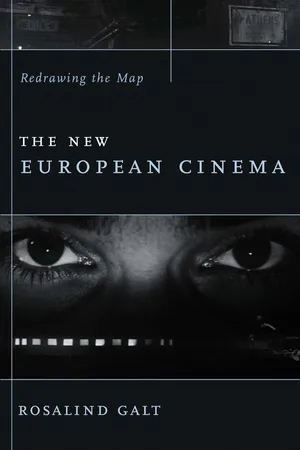
New European Cinema offers a compelling response to the changing cultural shapes of Europe, charting political, aesthetic, and historical developments through innovative readings of some of the most popular and influential European films of the 1990s. Made around the time of the revolutions of 1989 but set in post-World War II Europe, these films grapple with the reunification of Germany, the disintegration of the Balkans, and a growing sense of historical loss and disenchantment felt across the continent. They represent a period in which national borders became blurred and the events of the mid-twentieth-century began to be reinterpreted from a multinational European perspective.
Featuring in-depth case studies of films from Italy, Germany, eastern Europe, and Scandinavia, Rosalind Galt reassesses the role that nostalgia, melodrama, and spectacle play in staging history. She analyzes Giuseppe Tornatore's Cinema Paradiso, Michael Radford's Il Postino, Gabriele Salvatores's Mediterraneo, Emir Kusturica's Underground, and Lars von Trier's Zentropa, and contrasts them with films of the immediate postwar era, including the neorealist films of Roberto Rossellini and Vittorio De Sica, socialist realist cinema in Yugoslavia, Billy Wilder's A Foreign Affair, and Carol Reed's The Third Man. Going beyond the conventional focus on national cinemas and heritage, Galt's transnational approach provides an account of how post-Berlin Wall European cinema inventively rethought the identities, ideologies, image, and popular memory of the continent. By connecting these films to political and philosophical debates on the future of Europe, as well as to contemporary critical and cultural theories, Galt redraws the map of European cinema.
- English
- ePUB (mobile friendly)
- Available on iOS & Android
eBook - ePub
About this book
Information
Subtopic
Film & Video1 Mapping European Cinema in the 1990s
In the early 1990s, Europe became, as if it had not been so before, a question of space. The fall of the Berlin Wall in 1989, the breakup of the Soviet Union, the break-down of Yugoslavia, and the unification of Germany produced radical upheavals in every aspect of European life, but most urgently, they made a collective demand on an idea of Europe as a psychic, cultural, or geopolitical location. For the first time since the end of World War II, the borders of Europe were disconcertingly unstable. Through the 1990s, this traumatic overturning of spatial categories was augmented with a more gradual, although by no means painless, redefinition: the expansion of the European Union to include members and potential members as far apart as Finland, Bulgaria, and Turkey. It is clear that as the physical and political territory of Europe altered in the post–Cold War years, so, too, did its cultural imaginary. What is less clear is how we can read these changes cinematically: how European cinema represented revisions of European space narratively, formally, and stylistically, and, indeed, how the terrain of “European cinema” itself was acted on by the forces that were reshaping the continent.
Rethinking Post-Wall Europe
This question of Europe has grown in stature over the years since 1989, in cinema studies no less than in political philosophy. While Jacques Derrida’s 1991 essay The Other Heading inaugurated an important philosophical discourse on the “new Europe,” the British Film Institute’s 1990 conference “Screening Europe” had already asserted a comparable inquiry into the new European cinema and where it might be heading. For the conference participants, as for Derrida, the possibility of European identity formed a central, and often troubling, problematic. Filmmaker Chantal Akerman claimed that there is no such thing as a European film, while critic John Caughie described the difficult process of becoming European.1 Derrida pinpoints the difficult nature of this identity: the half-constructed European subject is caught between the devil of nationalistic dispersion and the deep blue sea of Eurocrat homogenization. Thus, “the injunction seems double and contradictory for whoever is concerned about European cultural identity: if it is necessary to make sure that a centralizing hegemony (the capital) not be reconstituted, it is also necessary, for all that, not to multiply the borders, i.e. the movements and margins…. Responsibility seems to consist today in renouncing neither of these two contradictory imperatives.”2 For an ethics of Europe, Derrida argues, this bind demands an impossible duty in which the European subject must respond, simultaneously, to two contradictory laws. European cinema, it seems, experiences a similar structural dilemma: how to become European—as opposed to simply continuing an older model of national cinemas—without degenerating into the filmic correlative of Brussels bureaucracy, the Europudding.
As film historian Mark Betz has noted, this debate obscures at least as much about European cinema as it illuminates. Films made in Europe have frequently been coproduced by two or more countries at least since World War II, and the idea of “pure” national film cultures is a myth.3 According to this historical revision, “Italian” or “French” art films are always already European, and the anxieties of the cultural moment immediately after the fall of the Berlin Wall (post-Wall) miss the point or, at the very least, beg the question. Betz points to a telling moment in the British Film Institute (BFI) conference, where a question from the audience about coproduction went unanswered by the panelists, who were unable or unwilling to consider European-ness as part of a mode of production. However, although Betz is quite correct that this unanswered question is symptomatic of an inability to think about European identity, the nature of this missed point is also significant—and has consequences both for European film production in the 1990s and, more to my point, for the developing model of its critical response.
For although we cannot directly map a political anxiety about national versus supranational sovereignty onto the film community’s unease around international coproduction, we can make out a discursive commonality in both cultural and political mobilizations of “Europe” in the post-Wall years. Once again, Derrida establishes the terms of the debate, when he calls for a Europe that refuses self-identity and engages rigorously with what he terms “the heading of the Other.” This ethics of the Other combines the contemporary philosophical elaboration of Emmanuel Levinas with a reading of Europe as a spatial and temporal figure (the “heading”). Clearly, this is a reading of some subtlety, but, given the level of ideological struggle over the terms and conditions of the new Europe, it is perhaps not surprising that public discourse on European identity tended to take up the question in exactly the binary forms of Europe/Other that The Other Heading problematizes. Thus, while conservatives made national sovereignty, immigration, and ethnic minorities into social problems, film cultures evolved an opposing liberal concern with regionalism, minority representation, and transnationalism.4
I do not want to condemn this shift, either as a series of cinematic practices or as a critical paradigm. The manifold concerns of, say, diasporic Turkish filmmakers, beur film, and European film studies cannot be reduced to one ideological imperative, and insofar as we can identify common ground, this is a terrain that has been highly productive, both creatively and theoretically.5 However, it seems to me that to focus on films that narrate the “Other” of Europe so directly, that articulate an anti-Eurocentric hybridity so transparently, is ultimately a self-exhausting critical endeavor. Derrida asks:
Is there then a completely new “today” of Europe beyond all the exhausted programs of Eurocentrism and anti-Eurocentrism, these exhausting and yet unforgettable programs? (We cannot and must not forget them since they do not forget us.) Am I taking advantage of the “we” when I begin saying that, in knowing them now by heart, and to the point of exhaustion—since these unforgettable programs are exhausting and exhausted—we today no longer want either Eurocentrism or anti-Eurocentrism?6
I, too, would like to take advantage of the “we.” If we are to take seriously the post-Wall European subject’s impossible responsibility, we cannot stop with a comfortably liberal celebration of the Other. To adapt Paul Gilroy’s notion of anti-anti-essentialism, any theoretical revision of European cinema needs to articulate an anti-anti-Eurocentrism.7
Such a position has recently been explored outside the field of film studies. Always good for a provocative line, Slavoj Žižek poses the question thus: “When one says Eurocentrism, every self-respecting post-modern leftist intellectual has as violent a reaction as Joseph Goebbels had to culture—to reach for a gun, hurling accusations of protofascist Eurocentric cultural imperialism. However, is it possible to imagine a leftist appropriation of the European political legacy?” Žižek begins to answer his own question (albeit in the form of another question) when, in a different article, he asks, “How are we to reinvent political space in today’s conditions of globalization?”8 What is crucial in this second formulation is that Žižek, like Derrida, stages the question of Europe as simultaneously a matter of space and of time. The time is punctual: Europe is a topic of today. Žižek is no less concerned than Derrida with today’s conditions, but he speaks from a different location, quite literally. The European political legacy is conjured here not from Europe’s headland, the cape, or capital inhabited by French philosophy but from the rapidly changing space of southeastern Europe: the recently and painfully redrawn map of the Balkans.
Why should we care from where each writer writes? Their locations matter not because their nationalities are intellectually determining but because anti-anti-Eurocentric thought intervenes in the relationship between material and discursive spaces. For Derrida, this means the wide-ranging social effects of the heading: the logic by which Europe imagines itself as a spatial and temporal advance-guard for the world. For Žižek, it demands a rethinking of political space, the space of politics, in the temporally constituted terrain of “the former Yugoslavia.” We could point, also, to Etienne Balibar’s work on European identity, which analyzes the meaning and constitutive power of borders.9 Like the heading, the border is a spatial trope that is rhetorical but not merely metaphoric. In centering his discussions of European racism and transnational identity in the figure of the border, Balibar illustrates the theoretical desire to articulate material borders—politically defining spaces—with and through the idea of Europe, its discursive imaginary.
Like this work in political philosophy, I would suggest, film studies needs to form the question of Europe as a matter of space and of time. An anti-anti-Eurocentric consideration of contemporary European cinema must not speak only of coproduction, of European Union funding, and of national heritage; neither must it speak only of the diasporic, the hybrid, and the radical. Rather, it must take on the logic of cartography: a form of writing that articulates both the discursive and the referential spaces of nations (recall that both Borges and Balibar imagine the mapped border as performative, a slippery relationship of image and referent). Cartography encompasses writing and drawing, politics and aesthetics, the political and the physical; it binds spectacle to narrative, graphic space to geopolitical space. And post-Wall European cinema, I will argue, mobilizes exactly this enunciative structure. It maps the spaces of Europe “today,” speaking both of and from the changing spaces of the continent. Most important, it does so as a textual work, coarticulating cinematic space and geopolitical space.
The production of cinematic space has been a recurrent area of film theoretical inquiry, where space is always, to some degree, understood in a relationship to time, temporality, or history.10 The nature of the (temporo-spatial) relationship between profilmic space and cinematic space plays a fundamental role in theories of cinematic specificity. As such, space is a determining element of the cinematic per se. This question has of late returned to theoretical prominence—and not coincidentally. In an article on theorists of cinematic specificity, Thomas Elsaesser—another European theorist who elsewhere has been explicitly concerned with questions of Europe—glosses Siegfried Kracauer thus:
In the often tortuous dialectic between photography and history which Kracauer was at pains to tease out all through his life, the cinema is given a redefinition which, it seems to me, is neither strictly ontological nor epistemological, and yet allocates it a place in a fundamental development of the Western mind: the systematic translation of the experience of time into spatial categories, as a necessary precondition for an instrumental control over reality, but with its equally necessary corollary, namely a narcissistic or melancholy bind of the subject to that reality as image, itself envisaged in the psychologically coherent but ideologically ambivalent form of loss and nostalgia, fragment and fetish.11
This is an astonishingly rich passage, reading cinematic space both through Kracauer’s ontological insistence on the essential qualities of the cinematic image and, at a slightly greater remove, through his Marxism. By extension, Elsaesser implies, we must conceive the historicity of the cinematic image at once in terms of the temporality of the subject and in terms of a dialectical understanding of historical process.
Here, Elsaesser (and, indeed, Kracauer) speaks of history as such, the category of temporality that is overcome, or at least tamed, by its translation into images, into film, into space. But, of course, Elsaesser is also historicizing both Kracauer and this ideological work of cinema in the context of the “real” histories of the twentieth century. The desire for an “instrumental control over reality” leads inevitably to theories of fascism and to the particular uses of geopolitical space, and of the cinematographic image, in twentieth-century Europe. We cannot separate these theoretical discourses on cinematic space and time from the histories and places that have underwritten them; this is no less true for the history of the post-Wall continent than it is for the traumas of mid-century. As the borders of Cold War Europe crumbled, so, too, did dominant narratives of postwar history and, to some extent, the theoretical apparatuses with which history could be thought. It is for this reason, perhaps, that Elsaesser’s contemporary rereading of Kracauer seems to resonate so deeply. For in the European cinema of the 1990s, the cinematic image becomes readable precisely as a troubling of space and time. Certain European films, I will demonstrate, textualize this uncomfortable encounter, and they do so exactly as Elsaesser’s contemporary reading of the cinematic suggests: through a mobilization of the historical image that is inflected with those fin de siècle themes of “loss and nostalgia, fragment and fetish.”
Where, then, does one start in the drawing of maps? It is tempting to essay the bird’s-eye view, the imperial sweep of the world map, with which we can locate European cinema in its proper relation to international currents. To be sure, post-Wall cinema can be viewed as a part of postclassical or even postmodern cinema: it must operate in the eddying currents of global film markets, the development of new distribution and exhibition structures, and the festival-fueled circuits of international art cinema. We can chart material relationships among European art cinemas, Hollywood blockbusters, and the East Asian New Waves, or we can draw theoretical connections around the uses of spectacle, genre, or affect in these contemporary forms. For better or worse, we must do these things. “European cinema,” as a cultural discourse, cannot signify without reference to at least one Other, and if Hollywood has been the dominating Other throughout most of the history of European film production and criticism, it is now necessary to consider a global dimension.
Many European films circulate in a global art film market, in which European-ness asserts specific (although not constant) levels of both cultural and economic capital. European films code internationally as both “not-American” and, in many markets, “not-Asian,” “not-Latin American,” and “not-Middle Eastern.” In addition to these external references, films—even coproductions—function within an internal European hierarchy, where French, British, and Italian mean quite different things to audiences than do, say, Czech, Swedish, and Portuguese. These encrustations of cultural meaning are by no means new (although the range of foreign films available in many markets is), but they are mutable, and like any other historical period, the postclassical era can be characterized by specific forms. In the 1980s and 1990s, this environment produced new kinds of production (television funding, increased coproduction, main-stream/art house crossover films) and new areas of critical interest (heritage culture, postcolonial and minority representations, transnationality). However, while we must keep in mind these large-scale charts of contemporary world or European cinemas, I am not convinced that we approach the question of cartography best by means of such a map. Rather than chart the shapes of European cinema exhaustively from above, it might be more in the spirit of mapping to trace some of its disputed borders: that is, to consider the debates in and around which an analysis of European films can be located.
Whither Heritage?
Particularly prevalent in western Europe, the heritage film is a critically and industrially contentious notion that gets to the heart of contemporary discourses on European culture, identity, and film production policy.12 Like many such critically invented terms, the heritage film is not an easily definable category. In general terms, however, we can say that such films use high production values to fill a mise-en-scène with period detail, representing their national pasts through sumptuous costume, landscape, and adaptations of well-known literary novels. Generally costume dramas (the name is telling) rather than history films per se, and mostly dealing with romanticizable eras such as the nineteenth and early twentieth centuries, these films are m...
Table of contents
- Cover
- Half title
- Series List
- Title
- Copyright
- Contents
- Acknowledgments
- 1. Mapping European Cinema in the 1990s
- 2. The Dialectic of Landscape in Italian Popular Melodrama
- 3. A Conspiracy of Cartographers?
- 4. Yugoslavia’s Impossible Spaces
- 5. Back-Projecting Germany
- 6. Toward a Theory of European Space
- Notes
- Bibliography
- Filmography
- Index
Trusted by 375,005 students
Access to over 1.5 million titles for a fair monthly price.
Study more efficiently using our study tools.
Frequently asked questions
Yes, you can cancel anytime from the Subscription tab in your account settings on the Perlego website. Your subscription will stay active until the end of your current billing period. Learn how to cancel your subscription
No, books cannot be downloaded as external files, such as PDFs, for use outside of Perlego. However, you can download books within the Perlego app for offline reading on mobile or tablet. Learn how to download books offline
Perlego offers two plans: Essential and Complete
- Essential is ideal for learners and professionals who enjoy exploring a wide range of subjects. Access the Essential Library with 800,000+ trusted titles and best-sellers across business, personal growth, and the humanities. Includes unlimited reading time and Standard Read Aloud voice.
- Complete: Perfect for advanced learners and researchers needing full, unrestricted access. Unlock 1.5M+ books across hundreds of subjects, including academic and specialized titles. The Complete Plan also includes advanced features like Premium Read Aloud and Research Assistant.
We are an online textbook subscription service, where you can get access to an entire online library for less than the price of a single book per month. With over 1.5 million books across 990+ topics, we’ve got you covered! Learn about our mission
Look out for the read-aloud symbol on your next book to see if you can listen to it. The read-aloud tool reads text aloud for you, highlighting the text as it is being read. You can pause it, speed it up and slow it down. Learn more about Read Aloud
Yes! You can use the Perlego app on both iOS and Android devices to read anytime, anywhere — even offline. Perfect for commutes or when you’re on the go.
Please note we cannot support devices running on iOS 13 and Android 7 or earlier. Learn more about using the app
Please note we cannot support devices running on iOS 13 and Android 7 or earlier. Learn more about using the app
Yes, you can access The New European Cinema by Rosalind Galt in PDF and/or ePUB format, as well as other popular books in Media & Performing Arts & Film & Video. We have over 1.5 million books available in our catalogue for you to explore.