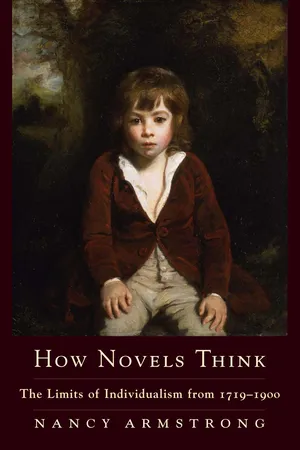
Nancy Armstrong argues that the history of the novel and the history of the modern individual are, quite literally, one and the same. She suggests that certain works of fiction created a subject, one displaying wit, will, or energy capable of shifting the social order to grant the exceptional person a place commensurate with his or her individual worth. Once the novel had created this figure, readers understood themselves in terms of a narrative that produced a self-governing subject.
In the decades following the revolutions in British North America and France, the major novelists distinguished themselves as authors by questioning the fantasy of a self-made individual. To show how novels by Defoe, Austen, Scott, Brontë, Dickens, Eliot, Hardy, Haggard, and Stoker participated in the process of making, updating, and perpetuating the figure of the individual, Armstrong puts them in dialogue with the writings of Locke, Hume, Rousseau, Malthus, Darwin, Kant, and Freud. Such theorists as Althusser, Balibar, Foucault, and Deleuze help her make the point that the individual was not one but several different figures. The delineation and potential of the modern subject depended as much upon what it had to incorporate as what alternatives it had to keep at bay to address the conflicts raging in and around the British novel.
- English
- ePUB (mobile friendly)
- Available on iOS & Android
eBook - ePub
About this book
Information
Subtopic
19th Century HistoryIndex
Literature1
HOW THE MISFIT BECAME A MORAL PROTAGONIST
Contrary to prevailing critical opinion, modern secular morality did not draw the extraordinary power it exercises to this day from any institutional religion, the Bible, or even a general sense of Judeo-Christian ethics. Its power, I believe, comes from and authorizes those works of fiction where morality appears to emanate from the very core of an individual, as that individual confronts and opposes socially inculcated systems of value. From this perspective, what I call bourgeois morality cannot be considered a value in and of itself so much as a way of reading, assessing, and revising both the prevailing categories of identity and whatever cultural apparatus may authorize them.1 Often suspicious of pleasure, unconcerned with profit, and heedless of life’s little necessities, this peculiarly modern form of morality appears to be nothing more nor less than the assertion of individuality itself, the objects one desires, and the means by which one pursues them. In opposing the values sustaining a blood-based hierarchy, bourgeois morality lends value to qualities within an individual that entitle him or her to a social position more gratifying than any station in life defined by wealth or rank alone. Indeed, we might see bourgeois morality as a rhetorical device that exists for the purpose of convincing us that such an alternative source of value is already there in the individual, waiting to be recognized by modern authors and readers. For it to be missing in some, the moral sense has to be present in most. This was not always true.2
To work with this notion of the term “morality,” however, I want to push it two steps further. For one thing, I see the novel’s apparent discovery of a source of value already there within an individual as a means of adding something distinctively modern to the very notion of the individual. Contemporary critical theory uses the figure of the supplement to describe an additive so different from and culturally so incompatible with its host category that it cannot be incorporated without a thoroughgoing reorganization of that category.3 No matter how many features the entity so supplemented seems to share with its earlier form and rhetorical behavior, the supplement in this aggressive sense changes the character to which it has been added into something with new and different properties and potentialities. I believe that it took this “something” in the form of a rhetorical additive to convince a readership that ordinary individuals were capable of acting and, if capable of acting, then also capable of refusing to act on desires independent of their social position, desires that presumably came strictly from within the individual. This chapter shows how the misfit incorporated the rhetorical power of the supplement to transform the British subject from a state of being, or position, into a process of becoming, or performance, whereby that subject could achieve a place commensurate to its desires and abilities.
While we cannot regard this additive as “material” in any conventional sense of the term, I nevertheless insist that bourgeois morality inflects the material wealth of a modern nation and its ruling elite just as powerfully as the elements of birth and rank gave meaning to the wealth of an earlier agrarian economy and aristocratic culture. This is precisely its point. Bourgeois morality sets itself up in opposition to the shallow devotion to objects and concern for surfaces that it invariably attributes, however indirectly, to an earlier and less deserving ruling class. What we now call materialism in the loose sense of the term—concern for property, the things of this world (especially things that can be bought), and the health of the body and its biological reproduction—consequently becomes the yardstick for bourgeois morality. In pursuing these universally desirable objects, an individual is either mindful or heedless of the common good. Provided they are not acquired at another’s expense (which would fly in the face of modern morality), these goods serve as the reward for that individual’s self-restraint and even self-sacrifice and as such become signs of his or her morality.4 Though not with anything approaching the consistency of novels, other kinds of writing—including travel writing, treatises on taste and moral philosophy, essays on morals and manners at home and around the world, anything dealing with self-improvement, indeed, anything dealing with improvement—used this additive to think about the individual’s relation to the given social order. Our own reading habits are the result.
THE BAD SUBJECT
The assumption that the modern subject is the product rather than the source of fiction is of course a version of the signature move of all the major strains of poststructuralism. What Louis Althusser calls the “ideological state apparatus,” for example, performs a similar reversal of individual identity and linguistic attribution. According to his account, the early modern church gave the individual freedom only to submit to external forms of authority, authority as different from that individual as day is from night. By contrast, the educational institutions of the modern secular state stress the freedom of subjectivity and conceptualize the individual, in the words of Althusser, as “a centre of initiatives author of and responsible for its actions.” For Althusser, a modern society depends for coherence on the education of individuals to locate them within sociocultural categories and to induce them to observe—without threat of force—the constraints defining their respective positions. Thus the modern state creates a contradiction within the subject between the ideology of free subjectivity and the fact of social subjection. No ideological apparatus is ever foolproof, and this mechanism of “hailing,” or “interpellation,” however expertly and repetitively performed, occasionally fails. What Althusser calls “bad subjects” are individuals who take the ideology of free subjectivity too much to heart and do not freely consent to their subjection. Bad subjects, he explains, on occasion provoke the intervention of the army or police.5
Between the subject who freely accepts his or her subjection and the criminal or heretic, the novel introduced a whole world of possibilities without which, I believe, a modern secular state ruled chiefly by ideology could not have emerged when and how it did. The shift from a culture dominated by the church, which also maintained itself by physical force, to a culture that relies primarily on ideology to keep people in place required no less than a political revolution in many countries. Curiously enough, although many people anticipated a revolution in Great Britain during the turbulent period between 1776 and 1848, it was not one of the countries to undergo a radical change in political government.6 Yet Britain eventually became the very example of the modern nation-state. Thus the emergence of a modern nation during the late eighteenth century raises an important question. When he characterizes modern states as states that displace violence with ideology as the means of controlling a population, Althusser does not address how, short of political revolution, ideology might have usurped the power formerly exercised by the military and the police to govern a population during turbulent times. Another essay by Althusser sets us on the path to an answer.
In examining exactly how early modern European culture rethought government in Enlightenment terms, Althusser focuses on how the social contract produces a logical contradiction within the old notion of the subject and then proceeds to conceal that contradiction behind a narrative of individual development.7 Such duplicity was not Rousseau’s aim, as Althusser reads it, so much as a by-product of the materials with which he worked. To imagine a state that did not put free subjectivity at odds with political subjection, a state in which free subjectivity and political subjection were indeed one and the same, Rousseau rejects an early modern solution and tries to imagine a purely secular government authorized by something more than its subjects’ consent to be governed. The individual can preserve his freedom, in Rousseau’s view, only if that individual consents to be governed by no one other than himself. To perform this grand equivocation, Rousseau comes up with a political body to which the individual’s subjection is not subjection so much as the guarantee of his freedom, because that political body forms only as the individual himself acquires the very authority to which he submits.8
For Althusser, this is the point in Rousseau’s argument where the author abandons the logic of contractual exchange and resorts to figuration in order to rethink the two parties to that exchange.9 To convert the early modern state into an aggregate of freely consenting individuals, he has to conceptualize an entirely new kind of individual, one endowed with the natural ability to understand the advantages of becoming a citizen. This new man gives Rousseau a fresh starting point from which to rethink the state as a political elite composed of individuals much like himself. But where does this social additive come from? What can the conceptual architects of the modern state use as their foundational category? It is in answer to these questions that Althusser’s notion of the bad subject, an individual who simply does not fit any available social category, suddenly becomes extremely important. The modern individual is not only a novelistic rendering of Rousseau’s new man, by nature inclined to self-government, but also the embodiment of Althusser’s bad subject, by nature incapable of being “hailed.”
By the 1740s, men of English letters were roundly dismissing Rousseau’s social contract as politically improbable, but that did not prevent them from thinking in contractual terms.10 In his essay “Of the Original Contract,” for example, David Hume points out the near-complete lack of historical evidence that any such promise provided the inaugural moment and foundation for government. There are, in his estimation, only two sources for the idea that men feel obligated to serve the general good and so submit voluntarily to government. “The first,” as he explains, “are those to which men are impelled by a natural instinct…, independent of all ideas of obligation, and of all views, either to public or private utility.” These obligations include “love of children, gratitude to benefactors, pity to the unfortunate” and occur before any reflection on the general good, which nevertheless results when one responds to these natural instincts. But Hume is more interested in a second kind of moral duty that is “not supported by any original instinct.”11 “If the reason be asked of that obedience, which we are bound to pay to government,” Hume would “readily” supply this answer: because without such predisposition to obedience, “society could not otherwise exist” (italics his). He concludes his essay with what initially looks like a dismissal of the social contract on grounds that it is more fiction than historical truth: “The only passage I meet with in antiquity, where the obligation of obedience to government is ascribed to a promise, is in PLATO’s Crito, where SOCRATES refuses to escape from prison, because he had tacitly promised to obey the laws” (201). In explaining, however, why men nevertheless obey the state even when there is no threat of force or monarch to disobey at risk of treason, Hume reveals his debt to the very logic he seems intent on dismissing. People, he claims, are perfectly aware of the fact that they “could not live at all in society, at least in a civilized society, without laws and magistrates and judges, to prevent the encroachments of the strong upon the weak, of the violent upon the just and equitable” (197).12 While he dismisses Rousseau’s claim for the natural origin of the contract, then, Hume accepts as common sense the principle that one has to limit one’s desires in order to live within a peaceable community.
CONTRACTUAL MORALITY
If Daniel Defoe can be called the first novelist and exponent of possessive individualism, it is primarily because his Robinson Crusoe identified individualism with the expression of certain qualities of mind, qualities worthy of written expression. I will not dwell on how the eponymous hero rationalizes repeated acts of disobedience toward various forms of social authority, from his father to the traditional Christian god. Let me simply assert that in making such gestures, Crusoe—quite without irony—defines himself in terms of what I have been calling the bad subject: “In the relating what is already past of my Story, this will be the more easily believ’d, when I shall add, that thro’ all the Variety of Miseries that had to this Day befallen me, I have never had so much as one Thought of it being the Hand of God, or that it was a just Punishment for my Sin; my rebellious Behaviour against my Father, or my present Sins which were great; or so much as a punishment for the Course of my wicked Life.”13 It is important that Crusoe does not see himself as sinful so much as naturally disinclined to respond to traditional forms of authority. “I never had so much as one Thought of what would become of me,” he explains, but was completely “thoughtless of a God, or a Providence; acted like a meer Brute from the Principles of Nature and by the Dictates of common Sense only, and indeed hardly that” (65). I am less interested in how this protagonist initially identifies what prompts him to reject the place assigned him within the middle ranks than I am in the rhetorical consequences of his refusal to fit in. Accordingly, I focus on what happens to the category of the bad subject in the new model of government that emerges as Crusoe discovers other men on his island. To coexist with these people, he must hold one and all to the same code of conduct that he brought to bear on himself, a code that implicitly acknowledges its philosophical debt to the English version of the social contract. As he explains to the ship’s captain who has escaped mutineers, “My Conditions are but two. 1. That while you stay on this Island with me, you will not pretend to any Authority here; and if I put Arms into your Hands, you will upon all Occasions give them up to me, and do not Prejudice to me or mine, upon this Island, and in the mean time be govern’ed by my Orders. 2. That if the Ship is, or may be recover’d, you will carry me and my Man to England Passage free” (184). This is not merely an exchange of services but an agreement on the part of each to respect and defend both the other’s autonomy and his mobility.
According to John Locke’s Second Treatise of Government, a son does not simply step into his father’s position but earns his citizenship as he comes to understand the law. To understand the law is to obey it and thus to fulfill the precondition for governing others.14 Citizenship therefore depends entirely on one’s ability to harness the very aggression by means of which one expresses one’s individuality. In this respect, the modern state can, from its very inception, be understood as a defensive formation, a collective dedicated to protecting both its citizens and those unfit to be citizens from any aggression that would encroach on their respective rights to property and personal autonomy. The modern state is justified, in other words, by the need to defend individualism against forms of aggression that often bear uncanny resemblance to expressions of that very same individualism. Under these circumstances, how can the bad subject become a good citizen? Bourgeois morality accomplishes this sleight of hand. This peculiar code of conduct opposes self-expression that springs straight from the heart to those expressions of feeling crafted to flatter, cajole, deceive, coerce, or corrupt those for whom they are performed. At the same time, bourgeois morality also distinguishes those passions and drives that serve the general good from those more likely to disrupt the social order. For the expressive individual to become a good subject, his desires must not only be strictly his; they must ultimately serve the general interest as well.
When Crusoe is alone, there is no discernible difference between his particular interest and the general interest. Thus the first half of the story reads as an unfolding of the supplement, whereby Crusoe accrues to himself first knowledge of the land around him and then the land itself in the form of property. This accumulation of information in the form of property transforms him from laborer to landowner. To put Locke’s twin principles of mind and property into narrative form, in other words, Defoe adds something to Crusoe that exceeds the limits of his assigned social position. This something exerts itself implicitly in and through the “I” offering this explanation, as well as in the influence of his “rambling Thoughts”: “Being the third Son of the Family, and not bred to any Trade, my Head began to be fill’d very early with rambling Thoughts: My Father, who was very ancient, had given me a competent Share of Learning, as far as House-Education and a Country Free-School generally goes, and design’d me for the Law; but I would be satisfied with nothing but going to Sea” (4). Besides overturning the Lockean model whereby the son would become a citizen as he reproduced the father’s understanding of the law, Crusoe’s stubborn insistence on mobility affords him a setting in which that excess can spill over onto the landscape and convert what had at home been completely mapped and classified into a new form of property that expressed his own will and desire:
You are to understand, that now I had, as I may call it, two Plantations on the Island; one my little Fortification or Tent, with the Wall about it under the Rock, with the Cave behind me, which by this time I had enlarg’d into several Apartments, or Caves, one within another.… Besides this, I had my Country Seat, and I had now a tolerable Plantation there also; for first, I had my little Bower, as I call’d it,… that is to say, I kept the Hedge which circled it in, constantly fitted up to its usual Height, the Ladder standing always on the Inside. (110–11)
One cannot help noting that the desire for self-expansion would simply expand desire were it not for the fact that it is ever accompanied by fear that is assuaged only by mechanisms of self-enclosure. Crusoe’s “Ladder” tips us off to the fact that this subject is inclined to feel vulnerable with each expansion of property: vulnerable, ever anxious to preserve the autonomy of his body and its provisions, and thus extremely defensive, even though he is clearly the intruder.
That this process of expansion and self-enclosure dominates more than half the novel is rather self-evident, and generations of illustrious commentators, none more so perhaps than Rousseau and Marx, have provided a rich legacy of readings that testify to Defoe’s accomplishment. Less interesting to the majority of readers is the process by which Defoe transforms Crusoe into the governor of a peaceful cosmopolitan nation. By means of this transformation, his protagonist no longer plays the role of supplement, at least not so overtly, and acts in the name of a disparate assortment of individuals so as to make them cohere as a group. He exacts a sacrifice of individualism in return for protection of life, limb, and property. From the perspective of such a government, an individual’s willingness to stay in his place is what gives him moral value.
The apparent contradiction posed by the two halves of Crusoe’s stay on the island is one and the same as the contradiction enacted by the social contract itself, which demands that an individual restrain his or her individuality...
Table of contents
- Cover
- Half title
- Title
- Copyright
- Dedication
- Contents
- Acknowledgments
- Introduction: How Novels Think
- 1. How the Misfit Became a Moral Protagonist
- 2. When Novels Made Nations
- 3. Why a Good Man Is Hard to Find in Victorian Fiction
- 4. The Polygenetic Imagination
- 5. The Necessary Gothic
- Notes
- Index
Trusted by 375,005 students
Access to over 1.5 million titles for a fair monthly price.
Study more efficiently using our study tools.
Frequently asked questions
Yes, you can cancel anytime from the Subscription tab in your account settings on the Perlego website. Your subscription will stay active until the end of your current billing period. Learn how to cancel your subscription
No, books cannot be downloaded as external files, such as PDFs, for use outside of Perlego. However, you can download books within the Perlego app for offline reading on mobile or tablet. Learn how to download books offline
Perlego offers two plans: Essential and Complete
- Essential is ideal for learners and professionals who enjoy exploring a wide range of subjects. Access the Essential Library with 800,000+ trusted titles and best-sellers across business, personal growth, and the humanities. Includes unlimited reading time and Standard Read Aloud voice.
- Complete: Perfect for advanced learners and researchers needing full, unrestricted access. Unlock 1.5M+ books across hundreds of subjects, including academic and specialized titles. The Complete Plan also includes advanced features like Premium Read Aloud and Research Assistant.
We are an online textbook subscription service, where you can get access to an entire online library for less than the price of a single book per month. With over 1.5 million books across 990+ topics, we’ve got you covered! Learn about our mission
Look out for the read-aloud symbol on your next book to see if you can listen to it. The read-aloud tool reads text aloud for you, highlighting the text as it is being read. You can pause it, speed it up and slow it down. Learn more about Read Aloud
Yes! You can use the Perlego app on both iOS and Android devices to read anytime, anywhere — even offline. Perfect for commutes or when you’re on the go.
Please note we cannot support devices running on iOS 13 and Android 7 or earlier. Learn more about using the app
Please note we cannot support devices running on iOS 13 and Android 7 or earlier. Learn more about using the app
Yes, you can access How Novels Think by Nancy Armstrong in PDF and/or ePUB format, as well as other popular books in Literature & 19th Century History. We have over 1.5 million books available in our catalogue for you to explore.