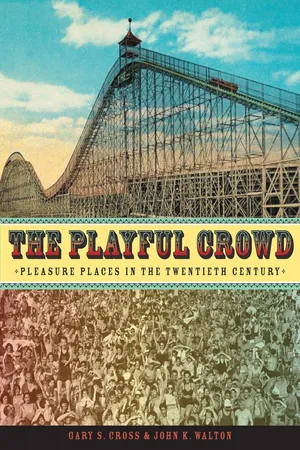
During the first part of the twentieth century thousands of working-class New Yorkers flocked to Coney Island in search of a release from their workaday lives and the values of bourgeois society. On the other side of the Atlantic, British workers headed off to the beach resort of Blackpool for entertainment and relaxation. However, by the middle of the century, a new type of park began to emerge, providing well-ordered, squeaky-clean, and carefully orchestrated corporate entertainment. Contrasting the experiences of Coney Island and Blackpool with those of Disneyland and Beamish, Gary S. Cross and John K. Walton explore playful crowds and the pursuit of pleasure in the twentieth century to offer a transatlantic perspective on changing ideas about leisure, class, and mass culture.
Blackpool and Coney Island were the definitive playgrounds of the industrial working class. Teeming crowds partook of a gritty vulgarity that offered a variety of pleasures and thrills from roller coaster rides and freak shows to dance halls and dioramas of exotic locales. Responding to the new money and mobility of the working class, the purveyors of Coney Island and Blackpool offered the playful crowd an "industrial saturnalia."Cross and Walton capture the sights and sounds of Blackpool and Coney Island and consider how these "Sodoms by the sea" flouted the social and cultural status quo. The authors also examine the resorts' very different fates as Coney Island has now become a mere shadow of its former self while Blackpool continues to lure visitors and offer new attractions.
The authors also explore the experiences offered at Disneyland and Beamish, a heritage park that celebrates Britain's industrial and social history. While both parks borrowed elements from their predecessors, they also adapted to the longings and concerns of postwar consumer culture. Appealing to middle-class families, Disney provided crowds a chance to indulge in child-like innocence and a nostalgia for a simpler time. At Beamish, crowds gathered to find an escape from the fragmented and hedonistic life of modern society in a reconstructed realm of the past where local traditions and nature prevail.
- English
- ePUB (mobile friendly)
- Available on iOS & Android
eBook - ePub
About this book
Trusted by 375,005 students
Access to over 1.5 million titles for a fair monthly price.
Study more efficiently using our study tools.
Information
Subtopic
North American HistoryIndex
History1 |  | Making the Popular Resort CONEY ISLAND AND BLACKPOOL ABOUT 1900 |

Coney Island and Blackpool came to define the playful crowd across the Atlantic World of 1900, creating through their innovations and diversity unique settings for industrial peoples to find release from routine and care. To explain their success, we have to ask: Why and how did these resorts break away from the ruling conventions of the Victorian seaside and embrace the exciting otherness of the popular classes at play? Simultaneously, we must question how Coney Island and Blackpool differed, leading them on sharply contrasting paths. Divergences in physical and climatic settings, land holdings, entertainment customs, political contexts, and ultimately social and cultural traditions will shape our query. What follows is a brief historical comparison of how the industrial saturnalia of the seaside emerged in all of its diversity by the 1900s.
Sites and Seasons: Origins of the Urban and Provincial Seaside Resort
Coney Island and Blackpool were shaped by their geography and climate, which led them to draw crowds in similar but still unique ways. Coney Island is a five-mile-long, oval-shaped peninsula on the southern tip of Brooklyn on the southwestern shore of Long Island. It is located nine miles east of New York City’s Manhattan Island. It was little more than a flat wasteland until it was settled in 1824 when a private road covered with seashells was built over the creek that divided Coney “Island” from Long Island. Given the cost and time of carriage travel and ferryboats across the water from Manhattan, Coney’s earliest visitors were mostly an adventurous handful of genteel New Yorkers and more distant travelers. Road owners opened a hotel that appealed to these pursuers of solitude and health-giving salt air. Coney attracted political and cultural notables (from leading Senators Henry Clay and John C. Calhoun to writers Herman Melville and the young Walt Whitman). Its main advantage was its south-facing east-west axis, assuring long sunny days in summer along with cool ocean breezes.
The scene became far more commercial when regular ferry service began in the mid-1840s to the western end of Coney nearest to Manhattan. In hopes of attracting the business or casual crowd from the city, two enterprising New Yorkers built a circular wooden platform upon which they placed a tent. Soon, around this “pavilion” gathered a smattering of cheap wooden bathhouses, eateries, saloons, gypsy fortunetellers, and ballad singers who attracted New York’s diverse, even plebeian crowds. One visitor remembered the “barn-like bar room” with “counter boards held up with barrels.”1 By the 1860s, this western section of beach had become a notorious refuge for gamblers and crooks evading police because, though it was near the city, it was beyond the control of the authorities. The West End also drew the slumming rich and politicians seeking respite from the demands of respectable society. Later it was known as Norton’s Point, named after the notorious politician Michael Norton of Tammany Hall who bought the site in 1874. The West End of Coney Island reflected the curious culture of the city with its mixture of dandies, corrupt politicians, and plebeian underworld figures.2
Blackpool was similarly situated close to rapidly expanding urban areas, in this case that part of the English county of Lancashire where the first Industrial Revolution got under way in the late eighteenth century and continued to gather momentum until the First World War. It was, however, further from the developing population centers than Coney Island was from New York: The nearest substantial town was 20 miles away and Manchester was more than double that distance. Its main original asset was similarly a long, open shoreline, facing westward to the Irish Sea, with generous and often boisterous tides. From at least the 1750s, Blackpool slowly built up a polite visiting season based on the provincial gentry and the middle ranks, in response to the new fashion for sea-bathing cures and seaside scenery.3 Alongside this, and apparently antedating it, was a plebean tradition of popular sea-bathing at the August spring tides, when there was said to be “physic in the sea.” Artisans and small farmers traveled on foot and by horse-drawn cart right across Lancashire to take the waters in their own way. This was an ancient custom, widespread across Europe and coinciding with the Roman Catholic festival of the Assumption of the Virgin Mary. It was eventually to be imported to the United States by Irish migrants in the form of “Cure Day,” still a feature of Coney Island in the 1950s.4 In its Lancashire guise this popular festivity involved drinking seawater by the gallon, and as well as bathing unclad in the sea and consuming spirits to “fortify the stomach.” This latter custom continued to grow in popularity right up to the arrival of the railroad in 1846, which linked Blackpool to the growing industrial towns of south and east Lancashire.5
By this time the little town had a year-round population of perhaps 1,500, which doubled at the August peak of the holiday season. Blackpool was therefore a longer-established and more respectable place of resort than Coney Island at this stage, except when the “Padjamers,” as the plebian bathers were known, arrived. Its middle-class visitors had a reputation for being plain in dress and speech; and also for a healthy appetite for food and drink.6 By 1850, the horse racing on the beach, and the local summer fair, had both been suppressed. Uncle Tom’s Cabin, on the northern cliffs, one of several public houses with dancing and other amusements, was a far cry from Norton’s Point. Finally, the gypsy fortune-tellers among the sand dunes remained almost invisible. The trains brought up to 12,000 visitors from the cotton industry towns at an August weekend in the early 1850s. New local government bodies controlled bathing and licensed street vendors and donkey drivers. Some visitors dressed flashily or scruffily, swore noisily and tried to bathe naked without using the bathing-machines. But these were the only blemishes on mid-century Blackpool’s respectability.7
Advances in road and rail transportation enabled both seaside resorts to become sites of an extraordinary range of entertainments that by 1900 appealed broadly to the popular classes. Given its location, Coney Island may have been destined to prevail over other American seaside spots. But investments in roads and rails from New York City population centers guaranteed it, especially in developing the central and eastern sections of the Island. The opening of a plank road (1850), horse tram (1862) and a steam rail link (1864) from Brooklyn to the center of the island superseded the advantage of the West End’s being closer to Manhattan by sea. The land development schemes of William Engeman in the center, known as West Brighton, provided a vast range of alternatives to the notorious male-oriented West End and heralded the advent of a more hetero-social pleasure zone. The opening of two Iron Piers at the center in 1879 and 1881 made possible boat transit on a grand scale, bringing visitors from as far away as Philadelphia, Newark, and New Haven. The piers were entertainment sites in themselves, each offering a 1,000-foot platform of ballrooms, restaurants, and other activities jutting out into the sea.8
This was merely the beginning. Ultimately, Coney Island became the seaside counterpoint to America’s greatest city when still newer railroad lines and the entertainment complexes built in conjunction with them completed the shift of commercial activities from the West End to the center and east side of Coney. In the meantime, the western section was transformed into a respectable suburban housing district called Sea Gate. Between 1867 and 1880, five railroads were constructed specifically to facilitate tourism. In 1867, what became the Brooklyn, Bath and Coney Island Railroad was extended to West Brighton, prompting the development of a diverse bathing and entertainment zone. Nearby, Andrew Culver in 1876 opened a railroad that extended from Brooklyn’s Prospect Park to Culver Plaza along Surf Avenue (a commercial road parallel to the beach). Lying between the two piers, Culver Plaza became a choice area for Coney Island entertainments. These train lines opened Coney Island to the salaried employee on a day trip from Manhattan, eventually via the Brooklyn Bridge. The fare was 35 cents for a round trip ticket, cheaper than the ferry (50 cents), but still beyond the reach of most wage earners. In addition to its stately 300-foot Centennial Tower, Culver Plaza offered a telegraph office that provided current stock quotes and Paul Bauer’s West Brighton Hotel for a business clientele. Nearby, Charles Feltman’s Ocean Pavilion, with a dance floor for 2,000 and a restaurant that served up to 8,000, catered especially to prosperous German immigrants. In 1879, another syndicate built the Sea Beach Palace in the heart of West Brighton and linked it with a third line, the New York and Sea Beach Railroad.9
West Brighton became identified with what New Yorkers meant by “Coney Island.” It was a classic example of a late Victorian seaside pleasure spot, but on a relatively huge scale: Purpose-built railroads fed customers into anchor hotels and pier businesses and leased concessions surrounded these featured attractions. Gradually, the crowd at West Brighton became more plebeian. In the 1890s, when these rail lines were linked via mergers that made possible direct electric trains from downtown, Manhattan wage earners could reach the Island in 45 minutes. By 1896, that trip cost only 20 cents, making Coney Island the natural destination of ordinary New Yorkers on a day trip.10
In response to the social mix that the new rails and private development provided, West Brighton became a curious combination of genteel pretensions and popular fascinations. The Seaside Aquarium opened in 1877 with an aviary, zoo, and aquatic tanks. These exhibits may have appealed to the more refined tastes of the middle classes. But the Aquarium also provided performing bears and ostriches, Punch and Judy shows, a music hall, and even displayed Siamese twins. The Iron Steam Boat Company stressed the scenic journey from the Battery to West Brighton in 1883, but also proudly noticed the thrills of the “flying horses, wings and velocipede machines” that could be found on Coney. A mark of sophistication was the claim that Bunnell’s Brighton Museum of albinos, armless boys, and “Hindoos” was run by an “honest showman” who provided “true wonders.”11
Even after rail travel made West Brighton a popular site, more discerning genteel visitors could still find relief from the teeming crowds. On the more secluded far eastern end of Coney Island were built two additional railroads to accommodate the more upscale customer at hotels of suitable status. Austin Corbin’s New York and Manhattan Beach Railroad (completed in 1877) delivered affluent New Yorkers disembarking from Brooklyn ferryboat docks to his Manhattan and Oriental hotels on Manhattan Beach. In 1878, Brooklyn developers (including William Engeman) imitated Corbin’s scheme by building the Brooklyn, Flatbush and Coney Island railroad from Brooklyn depots to the door of their Brighton Beach Hotel (located between the east end and the West Brighton center). These railroads created a relatively exclusive zone, isolated from the more plebeian center.
Despite these differences, Coney Island remained primarily a destination of the urban day tripper. The luxury hotels served mostly guests on short stays and many more visited the hotels for dining or promenading than rented rooms. Missing were the vast stands of hotels and rooming houses usually associated with seaside resorts like Blackpool or Atlantic City. The most numerous private spaces on Coney Island were bathhouses for changing into swimming suits. The proximity of the Island to New York made the crowds more ephemeral than at Blackpool. Even more significant, the increasing ease of access to the resort meant that distance and cost of transportation no longer filtered out the underclasses. Coney Island drew its visitors increasingly from the rich ethnic and cultural mix of the New York tenements, with access so cheap and easy as to pose few barriers even to the poorest so long as they confined themselves to the free entertainments of the beach and the visual pleasures of looking on. This created an extraordinary social mix that both disturbed elites and created potential social tensions on the Island.12
Blackpool similarly broadened, deepened, and expanded its appeal during the late nineteenth century, but with somewhat different outcomes. Its crowds grew from about 200,000 per year in the early 1860s to three million forty years later.13 Almost all came by railroad: In addition to the line built in 1846, a second connection with industrial Lancashire was opened in 1874 and another direct line for holiday services opened in 1913.14 The railroads were willing to provide cheap fares for day and weekend visitors and for people staying for a week. Still, the main impetus to growth came from the ability and desire of working-class people from the cotton towns to spend time and money at Blackpool. This built on the tradition of the Padjamers but extended it greatly. Of crucial importance was the growing purchasing power of working-class families from the 1870s, when basic commodity prices began a sustained fall, and where young couples and mature families in the textile towns had access to more than one income. This excluded working-class families with young dependent children and where wives were unable to work outside the home. As a result, working-class Blackpool became predominantly an adult resort, an unusual phenomenon in Victorian England. In contrast with the United States, a week’s vacation was commonly available, even for factory workers. The Industrial Revolution had not extinguished the traditional Wakes’ holidays of the cotton district, which at mid-century were transformed from local festivals into popular seaside holidays.15 These were not paid holidays. They had to be budgeted during the year, but savings clubs were organized by religious bodies, the retail Co-operative societies, and even street or neighborhood committees.16 During this period “cotton Lancashire” also gave professional soccer to the world. Music-halls, indulgence in tasty convenience foods like fish and chips, music-making (with a surprising number of piano purchases), and a cheap popular press all were part of the rise of the world’s first working-class consumer society.17 Blackpool was central to this “work hard, play hard” culture because it offered an explosive, inexpensive release from regular, monotonous work in a place that was accessible and familiar, while it also offered exciting novelty.
Here we identify a clear and enduring contrast. While Coney drew on the diversity of nearby New York City, Blackpool recruited its visitors over longer distances, but from much more closely knit, firmly established communities with a strong sense of identity and a broad familiarity with each other’s occupations and ways of life. These were universally white and English-speaking, with a variety of Lancashire town and village accents; practically all Protestants but with a smattering of Catholics. Whole towns went on holiday at the same time and thus there were fewer anxieties about the anonymity and decency of the crowds than at Coney. And Blackpool kept its middle-class visitors. The central district between the two piers of the 1860s was a working-class preserve, while the North and South Shore areas were consecrated to middle-class families.18 Even in the working-class zone, however, many stayed up to a full week, and this generated a demand for cheap rooms with breakfast, hot water, and cooking services. Whole streets of redbrick, four-story lodging-houses went up around the stations between the 1860s and the 1890s. By 1901, there were 2,642 landladies listed in the census.19 Many of them came from the towns of Blackpool’s hinterland and offered accommodation to their former workmates and neighbors. While Coney Island had a few clusters of summer bungalows for families living away from the City, they paled in comparison to the permanence and size of the Blackpool boarding houses.20 These aspects of the local economy gave greater stability and security to Blackpool as a permanent and year-round resort settlement.
As influential as geographical location and transportation were the climate and length of the season. Coney Island’s cold winters and hot summers made for a short, but very intense season. While most entertainment venues closed by mid-...
Table of contents
- Cover
- Half title
- Title
- Copyright
- Contents
- Preface
- Introduction
- 1. Making the Popular Resort: Coney Island and Blackpool about 1900
- 2. Industrial Saturnalia and the Playful Crowd
- 3. The Crowd and its Critics
- 4. Decline and Reinvention: Coney Island and Blackpool
- 5. The Disney Challenge
- 6. “Enrichment through Enjoyment”: The Beamish Museum in a Theme Park Age
- 7. The Crowd Transformed?
- Notes
- Index
Frequently asked questions
Yes, you can cancel anytime from the Subscription tab in your account settings on the Perlego website. Your subscription will stay active until the end of your current billing period. Learn how to cancel your subscription
No, books cannot be downloaded as external files, such as PDFs, for use outside of Perlego. However, you can download books within the Perlego app for offline reading on mobile or tablet. Learn how to download books offline
Perlego offers two plans: Essential and Complete
- Essential is ideal for learners and professionals who enjoy exploring a wide range of subjects. Access the Essential Library with 800,000+ trusted titles and best-sellers across business, personal growth, and the humanities. Includes unlimited reading time and Standard Read Aloud voice.
- Complete: Perfect for advanced learners and researchers needing full, unrestricted access. Unlock 1.5M+ books across hundreds of subjects, including academic and specialized titles. The Complete Plan also includes advanced features like Premium Read Aloud and Research Assistant.
We are an online textbook subscription service, where you can get access to an entire online library for less than the price of a single book per month. With over 1.5 million books across 990+ topics, we’ve got you covered! Learn about our mission
Look out for the read-aloud symbol on your next book to see if you can listen to it. The read-aloud tool reads text aloud for you, highlighting the text as it is being read. You can pause it, speed it up and slow it down. Learn more about Read Aloud
Yes! You can use the Perlego app on both iOS and Android devices to read anytime, anywhere — even offline. Perfect for commutes or when you’re on the go.
Please note we cannot support devices running on iOS 13 and Android 7 or earlier. Learn more about using the app
Please note we cannot support devices running on iOS 13 and Android 7 or earlier. Learn more about using the app
Yes, you can access The Playful Crowd by Gary Cross,John K. Walton in PDF and/or ePUB format, as well as other popular books in History & North American History. We have over 1.5 million books available in our catalogue for you to explore.