eBook - ePub
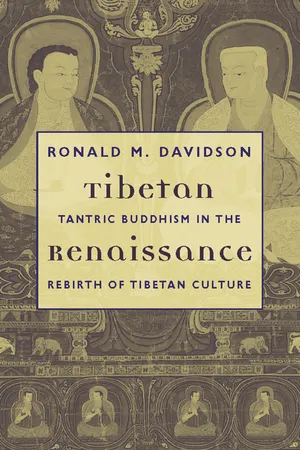
Tibetan Renaissance
Tantric Buddhism in the Rebirth of Tibetan Culture
- English
- ePUB (mobile friendly)
- Available on iOS & Android
eBook - ePub
About this book
How did a society on the edge of collapse and dominated by wandering bands of armed men give way to a vibrant Buddhist culture, led by yogins and scholars? Ronald M. Davidson explores how the translation and spread of esoteric Buddhist texts dramatically shaped Tibetan society and led to its rise as the center of Buddhist culture throughout Asia, replacing India as the perceived source of religious ideology and tradition. During the Tibetan Renaissance (950-1200 C.E.), monks and yogins translated an enormous number of Indian Buddhist texts. They employed the evolving literature and practices of esoteric Buddhism as the basis to reconstruct Tibetan religious, cultural, and political institutions. Many translators achieved the de facto status of feudal lords and while not always loyal to their Buddhist vows, these figures helped solidify political power in the hands of religious authorities and began a process that led to the Dalai Lama's theocracy. Davidson's vivid portraits of the monks, priests, popular preachers, yogins, and aristocratic clans who changed Tibetan society and culture further enhance his perspectives on the tensions and transformations that characterized medieval Tibet.
Information
Topic
Theology & ReligionSubtopic
Asian HistoryTable of contents
- Cover
- Half title
- Title
- Copyright
- Contents
- Preface
- List of Maps, Figures, and Tables
- Pronunciation Guide
- Introduction
- 1. Early Medieval India and the Esoteric Rhapsody
- 2. The Demise of Dynasty and a Poorly Lit Path
- 3. Renaissance and Reformation: The Eastern Vinaya Monks
- 4. Translators as the New Aristocracy
- 5. Drokmi: The Doyen of Central Tibetan Translators
- 6. Treasure Texts, the Imperial Legacy, and the Great Perfection
- 7. The Late Eleventh Century: From Esoteric Lineages to Clan Temples
- 8. The Early Twelfth Century: A Confident Tibetan Buddhism
- 9. The Late Twelfth to Early Thirteenth Century: Ethical Crises, International Prestige, and Institutional Maturation
- 10. Conclusion and Epilogue: The Victory of the Clan Structure, Late Tantric Buddhism, and the Neoconservative Vision
- Notes
- Glossary
- Tibetan Orthographic Equivalents
- Appendix 1: Eastern Vinaya Temples, Cave Temples, and Residences in the Mid-Eleventh Century
- Appendix 2: Translation and Text of the Root Text of the *Mārgaphala
- Appendix 3: A Concordance of Early Commentaries on the Root Text of the *Mārgaphala
- Notes to Appendices
- Abbreviations
- Bibliography
- Index
Trusted by 375,005 students
Access to over 1.5 million titles for a fair monthly price.
Study more efficiently using our study tools.
Frequently asked questions
Yes, you can cancel anytime from the Subscription tab in your account settings on the Perlego website. Your subscription will stay active until the end of your current billing period. Learn how to cancel your subscription
No, books cannot be downloaded as external files, such as PDFs, for use outside of Perlego. However, you can download books within the Perlego app for offline reading on mobile or tablet. Learn how to download books offline
Perlego offers two plans: Essential and Complete
- Essential is ideal for learners and professionals who enjoy exploring a wide range of subjects. Access the Essential Library with 800,000+ trusted titles and best-sellers across business, personal growth, and the humanities. Includes unlimited reading time and Standard Read Aloud voice.
- Complete: Perfect for advanced learners and researchers needing full, unrestricted access. Unlock 1.5M+ books across hundreds of subjects, including academic and specialized titles. The Complete Plan also includes advanced features like Premium Read Aloud and Research Assistant.
We are an online textbook subscription service, where you can get access to an entire online library for less than the price of a single book per month. With over 1.5 million books across 990+ topics, we’ve got you covered! Learn about our mission
Look out for the read-aloud symbol on your next book to see if you can listen to it. The read-aloud tool reads text aloud for you, highlighting the text as it is being read. You can pause it, speed it up and slow it down. Learn more about Read Aloud
Yes! You can use the Perlego app on both iOS and Android devices to read anytime, anywhere — even offline. Perfect for commutes or when you’re on the go.
Please note we cannot support devices running on iOS 13 and Android 7 or earlier. Learn more about using the app
Please note we cannot support devices running on iOS 13 and Android 7 or earlier. Learn more about using the app
Yes, you can access Tibetan Renaissance by Ronald M. Davidson in PDF and/or ePUB format, as well as other popular books in Theology & Religion & Asian History. We have over 1.5 million books available in our catalogue for you to explore.