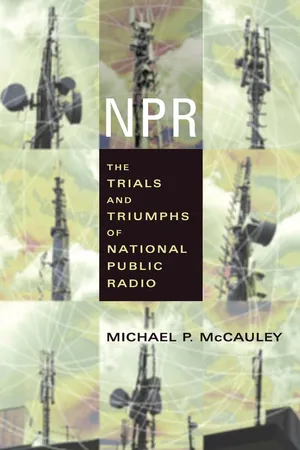
The people who shaped America's public broadcasting system thought it should be "a civilized voice in a civilized community"—a clear alternative to commercial broadcasting. This book tells the story of how NPR has tried to embody this idea. Michael P. McCauley describes NPR's evolution from virtual obscurity in the early 1970s, when it was riddled with difficulties—political battles, unseasoned leadership, funding problems—to a first-rate broadcast organization.
The book draws on a wealth of primary evidence, including fifty-seven interviews with people who have been central to the NPR story, and it places the network within the historical context of the wider U.S. radio industry. Since the late 1970s, NPR has worked hard to understand the characteristics of its audience. Because of this, its content is now targeted toward its most loyal listeners—highly educated baby-boomers, for the most part—who help support their local stations through pledges and fund drives.
- English
- ePUB (mobile friendly)
- Available on iOS & Android
eBook - ePub
About this book
Information
Subtopic
Radio
1 A LYCEUM OF THE AIRWAVES
When I first began to study the history of National Public Radio, I did not expect very much in the way of adventure. Given the civilized tone of the stories on Morning Edition and All Things Considered, I had no reason to think these shows would inspire the same level of passion as a playoff series between the Boston Red Sox and New York Yankees. Over time, though, I came to realize that NPR’s news programs often did stimulate passionate discussions later in the day, whether at home, in the supermarket, at the gym, or in the lobby of a local theater.
William Kling, the president and CEO of Minnesota Public Radio, agrees that NPR reporters can stir up emotion when they do in-depth stories on matters of public controversy: “A commercial network will have that story over in thirty seconds. You’re angry about it, but you’re onto something else. NPR might spend seven minutes on it, by which time you’re apoplectic, you’ve sent three faxes, and called two congressmen.”1 Radio is an intimate medium, one that stimulates the imagination and helps listeners feel a sense of personal connection with the people whose voices they hear. This is especially true in public radio, says NPR president Kevin Klose:
Radio is a much more open space, the way it is done in the public radio community. There’s time for reflection, there’s time for consideration, and there’s time for people to think as they’re driving to or from work, as they’re patting the dog, or doing the dishes, or jogging with the headphones in their ears.… “Which way is my compass pointing today? Let me hear some interesting stories about how people’s compasses are being set, or how they got reset.” … I think that’s what public radio does.2
People who work at NPR often speak about “The Driveway Moment,” which happens when someone listening to public radio on the way home from work is so captivated by the last story they hear that she or he pulls into the driveway, stays in the car, and listens until the story is over. Pity the spouse, partner, or child who interrupts this experience … This book is an attempt to understand why NPR holds such powerful appeal for certain listeners. The people who have the strongest affinity for the network’s programs are highly educated baby boomers3 who could easily have been mistaken, at certain points in their lives, for cast members from the ABC television series thirtysomething.4 America’s public radio audience began to grow at an explosive rate in the early 1980s, and that growth was fueled by people who studied or worked at university campuses during the prior two decades. These idealistic boomers were imbued with the mythical American dream and a sense that their childhood communities—safe, prosperous places—could be replicated during their adult years. Many of these dreams were shattered in the 1970s, when the post–World War II economic boom came to a crashing halt. This was a time of unprecedented inflation and unemployment, one that destroyed many Americans’ sense of control and direction.5 Not coincidentally, thirtysomething’s characters longed for the innocent days of their youth and craved the sense of idealism and community they felt while in college. It would stretch the imagination to think that NPR News is modeled upon the same themes we can find in thirtysomething. It is not an exaggeration, however, to say that the American public radio industry began to soar when its leaders realized that people who were very much like this program’s characters—highly educated, socially conscious, politically active—were most likely to listen to their brand of broadcasting.
The possibility of such a nationwide community of listeners is one of the things that attracted me to public radio and the task of unearthing its history. This interest was a natural outgrowth of my own career in radio, which began in December 1982 with a newswriting job at KQV-AM, a commercial all-news station in Pittsburgh. For the most part, I remained in this line of work, as a reporter, anchor, and news director, until I entered graduate school at the University of Wisconsin–Madison in the fall of 1989. As it happened, WHA-AM—a leader in the public radio industry and one of the oldest stations in the country—was located in the very same building as the School of Journalism and Mass Communication, just two floors above the office I occupied as a teaching assistant. Soon I would meet Jack Mitchell, the director of Wisconsin Public Radio and one of the first producers of All Things Considered. I began a series of conversations with Jack about the ways in which public radio stations were managed and was quickly impressed by the level of sophistication that he and his colleagues demonstrated. Hands down, these people knew their audiences better than any other broadcasters I had met. They were also motivated to serve listeners for reasons that went beyond the profit motive that underpins most of the U.S. radio industry.
In early 1996, stuck between limited-term student jobs, I began to wonder if the WPR newsroom could use the services of another radio journalist. When I asked Jack Mitchell if there was anything I could do for him, a series of discussions ensued that resulted in my being hired as a news anchor and reporter a few months later. Besides reading the news and running the audio console for WPR’s seventeen-station Ideas Network, I reported on a wide variety of topics—from medical news to politics, from education to the environment—and produced my stories within a format that allowed much more air time than any of my former employers did. I also had the opportunity to interact with WPR’s staff, management, and board of directors about my research on public radio—in effect, to analyze a company while working for it. I left Madison in July 1997 to prepare for a faculty position at the University of Maine but continued to admire Wisconsin Public Radio from afar. I often use it as a yardstick to measure how good public radio can be, especially in terms of its capacity to deliver multiple program streams (e.g., separate “Ideas” and “News and Classical” networks) to people who live in the very same community. My wife Judy and I continue to support WPR and listen to some of its fine programs on the Web.
Throughout graduate school, I read everything I could get my hands on about public radio—in newspapers, popular journals and academic volumes—on the bet that this industry would provide a fitting series of topics for a career in academic research. In the beginning, I was content to read straightforward, descriptive accounts of NPR, a network whose thoughtful long-form programs transcended the least-common-denominator feel of commercial radio. Once again, I had little idea that the public’s reaction to this new kind of radio, largely unknown before the late 1970s, would be so passionate and, at times, polarized. Some people adored NPR, while others seemed to despise it. Since the U.S. public radio industry then received, and still receives, a portion of its funding from the federal government, politicians, pundits, and activists of various stripes often questioned whether NPR was “doing its job.” This was especially interesting for me, since each person’s conception about what the network’s job actually was bore some resemblance to that person’s preexisting social, political, and economic views. Some conservatives, for example, claimed that NPR was a “little Havana on the Potomac,” while critics on the left thought it had abandoned its essential role as a change agent in American society.6 Why were so many people arguing about NPR, a network whose programs I had barely heard of? Was public radio really worth arguing about to this extent? The answers to these questions were not as simple as you might think.
Members of the Carnegie Commission on Educational Television—a group anointed by Lyndon Johnson for the purpose of dreaming up the contemporary public broadcasting system—thought the industry should be “a civilized voice in a civilized community,” one that would “arouse our dreams [and] satisfy our hunger for beauty.” In short, public broadcasting would become “our Lyceum, our Chataqua, our Minsky’s and our Camelot.”7 We can find many examples, over the years, of NPR programs that have lived up to this ideal: for example, Robert Montiegel’s documentary portraits of leading twentieth-century intellectuals, a thirteen-part radio adaptation of Star Wars, and hundreds of sparkling performances on Marian McPartland’s Piano Jazz. Many of NPR’s news and information programs have also been memorable, from live broadcasts of Senate hearings on the Vietnam War; to the expert political and legal reporting of Linda Wertheimer, Cokie Roberts, and Nina Totenberg; to award-winning coverage of the Persian Gulf wars and the aftermath of September 11, 2001. The fact that NPR has succeeded to this extent is nothing less than amazing, given the manner in which it was born and raised.8
Over the years, many people have criticized the network for targeting its programs almost exclusively to an audience of upscale baby boomers. Those who take this position seem to long, instead, for a national broadcaster that could offer meaningful programs for people from all socioeconomic and cultural groups—including those that are not well-served by the dominant commercial broadcasting system. This brand of public service broadcasting is common in Western Europe where most national systems, like the BBC, are funded by a license fee that is tied to the purchase of television or radio sets. By virtue of paying this fee, each European citizen has typically donated between $36 and $136 per year toward his or her national broadcasting system (compare that to a little more than one dollar’s worth of federal support for each U.S. citizen). The BBC operates eight television networks, ten radio networks, more than fifty local radio and TV stations, and a forty-three-language worldwide news and information service. It also produces musical performances and children’s programs and provides digital platforms for the integration of a wide variety of audio, video, and textual content. Britain’s national broadcaster provides both popular programs and minority shows, with, as one observer puts it, “the former being the majority’s reward for helping to fund the latter.”9
This is a very different broadcasting system from the one that America’s public radio audience enjoys. In recent years, the amount of federal money earmarked for public radio has dwindled to about 14 percent of the industry’s annual budget (33 percent if you include money from state and local governments); income from private sources such as pledge drives and corporate underwriting accounts for a little more than half of the funding mix.10 Given the heavy influence of these “listener-sensitive” funds, America’s public radio system must, as a matter of survival, focus its programming and fund-raising efforts on the highly educated thirtysomething (now fifty-something) audience that covets its programs most. It is tempting to charge, as some critics have, that NPR’s financial maturation has moved the enterprise away from its funky, alternative roots and closer to the pedestrian fare of commercial radio. But, as we shall see, American public broadcasting grew up in a political culture that actually precluded most of the funk that is supposedly missing. NPR’s liberal critics may also be waxing nostalgic for a kind of radio format that, for the most part, no longer exists—and has not existed for several decades. Starting in the mid-to-late 1920s, when commercial networks and their star performers became a national phenomenon, radio was a full-service medium whose local stations often provided something for everyone. But this picture began to change by the mid-1950s when, for the first time, more than half of all American households had television sets. Commercial TV, with its comedy shows, anthology dramas, and entertainment spectaculars, quickly became the country’s full-service medium of choice. In order to survive, radio stations had to specialize, to move toward niche-market formats that would serve some people very well and others not at all.
Such was the fate of public radio in the United States. Born in the early 1970s, the industry lacked the coherent strategy for universal public service that its European counterparts had from the very beginning. NPR was founded because the federal government made a relatively modest sum of money available for building a ragtag collection of educational radio and TV stations into a national system—one that would hardly be formidable by commercial standards. Compared to Europe’s national broadcasters, the U.S. public radio system has no unified sense of purpose, no firm guidelines about the kind of service that networks or local stations should provide to citizens and communities.11 The development of NPR’s civilized voice happened through trial and error—or, in the words of one long-time employee, after an initial “period of sacrificial audiences.”12 About a decade after the network’s founding, its managers began to better understand how many people were listening, which kinds of people were listening, and why they chose to listen at any given time. Audience research helped public radio fuse its programs more snugly to the values, beliefs, and attitudes of the people who tuned in (and pledged their financial support) most often. The central insight to be gleaned from NPR’s history, then, is not that its programs are politically biased or aesthetically tilted in one way or the other or that the network could do a much better job than it has of serving each and every American. The most noteworthy thing about this organization (and the wider public radio industry) is the remarkable job that a few talented and dedicated broadcasters have done in playing the hand they were dealt. Born of humble circumstances, NPR has blossomed into a civilized voice which serves its listeners better than any other network could.
AN OVERVIEW
This book traces the history of noncommercial radio in the United States from its roots in the educational radio stations of the early twentieth century, to the creation of a modern public broadcasting system, to NPR’s development as a primary purveyor of high quality news, information, and cultural programming. Nonprofit educational stations, most of them owned by colleges and universities, were the pioneering institutions of American radio; more than 200 of them were licensed in the 1920s. But many of these stations began to languish just a few years after signing on, as university administrators failed to see the usefulness of radio beyond the sheer novelty of music and human voices that somehow, invisibly, flew into and out of speaker boxes. Regulatory decisions in Washington, pressure from would-be commercial broadcasters, and the Great Depression also took their toll, forcing more than 75 percent of these stations off the air by 1933.
Chapter 2 covers the development of nonprofit radio from its meager beginnings through NPR’s first two years of existence. As commercial radio entered its heyday in the 1930s and 1940s, educational and other nonprofit broadcasters fought for their very lives. The Ford Foundation kept them going through the late 1960s, when Washington politicians were finally persuaded to bankroll the Corporation for Public Broadcasting (which later begat NPR and PBS). Public radio and television, as this newly revitalized form of broadcasting was called, promised to give us much more than classroom lectures, book recitations, and “your favorite classical music hits.” But the Public Broadcasting Act of 1967 contained precious little money for ensuring that local stations were up to the task or for molding them into a functional nationwide system. This was unfortunate, since just prior to NPR’s formation, only 16 percent of America’s noncommercial radio stations were deemed strong enough to warrant federal support. The story of public radio’s early years leads, finally, to NPR’s birth in March 1970 and to the care it received from two influential “parents”—Donald Quayle, its first president, and William Siemering, its first program director. These men literally brought the network to life, yet their awkward, uncomfortable dialogue did little to further the discussion about what it should do for local stations and their listeners.
The next phase of NPR’s existence was marked by a sharp struggle between employees who wanted the programming to maintain a strong cultural flair and those who wanted to produce the same kinds of reports that CBS News did, only longer and better. Chapter 3 picks up the story following Donald Quayle’s departure for a television job at CPB and the empowerment, by default, of his second-in-command as NPR’s new president. Lee Frischknecht planned to steer the organization out of the seemingly endless tangle of ad hoc decisions that characterized its first few years. But doubts about his leadership ability surfaced almost immediately, and they deepened with his failure to manage the widening “news vs. culture” schism. Frischknecht commissioned an internal study in 1976 as a way of bringing this tension out into the open, but the move backfired in a bad way. The staff railed at a recommendation that news and cultural programming be forced to coexist in one happy family, and a spate of name-calling, intimidation, and threatened walkouts ensued. These events led to a major reorganization of the public radio industry that forced Lee Frischknecht from his job and left NPR no stronger than it was the day he became president.
After tempers eased and a new board of directors was seated, NPR laid the groundwork for its first major burst of growth and expansion. The new directors looked for a high-profile figure to lead the network, someone who could draw publicity, increase listening, and secure more operating funds. Playing on the political connections of their chairman, they hired Frank Mankiewicz—a lawyer, journalist, and political operative who had once been Robert Kennedy’s press secretary and whose exploits take up the bulk of chapter 3. Mankieiwicz had mountains of charm, a huge Rolodex, and an easygoing rapport with NPR’s news team. He sought to elevate the status of his journalists, to boost them closer to the stratum of their commercial network colleagues (without the huge salaries, of course). His knack for publicity also began to pay off in terms of additional money from CPB, greater attention in the media, and the feeling that his organization was finally ready to launch a morning news program. But as NPR’s fortunes began to climb, Mankiewicz variously ignored or underplayed a significant competitive threat—Bill Kling.
Kling was no stranger to the field; he had worked at CPB’s radio office in the earliest days and had served on NPR’s planning board and first board of directors. Well schooled in the administrative aspects of noncommercial broadcasting, he was building a small group of Midwestern stations into a budding empire known as Minnesota Public Radio. His most visible success lay in the care and feeding of a young disk jockey named Garrison Keillor, who became a cult sensation shortly after his program, A Prairie Home Companion, was broadcast to a national audience for the first time in 1979. Kling wanted to distribute Keillor’s show over public radio’s new satellite system, but Mankiewicz, who was building his own empire with Morning Edition, rejected the idea. This moment would become pivotal in the creation of NPR’s biggest competitor, a distribution company that would later...
Table of contents
- Cover
- Half title
- Title
- Copyright
- Dedication
- Contents
- Acknowledgments
- 1. A Lyceum of the Airwaves
- 2. The Very First Brush Strokes
- 3. The Price of Fame
- 4. Phoenix Rising
- 5. A Civilized Voice in a New Media Environment
- Notes
- Bibliography
- Index
Trusted by 375,005 students
Access to over 1.5 million titles for a fair monthly price.
Study more efficiently using our study tools.
Frequently asked questions
Yes, you can cancel anytime from the Subscription tab in your account settings on the Perlego website. Your subscription will stay active until the end of your current billing period. Learn how to cancel your subscription
No, books cannot be downloaded as external files, such as PDFs, for use outside of Perlego. However, you can download books within the Perlego app for offline reading on mobile or tablet. Learn how to download books offline
Perlego offers two plans: Essential and Complete
- Essential is ideal for learners and professionals who enjoy exploring a wide range of subjects. Access the Essential Library with 800,000+ trusted titles and best-sellers across business, personal growth, and the humanities. Includes unlimited reading time and Standard Read Aloud voice.
- Complete: Perfect for advanced learners and researchers needing full, unrestricted access. Unlock 1.5M+ books across hundreds of subjects, including academic and specialized titles. The Complete Plan also includes advanced features like Premium Read Aloud and Research Assistant.
We are an online textbook subscription service, where you can get access to an entire online library for less than the price of a single book per month. With over 1.5 million books across 990+ topics, we’ve got you covered! Learn about our mission
Look out for the read-aloud symbol on your next book to see if you can listen to it. The read-aloud tool reads text aloud for you, highlighting the text as it is being read. You can pause it, speed it up and slow it down. Learn more about Read Aloud
Yes! You can use the Perlego app on both iOS and Android devices to read anytime, anywhere — even offline. Perfect for commutes or when you’re on the go.
Please note we cannot support devices running on iOS 13 and Android 7 or earlier. Learn more about using the app
Please note we cannot support devices running on iOS 13 and Android 7 or earlier. Learn more about using the app
Yes, you can access NPR by Michael P. McCauley in PDF and/or ePUB format, as well as other popular books in Media & Performing Arts & Radio. We have over 1.5 million books available in our catalogue for you to explore.