eBook - ePub
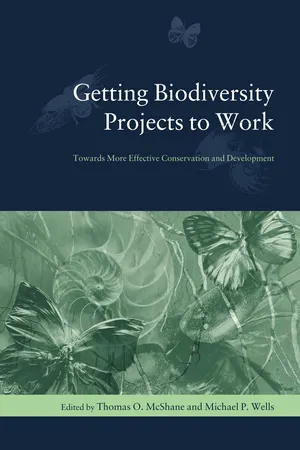
Getting Biodiversity Projects to Work
Towards More Effective Conservation and Development
- English
- ePUB (mobile friendly)
- Available on iOS & Android
eBook - ePub
Getting Biodiversity Projects to Work
Towards More Effective Conservation and Development
About this book
This book explores both the theoretical and practical underpinnings of integrated conservation and development. It synthesizes existing experience to better inform conservationists and decision makers of the role ICDPs play in conservation and management and analyzes their successes and shortcomings.
Information
Subtopic
Environmental ScienceIndex
Biological SciencesPART ONE
The Challenge
of Linking
Conservation and
Development
of Linking
Conservation and
Development
1
Integrated Conservation and Development?
Thomas O. McShane and Michael P. Wells
The ICDP Approach
Integrated conservation and development projects (ICDPs) have become one of the most widely implemented and yet controversial approaches to biodiversity conservation. The term itself emerged as a collective label for a new generation of projects that started to go outside park and reserve boundaries and pay particular attention to the welfare of local people (Wells and Brandon 1992). Most of these efforts took place in developing countries with international financial support. During the last two decades, ICDPs and their equivalents (comparable initiatives have used a variety of other labels) have exploded in popularity, rapidly metamorphosing from an untested idea attracting seed money for pilot projects to become widespread “best practice” for biodiversity conservation (Larson, Freudenberger, and Wyckoff-Baird 1998; Wells et al. 1999). ICDPs have attracted the lion’s share of the relatively large investments in conservation projects by bilateral development agencies and the Global Environment Facility (GEF), the interim financing mechanism for the Convention on Biological Diversity, during the 1990s. A key factor behind the growth in popularity of ICDPs seems to have been the prospect of delivering working models of “sustainable development,” which had become an overarching priority since the 1992 UN Conference on Environment and Development in Rio de Janeiro.
Even as the ICDP momentum was building, the initial experiences of some of the early field projects were disappointing. There was considerable uncertainty and debate over how much emphasis to put on biological versus social or economic goals, and the combining of conservation and development objectives was proving more difficult than had been anticipated (Wells and Brandon 1992). These possible indicators of the need for caution were generally overlooked, however, or were attributed to start-up problems that would be surmountable over time. Analysts began to question the contribution of ICDPs to biodiversity conservation, both from ecological perspectives (Redclift 1987; Sachs 1991; Stocking and Perkin 1992; Robinson 1993; Barrett and Arcese 1995) and social perspectives (West and Brechin 1991; Murphree 1993; Colchester 1994; Ghimire 1994; Ghimire and Pimbert 1997). Waves of new ICDPs continued to be launched, however, with few signs that lessons from the existing projects had been taken into account.
The seeds of doubt grew as more time passed, and convincing cases where ICDPs had effectively helped reconcile local people’s development needs with protected area management remained difficult to find. It became increasingly clear that many of the success stories reported earlier had been based more on overoptimistic ICDP goals and objectives than on a calm analysis of actual experience. By the millennium, concern among the organizations both implementing and financing ICDPs had become widespread, fueled by an expanding barrage of mostly critical literature (Agrawal 1997; Sanjayan, Shen, and Jansen 1997; Larson, Freudenberger, and Wyckoff-Baird 1998; Wells et al. 1999; McShane 1999; Few 2001; Hughes and Flintan 2001).
A backlash against the ICDP approach has begun to gain momentum among the organizations actually carrying out conservation activities in developing countries, as well as among the agencies providing the funding. The staff of some conservation organizations have begun questioning whether projects that emphasize sustainable development—a term that remains frustratingly elusive to define—can in practice be compatible with biodiversity conservation. Meanwhile, as the twenty-first century begins, the international development agencies show few signs of prioritizing biodiversity conservation or ICDPs in their efforts to help achieve the Millennium Development Goals by 2015.
The Aim of This Book
The editors of and contributors to this book all have extensive experience in various aspects of biodiversity conservation, from ecological, economic, and social perspectives, and include both practitioners and researchers. All have seen and experienced the changing priorities, issues, and trends in the practice of biodiversity conservation during the last decade or so. The rapid rise of ICDPs and now the uncertainty over the future of this approach have motivated these contributors to take this in-depth look at experience to date, to work out what has happened and why, and to map out a way forward.
It seems clear that the ICDP approach to biodiversity conservation should not and will not continue forward in the headlong rush seen in the past. But it seems equally clear that the approach should not be abandoned. This book tries to carefully analyze what has been learned and to point toward the implications of these lessons for future interventions. The challenge of establishing or maintaining protected areas while addressing the needs of local populations remains. Funding priorities may change over time, as they always do, but any long-term solution is going to need to draw on key aspects of the ICDP approach. Hence this book.
Learning from Experience
The papers that follow take a hard look at the ICDP approach. The authors examine the ecological, social, economic, and historical forces that have shaped the relationship between conservation and development. We have selected studies that cover a broad geographic range and delve into the key issues that influence the conservation initiatives linked to protected areas. Throughout the book we have tried to cross-reference papers to facilitate the readers’ exploration of these topics.
John Robinson and Kent Redford (ch. 2) argue that conservation and development objectives are often based on unrealistic assumptions, with profound implications for ICDPs. Thomas McShane and Suad Newby (ch. 4) examine some of these key assumptions underlying ICDPs, finding that many of the constraints being experienced involve capacity constraints related to social organization, governance, advocacy, and competing economic factors. Capacity weaknesses are also highlighted by Shekhar Singh and Arpan Sharma (ch. 13) in their analysis of ecodevelopment in India. All of these cases raise issues that conservationists are sometimes uncomfortable dealing with. Phil Franks and Thomas Blomley (ch. 5) and Katrina Brown (ch. 11) address the tug of opposing forces within ICDPs—where biodiversity goals can marginalize the interests of local stakeholders, while economic development goals can marginalize legitimate national and international interests in biodiversity. These authors identify the key challenge of distinguishing between conservation and development goals while reconciling the different interests of multiple stakeholders.
While some ICDPs have tried—and failed—to satisfy all interest groups, a more realistic approach must recognize the need for tradeoffs. Practical approaches to trade-off analysis are explored by Katrina Brown (ch. 11), and identifying and negotiating trade-offs is a recurring theme in case studies involving Yellowstone National Park (Dennis Glick and Curtis Freese, ch. 7), indigenous peoples in the Philippines (Edgardo Tongson and Marisel Dino, ch. 9), and community-based natural resource management in Zambia (Brian Child and Barry Dalal-Clayton, ch. 12). Steve Gartlan (ch. 10) compares and contrasts the Korup and Kilum ICDPs in Cameroon and documents how tenurial rights have influenced project implementation.
The institutional characteristics of ICDPs are usually critical. These include legal and institutional frameworks, formal and informal property rights and resource management rules, and the norms and traditions of the various stakeholders and actors. Brian Child and Barry Dalal-Clayton, analyzing the Luangwa Valley of Zambia (ch. 12), as well as Shekhar Singh and Arpan Sharma, examining ecodevelopment in India (ch. 13), argue that ICDPs require institutional forms with the capacity to deal with ecological, social, economic, and even political change, necessitating adaptive approaches to management, a topic explored in depth by Nick Salafsky and Richard Margoluis (ch. 16). Gill Shepherd (ch. 15) argues that poor monitoring of ICDP biodiversity and livelihood impacts has prevented these projects from learning from their own efforts.
Jeffrey Sayer and Michael Wells (ch. 3) explore the inherent contradictions in the conventional project framework, where local actors are expected to achieve “ownership” and project activities are expected to achieve “sustainability” even though the objectives, design, time frame, and budget are largely determined by outsiders. Similar concerns are voiced by Phil Franks and Thomas Blomley (ch. 5), who review CARE’s experience of fitting integrated conservation and development into a project framework and argue for a vision-driven planning approach.
ICDPs have tended to concentrate their efforts on mitigating the threats to protected areas from the activities of local communities. Broader threats are often of greater significance, however, and can be addressed through improved policy formulation and implementation (Katrina Brandon and Michelle O’Herron in Costa Rica, ch. 8), greater influence over public and private investment (Dennis Glick and Curtis Freese in Yellowstone National Park, ch. 7), and spatial planning (Stewart Maginnis, William Jackson, and Nigel Dudley, ch. 14). As an alternative approach to the conventional project framework, Agnes Kiss (ch. 6) examines in detail the potential and limitations of direct payments to stakeholders and argues that this approach could be more cost-effective than many ICDPs.
The predominant paradigm of most of the major international conservation organizations has shifted from ICDPs to conservation at larger scales, whether ecoregions, bioregions, hotspots, or landscapes. Most of these efforts have focused on defining large-scale conservation priorities and conservation-friendly policies across diverse sectors. Stewart Maginnis, William Jackson, and Nigel Dudley (ch. 14) examine ICDPs within a larger, landscape perspective, proposing that this perspective holds the potential for reconciling conflicting stakeholder needs much more effectively than at the local level. There is general acknowledgment that ICDPs must address issues at multiple scales, though the form this might take varies. Phil Franks and Thomas Blomley (ch. 5) question whether these large-scale approaches are the new paradigm for integrated conservation and development.
To conclude, a group of authors attempt an overall synthesis of all of the contributors’ findings (ch. 17). Despite the discouraging record of ICDPs, they argue that no other approach has been more effective. Linking protected area management with the interests of local stakeholders remains one of the few widely applicable approaches to site-based biodiversity conservation that offers a realistic prospect of success. Likewise, integrated conservation and development is one of the pillars of sustainable development and is well embedded in international aid policy (cf. IUCN 1980; WCED 1987; Munro 1991; OECD 1996). These authors conclude that learning more lessons is less important than applying the ones that are already available. Some of the key characteristics and ingredients needed for successful ICDPs and similar initiatives are identified.
References
Agrawal, A. 1997. Community in Conservation: Beyond Enchantment and Disenchantment. Gainesville, Fla.: Conservation and Development Forum.
Barrett, C. S. and P. Arcese. 1995. Are integrated conservation and development projects sustainable? On the conservation of large mammals in sub-Saharan Africa. World Development 23:1073–1084.
Colchester, M. 1994. Salvaging Nature: Indigenous Peoples, Protected Areas, and Biodiversity Conservation. Discussion Paper no. 55. Geneva: UN Research Institute for Social Development.
Few, R. 2001. Containment and counter-containment: Planner/community relations in conservation planning. The Geographical Journal 167:111–124.
Ghimire, K. B. 1994. Parks and people: Livelihood issues in national parks management in Thailand and Madagascar. Development and Change 25:195–229.
Ghimire, K. B. and M. P. Pimbert, eds. 1997. Social Change and Conservation: Environmental Politics and Impacts of National Parks and Protected Areas. London: Earthscan.
Hughes, R. and F. Flintan. 2001. Integrated Conservation and Development Experience: A Review and Bibliography of the ICDP Literature. London: International Institute for Environment and Development (IIED).
IUCN (International Union for Conservation of Nature and Natural Resources). 1980. World Conservation Strategy: Living Resource Conservation for Sustainable Development. Gland, Switzerland: International Union for Conservation of Nature and Natural Resources.
Larson, P. S., M. Freudenberger, and B. Wyckoff-Baird. 1998. WWF Integrated Conservation and Development Projects: Ten Lessons from the Field 1985–1996. Washington, D.C.: World Wildlife Fund.
McShane, T. O. 1999. Voyages of discovery: Four lessons from the DGIS-WWF Tropical Forest Portfolio. Arborvitae suppl.: 1–6.
Munro, David, dir. 1991. Caring for the Earth: A Strategy for Sustainable Living. Gland, Switzerland: International Union for Conservation of Nature and Natural Resources, UN Environment Program, World Wildlife Fund.
Murphree, M. W. 1993. Communities as Resource Management Institutions. Gatekeeper Series no. 36. London: International Institute for Environment and Development (IIED).
OECD (Organisation for Economic Co-operation and Development). 1996. Shaping the 21st Century: The Contribution of Development Cooperation. Paris: Organisation for Economic Co-operation and Development.
Redclift, M. 1987. Sustainable Development: Exploring the Contradictions. London: Methuen.
Robinson, J. G. 1993. The limits to caring: Sustainable living and the loss of biodiversity. Conservation Biology 7:20–28.
Sachs, W. 1991. Environment and development: The story of a dangerous liaison. The Ecologist 21:252–257.
Sanjayan, M. A.,...
Table of contents
- Cover
- Half title
- Series Page
- Title
- Copyright
- Contents
- Foreword
- Preface
- List of Contributors
- Part 1: The Challenge of Linking Conservation and Development
- Part 2: Applications and Issues
- Part Three. Conclusion
- Index
Trusted by 375,005 students
Access to over 1.5 million titles for a fair monthly price.
Study more efficiently using our study tools.
Frequently asked questions
Yes, you can cancel anytime from the Subscription tab in your account settings on the Perlego website. Your subscription will stay active until the end of your current billing period. Learn how to cancel your subscription
No, books cannot be downloaded as external files, such as PDFs, for use outside of Perlego. However, you can download books within the Perlego app for offline reading on mobile or tablet. Learn how to download books offline
Perlego offers two plans: Essential and Complete
- Essential is ideal for learners and professionals who enjoy exploring a wide range of subjects. Access the Essential Library with 800,000+ trusted titles and best-sellers across business, personal growth, and the humanities. Includes unlimited reading time and Standard Read Aloud voice.
- Complete: Perfect for advanced learners and researchers needing full, unrestricted access. Unlock 1.5M+ books across hundreds of subjects, including academic and specialized titles. The Complete Plan also includes advanced features like Premium Read Aloud and Research Assistant.
We are an online textbook subscription service, where you can get access to an entire online library for less than the price of a single book per month. With over 1.5 million books across 990+ topics, we’ve got you covered! Learn about our mission
Look out for the read-aloud symbol on your next book to see if you can listen to it. The read-aloud tool reads text aloud for you, highlighting the text as it is being read. You can pause it, speed it up and slow it down. Learn more about Read Aloud
Yes! You can use the Perlego app on both iOS and Android devices to read anytime, anywhere — even offline. Perfect for commutes or when you’re on the go.
Please note we cannot support devices running on iOS 13 and Android 7 or earlier. Learn more about using the app
Please note we cannot support devices running on iOS 13 and Android 7 or earlier. Learn more about using the app
Yes, you can access Getting Biodiversity Projects to Work by Thomas O. McShane,Michael P. Wells, Thomas McShane, Michael Wells in PDF and/or ePUB format, as well as other popular books in Biological Sciences & Environmental Science. We have over 1.5 million books available in our catalogue for you to explore.