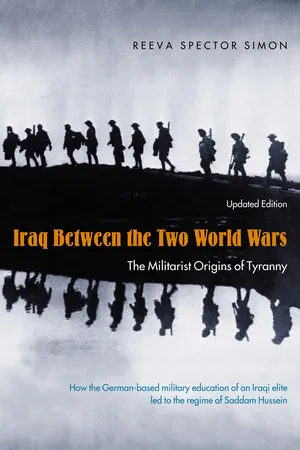
Why did a group from the Iraqi army seize control of the government and wage a disastrous war against Great Britain, rejecting British and liberal values for those of a militaristic Germany? What impact did these actions have on the thirty-year regime of Saddam Hussein?
Departing from previous studies explaining modern Iraqi history in terms of class theory, Reeva Simon shows that cultural and ideological factors played an equal, if not more important, role in shaping events. In 1921 the British created Iraq, and an entourage of ex-Ottoman army officers, the Sharifians, became the new ruling elite. Simon contends that this elite, returning to an Iraq made up of different ethnic, religious, and social groups, had to weld these disparate elements into a nation. Pan-Arabism was to be the new ideological source of unity and loyalty. Schools and the army became the means through which to implant it, and a series of military coups gave the officers the chance to act in its name. The result was an abortive revolt against Britain in 1941. And the legacy of the revolt is still apparent in the next two generations of Iraqi officers that led to the regime of Saddam Hussein.
This updated edition locates the sources of Iraqi nationalism in the experience of these ex-Ottoman army officers who used the emergent pan-Arabism to weld a disparate population into a nation. Simon shows that the relationships forged between Iraqi officers and Germans in Istanbul before WWI left deep legacies that go a long way toward explaining the disastrous war against Great Britain in 1941, the rejection of liberal values, the revolution of 1958 in which the military finally seized power, and the outlook of the leadership recently overthrown by American and British armies.
- English
- ePUB (mobile friendly)
- Available on iOS & Android
eBook - ePub
About this book
Information
CHAPTER
I
The Creation of a State
They were all there, the “Forty Thieves” as Winston Churchill called them. Actually, their number was thirty-eight including one woman, Gertrude Bell, and two Iraqis—the best experts on the Middle East. Churchill, newly appointed minister at the Colonial Office, had summoned them to I. Cairo during the second week of March 1921 to reorganize the administration of British Middle East interests.
While Churchill sat at his easel sketching pictures of the Pyramids in the shadow of an armored car during his frequent absences from committee meetings,1 the specialists at the Cairo Conference, as it was to be known, sketched from three provinces of the former Ottoman empire—Baghdad, Basra, and Mosul—what would become the kingdom of Iraq. And they provided a king: Faysal, second son of the Sharif of Mecca,2 newly exiled from a temporary throne in Syria, who, after some persuasion by his former comrade-in-arms T. E. Lawrence and by Sir Kinahan Cornwallis of the Colonial Office, reluctantly agreed to take on the task of ruling the new country. Gertrude Bell, Oriental Secretary to the British High Commissioner, Sir Percy Cox, found the creation of the kingdom a satisfying but exhausting job. “You may rely on one thing,” she wrote to her father on July 8, 1921, “I’ll never engage in creating kings again;”“it’s too great a strain.”3 By August, Faysal was crowned king and the process of governing began.
Faysal brought his own entourage to Iraq. Also known as the Sharifians, these were former Ottoman army officers, most of Iraqi origin, who had been the military backbone of the Arab revolt which Faysal had led during World War I and who would now serve as the officers and administrators of Iraq until the end of the monarchy in 1958. They “have risked their lives and their futures and those of their families, in volunteering their services during the war,” Faysal told the British, “and at every period of the struggle they have served me loyally …
to those who say that it is impossible to constitute such a [national] government owing to the lack of trained men, I will say that until now not the slightest effort has been made to collect them, for most of the highest posts in the Eastern Zone of the O.E.T. are filled by Baghdadis today. Doubtless among the tribes a great deal of assistance will be necessary and the Baghdadis would all be only too glad to undertake it.4
They were young men; their average age in 1921 was in the low thirties. Most were lower-middle-class Sunni Arabs from Baghdad and the north who were products of Ottoman military and bureaucratic education which had become available to provincial Arabs during the last half of the previous century and many of them were related to one another by blood and marriage. But they had neither a local following nor a power base in Iraq and so were dependent upon the government for position and livelihood, unlike the indigenous politically and socially prominent groups.
They came to rule a country whose literate population as late as 1955 numbered only some 400,000 of about 4 million people.5 Most of them pastoralists, farmers, and villagers, organized by tribe, village, or faith. The capital city, Baghdad, which in essence represented Iraqi political history after 1932, had a population of 300,000 before World War II.
They returned to an artificially created entity, a mandate entrusted to Britain at the San Remo Conference in 1920 by the World War I victors. Britain had occupied Iraq during the war in order to safeguard the route to British India, blocking German encroachments from the north and Russian penetration from the east through Iran. Although the British did manage eventually to secure Mosul and its oil for Iraq, outmaneuvering both the Turks and the French who claimed the former Ottoman province, Iraq was but a piece of the territory that Faysal and the Sharifians believed promised to them during the war. France now controlled Syria, and Britain governed Palestine which was also declared to be a Jewish homeland.
As Sunni Arabs, the Sharifians were part of a minority compared with the Shi‘is who comprised over 50 percent of the population. Their country was composed of relatively discrete areas of ethnic and religious diversification, exemplified by the provinces into which the Ottomans had divided the territory. Baghdad and the northwest were primarily Sunni Arab; Basra with a significant Sunni population was the largest city in the predominately Shi‘i south; and Mosul, although Sunni, contained a large Turkman population. In the mountains to the northeast of Mosul lay Kurdistan, an area of Kurdish speaking non-Arab Sunni tribesmen divided among Iraq, Turkey, and Iran which aspired to autonomy or independence. There were also Yazidis, the center of whose religion, which combined elements of paganism, Zoroastrianism, Christianity, and Islam, lay in the mountains to the west of Mosul, and Sabians who practiced their baptismal rites in the marsh areas in the south. Christians and Jews lived for the most part in the cities, except for a large number of Assyrian (Nestorian) Christians brought to Iraq from north of Mosul to help the Allies. After the war the British resettled the refugees in Iraqi territory.
The three provinces had different orientations. Basra, which at one time had applied for autonomous rule, looked to the Gulf and to India for commerce and was separated from Baghdad by the virtually ungovernable marsh areas of the Shatt al-‘Arab; Mosul lay on the trade route to Syria and Turkey; and Baghdad had been on the frontier between the Sunni Ottoman Empire and the Shi‘i Safavid state of Iran. There was a constant population flow at the Iranian border because the Shi‘i Holy Cities of al-Najaf and Karbala lay just to the south of Baghdad and pilgrims and students traveled there in large numbers.
Needless to say, there was no focus of nationalist identification at the time of Iraq’s creation. As late as 1933 Faysal was to despair:
In Iraq there is still—and I say this with a heart full of sorrow—no Iraqi people but unimaginable masses of human beings, devoid of any patriotic ideal, imbued with religious traditions and absurdities, connected by no common tie, giving ear to evil, prone to anarchy, and perpetually ready to rise against any government whatsoever. Out of these masses we want to fashion a people which we would train, educate, and refine … The circumstances being what they are, the immenseness of the efforts needed for this (can be imagined).6
The people of Iraq had traditionally looked to the tribal shaykh, the village headman, and religious leader for guidance and allegiance and paid taxes to whoever could collect them—the Turks in the garrison towns, or the shaykhs the British used to control the tribes. The problem which the new rulers faced was how to create an identification—a nationalist ideology which could weld their fractured country into a state—while being occupied by a foreign power.
For what the British had taken as an imperial prize during the war turned out to be an expensive hornets’ nest, requiring money and troops for internal pacification. Local reaction to the decisions at San Remo was a revolt in 1920 which cost the British more than four hundred lives and 40 million pounds. So, instead of direct rule and a complete British occupation, they devised a government with an “Arab façade” containing all of the external trappings and institutions of a constitutional monarchy, complete with cabinet, political parties, and parliament on the British model. After an eleven-year training period, the fledgling state became independent in 1932.
But the British did not leave. Instead, they attempted to control Iraq via a covey of British advisers who supervised and reported on Iraqi internal developments, and by a treaty signed in 1930 as a prerequisite for independence. It provided for an Anglo-Iraqi alliance and for full consultations between the two countries in all matters of foreign policy. The treaty which was to endure for twenty-five years granted Britain the right to use airbases near Basra and at al-Habbaniyyah, and the right to move troops across the country. Britain was supposed to sell Iraq arms.
To the British, this system whereby Iraq would finance and secure a protective shield for the British route to India and would control the strategic oil-producing areas and the pipeline—in operation pumping oil to refineries in Haifa by the mid-1930s—seemed ideal. And it satisfied wartime promises to their Hashimite allies: Faysal had gotten his kingdom after all.
For insurance they fostered alternative power groups to the Sharifians, whom they mistrusted; but aside from token Shi‘i cabinet members, they virtually ignored the Shi‘i majority whom they considered to be religious fanatics. Instead, the British sponsored the election of some Shi‘i landlords, of tribal shaykhs and urban notables to parliament; and, after a slow start, parliamentary seats became popular as sources of lucrative perquisites and powerful local patronage. The shaykhs were given administrative positions and land grants. Huge tracts of land which had been the personal possession of Ottoman Sultan Abdulhamid II were now state lands, leased by the politicians and their supporters. Ownership of formerly communal tribal lands by absentee landlords who had acquired title under the Ottomans was guaranteed by the Land Settlement Law of 1932 which granted tenure to anyone who had usufruct of the land for a period of over fifteen years. And the peasant was tied to the land by the Law for the Rights and Duties of Cultivators (1933) which stipulated that only peasants free from debt could leave the land to find other employment.
Throughout the 1920s the king and the politicians busied themselves jockeying for power, assuring their personal financial security, negotiating and opposing the treaty with Britain, and participating in the institutions the British had imposed on them. But the British did not provide an ideology, a focus for loyalty and belief to replace the traditional values and religion which they challenged by supporting secular education and “westernization.” A flag, new headgear, and a foreign king did not produce a national identity. The British could create an Iraqi state, but they did not introduce British values.
So in 1941 the British were shocked to find themselves at war with a pan-Arab nationalist Iraq which seemed to yearn for a German victory. The Sharifians had not merely assimilated themselves into the ruling elite,7 but had, under British noses, provided the new country with an ideology, a focus for loyalty derived from their Ottoman educational experience. Despite the attraction of French liberal thought and political nationalism in the Ottoman Empire, the officers transmitted a cultural nationalism with a militaristic bent, influenced by German nationalism and the German militarist tradition they had encountered in Istanbul. Once the Sharifians had taken control of the government apparatus, they had proceeded to inculcate pan-Arab nationalism via education and the military, following the pattern of the French, the Germans, and the Japanese.
This, then, is the story of the beginnings of an Iraqi nationalism which saw Iraq as part of a greater Arab whole and which subordinated a local Iraqi future to the evocation of a glorious Arab past, a nationalism that became the rallying cry for the Rashid ‘Ali movement and the war with Britain, a second attempt at independence and Arab irredentism that failed. A description of the nationalist ideology and a discussion of who created it and how it was inculcated will be the subject of the following pages.
CHAPTER
II
The Officers, Germany, and Nationalism
Returning to only a part of the territory they had envisioned ruling, the Iraqi officers drew upon their Ottoman educational experience for a model upon which to base their goals for resurgent Arab strength and unification. They rejected Britain because of her role in dividing the Arab world after World War I and because Britain ruled their country. And unlike the Ottoman civilian intellectuals who saw in European liberal thought, introduced into the Middle East after Napoleon’s invasion of Egypt in 1798, the prescription for the financial and political ills of the Ottoman Empire, the officers, for whom reform connoted military modernization, were impressed by Germany, which had achieved unification and military superiority in a short period of time.
Like their counterparts from all over the Empire, the Iraqi officers in the Ottoman army before World War I were educated during the early years of the twentieth century when German military officers organized, supervised, and taught in the Ottoman military schools. There they encountered modern military thought from von Clausewitz to von der Goltz, and they were exposed to the concept of cultural nationalism as a means for knitting back together the disparate elements of the Arab world.
From their side, the Wilhelmian Germans looked to the weak Ottoman Empire both as an area ripe for colonization through which they could compete with British and French imperialism, and as an area compatible for cultural propagation. They hoped to use control of education as a means for indoctrination and eventual diplomatic alliance.
Despite military defeat in World War I and the German adoption of the National Socialist ideology which placed the Arabs slightly above the Jews on the racial scale, links remained between the German military and Iraq during the postwar period. In Iraq, Germans, who had served in the Middle East during World War I, found fertile ground for the reactivation of anti-British propaganda, taking advantage of the steadily growing Iraqi anti-British sentiments. Thus, in 1940–1941 when the lines for an impending conflict between Iraq and Britain began to be drawn, the Iraqi officers, now in charge of the government, turned to Germany, seen once again as a model and possible strategic alley for another attempt at Arab unification and independence.
Before turning to the actual role of the Iraqi officers in politics, however, let us set the stage by discussing their educational background and the residual legacy of this education: namely, the creation of a cohesive officer corps which retained linkages long after service in the Ottoman army, the adoption of cultural nationalism as a model for Arab nationalism, and by illustrating how German operatives began to use Iraq as a base for anti-British propaganda in the Middle East during the 1930s, reactivating a policy set in motion by the Kaiser in World War I. The impact of German activities in Iraq will be taken up later.
THE OTTOMANS TURN TO GERMANY
Until the 1830s the Ottomans had turned to Europe intermittently for military technology and technicians. Various European soldiers of fortune, mercenaries, and eventually a French military mission in Istanbul advised the Ottomans. French became the second language in the Ottoman military schools.1 But French defeat in 1870 and their refusal to renew the military mission in 1877, coupled with the Ottoman defeat in the Russo-Turkish War (1877–1878) led to a reassessment of the situation. In ...
Table of contents
- Cover
- Half title
- Title
- Copyright
- Dedication
- Contents
- Acknowledgments
- Introduction
- Chapter I. The Creation of a State
- Chapter II. The Officers, Germany, and Nationalism
- Chapter III. The Officers in Iraq
- Chapter IV. Education
- Chapter V. The Army
- Chapter VI. The Rashid ‘Ali Coup
- Chapter VII. Conclusion: Ideological Prelude to Tyranny
- Appendix I. The Hashimites
- Appendix II. Iraqi Cabinets 1921–1941
- Appendix III. Biographical Sketches
- Notes
- Bibliography
- Index
Trusted by 375,005 students
Access to over 1.5 million titles for a fair monthly price.
Study more efficiently using our study tools.
Frequently asked questions
Yes, you can cancel anytime from the Subscription tab in your account settings on the Perlego website. Your subscription will stay active until the end of your current billing period. Learn how to cancel your subscription
No, books cannot be downloaded as external files, such as PDFs, for use outside of Perlego. However, you can download books within the Perlego app for offline reading on mobile or tablet. Learn how to download books offline
Perlego offers two plans: Essential and Complete
- Essential is ideal for learners and professionals who enjoy exploring a wide range of subjects. Access the Essential Library with 800,000+ trusted titles and best-sellers across business, personal growth, and the humanities. Includes unlimited reading time and Standard Read Aloud voice.
- Complete: Perfect for advanced learners and researchers needing full, unrestricted access. Unlock 1.5M+ books across hundreds of subjects, including academic and specialized titles. The Complete Plan also includes advanced features like Premium Read Aloud and Research Assistant.
We are an online textbook subscription service, where you can get access to an entire online library for less than the price of a single book per month. With over 1.5 million books across 990+ topics, we’ve got you covered! Learn about our mission
Look out for the read-aloud symbol on your next book to see if you can listen to it. The read-aloud tool reads text aloud for you, highlighting the text as it is being read. You can pause it, speed it up and slow it down. Learn more about Read Aloud
Yes! You can use the Perlego app on both iOS and Android devices to read anytime, anywhere — even offline. Perfect for commutes or when you’re on the go.
Please note we cannot support devices running on iOS 13 and Android 7 or earlier. Learn more about using the app
Please note we cannot support devices running on iOS 13 and Android 7 or earlier. Learn more about using the app
Yes, you can access Iraq Between the Two World Wars by Reeva Spector Simon in PDF and/or ePUB format, as well as other popular books in History & Middle Eastern History. We have over 1.5 million books available in our catalogue for you to explore.