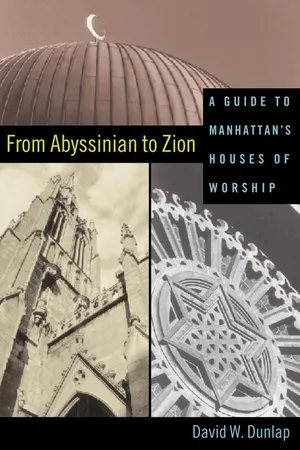
From modest chapels to majestic cathedrals, and historic synagogues to modern mosques and Buddhist temples: this photo-filled, pocket-size guidebook presents 1,079 houses of worship in Manhattan and lays to rest the common perception that skyscrapers, bridges, and parks are the only defining moments in the architectural history of New York City. With his exhaustive research of the city's religious buildings, David W. Dunlap has revealed (and at times unearthed) an urban history that reinforces New York as a truly vibrant center of community and cultural diversity.
Published in conjunction with a New-York Historical Society exhibition, From Abyssinian to Zion is a sometimes quirky, always intriguing journey of discovery for tourists as well as native New Yorkers. Which popular pizzeria occupies the site of the cradle of the Christian and Missionary Alliance movement, the Gospel Tabernacle? And where can you find the only house of worship in Manhattan built during the reign of Caesar Augustus? Arranged alphabetically, this handy guide chronicles both extant and historical structures and includes
• 650 original photographs and 250 photographs from rarely seen archives
• 24 detailed neighborhood maps, pinpointing the location of each building
• concise listings, with histories of the congregations, descriptions of architecture, and accounts of prominent priests, ministers, rabbis, imams, and leading personalities in many of the congregations
- English
- ePUB (mobile friendly)
- Available on iOS & Android
eBook - ePub
About this book
Trusted by 375,005 students
Access to over 1.5 million titles for a fair monthly price.
Study more efficiently using our study tools.
Information
Topic
ArchitectureSubtopic
Religious Architecture
Abyssinian Baptist Church. They were only looking for a place to worship. Several traders from Abyssinia—now Ethiopia—came to the First Baptist Church on Gold Street one Sunday in 1808. They were ushered to the slave loft. “Wealthy, educated world travelers, proud human beings, with a well-defined philosophy of religion that matched that of anyone in that auditorium, they resented this and walked out in protest,” the Rev. Adam Clayton Powell Jr. wrote. Eighteen black members of First Baptist joined their boycott, forming the nucleus of Abyssinian Baptist Church, founded in 1809.
They worshiped first at 44 Anthony Street [B39], as Worth Street was called, moving in 1856 to 166 Waverly Place [E46], when Greenwich Village was an African-American hub. This little building once stood on Christopher Street, but had been moved in its entirety in 1826 by the Second Reformed Presbyterian Church. Abyssinian followed the black population uptown in 1902, moving to 242 West 40th Street [I50], the former Fourth German Mission Reformed Dutch Church. Membership swelled after the Rev. Adam Clayton Powell Sr. began preaching in a tent next to Marcus Garvey’s Liberty Hall in Harlem. The new Abyssinian was built on the same block in 1922/1923, at 132 West 138th Street [●T16★], since renamed Odell M. Clark Place after an Abyssinian deacon. The amphitheater-style church was designed by Charles W. Bolton & Son in Tudor Gothic style. There were some 13,000 members in the 1930s, when Abyssinian was described as the largest and most influential black church in New York, and the world’s largest Baptist church.
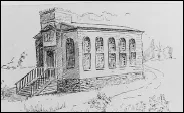
Abyssinian Baptist Church [E46]
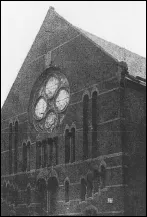
Abyssinian Baptist Church [I50]
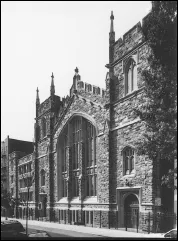
Abyssinian Baptist Church [T16]
Much of its influence was owed to the younger Powell, a charismatic maverick who assumed the pulpit in 1937 and, in 1944, became the first African-American elected to the House of Representatives from New York State. Upper Seventh Avenue was renamed in his honor. He was followed by the Rev. Samuel DeWitt Proctor and the Rev. Calvin O. Butts III, who established the Abyssinian Development Corporation, which has played a leading role in the recent redevelopment of Harlem.
Actors’ Chapel. See St. Malachy’s Church
Actors Studio. See West Forty-fourth Street United Presbyterian Church
Actors’ Temple. See Ezrath Israel, Congregation
Adams-Parkhurst Presbyterian Church. This Victorian Gothic castle by J. Cleveland Cady was built in 1875 at 211 East 30th Street [H17] as the Memorial Chapel of the Madison Square Presbyterian Church, later renamed to honor two pastors of Madison Square: the Rev. William Adams and the Rev. Charles Henry Parkhurst. The Armenian Evangelical Church and radio station WLIB shared the building over time. Adams-Parkhurst merged in 1965 with the Church of the Covenant, and the sanctuary was razed. A 10-story apartment building now stands on the site.
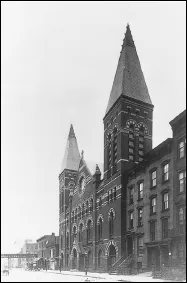
Adams-Parkhurst Presbyterian Church [H17]
Adas Yisroel Anshe Mezeritz, Congregation. Unlike most nearby synagogues, this exquisite sanctuary at 415 East 6th Street [●F19] is marvelously preserved. It was altered in 1910 from a three-story dwelling by Hermann Horenburger. It is nearly identical to the contemporary Congregation Kolbuszower Teitelbaum Chevra Banai. Adas Yisroel Anshe Mezeritz (Community of Israel, People of Mezeritz) was founded in 1892 and named for a town in Poland that was once a center of Jewish learning. The Orthodox group remains here to this day.
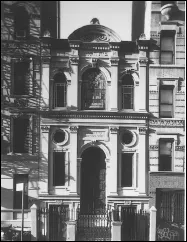
Congregation Adas Yisroel Anshe Mezeritz [F19]
Adoration, Chapel of the. The Cenacle of St. Regis, at 628 West 140th Street [S23], a Roman Catholic retreat for women and children, was built in 1901 to designs by W. E. Bosworth and W. C. Chase. A large chapel stood on the bucolic grounds, which were used until 1952.
Advent Hope, Church of the. At home in German Yorkville, at 111 East 87th Street [●N8], is the HAUS DER ADVENT HOFFNUNG, as it says over the entryway, a Seventh-Day Adventist church. Plans for the Church of the Advent Hope were filed in 1955 by the architect Alfred B. Heiser.
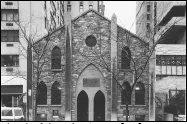
Church of the Advent Hope [N8]
Advent Lutheran Church. Not far on the map of Manhattan from William A. Potter’s Fourth Universalist Society, Advent Lutheran Church, at 2504 Broadway [●M1], is quite distant on the map of Europe. Although it was also designed by Potter, Advent draws on German rather than English Gothic for its inspiration. Built in 1900/1901, the sanctuary almost seems to presage the planar interpretation of Gothic in later twentieth-century churches. It is still used by the congregation that built it, a Lutheran body founded in 1897. Advent Lutheran was joined in 2000 by the peripatetic Broadway United Church of Christ, which has moved from one home to another in the 30 years since its own Broadway Tabernacle was sold and demolished.
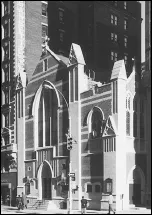
Advent Lutheran Church [M1]
Agudas Anshei Mamod Ubeis Vead Lachachomim, Congregation. See Chung Te Buddhist Association
Agudat Yesharim, Congregation. See Park Avenue Synagogue
Agudath Achim M’Krakau, Congregation. Originally built as a parochial school in 1855, 54 Pitt Street [F51] later served Congregations Brith Sholem, Kochob Jacob Anshe Kamenitz de Lite, Poel Zedek Anshe Ileya, and Agudath Achim M’Krakau. This congregation from Poland, founded in 1867, moved to 525 West 147th Street [●S10], now Bethel Holy Church of Deliverance.
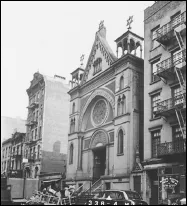
Congregation Agudath Achim M’Krakau [F51]
Ahavath Acheim Anshe Ungarn, Congregation. Congregation Ohab Zedek’s first synagogue, built in 1881 at 70 Columbia Street [F54], was later used by the Hungarian congregation Ahavath Acheim Anshe Ungarn.
Ahawath Chesed Shaar Hashomayim, Congregation. See Central Synagogue
Ahawath Yeshurun Shara Torah, Congregation. The name of Congregation Ahawath Yeshurun Shara Torah (Love of Israel, Gates of the Torah) is still visible at 638 East 6th Street [●F25], which is now the Sixth Street Community Center.
All Angels’ Church. In the community of Seneca Village, in the middle of what would become Central Park, All Angels’ Episcopal parish was organized in 1846. Its first wooden church, described by the Rev. Thomas McClure Peters as a place “in which white and black and all intermediate shades worshiped harmoniously together,” was consecrated in 1849 and stood approximately on the line of West 85th Street [M19]. Property condemnation for the new park closed this church in 1856. A new sanctuary was opened two years later at 428 West End Avenue [M28]. In 1873, the Rev. Charles F. Hoffman was called as rector. Heir to a large fortune, he offered to pay for the cost of a new church on the same site [M29]. Built from 1888 to 1890 and designed by Samuel B. Snook of J. B. Snook & Sons, this Gothic building was ingeniously oriented on a diagonal bias, creating a 140-foot-long sanctuary on a 100- by 102-foot plot of ground. But the size of All Angels’ Church, which seated 1,200, was ultimately a liability...
Table of contents
- Cover
- Half title
- Title
- Copyright
- Dedication
- Contents
- Foreword
- Preface
- Acknowledgments
- Neighborhood Maps
- Introduction
- A–Z
- Bibliography
- Credits and Permissions
- Index
Frequently asked questions
Yes, you can cancel anytime from the Subscription tab in your account settings on the Perlego website. Your subscription will stay active until the end of your current billing period. Learn how to cancel your subscription
No, books cannot be downloaded as external files, such as PDFs, for use outside of Perlego. However, you can download books within the Perlego app for offline reading on mobile or tablet. Learn how to download books offline
We are an online textbook subscription service, where you can get access to an entire online library for less than the price of a single book per month. With over 1.5 million books across 990+ topics, we’ve got you covered! Learn about our mission
Look out for the read-aloud symbol on your next book to see if you can listen to it. The read-aloud tool reads text aloud for you, highlighting the text as it is being read. You can pause it, speed it up and slow it down. Learn more about Read Aloud
Yes! You can use the Perlego app on both iOS and Android devices to read anytime, anywhere — even offline. Perfect for commutes or when you’re on the go.
Please note we cannot support devices running on iOS 13 and Android 7 or earlier. Learn more about using the app
Please note we cannot support devices running on iOS 13 and Android 7 or earlier. Learn more about using the app
Yes, you can access From Abyssinian to Zion by David W. Dunlap in PDF and/or ePUB format, as well as other popular books in Architecture & Religious Architecture. We have over 1.5 million books available in our catalogue for you to explore.