From one of China's most celebrated contemporary novelists comes this riveting tale of a young woman's emotional and sexual awakening. Set in the turbulent decades of the Cultural Revolution and the Tian'anmen Square incident, A Private Life exposes the complex and fantastical inner life of a young woman growing up during a time of intense social and political upheaval.
At the age of twenty-six, Ni Niuniu has come to accept pain and loss. She has suffered the death of her mother and a close friend and neighbor, Mrs. Ho. She has long been estranged from her tyrannical father, while her boyfriend—a brilliant and handsome poet named Yin Nan—was forced to flee the country. She has survived a disturbing affair with a former teacher, a mental breakdown that left her in a mental institution for two years, and a stray bullet that tore through the flesh of her left leg. Now living in complete seclusion, Niuniu shuns a world that seems incapable of accepting her and instead spends her days wandering in vivid, dreamlike reveries where her fractured recollections and wild fantasies merge with her inescapable feelings of melancholy and loneliness. Yet this eccentric young woman—caught between the disappearing traditions of the past and a modernizing Beijing, a flood of memories and an unknowable future, her chosen solitude and her irrepressible longing—discovers strength and independence through writing, which transforms her flight from the hypocrisy of urban life into a journey of self-realization and rebirth.
First published in 1996 to widespread critical acclaim, Chen Ran's controversial debut novel is a lyrical meditation on memory, sexuality, femininity, and the often arbitrary distinctions between madness and sanity, alienation and belonging, nature and society. As Chen leads the reader deep into the psyche of Ni Niuniu—into her innermost secrets and sexual desires—the borders separating narrator and protagonist, writer and subject dissolve, exposing the shared aspects of human existence that transcend geographical and cultural differences.
- English
- ePUB (mobile friendly)
- Available on iOS & Android
eBook - ePub
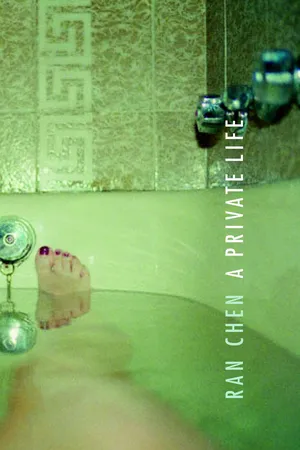
A Private Life
About this book
Information
Topic
LittératureSubtopic
Littérature générale1 DANCING ON TIPTOE IN BLACK RAIN . . .
This woman is a deep wound,
The sanctuary through which we enter the world.
Our road is the light
That shines from her eyes.
This deep wound is our mother,
The mother each of us gives birth to.
The sanctuary through which we enter the world.
Our road is the light
That shines from her eyes.
This deep wound is our mother,
The mother each of us gives birth to.
I was eleven then, or perhaps younger. The late afternoon summer weather was as unsettled as my mind. The rain would suddenly start pelting down, choosing me as its target. Afterward, I would see that the sleeves covering my skinny arms had angrily twisted themselves into stubborn wrinkles, and that my pant legs, even more obviously angered, as stiff as spindly sticks, kept an uncivil silence.
So I would say to my arms, “Misses Don’t, don’t be angry.” I called my arms “the Misses Don’t,” because they most often followed my brain’s bidding.
Then I would say to my legs, “Misses Do, let’s go home to Mama, then everything will be okay.” I called my legs “the Misses Do,” because I thought that they most often followed the bidding of my body, paying no attention to my brain.
I would then set off with my Misses Do and Don’t, soothing them with sweet talk along the way. Of course, these were private, unspoken conversations.
Sometimes I felt like I was a whole group of people. It was a lot more fun that way. We exchanged ideas all the time, telling one another all our problems. I always had plenty of problems.
But what was really strange that day was when I looked up from the soggy Misses Do and Don’t and was surprised to see that none of the people around me was wet. Why was I always the first one to get soaked in the rain? I didn’t understand, but I was much more easygoing than my Misses Do and Don’t. I didn’t get angry.
What’s the good of getting angry?
Once, after a thunderstorm, an ethereal rainbow hung suspended across the horizon, and our courtyard, still drenched with rain, was carpeted with the rich green leaves brought down by the wind and rain. In front of our house there was a really huge date tree. I was sure that it was much larger than the courtyard date trees described in my schoolbooks, because its great armlike limbs were the largest I had ever seen. Stretching completely across the courtyard, they rested firmly on the top of the high walls, forming a great, protective crown. Every summer they filled our courtyard with round, crisp, honey-sweet dates as fat as little pigs. Right after the storm, before the rain puddles had disappeared, I went out to collect the big dates that had been blown down. There was a tiny sparrow, head cocked to one side, still dazed, clinging to a fallen limb. I quickly cupped it in my hands and put it in a cage we had, with fresh water and millet.
My mother told me that if I kept it, it would die of frustration, because it had its own life, its own home.
I replied that I loved it very much and that I would feed it.
Mother said it wouldn’t eat what I gave it.
I wouldn’t listen.
And after a few days my sparrow died, because it refused to eat.
When he saw that I had a bird, one of the neighbor’s children brought home a pussycat. Already full grown, it was sleek and fat, and its readiness to accept amazed me. It would eat whatever food it came across, sleep wherever there was a place to curl up, waggle its tail and play up to whoever came along, and attach itself to whoever provided its saucer of milk. As a result, unlike my stubborn, intractable sparrow, it survived. Since that time I have detested monsters like that cat who would do anything just to stay alive. To me they are nothing more than a bunch of depraved opportunists, like many more of different types that I have encountered since I have grown up.
The sparrow incident upset me terribly, and, in my eleventh year, gave me a lesson in life. I always counseled my index finger, “Miss Chopstick, we have to learn how to control our temper or we’ll do ourselves in.”
I called my index finger “Miss Chopstick” because she helped me eat.
I once heard my mama say that the faster you run in the rain, the faster you get wet. But like other people who pay no heed before they get wet, I continued to act and think as before. On the one hand, I soothed my Misses Do and Don’t, while on the other, I tried to figure out just what had happened. Eventually, I convinced myself that it was something to do with my nerves or my blood or some other unobservable inner thing that made me run too fast, so I got soaking wet.
I was walking home alone. I knew that none of my little classmates wanted to or would dare to walk with me. No one wanted anything to do with me, because, in addition to being the youngest member of the class, I was skinny and weak and not very outgoing. An even more important reason was that Mr. Ti, the teacher in charge of our class, had been encouraging them to exclude me. I couldn’t understand this and had long resented him for it.
I was very angry and hurt because he always tried to embarrass me and make me look stupid in front of the class. Although I was the youngest member of the class and not a particularly clever girl, on occasion I would stand up to him. When I was nervous, I would mix up my left and right hands, and my right hand would forget how to write. But I was always trying to prove that I wasn’t the class dunce.
One time, he asked my mother to come into the office. He wanted her to take me to the hospital to see if I was mentally handicapped. He said I behaved like a mute. He had no idea that my brain was racing incessantly.
How mean of him to say I was “handicapped”!
Although only twenty-eight or twenty-nine at the time, and nearly ten years my mother’s junior, Ti was terribly abrupt and impolite with her.
I remember my mother standing humbly in front of him, holding my hand. Outside the office, under the green shade of a huge black date tree, the three of us made a tense little group. I remember that there was a crude concrete Ping-Pong table behind us, its surface pitted from constant use by the children, who had very few recreational facilities at the time. The pockmarks must have made it impossible for players to react quickly enough to return the ball, like the distraction of having someone continually shouting at you.
The three of us standing there facing one another formed anything but a friendly, easy group. He was a heavy-set man. I could see angry, invisible flames licking up in the space between us. I remember clearly that his elbow was on a level with my eyes. I am absolutely certain of this detail, because I was comparing our heights at the time and my eyes never left his muscular arms. Although I didn’t actually fly at him and bite him, because I kept restraining myself, that thick arm must have borne the imprint of my tiny teeth, because I willed it so.
It was at that time that I realized that even when I grew up, I would not be as tall or strong as he was, nor would I ever be able to get the best of him. It was through my mother’s behavior that I discovered a cruel, incontrovertible fact—he was a male.
My mother’s patient reserve almost had me feeling that I should apologize to him. She told him I was still an innocent child, just a bit oversensitive and stubborn, and inordinately shy.
Mr. Ti said that I was a “problem child,” that I spoke when I shouldn’t and was silent when I should speak.
I thought he was a shameless liar. I wasn’t like that at all.
Our school’s Office of Instruction had been conducting weekly classroom assessments of the teachers. The first time they checked our class, I was the only student who had nothing to say. The others all said what Mr. Ti had instructed them to say the day before. It was nothing more than an orchestrated eulogy to Mr. Ti. The only one who didn’t speak up, I stared down at my desk or looked at the wall. When the class monitor spoke of how Mr. Ti exhausted himself marking our assignments, she actually burst into tears.
My heart was pounding, and I was so upset and ashamed that I couldn’t utter a single word.
As soon as the man from the Office of Instruction had left, Teacher Ti jerked me out of my seat and dressed me down, making me feel even worse.
At the next inspection, I mustered up enough courage to be the first to speak.
I said, “At the last inspection I didn’t say anything, and Teacher Ti criticized me severely afterward. I know I was in the wrong, so this time I want to make up for my bad behavior. Teacher Ti is a dedicated man. For example, to help with today’s inspection he stayed very late last night coaching us in what we should say.”
After blurting out this long speech, I jubilantly sat down.
But as soon as the inspector had left, Teacher Ti bellowed, “Ni Niuniu, stand up!”
Again, he jerked me out of my seat and scolded me, this time even more severely than the last time. I really had no idea what I had done wrong. I swear that I meant only to praise him, even though I really didn’t want to.
It wasn’t only that I didn’t understand what I had done wrong; the way his face changed so abruptly had upset me so badly that all I could do was look at my feet and mumble.
He demanded that I explain myself, but I couldn’t bring myself to speak to him. As shy and timid as I was, there was no way that I could reveal to him even a single word of my inner turmoil. There was nothing I could do but stand there rigidly like a mute.
After that, nobody in the class would speak to me, and naturally I felt there was no one I could trust. I can’t say exactly why, but I felt that even the daily weather was false, and when I was away from home I was a stray black cloud lost in the clear void. As I walked along, I said to myself that without hypocrisy the world would stop turning.
Every day my only wish was to get back home as soon as possible.
I couldn’t depend on my father. That was one thing I was very clear on. He was an arrogant and pushy civil servant who never got very far. For many years (probably from about the time I was born), he had been pushed around and passed over. This intensified his arrogance, rancor, and neurosis. He thought it was beneath him to sit down and talk with a primary school teacher, even though it might have an effect on my future. And Teacher Ti himself was such an arrogant male that I was sure that if you gave them a few minutes together, they would hate each other. Because they were males.
So it was always Mother who went to see Teacher Ti, simply because Father had no interest in my affairs. In fact, I could feel that he had no interest in my mother either, that to him our problems were one and the same. He thought about nothing but himself.
I decided that when I grew up, I would not marry a man like my father, who neglected Mother and me. At that moment, it occurred to me that I should marry the Dean of Instruction. He could rake Teacher Ti over the coals, even box his ears. He wouldn’t have to let his shame stew inside, as Mother and I had to do.
But then I thought about the kitchen renovations we were having done at that time. Not only was father no good at that kind of work, he also irritated the workers Mother had hired to help with the job, making it very difficult for her, constantly having to apologize for him. Seeing my mother’s difficulties, I vowed that I would marry a man who knew how to build kitchens.
By this time my mind was in a mess. Whom should I choose? The Dean of Instruction or a man who could build kitchens?
The black raindrops still fell with a persistent madness out of a clear evening sky, surrounding me with a harsh and jarring clatter.
Through the rain, I suddenly caught sight of the silent silhouette of my mother leaning forward, stepping lightly on tiptoe, at the entrance to our street—a woman unswayed in her conviction, seeking light under the combined oppressiveness of the real rain and of the black rain that falls in human life. To her, the drenched figure of her daughter in the distance was a small slip of flame threatened by the flood around her—a flame that inspired her to rise to her toes in a dance of body and spirit upon the stage of human life.
2 MY ONE-EYED NANNY . . .
Our most profound self-denial comes when
we say yes to our fathers and yes to our lives.
we say yes to our fathers and yes to our lives.
When I heard my father shouting, the rain suddenly stopped.
Like a baby’s crying, which has no prelude or progression from sobs to outpouring of tears, this rain began unannounced, and it ceased just as abruptly. There was no gradual diminution in its intensity, nor did the dark clouds slowly dissipate. To me it seemed as if the raindrops suddenly decided, in mid-flight, to stop their descent, probably because of my father’s ability to fill them with terror.
Frightened, I stopped and pulled on my mother’s sleeve. “Mama?”
Looking up at the heavy, now rainless sky and forcibly staying her own tears, she put her arm around my shoulders, and we resumed our steps homeward.
That she didn’t want to say anything to me made me realize that she and Father had been quarreling again.
“Mama,” I said, trying to clear my throat and suppress the fear and confusion in my heart, so that my words might spool out as smooth and unbroken as a cotton thread. I didn’t...
Table of contents
- Cover
- Half title
- Series Page
- Title
- Copyright
- Contents
- Translator’s Note
- Acknowledgments
- 0. All Time Has Passed Away and Left Me Here Alone
- 1. Dancing on Tiptoe In Black Rain
- 2. My One-Eyed Nanny
- 3. I Carry an Infectious Disease
- 4. Scissors and Seduction
- 5. The Widow Ho and Her Changing Room
- 6. A Stranger to Myself
- 7. Yi Qiu
- 8. The Inner Room
- 9. A Coffin Looks for an Occupant
- 10. Bed A Stage for the Drama of the Sixes
- 11. A New Myth of Sisyphus
- 12. A Bed Cries Out
- 13. Yinyang Grotto
- 14. One Persons Death Brings Punishment to Another
- 15. Endless Days
- 16. Apple Bobbing
- 17. A Fiery Dance of Death
- 18. A Stray Bullet
- 19. The Birth of Miss Nothing
- 20. The Years Have Passed Away and Left Me Here Alone
- 21. The Lonely are a Shameless Lot
Trusted by 375,005 students
Access to over 1.5 million titles for a fair monthly price.
Study more efficiently using our study tools.
Frequently asked questions
Yes, you can cancel anytime from the Subscription tab in your account settings on the Perlego website. Your subscription will stay active until the end of your current billing period. Learn how to cancel your subscription
No, books cannot be downloaded as external files, such as PDFs, for use outside of Perlego. However, you can download books within the Perlego app for offline reading on mobile or tablet. Learn how to download books offline
Perlego offers two plans: Essential and Complete
- Essential is ideal for learners and professionals who enjoy exploring a wide range of subjects. Access the Essential Library with 800,000+ trusted titles and best-sellers across business, personal growth, and the humanities. Includes unlimited reading time and Standard Read Aloud voice.
- Complete: Perfect for advanced learners and researchers needing full, unrestricted access. Unlock 1.5M+ books across hundreds of subjects, including academic and specialized titles. The Complete Plan also includes advanced features like Premium Read Aloud and Research Assistant.
We are an online textbook subscription service, where you can get access to an entire online library for less than the price of a single book per month. With over 1.5 million books across 990+ topics, we’ve got you covered! Learn about our mission
Look out for the read-aloud symbol on your next book to see if you can listen to it. The read-aloud tool reads text aloud for you, highlighting the text as it is being read. You can pause it, speed it up and slow it down. Learn more about Read Aloud
Yes! You can use the Perlego app on both iOS and Android devices to read anytime, anywhere — even offline. Perfect for commutes or when you’re on the go.
Please note we cannot support devices running on iOS 13 and Android 7 or earlier. Learn more about using the app
Please note we cannot support devices running on iOS 13 and Android 7 or earlier. Learn more about using the app
Yes, you can access A Private Life by Ran Chen, John Howard-Gibbon in PDF and/or ePUB format, as well as other popular books in Littérature & Littérature générale. We have over 1.5 million books available in our catalogue for you to explore.