Used in China as a book of divination and source of wisdom for more than three thousand years, the I Ching has been taken up by millions of English-language speakers in the nineteenth century. The first translation ever to appear in English that includes one of the major Chinese philosophical commentaries, the Columbia I Ching presents the classic book of changes for the world today.
Richard Lynn's introduction to this new translation explains the organization of The Classic of Changes through the history of its various parts, and describes how the text was and still is used as a manual of divination with both the stalk and coin methods. For the fortune-telling novice, he provides a chart of trigrams and hexagrams; an index of terms, names, and concepts; and a glossary and bibliography.
Lynn presents for the first time in English the fascinating commentary on the I Ching written by Wang Bi (226-249), who was the main interpreter of the work for some seven hundred years. Wang Bi interpreted the I Ching as a book of moral and political wisdom, arguing that the text should not be read literally, but rather as an expression of abstract ideas. Lynn places Wang Bi's commentary in historical context.
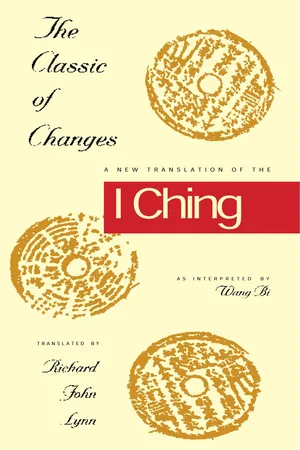
eBook - ePub
The Classic of Changes
A New Translation of the I Ching as Interpreted by Wang Bi
- English
- ePUB (mobile friendly)
- Available on iOS & Android
eBook - ePub
About this book
Information
Topic
PhilosophySubtopic
Eastern PhilosophyCommentary on the Appended Phrases [Xici zhuan], Part One
1. As Heaven is high and noble and Earth is low and humble, so it is that Qian [Pure Yang, Hexagram 1] and Kun [Pure Yin, Hexagram 2] are defined. {It is because Qian and Kun provide the gateway to the Changes that the text first makes clear that Heaven is high and noble and Earth is low and humble, thereby determining what the basic substances of Qian and Kun are.1} The high and the low being thereby set out, the exalted and the mean have their places accordingly. {Once the innate duty of Heaven to be high and noble and that of Earth to be low and humble are set down, one can extend these basic distinctions to the myriad things, so that the positions of all exalted things and all mean things become evident.} There are norms for action and repose, which are determined by whether hardness or softness is involved. {Hardness means action, and softness means repose. If action and repose achieve normal embodiment, the hardness and softness involved will be clearly differentiated.2} Those with regular tendencies gather according to kind, and things divide up according to group; so it is that good fortune and misfortune occur. {Thus similarities and differences exist, and gatherings and divisions occur. If one conforms to things with which he belongs, it will mean good fortune, but if one goes against things with which he belongs, misfortune will result.} In Heaven this [process] creates images, and on Earth it creates physical forms; this is how change and transformation manifest themselves. {“Images” here are equivalent to the sun, moon, and the stars, and “physical forms” here are equivalent to the mountains, the lakes, and the shrubs and trees. The images so suspended revolve on, thus forming the darkness and the light; Mountain and Lake reciprocally circulate material force [qi],3 thus letting clouds scud and rain fall.4 This is how “change and transformation manifest themselves.”} In consequence of all this, as hard and soft stroke each other, {That is, they urge each other on, meaning the way yin and yang stimulate each other.} the eight trigrams activate each other. {That is, they impel each other on, referring to the activation that allows change to fulfill its cyclical nature.}
It [the Dao] arouses things with claps of thunder, moistens them with wind and rain. Sun and moon go through their cycles, so now it is cold, now hot. The Dao of Qian forms the male; the Dao of Kun forms the female. Qian has mastery over the great beginning of things, and Kun acts to bring things to completion. {The Dao of Heaven and Earth starts things perfectly without deliberate purpose and brings them to perfect completion with no labor involved. This is why it is characterized in terms of ease and simplicity.}
Qian through ease provides mastery over things, and Kun through simplicity provides capability. As the former is easy, it is easy to know, and as the latter is simple, it is easy to follow. If one is easy to know, he will have kindred spirits; and if one is easy to follow, he will have meritorious accomplishments. {This is to be in accord with the innate tendencies of the myriad things, thus the text says, “He will have kindred spirits,” and here one is in tune with the design inherent in all things in the world, thus the text says: “He will have meritorious accomplishments.”} Once one has kindred spirits, he can endure, and once one has meritorious accomplishments, he can grow great. {With the virtues of ease and simplicity, one will achieve meritorious accomplishments that can endure and be great.} Being able to endure is inherent in a worthy man’s virtue, and being able to grow great is inherent in the enterprise of the worthy man. {Because of the ease and simplicity of Heaven and Earth, each of the myriad things carries the outer form of what it is. The worthy man does not act with deliberate purpose, yet of all the methods he might employ, each and every one will bring about his enterprise. Once virtue is realized and enterprise accomplished, these then become translated into concrete form. Thus it is by means of the worthy man that we are allowed to lay eyes on the virtue and enterprise [of Heaven and Earth].}
It is through such ease and simplicity that the principles of the world obtain. {Every single principle in the world derives from ease and simplicity, thus each thing manages to behave commensurate with its particular position.} As the principles of the world obtain in this way, they form positions here between them [Heaven and Earth]. {“Form positions” means the way the images are perfectly constituted. Only something capable of the utmost ease and simplicity will be able to provide a channel for the principles of the world. As these [hexagrams] provide channels for the principles of the world, they are able to form images and so provide links to Heaven and Earth. As the text says “between them,” such links are clearly to Heaven and Earth.}
2. The sages set down the hexagrams and observed the images. {This is the general summary [of what follows].} They appended phrases to the lines in order to clarify whether they signify good fortune or misfortune and let the hard and the soft lines displace each other so that change and transformation could appear. {It is by appending phrases that they clarified the good fortune and the misfortune involved, and it is by allowing the strong and the weak lines to displace each other that this good fortune and misfortune were brought to light. Good fortune and misfortune are inherent in the affairs of men, and change and transformation are inherent in how things go through their natural cycles.} Therefore, good fortune and misfortune involve images respectively of failure or success. {Because there is failure and success, good fortune and misfortune occur.} Regret and remorse involve images of sorrow and worry. {When the signs of failure or success are such that they do no more than cause sorrow and worry, the texts say “regret” and “remorse.”} Change and transformation involve images of advance and withdrawal. {Going forth prompts a coming back and vice versa; this means advance and withdrawal in turn.} The strong and the weak provide images of day and night. {If it is day, then it is yang and strong, and if it is night, then it is yin and weak. The text here first provides a general discussion of good fortune and misfortune, change and transformation, and then after that separately clarifies what is involved with regret and remorse, day and night. Regret and remorse are the equivalents of good fortune and misfortune, and, for their part, day and night are constituents of the change and transformation that make up the Dao. As regret and remorse belong with good fortune and misfortune, they rely in the same way on appended phrases to have their meaning made clear, and as day and night are constituents of the Dao of change and transformation, they equally become manifest through the strong and the weak. Thus the text begins with a general summary, then clarifies the difference between the greater and lesser types of failure and success, and finally distinguishes between the major and minor aspects of change and transformation. This is why the concepts involved are dealt with separately in this sequence.} The movement of the six hexagram lines embodies the Dao of the three ultimates {The three ultimates are the three powers [Heaven, Earth, and Man]. As the hexagrams are commensurate with the Dao of the three powers, they are able to reveal good fortune and misfortune and realize change and transformation.}
Therefore what allows the noble man to find himself anywhere and yet remain secure are the sequences presented by the Changes. {Sequences [xu] mean the succession of images [xiang] in the Changes.5} What he ponders with delight are the phrases appended to the lines. Therefore, once the noble man finds himself in a situation, he observes its image and ponders the phrases involved, and, once he takes action, he observes the change [of the lines] and ponders the prognostications involved. This is why, since Heaven helps him, “it is auspicious” and “nothing will fail to be advantageous.”
3. The Judgments [tuan] address the images, {A Judgment sums up the concept of an entire hexagram.} and the line texts address the states of change. {Each line text addresses itself to the change involved with that line.} The terms auspicious and inauspicious address the failure or success involved. The terms regret and remorse address the small faults involved. The expression there is no blame indicates success at repairing transgressions. Therefore the ranking of superior and inferior depends on the positions. {Where a line is situated is called a position. Among the six positions, there are those that are noble and those that are humble.} Distinction between a tendency either to the petty or to the great is an inherent feature of the hexagrams. {Hexagrams are devoted either to tendencies to the petty or to the great. Distinction here means the same as “differentiation,” which is what happens when “the Judgments address the images.”6} The differentiation of good fortune and misfortune depends on the phrases. {“The phrases” are the line texts. This is what is meant by “the line texts address the states of change.” It is by addressing the images that the petty and the great are brought to light, and it is by addressing change that good fortune and misfortune are clarified. Therefore concepts of either pettiness or greatness are inherent to the hexagrams, and the states of good fortune and misfortune are revealed in the phrases. As for regret, remorse, and “no blame,” they follow the same routine. Good fortune, misfortune, remorse and regret, “small fault,” and “no blame” all are produced by change, but since affairs include both the petty and the great, the text later addresses the differences among these five in turn.} The means to make one anxious about regret and remorse depend on the subtle, intermediate stages [jie]. {Jie means “small matters.” Wang Bi states [in section three of his General Remarks]: “Once one encounters occasions where one should be anxious about remorse and regret, even small matters must not be treated lightly.” Thus, remorse and regret are addressed to small faults.7} The means to arouse one so to have “no blame” depends on remorse. {The reason one suffers no blame is that he is good at repairing mistakes.} Arouse means “to move.” Thus to be moved so as to be without blame is inherent in the remorse one feels for one’s mistakes. This is why there are hexagrams that deal with decrease and those that deal with growth [of the Dao], and why there are appended phrases that impart a sense of danger and those that impart a sense of ease. {When this Dao shines brightly, it is said to be growing large, and when the Dao of the noble man is dwindling, it is said to be decreasing. If a hexagram is tending toward Peace [Tai, Hexagram 11], its phrases impart a sense of ease, but if a hexagram is tending toward Obstruction and Stagnation [Pi, Hexagram 12], its phrases impart a sense of danger.} The phrases, in fact, in each case indicate the direction taken.
4. The Changes is a paradigm of Heaven and Earth, {[The sages] made the Changes in order to provide a paradigm of Heaven and Earth.}, and so it shows how one can fill in and pull together the Dao of Heaven and Earth. Looking up, we use it [the Changes] to observe the configurations of Heaven, and, looking down, we use it to examine the patterns of Earth. Thus we understand the reasons underlying what is hidden and what is clear. We trace things back to their origins then turn back to their ends. Thus we understand the axiom of life and death. {The hidden and the clear involve images that have form and that do not have form. Life and death are a matter of fate’s allotment for one’s beginning and end.} With the consolidation of material force into essence [jingqi] a person comes into being, but with the dissipation of one’s spirit [youhun], change comes about. {When material force consolidates into essence, it meshes together, and with this coalescence, a person is formed. When such coalescence reaches its end, disintegration occurs, and with the dissipation o...
Table of contents
- Cover
- Title Page
- Copyright
- Contents
- Acknowledgments
- Introduction
- General Remarks on the Changes of the Zhou, by Wang Bi
- Commentary on the Appended Phrases, Part One
- Commentary on the Appended Phrases, Part Two
- Providing the Sequence of the Hexagrams
- The Hexagrams in Irregular Order
- Explaining the Trigrams
- The Sixty-Four Hexagrams, with Texts and Commentaries
- Bibliography
- Glossary
- List of Proper Nouns
- Index
- Chart of the Trigrams And Hexagrams
Trusted by 375,005 students
Access to over 1.5 million titles for a fair monthly price.
Study more efficiently using our study tools.
Frequently asked questions
Yes, you can cancel anytime from the Subscription tab in your account settings on the Perlego website. Your subscription will stay active until the end of your current billing period. Learn how to cancel your subscription
No, books cannot be downloaded as external files, such as PDFs, for use outside of Perlego. However, you can download books within the Perlego app for offline reading on mobile or tablet. Learn how to download books offline
Perlego offers two plans: Essential and Complete
- Essential is ideal for learners and professionals who enjoy exploring a wide range of subjects. Access the Essential Library with 800,000+ trusted titles and best-sellers across business, personal growth, and the humanities. Includes unlimited reading time and Standard Read Aloud voice.
- Complete: Perfect for advanced learners and researchers needing full, unrestricted access. Unlock 1.5M+ books across hundreds of subjects, including academic and specialized titles. The Complete Plan also includes advanced features like Premium Read Aloud and Research Assistant.
We are an online textbook subscription service, where you can get access to an entire online library for less than the price of a single book per month. With over 1.5 million books across 990+ topics, we’ve got you covered! Learn about our mission
Look out for the read-aloud symbol on your next book to see if you can listen to it. The read-aloud tool reads text aloud for you, highlighting the text as it is being read. You can pause it, speed it up and slow it down. Learn more about Read Aloud
Yes! You can use the Perlego app on both iOS and Android devices to read anytime, anywhere — even offline. Perfect for commutes or when you’re on the go.
Please note we cannot support devices running on iOS 13 and Android 7 or earlier. Learn more about using the app
Please note we cannot support devices running on iOS 13 and Android 7 or earlier. Learn more about using the app
Yes, you can access The Classic of Changes by Richard John Lynn in PDF and/or ePUB format, as well as other popular books in Philosophy & Eastern Philosophy. We have over 1.5 million books available in our catalogue for you to explore.