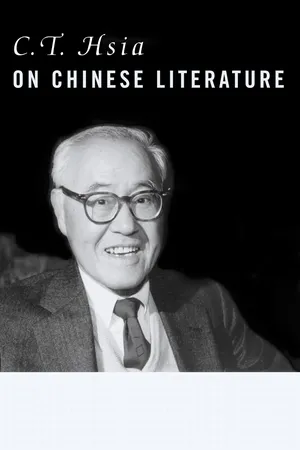
Best known for the groundbreaking works A History of Modern Chinese Fiction (1961) and The Classic Chinese Novel (1968), C. T. Hsia has gathered sixteen essays and studies written during his Columbia years as a professor of Chinese literature. Wider in range and scope, C. T. Hsia on Chinese Literature stands beside his two earlier books as part of his critical legacy to all readers seriously interested in the subject.
C. T. Hsia's writings on Chinese literature express a candor rare among his Western colleagues. Thus the first section of the book contains three essays that place Chinese literature in critical perspective, examining its substance and significance and questioning some of the critical approaches and methods adopted by Western sinologists for its study and appreciation. The second section has two essays on traditional drama—one on the Yuan masterpiece The Romance of the Western Chamber and the other a sophisticated study of the plays of the foremost Ming dramatist T'ang Hsien-tsu.
The third section is the richest and longest of the book, containing six essays on traditional and early modern fiction. At least four of these—on "The Military Romance" and the novels Flowers in the Mirror, The Travels of Lao Ts'an, and Jade Pear Spirit—are among the author's finest works. Finally, the fourth section of the book, covering modern fiction, includes one essay on the novel The Korchin Banner Plains, an essay on women in Chinese communist fiction, and three concise yet illuminating studies of the short story during the three republican decades before Mao, the first dozen years under Mao, and in Taiwan during the 1960s.
- English
- ePUB (mobile friendly)
- Available on iOS & Android
eBook - ePub
C. T. Hsia on Chinese Literature
About this book
Information
Subtopic
Asian Literary CriticismIndex
LiteratureGLOSSARY
In part I of this glossary all Chinese and Japanese names, titles, terms, and other expressions consisting of six characters or fewer are alphabetized. Only book titles, chapter headings, and titles of individual poems, stories, essays, and all such compositions and translations are italicized. In part II all Chinese names, titles, and qu...
Table of contents
- Cover
- Half title
- Title
- Copyright
- Dedication
- Contents
- Preface
- Acknowledgments
- I: Chinese Literature in Perspective
- II: Traditional Drama
- III: Traditional and Early Modern Fiction
- IV: Modern Fiction
- Notes
- Glossary
- Index
Trusted by 375,005 students
Access to over 1.5 million titles for a fair monthly price.
Study more efficiently using our study tools.
Frequently asked questions
Yes, you can cancel anytime from the Subscription tab in your account settings on the Perlego website. Your subscription will stay active until the end of your current billing period. Learn how to cancel your subscription
No, books cannot be downloaded as external files, such as PDFs, for use outside of Perlego. However, you can download books within the Perlego app for offline reading on mobile or tablet. Learn how to download books offline
Perlego offers two plans: Essential and Complete
- Essential is ideal for learners and professionals who enjoy exploring a wide range of subjects. Access the Essential Library with 800,000+ trusted titles and best-sellers across business, personal growth, and the humanities. Includes unlimited reading time and Standard Read Aloud voice.
- Complete: Perfect for advanced learners and researchers needing full, unrestricted access. Unlock 1.5M+ books across hundreds of subjects, including academic and specialized titles. The Complete Plan also includes advanced features like Premium Read Aloud and Research Assistant.
We are an online textbook subscription service, where you can get access to an entire online library for less than the price of a single book per month. With over 1.5 million books across 990+ topics, we’ve got you covered! Learn about our mission
Look out for the read-aloud symbol on your next book to see if you can listen to it. The read-aloud tool reads text aloud for you, highlighting the text as it is being read. You can pause it, speed it up and slow it down. Learn more about Read Aloud
Yes! You can use the Perlego app on both iOS and Android devices to read anytime, anywhere — even offline. Perfect for commutes or when you’re on the go.
Please note we cannot support devices running on iOS 13 and Android 7 or earlier. Learn more about using the app
Please note we cannot support devices running on iOS 13 and Android 7 or earlier. Learn more about using the app
Yes, you can access C. T. Hsia on Chinese Literature by C. T. Hsia in PDF and/or ePUB format, as well as other popular books in Literature & Asian Literary Criticism. We have over 1.5 million books available in our catalogue for you to explore.