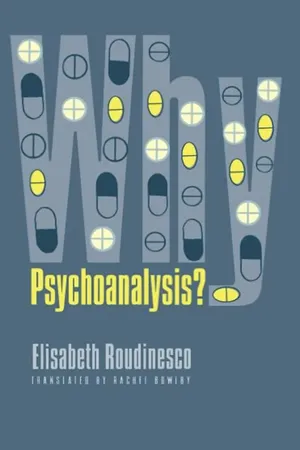
Why do some people still choose psychoanalysis-Freud's so-called talking cure-when numerous medications are available that treat the symptoms of psychic distress so much faster? Elisabeth Roudinesco tackles this difficult question, exploring what she sees as a "depressive society": an epidemic of distress addressed only by an increasing reliance on prescription drugs.
Far from contesting the efficacy of new medications like Prozac, Zoloft, and Viagra in alleviating the symptoms of any number of mental or nervous conditions, Roudinesco argues that the use of such drugs fails to solve patients' real problems. In the man who takes Viagra without ever wondering why he is suffering from impotence and the woman who is given antidepressants to deal with the loss of a loved one, Roudinesco sees a society obsessed with efficiency and desperate for the quick fix.
She argues that "the talking cure" and pharmacology represent not just different approaches to psychiatry, but different worldviews. The rush to treat symptoms is itself symptomatic of an antiseptic and depressive culture in which thought is reduced to the firing of neurons and desire is just a chemical secretion. In contrast, psychoanalysis testifies to human freedom and the power of language.
- English
- ePUB (mobile friendly)
- Available on iOS & Android
eBook - ePub
Why Psychoanalysis?
About this book
Information
Topic
MedicineSubtopic
Psychiatry & Mental HealthPART I
The Depressive Society
CHAPTER 1
The Defeat of the Subject
Nowadays, psychical suffering manifests itself in the form of depression. Depressive people, affected body and soul by this strange syndrome mixing sadness and apathy, the quest for identity, and the cult of oneself, no longer believe in the validity of any therapy. And yet, before rejecting all treatments, they seek desperately to conquer the emptiness of their desire. They thus move from psychoanalysis to psychopharmacology, and from psychotherapy to homeopathic medicine, without taking the time to reflect on the origin of their unhappiness. And indeed they no longer have the time for anything, even as the time of life and the time of leisure, the time of unemployment and the time of boredom are extended. Depressive individuals suffer all the more from the freedoms obtained because they no longer know how to use them.1
The more society favors emancipation by stressing the equality of everyone before the law, the more it accentuates differences. At the heart of this structure, everyone claims his or her singularity by refusing to identify with figures of universality deemed to have fallen into decay. So the era of subjectivity has given place to the era of individuality:2 giving themselves the illusion of a freedom without constraint, an independence without desire, and a historicity without history, people of today become the opposite of subjects. Far from constructing their beings on the basis of the consciousness of the unconscious determinations that pass through them unawares, far from being biological individuals,3 far from wanting to be free subjects, disengaged from their roots and their collectivity, they think themselves master of a destiny whose significance is reduced to a normative claim. Thus they attach themselves to networks, to groups, to collectives, to communities, without managing to affirm their true difference.4
It is certainly the nonexistence of the subject that determines not only current psychopharmacological prescriptions but the behaviors linked to psychical suffering.5 Each patient is treated as an anonymous being belonging to an organic totality. Immersed in a mass where each is in the image of a clone, they find they are prescribed the same range of medications whatever their symptoms. But at the same time, they seek another kind of outlet for their unhappiness. They fall back on scientific medicine, and at the same time they long for a therapy they think more appropriate to the recognition of their identity, thereby losing themselves in the labyrinth of alternative medicines.
Thus in Western societies we are seeing an unbelievable growth in the little world of bonesetters, wizards, clairvoyants, and mesmerists. In the face of a scientism elevated to the status of religion, and in the face of the cognitive sciences, which valorize the machine-person over the desiring person,6 we see the counterflourishing of all sorts of practices, sometimes arising out of the prehistory of Freudianism, sometimes out of an occult conception of body and mind: mesmerism, sophrology, naturopathy, iridology, auriculotherapy, transpersonal energetics, suggestology, mediumism, and so forth. Contrary to what one might think, these practices attract the middle classes—office workers, professional people, and upper-level management—more than lower-class groups who, in spite of the increasing precariousness of social life, are still attached to a republican conception of scientific medicine.7
The common denominator of these practices is that they all offer a belief—and thus an illusion of cure—to people who are reasonably well off but destabilized by the economic crisis and who feel they are victims, sometimes of medical technology that is too remote from their suffering and sometimes of medicine’s real inability to cure particular functional disorders. Thus the weekly news magazine L’Express published an opinion poll revealing that 25 percent of French people now seek a solution to their existential problems in reincarnation and the belief in previous lives.8
Modern democratic society wants to banish from view the reality of unhappiness, death, and violence, even as it seeks to integrate differences and resistances into a single system. It has tried to abolish the idea of social conflict, in the name of global politics and economic success. In the same way, it tends to treat revolutions as criminal and to deheroicize war, with a view to replacing politics with ethics, historical judgment with judicial sanction. It has thus moved from the age of confrontation to the age of avoidance and from the cult of glory to the valorization of the cowardly. It is not shocking nowadays to prefer Vichy to the Resistance or to transform heroes into traitors, as recently happened with Jean Moulin or Lucie and Raymond Aubrac. Never before has the duty of remembering been so celebrated, never before has there been so much preoccupation with the Shoah and the extermination of the Jews, and yet never has the reassessment of history been so far off.
Whence a conception of norm and pathology that rests on an intangible principle: each individual has the right, and thus the duty, of no longer showing their suffering, of no longer becoming enthusiastic about the tiniest ideal, other than pacifism or humanitarian morality. As a result, hatred of the other has become devious, perverse, and all the more formidable in that it puts on the mask of devotion to the victim. If hatred of the other is first of all hatred of the self, then like all masochism it rests on the imaginary negation of otherness. So the other is always a victim, and this is the reason why intolerance is generated by the wish to set up over the other the sovereign coherence of a narcissistic self whose ideal would be to destroy it before it could even exist.9
Since neurobiology seems to affirm that all psychical disturbances are linked to an abnormality in the functioning of nervous cells, and since adequate medication exists, why should we worry? Today, it is no longer a question of entering into struggle with the world but of avoiding litigation by applying a strategy of normalization. So it will come as no surprise that the unhappiness that one is claiming to exorcise should make its return in an overwhelming way in the field of social and affective relations: recourse to the irrational, the cult of minor differences, valorization of emptiness and stupidity, and so on. The violence of calm10 is often more dreadful than passing through storms.
An attenuated form of the old melancholia, depression dominates contemporary subjectivity in the way that the hysteria of the end of the nineteenth century reigned in Vienna, through Anna O., Josef Breuer’s famous patient, or in Paris, with Augustine, Charcot’s renowned madwoman at the Salpêtrière hospital. On the eve of the third millennium, depression has become the psychical epidemic of democratic societies, even as treatments offering every consumer an honorable solution proliferate. Of course, hysteria has not disappeared, but it is increasingly experienced and treated as a form of depression. Yet this replacement of one paradigm by another is not innocent.11
The substitution is in fact accompanied by a valorization of the normalizing psychological processes, to the detriment of different forms of exploration of the unconscious. Treated as depression, contemporary neurotic conflict no longer seems to derive from any psychical causality arising from the unconscious. And yet the unconscious reappears through the body, opposing a strong resistance to the disciplines and practices seeking to get rid of it. Whence the relative failure of the multiplying therapies. However much they exert themselves compassionately at the bedside of the depressive subject, they don’t succeed in curing her or in grasping the true causes of her torment. All they do is to improve her state by letting her hope for better days: “Depressed people suffer all over,” writes the rheumatologist Marcel Francis Kahn, “which is well known. What is less well known is that one also sees conversion syndromes as spectacular as the ones observed by Charcot and Freud. Hysteria has always given pride of place to the locomotive mechanism. We are struck to see how far it can be forgotten. How far, too, the fact of mentioning hysteria gives rise, on the part of both medical and nonmedical caregivers, to anxiety, refusal, even aggression—in regard to the patient but also to the person making the diagnosis.”12
We know that Freud’s invention of a new figure of the psyche presupposed the existence of a subject capable of internalizing prohibitions. Immersed in the unconscious and riven by a guilty conscience, this subject, given up to its instincts by the death of god, is constantly at war with itself. From this follows the Freudian conception of neurosis, centered on discord, anguish, guilt, disturbances of sexuality. It is this idea of subjectivity, so characteristic of the coming of democratic societies, themselves based on the idea of permanent confrontation between the same and the other, that is being erased from contemporary mental organization, replaced by the psychological notion of depressive personality.
Derived from neurasthenia, a notion abandoned by Freud, and from the psychasthenia described by Pierre Janet, depression is not a neurosis, or a psychosis, or a form of melancholia but a feeble entity referring to a “state” thought of in terms of “fatigue,” “deficit,” or “weakening of the personality.” The growing success of this designation demonstrates clearly that the democratic societies of the end of the twentieth century have ceased to privilege conflict as the normative kernel of the formation of subjectivity. In other words, in place of the Freudian conception of a subject of the unconscious, conscious of his or her liberty but haunted by sex, death, and prohibition, there is the more psychological conception of a depressive individual fleeing his or her unconscious and concerned to rub out the essence of all conflict in himself.13
Freed from prohibitions by the equalization of rights and the leveling of conditions, the depressed person at the end of the century has inherited an addictive dependence on the world. Condemned to exhaustion by the absence of a revolutionary perspective, he or she seeks in drugs or religion, in devotion to health or the cult of the perfect body, the ideal of an impossible happiness. “For this reason,” concludes Alain Ehrenberg, “the drug addict is nowadays the symbolic figure used to define the features of an antisubject. In previous ages, it was the madman who occupied this place. If depression is the history of a subject who cannot be found, addiction is nostalgia for a lost subject.”14
Instead of fighting this imprisonment, which leads to the abolition of subjectivity, depressive liberal society is happy to pursue its logic. So nowadays consumers of tobacco, alcohol, and psychotropic drugs are assimilated to drug addicts regarded as a danger to themselves and to the group. Among these new “sick people,” the nicotine addicts and the alcoholics are treated as depressives to whom you prescribe psychotropic drugs. What medications of the mind will have to be invented in the future to treat the dependence of those who have been “cured” of their alcoholism, their nicotine addiction, or another addiction (to sex, food, sport, etc.) by the replacement of one form of abuse with another?
CHAPTER 2
The Medications of the Mind
Since 1950 chemical substances—or psychotropic drugs—have changed the landscape of madness. They have emptied the mental hospitals and replaced straitjackets and shock treatments with the soft wrapping of medication.1 Although they do not cure any mental or nervous illnesses, they have revolutionized representations of the psyche by fabricating new human beings, smooth and moodless, exhausted by avoiding passions, ashamed of not conforming to the ideal offered to them.
Prescribed as much by general practitioners as by specialists in psychopathology, psychotropic drugs have the effect of normalizing behaviors and suppressing the most painful symptoms of psychical suffering without seeking to find their meaning.
Psychotropic drugs are classified into three groups: psycholeptics, psychoanaleptics, and psychodysleptics. The first group includes hypnotic drugs, which treat sleeping difficulties; anxiolytics and tranquilizers, which suppress the signs of distress, anxiety, phobia, and various other neuroses; and finally neuroleptics (or antipsychotics), medications specifically for psychosis and all forms of chronic or acute delirium. The second group brings together stimulants and antidepressives; and the third, hallucinogenic medications, narcotics, and mood-controlling drugs.
Psychopharmacology initially brought humanity a renewal of freedom. Launched in 1952 by two French psychiatrists, Jean Delay and Pierre Deniker, neuroleptics let the insane speak again. They made it possible for them to be reintegrated into society. Thanks to these drugs, barbaric and ineffective treatments were abandoned. Meanwhile, anxiolytics and antidepressants brought greater tranquility to neurotic and depressed people.
Through belief in the power of its potions, however, psychopharmacology ended up losing a part of its prestige, in spite of its formidable efficacy. In effect, what it did was to shut subjects up in a new form of alienation by claiming to cure them of the very essence of the human condition. It thereby fostered, through its illusions, a new form of irrationalism. For the more an “end” to psychical suffering is promised through the absorption of pills, which never do more than alleviate symptoms or alter a personality, the more subjects then turn, in their disappointment, to bodily or magical types of treatment.
It will come as no surprise that the excesses of pharmacology have been denounced by the very people who previously celebrated it and who nowadays demand that mind medicines be administered in a more rational way and in conjunction with other forms of cure: psychotherapy and psychoanalysis. This was already the opinion of Jean Delay, the principal French exponent of biological psychiatry, who was declaring in 1956: “We should recall that in psychiatry, medication is only one aspect of the treatment of a mental illness and that psychotherapy continues to be the fundamental treatment.”2
And the drugs’ inventor, Henri Laborit, has always maintained that psychopharmacology was not, as such, the solution to all the problems:
Why is one happy to have psychotropic drugs? Because the society we live in is intolerable. People can’t sleep anymore, they are distressed, they need to be tranquilized, more so in the big cities than elsewhere. I am sometimes reproached for having invented the chemical straitjacket. But what has no doubt been forgotten is the time when, as a duty doctor in the Marines, I entered the disturbed patients’ wing with a revolver and two sturdy male nurses, because the patients were at breaking point in their strait-jackets, sweating and shouting.… In the cou...
Table of contents
- Cover
- Half title
- Series Page
- Title
- Copyright
- Epigraph
- Contents
- Translator’s Note
- Preface
- Part 1: The Depressive Society
- Part 2: The Great Quarrel Over the Unconscious
- Part 3: The Future Of Psychoanalysis
- Notes
- Index
- Series List
Trusted by 375,005 students
Access to over 1.5 million titles for a fair monthly price.
Study more efficiently using our study tools.
Frequently asked questions
Yes, you can cancel anytime from the Subscription tab in your account settings on the Perlego website. Your subscription will stay active until the end of your current billing period. Learn how to cancel your subscription
No, books cannot be downloaded as external files, such as PDFs, for use outside of Perlego. However, you can download books within the Perlego app for offline reading on mobile or tablet. Learn how to download books offline
Perlego offers two plans: Essential and Complete
- Essential is ideal for learners and professionals who enjoy exploring a wide range of subjects. Access the Essential Library with 800,000+ trusted titles and best-sellers across business, personal growth, and the humanities. Includes unlimited reading time and Standard Read Aloud voice.
- Complete: Perfect for advanced learners and researchers needing full, unrestricted access. Unlock 1.5M+ books across hundreds of subjects, including academic and specialized titles. The Complete Plan also includes advanced features like Premium Read Aloud and Research Assistant.
We are an online textbook subscription service, where you can get access to an entire online library for less than the price of a single book per month. With over 1.5 million books across 990+ topics, we’ve got you covered! Learn about our mission
Look out for the read-aloud symbol on your next book to see if you can listen to it. The read-aloud tool reads text aloud for you, highlighting the text as it is being read. You can pause it, speed it up and slow it down. Learn more about Read Aloud
Yes! You can use the Perlego app on both iOS and Android devices to read anytime, anywhere — even offline. Perfect for commutes or when you’re on the go.
Please note we cannot support devices running on iOS 13 and Android 7 or earlier. Learn more about using the app
Please note we cannot support devices running on iOS 13 and Android 7 or earlier. Learn more about using the app
Yes, you can access Why Psychoanalysis? by Elisabeth Roudinesco, Rachel Bowlby in PDF and/or ePUB format, as well as other popular books in Medicine & Psychiatry & Mental Health. We have over 1.5 million books available in our catalogue for you to explore.