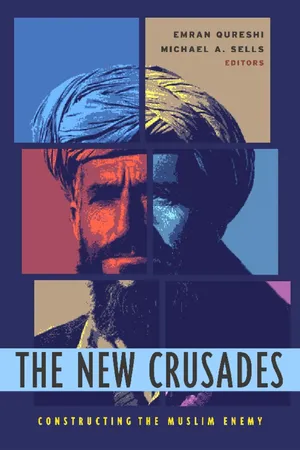
Not since the Crusades of the Middle Ages has Islam evoked the degree of fear, hostility, and ethnic and religious stereotyping that is evident throughout Western culture today. As conflicts continue to proliferate around the globe, the perception of a colossal, unyielding, and unavoidable struggle between Islam and the West has intensified. These numerous conflicts, both actual and ideological, have revived fears of an ongoing "clash of civilizations"—an intractable and irreconcilable conflict of values between Western cultures and an Islam that is portrayed as hostile and alien.
The New Crusades takes head-on the idea of an emergent "Cold War" between Islam and the West. It explores the historical, political, and institutional forces that have raised the specter of a threatening and monolithic Muslim enemy and provides a nuanced critique of much received wisdom on the topic, particularly the "clash of civilizations" theory. Bringing together twelve of the most influential thinkers in Middle Eastern and religious studies—including Edward Said, Roy Mottahedeh, and Fatema Mernissi—this timely collection confronts such depictions of the Arab-Islamic world, showing their inner workings and how they both empower and shield from scrutiny Islamic radicals who operate from similar paradigms of inevitable and absolute conflict.
eBook - ePub
The New Crusades
Constructing the Muslim Enemy
- English
- ePUB (mobile friendly)
- Available on iOS & Android
eBook - ePub
The New Crusades
Constructing the Muslim Enemy
About this book
Information
Topic
Theology & ReligionSubtopic
TerrorismPart I
Palace Fundamentalism and Liberal Democracy
Islamic fundamentalism is usually perceived by Western liberal democracies as something not only alien to, but also entirely incompatible with, their philosophical and ethnical foundations. Often, though, they fail to make even the elementary distinction between Islamic fundamentalism—an authoritarian ideology and political system, which sacralizes hierarchy and repudiates pluralism—and Islam as a religion and a culture. Thus the incompatibility between Islam and the West has been promoted, since the fall of the communist camp, as the principal field of conflict and lurking danger in the next century.
After making the necessary distinction between Islam as a culture and fundamentalism as a political ideology, I would like to suggest that the liberal democracies in fact have a history of promoting Islamic fundamentalism; and that, in particular, they have made extraordinary profits from Saudi fundamentalism. The internationally overwhelming role of Saudi Arabia as promoter of a kind of aggressive “petro-fundamentalism”—with its primitive messages of obedience (Ta’a), intolerance, misogyny and xenophobia—is inconceivable without the liberal democracies’ strategic support of conservative Islam, both as a bulwark against communism and as a tactical resource for controlling Arab oil.
Saudi Wahhabism (named after its preacher Muhammed Ibn ‘Abd al-Wahhab, 1703–92) is, by the standards of many Moslems, one of the most fanatical sects of extremist Islam. It insists upon a return to the “ideal” customs of seventh-century Arab desert tribes and considers everything “added” since the prophet’s time to be a foreign perversion—including all scientific and cultural achievements (with their Hellenistic and Persian components). Beginning with the alliance between the preacher Abdelwahab and the warrior Emir Muhammad Ibn Saud in 1740, Wahhabism unsuccessfully tried to invade neighboring areas. It was halted and crushed by the Ottoman Turks at the beginning of the nineteenth century.
After complete marginalization for more than a century, Wahhabism reemerged with the discovery of oil, becoming a trump card in the energy and cold war strategies of the liberal democracies. Fanatical Wahhabism proved to be an extraordinary machine for manufacturing “certainty” in world politics, since it concentrated control over one of the planet’s most important sources of petroleum, and the major assets of 230 million Arab citizens, in the hands of one prince and his close court.1
Here we see one of the most puzzling marriages of the century: the bond between a fanatical creed and the most modern liberal states. How is this possible? How can liberal democracies oppose democratization in the Arab world? How can liberal democracies support authoritarianism and tyranny? This brings us to the almost unthinkable question: Can liberal democracies be irrational? Concern has been increasing for decades within these countries that the growth and consolidation of a very ambiguous managerial corporate power interferes with the fundamental principles of pluralism and democracy,2 but this has not seemed to shake the average Westerner’s strong belief in the pretension of the society to rationality and respect of the individual.
On the contrary, many people in the West would tend to reject as absurd the idea that their government supports Saudi palace fundamentalism, because this destabilizes the comfortable duality according to which the West is rational and progressive, and the East is a dark hole of irrationality and barbarism. Furthermore, many Westerners think it normal to believe that Islam is irrational; and when they say “Islam,” they mean not only the civilization with its religions and cultural heritage and philosophical worldview, but also the entire population, regardless of class, sex, ethnic, or economic interests. Their word “Islam” refers to an indiscriminate magma of people who have the same interests and share the same fanaticism; and their unquestionable popular slogan is “Islam is Irrational.” But the game becomes more interesting if we include the liberal democracies in the discussion.
Is Islam Irrational? Are the Liberal Democracies Rational?
Liberal democracies, as Francis Fukuyama describes them, leave an Arab woman bathing in dream-like envy. According to Fukuyama, they are uncompromisingly ethical and universalist: “The chief psychological imperative underlying democracy is the desire for universal and equal recognition…. Only liberal democracy can rationally satisfy the human desire for recognition, through the granting of elementary rights of citizenship on a universal and equal basis”3 Many experts like Fukuyama and Samuel Huntington go on to predict that, after the fall of the communist bloc, the next challenge to universalist liberal democracies will come from authoritarian regimes in general and theocracies in particular.4 Islam, unlike Confucianism, is singled out as the enemy most totally incompatible with liberal democracies’ philosophies and interests.
The problem here is that equating Islam with irrationality immediately turns the world’s 1.2 billion Muslims into potential enemies. Since creating such masses of enemies is a bellicosity smacking more of irrationality than of cold analysis, and since many Western intellectuals have produced “scientific” and “philosophical” grounds for sustaining this crusade in academic circles, while neo-fascist mobs attack Muslims in many European cities,5 I suggest that we try to reformulate the question.
If we define irrationality as basically the intolerant behavior of a person or system believing in certainty, and therefore holding that there is only one truth and that those who think otherwise ought to be repressed, then rationality could be defined as the opposite—as what Ralf Dahrendorf has called the “ethics of uncertainty.” “The ethics of uncertainty are the ethics of liberty, and the ethics of liberty are the ethics of conflict, of antagonism generated and institutionalized.”6 Within this framework, we can assume without being completely unrealistic that there must be in the Muslim world some individuals and some institutions (banks, firms, factories) that operate rationally and see their survival as vitally depending on the institutionalization of conflict. Such would certainly be the case for individuals belonging to religious and ethnic minorities (Copts in Egypt, Christians in Sudan, Kurds in Iraq, Berbers in Algeria and Morocco, and so forth), for women who suffer from official legal discrimination, and for free thinking intellectuals, or simply for individuals who have interests that conflict with the ruling elites.7
We can also assume, without being too unrealistic, that some Western citizens and some institutions, although belonging to liberal democracies, might identify a despotic irrationality (as defined above) as suitable for the pursuit of their interests. We hear daily about scandalous aberrations in the ethical rules regulating the liberal market and the political systems of representative democracy. Corrective devices exist in the economic and political systems of the latter precisely because irrationality is assumed to be a possible choice for some individuals.
Assuming that citizens of liberal democracies are rational at all times and in all situations eliminates the dimension of “uncertainty” so essential to rationality and smacks of a Muslim Imam’s fiat. But once we assume rationality and irrationality to be possible in both liberal democracies and Muslim countries, we can reformulate the question as follows: How can we increase the scope of rationality in the Muslim world? Of course, another question follows immediately: Who are “we”? “We” could be any individuals, regardless of culture and nationality, who are interested in nurturing the chances of rationality in the next century; and this “we” represents millions of lovers of peace and justice within and outside the Muslim world. In fact, the most difficult of all intellectual enterprises is the attempt to separate “East” from “West”.
Focusing our attention on how to increase rationality in the Muslim world has at least a few advantages. The first is that it frees us of the racist bias inherent in opening a debate about which cultural group is rational and which is not. The second is that it empowers us—both “Westerns” and “Muslims”—by helping us identify key factors that can increase the chances of rational problem-solving methods and reduce violent outcomes to conflict. By focusing on the people, on the citizens’ desire to exercise their free choice, we reveal the political nature of the conflict. If, to justify their budgets, some generals and arms lobbies find it appropriate to blow cultural differences into a Medieval crusade, we should not jump blindly onto their bandwagon, because we might have different interests—such as promoting dialogue, tolerance, and global responsibility, which is, at any rate, the ultimate goal of this essay.
Now let us further narrow the scope of the question to the following: How can we increase the chances for rationality in the Arab world, considering the two determinant strategic factors, which are oil and arms sales? For when one looks at the issue through the perspective of Arab oil, the landscape shifts dramatically, and strange sights begin to appear. The incompatibility between Beauty (ethical liberal democracies) and the Beast (authoritarian Islam) disappears entirely. As in The Tales of a Thousand and One Nights, Beauty and the Beast can then be seen entwined together, Liberal Democracies and Wahhabism in intimate embrace.
What does this mean for the livelihood of people in the Arab world, and in particular for women and minorities who are singled out as sacrificial victims by fanatics? It means repression (not only of women and minorities, but of all political dissent), support for fanatical political movements, and an irrational use of resources which could provide a decent standard of living for all people, both in the Arab world and outside it. Growing poverty and joblessness in the Arab region (and outside it) oblige us to question the way profits from oil are profligately invested in arms. They force us to ask the only question worth asking: How can we change the situation? How can we create a model of oil management that enhances dignity and well being in both West and East?
The Hijacking of Arab Jobs by the Western Arms Industry
Today, the number of unemployed in the Middle East and North Africa is estimated at ten million.8 But a look at the national budgets of the Arab states in general, and of Saudi Arabia in particular, shows that Arab money goes to buy arms which create jobs in Los Angeles and France, rather than in Cairo and Casablanca.9
The Middle East is a bonanza market for arms sales—the largest in the world. While the arms purchases of developed countries represented one quarter of the world market in 1985, for example, those of the Middle East amounted to 35 percent—down from 43 percent in the two previous years. The end of the Cold War ought to have reduced arms supplies to the region. One might also have expected that the defeat of Iraq and the concentration on the peace process between Israel and its neighbors would have led to a substantial reduction in arms purchases, but his has not been so.
An overview of arms sales published in the latest report of the United States Arms Control and Disarmament Agency reveals that while these sales throughout the world are substantially decreasing, the Middle East scores higher than ever, with military expenditures representing 54 percent of public outlays and 20 percent of the GNP of these countries.10 The only significant change since the end of the Cold War and the Gulf War is that the United States now tops the list as the most important arms supplier for the Third World, replacing the Soviet Union. America’s most greedy client is Saudi Arabia, with yearly arms purchases of 3.5 to 4 billion dollars.11
At a time of tragic global elimination of jobs, associated with a process of seemingly irresistible structural technological transformation, American and French presidents (as well as others from important arms-producing nations) scour the planet to secure employment for their citizens. The transformation of the heads of state of some major liberal democracies into salesmen seems neither a transient feature of current affairs nor an ethically doubtful event. On the contrary, it looks like an important shift in the role of the state in the post-modern global market. A recent issue of Newsweek, with a title story dedicated to “The New Diplomacy: Uncle Sam as Salesman,” announces: “Now that the Cold War is over, Washington is reaffirming to the world that in foreign policy, the business of America is business.” The American Secretary of State, Warren Christopher, is quoted as saying that if “for a long time Secretaries of State thought of economics as ‘low policy’ while they dealt only with high science like arms control, I make no apologies for putting economics at the top of our foreign policy agenda.”12 But of course American heads of state and diplomats are not the only ones helping their industries to get contracts; the leaders of other major powers do their best as well.
The...
Table of contents
- Cover
- Half title
- Title
- Copyright
- Dedication
- Contents
- Preface: A Tribute to Eqbal Ahmad
- Acknowledgments
- Introduction: Constructing the Muslim Enemy
- Part I
- Part II
- List of Contributors
- Index
Trusted by 375,005 students
Access to over 1.5 million titles for a fair monthly price.
Study more efficiently using our study tools.
Frequently asked questions
Yes, you can cancel anytime from the Subscription tab in your account settings on the Perlego website. Your subscription will stay active until the end of your current billing period. Learn how to cancel your subscription
No, books cannot be downloaded as external files, such as PDFs, for use outside of Perlego. However, you can download books within the Perlego app for offline reading on mobile or tablet. Learn how to download books offline
Perlego offers two plans: Essential and Complete
- Essential is ideal for learners and professionals who enjoy exploring a wide range of subjects. Access the Essential Library with 800,000+ trusted titles and best-sellers across business, personal growth, and the humanities. Includes unlimited reading time and Standard Read Aloud voice.
- Complete: Perfect for advanced learners and researchers needing full, unrestricted access. Unlock 1.5M+ books across hundreds of subjects, including academic and specialized titles. The Complete Plan also includes advanced features like Premium Read Aloud and Research Assistant.
We are an online textbook subscription service, where you can get access to an entire online library for less than the price of a single book per month. With over 1.5 million books across 990+ topics, we’ve got you covered! Learn about our mission
Look out for the read-aloud symbol on your next book to see if you can listen to it. The read-aloud tool reads text aloud for you, highlighting the text as it is being read. You can pause it, speed it up and slow it down. Learn more about Read Aloud
Yes! You can use the Perlego app on both iOS and Android devices to read anytime, anywhere — even offline. Perfect for commutes or when you’re on the go.
Please note we cannot support devices running on iOS 13 and Android 7 or earlier. Learn more about using the app
Please note we cannot support devices running on iOS 13 and Android 7 or earlier. Learn more about using the app
Yes, you can access The New Crusades by Emran Qureshi,Michael A. Sells, Emran Qureshi, Michael Sells in PDF and/or ePUB format, as well as other popular books in Theology & Religion & Terrorism. We have over 1.5 million books available in our catalogue for you to explore.