Stand, Columbia! Alma Mater
Through the storms of Time abide
Stand, Columbia! Alma Mater
Through the storms of Time abide.
"Stand, Columbia!" by Gilbert Oakley Ward, Columbia College 1902 (1904)
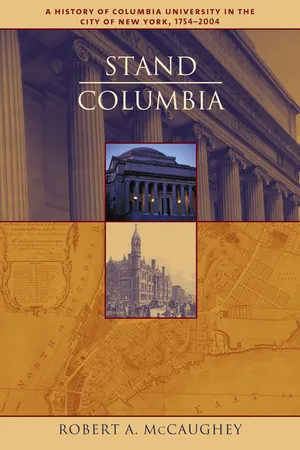
Marking the 250th anniversary of one of America's oldest and most formidable educational institutions, this comprehensive history of Columbia University extends from the earliest discussions in 1704 about New York City being "a fit Place for a colledge" to the recent inauguration of president Lee Bollinger, the nineteenth, on Morningside Heights. One of the original "Colonial Nine" schools, Columbia's distinctive history has been intertwined with the history of New York City. Located first in lower Manhattan, then in midtown, and now in Morningside Heights, Columbia's national and international stature have been inextricably identified with its urban setting.
Columbia was the first of America's "multiversities," moving beyond its original character as a college dedicated to undergraduate instruction to offer a comprehensive program in professional and graduate studies. Medicine, law, architecture, and journalism have all looked to the graduates and faculty of Columbia's schools to provide for their ongoing leadership and vitality. In 2003, a sampling of Columbia alumni include one member of the United States Supreme Court, three United States senators, three congressmen, three governors (New York, New Jersey, and California), a chief justice of the New York Court of Appeals, and a president of the New York City Board of Education. But it is perhaps as a contributor of ideas and voices to the broad discourse of American intellectual life that Columbia has most distinguished itself. From The Federalist Papers, written by Columbians John Jay and Alexander Hamilton, to Charles Beard's An Economic Interpretation of the Constitution and Jack Kerouac's On the Road to Edward Said's Orientalism, Columbia and its graduates have greatly influenced American intellectual and public life. Stand, Columbia also examines the experiences of immigrants, women, Jews, African Americans, and other groups as it takes critical measure of the University's efforts to become more inclusive and more reflective of the diverse city that it calls home.
- English
- ePUB (mobile friendly)
- Available on iOS & Android
eBook - ePub
About this book
Information
Topic
EducationSubtopic
Higher EducationTable of contents
- Cover
- Half title
- Title
- Copyright
- Epigraph
- Contents
- List of Illustrations
- Acknowledgments
- Chapter 1. Tory Preamble: The Short History of King’s College
- Chapter 2. Flirting with Republicanism
- Chapter 3. Knickerbocker Days: The Limits of Academic Reform
- Chapter 4. Midcentury Stirrings
- Chapter 5. Takeoff
- Chapter 6. The Aspect of a University
- Chapter 7. Bolt to the Top
- Chapter 8. 1917: Twilight of Idols
- Chapter 9. Jews at Columbia
- Chapter 10. The Invention of Columbia College
- Chapter 11. Prosperity Lost
- Chapter 12. Columbia in the American Century
- Chapter 13. A Second Flowering
- Chapter 14. Afternoon on the Hudson
- Chapter 15. Riding the Whirlwind: Columbia ‘68
- Chapter 16. It’s About Columbia
- Chapter 17. A Tough Place
- Chapter 18. Bottoming Out
- Chapter 19. Columbia Recovered
- Chapter 20. The Way We Are
- Epilogue: Worth the Candle?
- Notes
- Bibliographical Note
- Index
Trusted by 375,005 students
Access to over 1.5 million titles for a fair monthly price.
Study more efficiently using our study tools.
Frequently asked questions
Yes, you can cancel anytime from the Subscription tab in your account settings on the Perlego website. Your subscription will stay active until the end of your current billing period. Learn how to cancel your subscription
No, books cannot be downloaded as external files, such as PDFs, for use outside of Perlego. However, you can download books within the Perlego app for offline reading on mobile or tablet. Learn how to download books offline
Perlego offers two plans: Essential and Complete
- Essential is ideal for learners and professionals who enjoy exploring a wide range of subjects. Access the Essential Library with 800,000+ trusted titles and best-sellers across business, personal growth, and the humanities. Includes unlimited reading time and Standard Read Aloud voice.
- Complete: Perfect for advanced learners and researchers needing full, unrestricted access. Unlock 1.5M+ books across hundreds of subjects, including academic and specialized titles. The Complete Plan also includes advanced features like Premium Read Aloud and Research Assistant.
We are an online textbook subscription service, where you can get access to an entire online library for less than the price of a single book per month. With over 1.5 million books across 990+ topics, we’ve got you covered! Learn about our mission
Look out for the read-aloud symbol on your next book to see if you can listen to it. The read-aloud tool reads text aloud for you, highlighting the text as it is being read. You can pause it, speed it up and slow it down. Learn more about Read Aloud
Yes! You can use the Perlego app on both iOS and Android devices to read anytime, anywhere — even offline. Perfect for commutes or when you’re on the go.
Please note we cannot support devices running on iOS 13 and Android 7 or earlier. Learn more about using the app
Please note we cannot support devices running on iOS 13 and Android 7 or earlier. Learn more about using the app
Yes, you can access Stand, Columbia by Robert McCaughey in PDF and/or ePUB format, as well as other popular books in Education & Higher Education. We have over 1.5 million books available in our catalogue for you to explore.