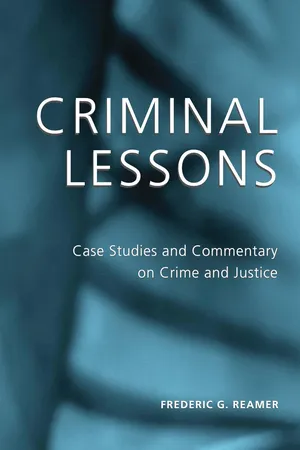
Why do people commit crimes? How can crime be prevented? And what can society and criminal justice professionals do to implement constructive responses to criminal behavior? Summarizing what he has learned about crime and criminals during his long career, one of social work's most distinguished theoreticians speculates about the factors that lead to crime and considers what we can do to prevent and respond to it meaningfully. Criminal Lessons is based on more than thirteen thousand cases in which Frederic G. Reamer has been involved as a parole board member, a role that was supplemented by his earlier experiences working in a federal correctional facility, a state penitentiary, and a forensic unit in a state psychiatric hospital.
Reamer presents an original and compelling typology of crime that classifies offenders on the basis of the circumstances that led to their offenses. He isolates seven categories, tracing crime to desperation, greed, rage, revenge, frolic, addiction, or mental illness. Using actual case studies to illustrate these patterns of 'criminal circumstances,' Reamer presents a model for the prevention of, and response to, crime and throughout the book offers recommendations related to social services, criminal justice, and public policy.
- English
- ePUB (mobile friendly)
- Available on iOS & Android
eBook - ePub
About this book
Trusted by 375,005 students
Access to over 1.5 million titles for a fair monthly price.
Study more efficiently using our study tools.
Information
Subtopic
Criminal LawIndex
Law1
First Lessons
Like many people—the general public, politicians, human service professionals, and professionals in the criminal justice field—I have spent years trying to understand crime and criminals. My journey started early. I clearly recall my first horror-filled realization that some people commit crimes so serious that they are imprisoned. When I was six years old my father took my older brother and me to the local library in my Baltimore neighborhood. While a librarian assisted my brother, I scanned books on the lower shelves in the stacks. Quite by accident my eyes landed on a book jacket that featured a photograph of an inmate in a prison cell. Intrigued, I reached for the book and sat on the floor staring at photo after photo. I remember feeling startled, curious, and unnerved. What, I wondered, had these people done to deserve being locked up in these cages? Why would these men do such terrible things? What was it like for them to be in prison?
During many subsequent trips to that library, I headed straight for that book. In a sense, I still have not put it down. Little did I know then that my naive fascination at six would turn into a lifelong preoccupation with these questions. Along the way I have spent considerable time working with convicted criminals. My tour of duty has included a stint as a group worker and social worker in a U.S. Bureau of Prisons institution in Chicago in the mid-1970s (the Metropolitan Correctional Center), the maximum-security state penitentiary in Jefferson City, Missouri, in the early 1980s, and the forensic unit of the state psychiatric hospital in Rhode Island in the mid-1980s. Since 1992 I have served on the Rhode Island Parole Board.
This book sums up what I have learned from these experiences about crime and criminals. It is based primarily on the more than thirteen thousand cases in which I have been involved as a parole board member, supplemented by my earlier experiences working in a federal correctional facility, a state penitentiary, and a forensic unit in a state psychiatric hospital (the forensic unit housed mentally ill prisoners and “patients” who had been found not guilty of a crime by reason of insanity or were not competent, psychiatrically, to stand trial). My purpose is to reflect on my encounters with a remarkably diverse group of criminals and to speculate about what leads to crime and what we, as a society, can do to prevent and respond to it meaningfully.
Of course, I am hardly the first person to pursue this topic. Hundreds of books address the subjects of crime, criminal behavior, and the criminal justice system. Serious scholarly observations and conclusions about the causes and consequences of crime fill these thoughtful tomes. There is no need for me to be redundant or to cover the same ground.
Put simply, the vast majority of authors of books on crime and criminal behavior are writing deductively, from the top down. That is, authors offer conceptual frameworks and typologies—rigorous and thoughtful ones, I should add—that readers may use to understand crime and criminal behavior (see, for example, Barkan 2000; Bernard, Vold, and Snipes 2002; Crutchfield, Kubrin, and Bridges 2000; Gottfredson and Hirschi 1990; Reid 1999; Schmalleger 2001; Sheley 2000; Siegel 2000; Wilson and Petersilia 1995). These frameworks and typologies are of two types. The first group—which I will describe more fully shortly—focuses on different causal (or, to use more formal terminology, etiological) theories, to explain why people commit crimes by exploring the relevance of, for example, psychological, biological, economic, political, community, and familial factors. The second group focuses on different types or categories of offenders, based on the patterns of their criminal activities and behaviors. Gibbons (1982), for example, distinguishes among a wide variety of “criminal role careers,” such as professional thieves, embezzlers, white-collar criminals, naive check forgers, semiprofessional property offenders, violent sex offenders, amateur shoplifters, addicts, and so on. Clinard and Quinney (1973; also see Clinard, Quinney, and Wildeman 1994) differentiate groups by types of criminal behavior: violent personal crime, occasional property crime, occupational crime, corporate crime, political crime, public-order crime (victimless crimes such as prostitution and drunkenness), conventional crime, organized crime, and professional crime. D. Glaser (1978) also classifies offenders according to types of crime: predatory crime, illegal performance offenses (vagrancy, disorderly conduct), illegal selling offenses (drug selling, prostitution), illegal consumption offenses, disloyalty offenses, and illegal status offenses. Abrahamsen (1960) compares and contrasts “acute criminals” (including situational, associational, and accidental offenders) and “chronic offenders” (including neurotic, psychopathic, and psychotic offenders), while Schafer (1976) classifies offenders based on their “life trends,” for example, occasional, professional, abnormal, and habitual criminals.
The Typology of Criminal Circumstances
In contrast, my approach in this book is to present a typology that integrates a number of useful elements found in other typologies but that classifies offenders on the basis of the circumstances that led to their crimes. This “typology of criminal circumstances” incorporates what we have learned about three key dimensions of crime and criminal behavior: the causes of crime, the diversity of types of crimes, and various types of criminal careers and patterns during the offenders’ lives. Also, this typology is unique in that I based it on inductive inquiry, from the bottom up. I have systematically collated information about the thousands and thousands of offenders whom I have encountered, along with a significant number of their victims, and have used qualitative research methods to create a typology of the circumstances that lead to serious criminal behavior (that is, criminal behavior that is serious enough to warrant incarceration).1 Using what academics call “grounded theory”—which entails deriving theories, concepts, propositions, and new hypotheses from qualitative data collected in the field—I have developed a seven-category typology of the circumstances that appear to lead to serious criminal behavior.2
Briefly, these categories include crimes that are the result of
Desperation. Put simply, people who find themselves in desperate circumstances—for example, as a result of sudden debt or family crises—sometimes engage in desperate acts. Examples of crimes of desperation include burglaries committed by parents living in dire poverty who need money to feed their children, fraud committed by people who are under intense pressure to pay their debt to organized crime figures, and embezzlement by white-collar offenders whose financial world has crumbled around them.
Greed, exploitation, and opportunism. For all kinds of reasons—some psychological, some cultural, and some, perhaps, biochemical—some people are eager to outdo the neighbors, even if they cannot afford the competition. They want more money and trappings, and they want them yesterday. For some, crime is the fastest route to big bucks, late-model cars, and large houses. Examples of crimes of greed, exploitation, and opportunism are financial schemes and Internet scams that take advantage of vulnerable people (for example, the elderly), corporate fraud, drug deals that generate large profits, racketeering, murder for hire and arson for hire, and warehouse thefts to obtain goods for black-market sales.
Rage. Everyone becomes angry at times, and most people are able to control their aggressive impulses during these episodes. But some people are unable or unwilling to contain their rage. They respond to conflict by lashing out or worse. Examples of crimes of rage include stabbings and murders that arise from fierce domestic disputes, assaults that arise from “road rage” conflicts, and spontaneous intergang warfare.
Revenge and retribution. Some crimes are mere payback. Party A becomes enraged with party B, and no easy resolution is apparent. The disagreement and resentment escalate and time runs out. Examples of crimes of revenge and retribution are planned (as opposed to spontaneous or impulsive) murders, assaults, and thefts whose goal is to “pay back” the victim for some perceived wrong or injustice.
Frolic. Many crimes occur in the context of people doing their best to have a good time—a really good time, often laced with mayhem and mischief. Examples of crimes of frolic are teenaged high-speed drag races that lead to serious injury or death, serious vandalism preceded by heavy drinking or drug use, and death caused by recreational gunplay (e.g., Russian roulette).
Addiction. This is the elephant in the room that we need to acknowledge. An overwhelming portion of crime is related to addiction. Examples include drug possession, prostitution by drug addicts to pay for their habits, pathological gambling, driving under the influence with death or serious injury resulting, and a wide range of property crimes committed to obtain goods to sell on the black market to finance addictions (for example, auto theft, breaking and entering, burglary, receiving stolen goods).
Mental illness. One sad and rather well-kept secret in this business is that many crimes are committed by people with diagnosable, although not always diagnosed, mental illness or brain damage. Typically, these crimes can be linked directly to psychiatric problems. For a variety of complex reasons—some justifiable and some not—a significant number of these offenders end up in the criminal justice system rather than the mental health system. Examples include sex offenders who have been diagnosed with pedophilia or mental retardation, individuals with bipolar disorder who have been arrested for domestic violence, and people with schizophrenia who have been convicted of murder or assault.
Although these seven categories of crime are compelling, these broad distinctions are not sufficient. Within each group we must distinguish many different subtypes of crime if we are to truly understand patterns of criminal behavior. With respect to crimes of addiction, for example, we need to distinguish among addictions related to drugs, alcohol, and gambling. With respect to crimes of rage we need to distinguish among offenses involving, for example, strangers (road rage) and offenses involving family and acquaintances (domestic disputes). With respect to crimes of greed, we need to distinguish among street offenses (such as drug dealing for profit), white-collar financial schemes, and crimes involving serious personal injury (such as murder for hire).
Although I firmly believe that typologies provide a useful way to conceptualize crime and criminals, I recognize that they have their limitations. Typologies sometimes oversimplify remarkably complex phenomena, forcing into tidy categories a diverse array of elements that are not nearly as homogeneous as the categories of the typology suggest. As Gibbons (1982:263, cited in Hagan 1990:111) says, criminals “defy pigeonholing.” Criminals are complicated and many do not specialize in particular types of offenses or engage in linear criminal careers. Criminals who commit offenses that fall within the category of crimes of addiction, for example, may also manifest symptoms of mental illness. Criminals who commit crimes of frolic may have been under the influence of cocaine at the time. That is, the seven categories in the typology that I present are not mutually exclusive.
In my experience, however, most offenders have a center of gravity, so to speak; their behavior and the challenge that they present tend to have a central theme that must be addressed if we are to prevent and control crime. For some, the central theme pertains to their struggles with substance abuse, while for others the central theme is mental illness or rage-filled interpersonal conflict, and so on. The typology that I present here will, I believe, help criminal justice professionals to focus on key central themes in offenders’ lives in constructive ways. As Hagan observes: “The real value of criminal typologies is their heuristic benefit in providing a useful, illustrative scheme, a practical device which, although subject to abstraction and overgeneralization, enables us to simplify and make sense of complex realities. Any ideal types are prone to oversimplification, but without them the categorical equivocations in discussing reality become overwhelming” (1990:112–13).
This book includes a large collection of case studies based on my experience with offenders. The cases serve two purposes. First, they provide readers with real-life portraits of criminal activity and the circumstances that surround it. These cases may provide criminal justice educators and professionals with valuable material for discussions about and analyses of crime, etiology, prevention, sanctions, and public policy. Second, the cases provide points of departure for my own observations about these topics and, in particular, my typology of criminal circumstances. These prototypical examples come directly from my extensive encounters with offenders to illustrate and support my points about conceptually distinct groups of criminals and crimes. These cases will bring to life what might otherwise be a relatively sterile discussion of abstruse concepts. With the exception of several case examples that are unusually well known and unique (for example, the conviction of a prominent judge for accepting a bribe and a governor for racketeering), I have modified the case examples to disguise the identities of the principals (both offenders and victims). All cases are based on actual circumstances and hence provide readers with realistic accounts of crimes, criminals, and offenders’ lives.
Lessons Learned
My discussion will focus mainly on factors that appear to explain criminal behavior, ways to prevent criminal behavior (for example, the role of primary prevention programs and services, economic policy, school reforms, drug interdiction) and appropriate responses to individual offenders (that is, the role of community-based and residential treatment, counseling, incarceration, probation, parole, electronic monitoring). Throughout the book I will offer succinct recommendations related to social services, criminal justice, and public policy.
Interestingly, the conceptual frameworks that I learned as an undergraduate student in criminology courses in the early 1970s are still taught today. Many intellectual debates about the subject in today’s literature—where authors speculate about the relative influence of diverse psychological, biological, economic, political, and environmental factors—are virtual clones of the debates that I first encountered in the 1970s. In one sense this is frustrating, in that little evidence exists that our collective understanding of the crime problem has advanced significantly, save for modest gains in empirically based knowledge about the correlates of crime and the effectiveness of various preventative and rehabilitation efforts. In another important respect, however, the sameness of the intellectual and conceptual contours of the debate—including our persistent attempts to sort out the relative influence of diverse psychological, biological, economic, political, and environmental factors—suggests that our initial instincts were on target: crime and criminals are complicated, and the multiple and complex reasons why people commit crimes force us to dissect the issue carefully, mindful that we will not find simple answers. Every crime and criminal produce a unique case study that requires in-depth analysis and subtle, complex interpretation. Fortunately, we can aggregate cases and find patterns and themes, which is what I will offer in subsequent pages.
Here is a précis, with supporting details to follow: Many of the public’s impressions and conclusions about crime and criminals are based on high-profile offenders, the cases that reach the public’s eye because of the journalistic flashlight that shines on them. This is regrettable because these are the remarkably atypical cases and circumstances. News reports about the more prosaic crimes and criminals—which are far more representative of the risks that each of us faces on a day-to-day and night-to-night basis—tend to be buried in the police blotter on page five of the metropolitan section of the paper and squeezed into twenty seconds during the thirty-minute local television newscast.
I am not suggesting that we ignore the dramatic, high-profile cases. These too are significant and, human nature being what it is, impossible to ignore. For me, several cases stand out: the senior official in a state child welfare department who was sexually involved and used drugs with a youngster who was in the department’s custody; the prominent judge who accepted a bribe from a lawyer; the incorrigible organized crime figure who seemed right out of central casting; a former governor who pleaded guilty to corruption-related charges.
But these headline cases—cases that deserve to be the lead story—are not the ones from which I have learned most of my lessons. The big lessons come from the sea of inmates—most of them poor—convicted of such crimes as drug dealing and possession, automobile theft, breaking and entering, robbery, credit card fraud, prostitution, domestic violence, and vehicular homicide. These inmates are the product of all that is wrong with our world, and their fractured lives offer messages about what we need to do to repair it.
Here is what I have learned, repeatedly, based on my face-to-face conversations with convicted criminals and my review of their remarkably diverse life circumstances: Most inmates are serving sentences for some drug- or alcohol-related offense or were heavily involved with alcohol or drugs during the period just before their arrest. These cases include armed robberies committed while under the influence or to get quick cash to buy drugs, heroin sold to undercover police officers, cars stolen to finance drug deals, and women stabbed by drunk partners. The connection between drugs and crime is stunning, and the general public needs to understand this. Effective drug- and alcohol-abuse prevention wi...
Table of contents
- Cover
- Half title
- Title
- Copyright
- Dedication
- Contents
- 1. First Lessons
- 2. Crimes of Desperation
- 3. Crimes of Greed, Exploitation, and Opportunism
- 4. Crimes of Rage
- 5. Crimes of Revenge and Retribution
- 6. Crimes of Frolic
- 7. Crimes of Addiction
- 8. Crimes of Mental Illness
- 9. Final Lessons
- Notes
- Reference
- Index
Frequently asked questions
Yes, you can cancel anytime from the Subscription tab in your account settings on the Perlego website. Your subscription will stay active until the end of your current billing period. Learn how to cancel your subscription
No, books cannot be downloaded as external files, such as PDFs, for use outside of Perlego. However, you can download books within the Perlego app for offline reading on mobile or tablet. Learn how to download books offline
Perlego offers two plans: Essential and Complete
- Essential is ideal for learners and professionals who enjoy exploring a wide range of subjects. Access the Essential Library with 800,000+ trusted titles and best-sellers across business, personal growth, and the humanities. Includes unlimited reading time and Standard Read Aloud voice.
- Complete: Perfect for advanced learners and researchers needing full, unrestricted access. Unlock 1.5M+ books across hundreds of subjects, including academic and specialized titles. The Complete Plan also includes advanced features like Premium Read Aloud and Research Assistant.
We are an online textbook subscription service, where you can get access to an entire online library for less than the price of a single book per month. With over 1.5 million books across 990+ topics, we’ve got you covered! Learn about our mission
Look out for the read-aloud symbol on your next book to see if you can listen to it. The read-aloud tool reads text aloud for you, highlighting the text as it is being read. You can pause it, speed it up and slow it down. Learn more about Read Aloud
Yes! You can use the Perlego app on both iOS and Android devices to read anytime, anywhere — even offline. Perfect for commutes or when you’re on the go.
Please note we cannot support devices running on iOS 13 and Android 7 or earlier. Learn more about using the app
Please note we cannot support devices running on iOS 13 and Android 7 or earlier. Learn more about using the app
Yes, you can access Criminal Lessons by Frederic G. Reamer in PDF and/or ePUB format, as well as other popular books in Law & Criminal Law. We have over 1.5 million books available in our catalogue for you to explore.