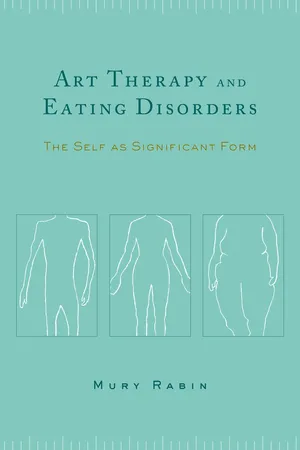
Art Therapy and Eating Disorders is a step-by-step approach to a new and extremely promising technique for treating people with eating disorders—children as well as adults, male and female sufferers alike—that has proven to be a crucial aid to identification, prevention, and intervention. Mury Rabin demonstrates how her award-winning art therapy technique, known as Phenomenal and Nonphenomenal Body Image Tasks or "PNBIT," can be used by clinicians other than art therapists and shows its effectiveness in combination with diverse therapeutic techniques.
Unlike traditional therapy programs that treat symptoms, this technique focuses on root causes and consists of a series of tasks—some phenomenal: weight recording, mirror viewing, and body dimension estimates; others not: chromatic family line drawings and body image mandalas. The book includes five case studies that illustrate how the PNBIT technique functions in practice.
- English
- ePUB (mobile friendly)
- Available on iOS & Android
eBook - ePub
About this book
Information
Topic
Sciences socialesSubtopic
Conseil en psychothérapieCHAPTER 1
Significance of Appropriate Body Image
——— Art Therapy in the Twenty-first Century
This book explores the use of phenomenal and nonphenomenal body image tasks as therapeutic treatment in anorexia nervosa and obesity. Treatment measures for these syndromes have been major topics of theory and research in recent years as these and other eating disorders have increased in frequency and even impacted on young children. There has been general failure to find lasting solutions to management of these intractable conditions, which have a high rate of morbidity and mortality (Weiner 1985).
The author’s interest in these concepts developed while working with groups of chronic alcoholic and drug-abused patients as well as those with eating disorders. The clinical evidence was compelling in identifying an addictive quality common to these various problems. Hatterer (1980) addresses this idea:
I do not believe that any one addictive personality type exists, but that people become addicted because they are vulnerable to the addictive process, which is rampant in our culture…. Today we extend the concept of addiction … not only to drugs or alcohol, but to food, smoking, gambling, buying, or some form of work, play or sex. I believe that all these addictions have a common denominator, which is a process that depends on constitutional, family, peer, environmental, and sometimes genetic, physiologic, chemical and ethnic factors, and which serve one or several functions in a person’s adaptation to life. (pp. 15–16)
Hatterer’s concept that the abuse of food may be a function of the addictive process is supported by studies by Dole at Rockefeller University. He observed that the tendency of obese patients to relapse after dieting resembled the tendency of cigarette smokers and heroin addicts to relapse even after long periods of abstinence. He concluded that relapses among some obese patients have a metabolic biochemical origin.
Hatterer’s and Dole’s view of eating disorders as addictive in quality is borne out by the work of Marrazzi and Luby (1986). They state, “Endogenous opioids may play a homeostatic role in appetite regulation in humans at both ends of the spectrum (pp. 193–194). They conclude:
Chronic anorexia seems unresponsive to the spectrum of psychotherapies. Current psychological hypotheses … are of limited utility in reversing its course when it has stubbornly persisted for years…. An auto-addiction model may not only provide a basis for further biological research but contribute to alternative therapeutic approaches as well. (p. 202)
This work is focused on the method used with individuals who have suffered with eating disorders. Chapter 5 details the case studies of five women, two anorectic and three obese, who completed the protocol described in chapter 4. Chapter 4, “Phenomenal and Nonphenomenal Body Image Tasks in the Treatment of Eating Disorders (PNBIT): The Method,” is presented in the form of a manual for the use of a therapist working with individuals who are affected with these syndromes. The PNBIT can be used by a therapist who works primarily with verbal means. Where the therapy appears to be static, the application of some or all of the tasks can move the patient/client toward self-management, healing, and growth.
Following are some definitions of terms used in the text:
—— Body image: The picture of our own body that we form in our minds (Schilder 1953). Bruch (1973) defines it as “a plastic concept which is built from all sensory and psychic experiences and is constantly integrated in the central nervous system. Underlying it is the concept of Gestalt, which sees life and personality as a whole” (p. 87).
—— Combined phenomenal and nonphenomenal task: Body Contour Drawing (BCD). See chapter 4.
—— Nonphenomenal body image: A term used to denote the individual’s unconscious and symbolic expression of the self acquired over time through interpersonal relationships.
—— Nonphenomenal tasks: 1. Chromatic Family Line Drawing (CFLD), 2. House/ Tree/Person/Person/Animal (HTPPA), pencil and chromatic, 3. Mandalas (M), Body Image and Self Image, 4. Sandworlds (SW), 5. Self Box (SB), 6. Kinetic Family Clay Sculpture (KFCS).
—— Normal weight: A term used to denote weight in pounds plus or minus five percent of the normative weight for age and height as designated in current medical weight table.
—— Phenomenal body image: A term used to denote the individual’s direct and conscious awareness of the body as an objective physical entity, based on sensory experiences, involving sight and touch, focusing on weight, form, mass, coloring, and measurements of length and breadth of the body boundaries.
—— Phenomenal tasks: 1. Weighing of individual on scale, 2. self-viewing in full-length mirror, 3. self-analysis through touch and other sensory input, 4. Body Dimension Estimates and Measurements (BDEM).
—— PNBIT: Phenomenal and nonphenomenal body image tasks, i.e., the group of eleven items administered to the individuals in chapter 5. (For a complete description of tasks see chapter 4.)
—— Self: “The psychophysical total of the person at any given moment, including both conscious and unconscious attributes” (Hinsie and Campbell 1970).
—— Self-concept: The whole range of complicated attitudes and fantasies an individual has about her identity, her life role, and her appearance. This is in contradistinction to attitudes an individual expresses about herself verbally. It is assumed some of the most important of the individual’s self-concepts are either so unpleasant to face or are acquired at such an early preverbal period as to be unavailable for conscious reporting (Fisher and Cleveland 1968).
—— Self-esteem: The appraisal or value the individual sets on the self.
—— TSCS: Tennessee (Department of Mental Health) Self Concept Scale, a pencil and paper verbal measure of self-concept. The scale consists of one hundred self-descriptive statements the subject uses to produce a verbal picture of herself.
—— Yo-yo syndrome: Chronic condition affecting an individual which manifests itself in episodes of alternative bingeing and dieting as a means of gaining and losing weight.
There is no way to understand how art therapy works without connecting it to the making of art. The search for meaningful form is one of the primary goals in psychotherapy.
Persons in analysis … are struggling with their world—to make sense out of nonsense, meaning out of chaos, coherence out of conflict. They are doing it by imagination, by constructing new forms and relationships in their world, and by achieving through proportion and perspective a world in which they can survive and live with some meaning. (May 1975:125)
If a nonhealth or pathological state is defined as having the quality of disturbance or disorder in one’s life, then a state of health may be defined as that which moves toward ordered form. Rogers said, “Man’s behavior is exquisitely rational, moving with subtle and ordered complexity toward the goals his organism is endeavoring to achieve” (1961:194–195). This idea is emphasized by May (1975):
Our passion for form expresses our yearning to make the world adequate to our needs and desires, and, more important, to experience ourselves as having significance…. Insights emerge not chiefly because they are “intellectually true” or even because they are helpful, but because they have a certain form, the form that is beautiful because it completes what is incomplete in us…. This new form that suddenly presents itself, comes in order to complete a hitherto incomplete Gestalt with which we are struggling in conscious awareness. (p. 132)
Such a process involves organismically selected direction that allows psychological freedom within prescribed limits set by the inner and outer environments of each individual. One may see a parallel here from psychological form to art form. Writing in 1913, Bell (1958), the English critical theoretician of art, revolutionized the study of all the arts by his concept of form:
For either all works of visual art have some common quality, or when we speak of “works of art” we gibber…. What is this quality? … Only one answer seems possible—significant form. In each, lines and colours combined in a particular way, certain forms and relations of forms, stir our aesthetic emotions. (p. 17)
He continues, “These relations and combinations of lines and colours, these aesthetically moving forms, I call ‘significant form’ and Significant Form is the one quality common to all works of art” (p. 18).
Langer (1957) reevaluated and expanded on Bell’s original concept:
Artistic form is congruent with the dynamic forms of our direct sensuous, mental, and emotional life; works of art are projections of “felt life,” as Henry James called it…. A work of art expresses a conception of life, emotion, inward reality…. It is a developed metaphor, a nondiscursive symbol that articulates what is verbally ineffable—the logic of consciousness itself. (pp. 25–26)
She continues:
A work of art is an expressive form created for our perception through sense or imagination, and what it expresses is human feeling…. One quality shared by all good works of art is “significant form” … structure, articulation, a whole resulting from the relation of mutually dependent factors or more precisely, the way that the whole is put together. (pp. 14–16)
And Langer concludes:
The more you study artistic composition, the more lucidly you see its likeness to the composition of life itself, from the elementary biological patterns to the great structures of human feeling and personality that are the import of our crowning works of art; and it is by virtue of this likeness that a picture, a song, a poem, is more than a thing—that it seems to be a living form, created, not mechanically contrived, for the expression of a meaning that seems inherent in the work itself: our own sentient being, Reality. (p. 58)
Analysis of the art productions of the individuals who participated in the case studies detailed in chapter 5 reveals that when the art approached the significant form of aesthetic art, it was also an index to the state of the psychological health of the person at the time it was made. A comparison of the quality of a task done at the outset of treatment and repeated later demonstrates the individual’s ability to improve her aesthetic art expression.
Improvement in the state of the individual’s ability to function, to self-manage, was achieved over time. But illumination and truth were revealed along the way, by their courage in facing their truth and being willing to give up denial. One woman was asked what art therapy did for her. She said, “I learned that my words didn’t match my pictures.” Perhaps this is as good an explanation of the dynamics of art therapy as any other.
In a person’s search for the Self, he is seeking congruence between what he is as a physical entity and what he is as a psychological entity. Repeated episodes of gaining or losing weight may be an effort to find the right dimension for the Self through the measure of the physical body and its relationship with the rest of the world.
The universal genetic template of the human form may act internally as the constant against which the everchanging concept of body image of each individual refers. The obese and anorectic may suffer disorder when this archetypal form is violated. The person is pulled or pushed (gaining or losing weight), irresistably drawn toward stabilizing the body boundaries, as they are both personally and collectively defined in human terms, in an effort to reestablish its gestalt.
This book offers a manual defining a system of prescribed tasks. The tasks invite the active participation from the client. She creates a visible, tangible, permanent record of her response to each task. Its permanency in its original form is its unique quality. This allows both the client and therapist the opportunity to reflect and review the work at a distance in time from its making. It also provides a way of comparing the state of the client from the first rendering of a task to the same task done at a later time.
Art therapy taps into the unconscious, no matter how attentive and focused the client was when working on the task. Art therapy productions, like dreams, contain manifest as well as latent material. I call these solar dreams. The subject drawn is the manifest material, but everything else, i.e., color, placement on the page, emphasis, omission, title, signature, etc., represents the latent or unconscious content.
——— American Body Image: Fat and Thin
More than twenty years ago the body of the ideal woman in the United States was supposed to resemble the then current British young fashion model named Twiggy. Her figure appeared to be that of a prepubescent girl whose body had not yet developed breasts or other features associated with the normal growth of a young woman. Thin, and thinner, was in and became the national standard for beauty of women’s bodies. Styles of clothing reflected the trend of the slim childlike figure: short straight skirts and shirts designed to deemphasize the more abundant form.
Department stores limited their inventory of apparel for large women. What little was available was usually confined to a small area, often situated in the basement near the ladies lounge. For some the focus on measures to reshape the normal female body dimension was sought through diet and exercise. The goal was to achieve the appearance of extreme thinness that was being promoted in the media. Celebrities were seen to be replicas of each other—and this fueled public adoration of the image. The public was shocked to learn that it was also life threatening.
The practice of extreme measures to limit food intake was identified as anorexia. Karen Carpenter, the popular young singer, died of the addictive abuse of these practices. The 1980 Diagnostic and Statistical Manual of Mental Disorders (DSM-I...
Table of contents
- Cover
- Half title
- Title
- Copyright
- Dedication
- Contents
- Acknowledgments
- Introduction
- Chapter 1. Significance of Appropriate Body Image
- Chapter 2. Body Image and the Self
- Chapter 3. The Therapy of Art Therapy
- Chapter 4. Phenomenal and Nonphenomenal Body Image Tasks in the Treatment of Eating Disorders and Other Addictions (PNBIT): The Method
- Chapter 5. PNBIT Clinical Applications
- Chapter 6. Conclusion
- Afterwords: Toward an Ethical Society
- Appendixes
- References
- Index
Trusted by 375,005 students
Access to over 1.5 million titles for a fair monthly price.
Study more efficiently using our study tools.
Frequently asked questions
Yes, you can cancel anytime from the Subscription tab in your account settings on the Perlego website. Your subscription will stay active until the end of your current billing period. Learn how to cancel your subscription
No, books cannot be downloaded as external files, such as PDFs, for use outside of Perlego. However, you can download books within the Perlego app for offline reading on mobile or tablet. Learn how to download books offline
Perlego offers two plans: Essential and Complete
- Essential is ideal for learners and professionals who enjoy exploring a wide range of subjects. Access the Essential Library with 800,000+ trusted titles and best-sellers across business, personal growth, and the humanities. Includes unlimited reading time and Standard Read Aloud voice.
- Complete: Perfect for advanced learners and researchers needing full, unrestricted access. Unlock 1.5M+ books across hundreds of subjects, including academic and specialized titles. The Complete Plan also includes advanced features like Premium Read Aloud and Research Assistant.
We are an online textbook subscription service, where you can get access to an entire online library for less than the price of a single book per month. With over 1.5 million books across 990+ topics, we’ve got you covered! Learn about our mission
Look out for the read-aloud symbol on your next book to see if you can listen to it. The read-aloud tool reads text aloud for you, highlighting the text as it is being read. You can pause it, speed it up and slow it down. Learn more about Read Aloud
Yes! You can use the Perlego app on both iOS and Android devices to read anytime, anywhere — even offline. Perfect for commutes or when you’re on the go.
Please note we cannot support devices running on iOS 13 and Android 7 or earlier. Learn more about using the app
Please note we cannot support devices running on iOS 13 and Android 7 or earlier. Learn more about using the app
Yes, you can access Art Therapy and Eating Disorders by Mury Rabin in PDF and/or ePUB format, as well as other popular books in Sciences sociales & Conseil en psychothérapie. We have over 1.5 million books available in our catalogue for you to explore.