- English
- ePUB (mobile friendly)
- Available on iOS & Android
eBook - ePub
About this book
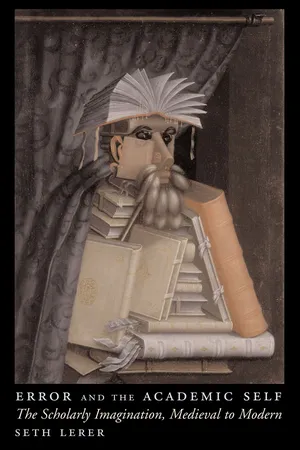
How and why did the academic style of writing, with its emphasis on criticism and correctness, develop? Seth Lerer suggests that the answer lies in medieval and Renaissance philology and, more specifically, in mistakes. For Lerer, erring is not simply being wrong, but being errant, and this book illuminates the wanderings of exiles, émigrés, dissenters, and the socially estranged as they helped form the modern university disciplines of philology and rhetoric, literary criticism, and literary theory. Examining a diverse group that includes Thomas More, Stephen Greenblatt, George Hickes, Seamus Heaney, George Eliot, and Paul de Man, Error and the Academic Self argues that this critical abstraction from society and retreat into ivory towers allowed estranged individuals to gain both a sense of private worth and the public legitimacy of a professional identity.
Trusted by 375,005 students
Access to over 1.5 million titles for a fair monthly price.
Study more efficiently using our study tools.
Information
Subtopic
AuthorshipIndex
LiteratureCHAPTER ONE
ERRATA: MISTAKES AND MASTERS IN THE EARLY MODERN BOOK
Over twenty years ago, in a chapter of his Renaissance Self-Fashioning, Stephen Greenblatt addressed what he called “the word of God in an age of mechanical reproduction.”1 Alluding to the title of Walter Benjamin’s famous essay, Greenblatt argued that the printing press made possible a new debate on scripture and power in early Renaissance England.2 William Tyndale’s New Testament in English had appeared in 1526, and his Old Testament in 1530.3 Together with the many polemics these publications spawned—the responses of Thomas More, the ripostes of Tyndale, and the myriad royal proclamations seeking to control the printing, reading, and disseminating of books in the age of Henry VIII—these volumes contributed to what Greenblatt called “the magical power of the Word.” The Tyndale Bible formed, at least in part, “a turning point in human history,” not just through the availability of scripture in a printed English book (though that itself was a major accomplishment) but through Tyndale’s exposing the rhetorical quality of holy writ: its power to persuade, its place in analysis and argument, in short, its new role in what Greenblatt calls “the seizure of power” by the movement of religious reform.4
So much since Renaissance Self-Fashioning has been written on the early printed book, and on the nexus of print, politics, and power in the English Renaissance, that it must seem temerity to add another chapter. For all its own reformist critical rhetoric, Greenblatt’s book is as celebratory as Elizabeth Eisenstein’s contemporary study, The Printing Press as an Agent of Change.5 Both see the story of the book as a story of the text triumphant: the spread of literacy, the dissemination of knowledge for its own sake, the facilitation of empirical science, the spatialization of our habits of thought. But much has changed in the two decades since their publication. The celebratory model of the printing press has given way to a fragmented, materialist, and skeptical dismantling of the grand récit. The technodeterminist approach (that the very technology of printing effected social change) associated with the work of Eisenstein and her intellectual forbears is largely gone. Print is now understood to be not simply a technology but a form of social behavior located in encounters with the published word that define both a public life and a private subjectivity.6 Those that have practiced what in France became known as l’histoire du livre stressed the reconstruction of distinctive moments in book history. The items of booksellers’ inventories, the lists found in wills, and the acts of physically sitting down with books all have contributed to a larger, context-bound conception of the act of reading as more than the absorption of printed information.7
But in addition to locating the impact of the printed word, these researches have challenged just what “print” itself may mean. As Adrian Johns has put it, in his recent massive and revisionary Nature of the Book, we need to ask anew “just what printing was.”8 Rather than denoting a specific device or a definable social habit, “print” has been taken to have meaning only in relationship to something else. Printing is anything that differs from handwriting. It connotes any form of verbal reproduction, in Michael Warner’s words, “relieved from the pressure of the hand.”9 Such a relational definition has deep historical importance. Early printed books were rarely distinguished from handmade documents. The typefaces of books made in the first half-century of printing were themselves modeled on manuscript hands.10 If Johns compels us to ask what printing was, we may ask now just what a book is, when anyone can be a desktop publisher and when computer-generated fonts and laser printers can make any document look like anything from Gutenberg to Garamond. And, of course, we may ask whether all this preoccupation with the printed word remains simply a form of academic nostalgia at a time when more and more transmitted information is read off screens rather than pages. Is our interest in the history of the book conditioned by our sense of living at the end of that history?
This chapter seeks an answer to these questions in the history of error. Instead of moving, once again, to an account of print and progress, it argues for a story grounded in mistake. The history of the early book is fraught with error. Indeed, the story of the Tyndale Bible, Greenblatt’s masterplot, is a tale of accusations of inaccuracy: failures of translation, faults uncaught at the press, errata that Tyndale himself sought to correct. Behind the list of “errours committed in the prynting” that closes the 1526 New Testament lies a hitherto unwritten history of the erratum. For the errata sheet, in the late fifteenth and early sixteenth centuries, records more than slips of typesetting; it details errors in doctrine, dialect, or usage. At its most complex and self-conscious, the errata sheet stands as the site of humanist erudition and early modern subjectivity. It is the place where the past is publicly brought into line with the present, where errors of all kinds could be confessed and corrected. To explore the early history of these sheets is to explore the loci of authority and action that make academic life both a performance and a defense. Together with a set of broader editorial and literary practices that I address here—humanist textual criticism, early lexicography, epistolary friendship, and the vernacular love-lyric—these early printed texts contribute to a new account of the self-fashioning sought by modern scholars of the Renaissance.
Though I attend, in part, to individual errors of the early printers and to the techniques of collation, comparison, and critical decision that went into the production of editions, I am primarily concerned here with the rhetoric of error and editorship and with the stories told through prefaces, errata sheets, and correspondence about the making—or mismaking—of books. The humanist account of error is invariably temporal: it situates the production of the book in a specific historical moment, charts its progress across time, and then invites the reader to locate it (and the reader’s own act of reading) on a temporally defined continuum. The story of correction and the artifact of the errata sheet historicize the book, much as the humanist practice of philology historicized the text. For, by acknowledging the historical difference between text and reader, the humanist critic not only recognized linguistic change or corruption of copies but also understood that the completed work was not an autonomous object but a counter in the historical story of its making and reception. The early book is always a work in progress and in process, a text intruded upon for emendation, a text that invites the correction of the reader. There is nothing like an errata sheet to prompt the reader to seek out yet more errata—that is, nothing like the admission of some errors to provoke us to believe that the work is full of errors. Moreover, the need to narrativize the story of such errors—to offer up a personal history of detection and correction—makes the true subject of the early humanist book not so much its content but the complex relationships between textual and political fealty that write the history of its own production.11
The errata sheet stands not as a static marker of uncaught mistakes but as a placeholder in the ongoing narratives of bookmaking, and book reading, themselves. Like many of the paratexts of early print—the prefaces, notes, correspondence, and occasional handwritten comments in the margins of the book—errata sheets illustrate how an early printed book was used by the first ones to see it. Such sheets were often guides to reading itself. Several early books survive with handwritten corrections drawn from those sheets: illustrations of rereading, in which owner’s pen corrected printer’s faults.12 But, more broadly, the study of the errata sheet and of the rhetoric of error also helps us understand the ways in which the disciplines of editorial review, legal judgment, political control, and religious devotion shared an idiom and imagery. In an age when the practice of confession came under close scrutiny (especially in early Reformation England), errata sheets and their accompanying paratexts became the places where the urge to confess could still find a voice and where the seeking of forgiveness found its listener not among the booths of the church but in the stalls of the bookseller.
Before beginning with the book, it is important to recall that the history of textual correction does not begin with print. Almost as soon as there were writers, fears of error motivated the control of textual dissemination. Roman authors, in particular, were acutely aware of the failings of scribes and the foibles of booksellers. Martial, quite specifically and at great length, could praise the careful scribe but could equally lament a careless one.13 In later times, the copying of sacred scriptures often became the occasion for reflections on the scribal art and, as a consequence, the fear of error. Cassiodorus, in the sixth century, considered scribes the bearers of God’s word, and he thought of writing (especially the copying of the Bible) as the highest of callings.14 The twelfth-century poet Baudri of Bourgeuil, in a set of Latin poems clearly influenced by Martial, reflected on the need for accurate copies of his texts (and his invectives against faulty scribes are as vicious as anything by the earlier Roman poet).15 Petrarch’s letters, in the fourteenth century, are famous for their complaints of incorrect texts and unauthorized copies,16 while, at the close of that century, Chaucer developed what may well be called a poetics of correction in his thematic attentions to the scribal culture of his day. All his work, he fears, is “subject to correction,” not just because it may be erroneous in fact or doctrine but because it has been mangled by the hands of others. At the close of Troilus and Criseyde, he fears the mismetering and misspelling of his poetry by scribes of different dialect regions or different levels of ability. And in his famous “Words to Adam Scriveyn,” he laments, almost godlike, the errancies of his aptly named and careless copyist, whom Chaucer curses unless he “wryte more trewe”:
So ofte adaye I mot thy werk reneweIt to correcte and eke to rubbe and scrape.17
All this did not change overnight with print. Early printed books can be as much unique, individual artifacts as the manuscripts that had preceded them. Corrections in midpressrun, broken types, resettings and additions, changes in type and paper stock have textual-critical value, as they can reveal a book’s relationship to the copy text or to the textual traditions of a different work. A close attention to such changes, too, throws into confusion traditional distinctions between such phenomena as error and variant. When is a printed book representative of an edition or an issue? And what role do errata sheets—and readerly engagement with them—play in the definition of just what we have when we hold an early printed book in our hands?18
Print enables publicly what was done privately before. It makes possible not the fixity of the text but the participation of the reading public in the act of correction. Though errata sheets enable readers to correct their personal copies, they also make readers active players in the game of textual confession. They serve to establish authorial authority through the acknowledgment of error. In the process, they refashion the relationship of author to reader along new templates of power. The writer stands as pleading witness to a knowing judge, as humble subject to a king or patron, as appellant student to a learned master. These are the metaphorical relationships of reading, and they govern both a rhetoric and a poetics of errata in the early modern period.
From the start, errata sheets recorded more than typos. The earliest account we have of one comes from the atelier of Sweynheim and Pannarz.19 Library catalogs record, for their edition of Lactantius published on October 29, 1465, two concluding pages of the volume titled “Lactantii Firmiani errata quibus ipse deceptus est per fratrem Antonium Randesem theologicum collecta et exarata sunt” (The errata of Lactantius Firmianus, which he himself did not catch, have been gathered and written down by brother Antonio Randesi, theologian).20 Other kinds of errors fill the sheets of early Italian printers. Francesco Bonaccorsi published an edition of the Laude of Jacopone da Todi in September 1490 that included not just a list of typographical mistakes but also those of dialect and historical idiom, in the words of Brian Richardson, an index that “had a threefold function as a glossary, an errata, and a kind of apparatus criticus.”21 Early editions of the works of Boccaccio, Sannazaro, Dante, and other Italian authors often contained, in addition to “errori de la stampa,” those of dialect and usage,22 while classical texts used the errata sheet as the occasion to review, reedit, and reprimand earlier editions or defective manuscripts. A Horace Opera printed by Antonio Miscomini in Florence in 1482 has on its last two pages the errore to be found in the edition and the commentary. Here, what is important is that these are not tipped-in extra sheets but an integral part of the foliation of the book. The errors noted are not printer’s mistakes but instead substantive emendations to the text. Errata sheets become the place where textual criticism is done—not in the body of the poetry itself or in the commentary.23
Similarly, in the Miscellanea of Politian (1489), also published by Miscomini, the final pages of “Emendationes” offer up not only corrections to the printed text but also new readings based, apparently, on fresh consultation with the manuscripts of Politian’s sources. Comments, for example, on the Greek text of Callimachus betray Politian’s concern (voiced in his letters and in the later remarks to his readers at the close of this volume) with the proper accents in the Greek. His final, general remarks bear noting, too, as statements of the larger relationships of will and intention in the making of the book and the establishing of author-audience association:
If any accents in the Greek words should be missing or wrongly written, let the well-educated restore or emend them according to their judgment. But if, reader, you find in addition to these errors, anything which escaped our hasty eyes, you will emend those also according to your judgment. Nor will you, whoever you are, consider that ours which is not quite right [i.e., don’t think those things that are not right are ours]. Rather, you will ascribe all errors either to the printers or the editors [curatoribus]. For if you believe me to be responsible for any error herein, then I will believe you have nothing in your heart.24
Here, under the heading “Emendationes,” are emended not just textual but personal relationships. The author offers...
Table of contents
- Cover
- Half title
- Title
- Copyright
- Contents
- Acknowledgments
- Dedication
- Introduction: The Pursuit of Error: Philology, Rhetoric, and the History of Scholarship
- Chapter 1. Errata: Mistakes and Masters in the Early Modern Book
- Chapter 2. Sublime Philology: An Elegy for Anglo-Saxon Studies
- Chapter 3. My Casaubon: The Novel of Scholarship and Victorian Philology
- Chapter 4. Ardent Etymologies: American Rhetorical Philology, from Adams to de Man
- Chapter 5. Making Mimesis: Exile, Errancy, and Erich Auerbach
- Epilogue: Forbidden Planet and the Terrors of Philology
- Notes
- Index
Frequently asked questions
Yes, you can cancel anytime from the Subscription tab in your account settings on the Perlego website. Your subscription will stay active until the end of your current billing period. Learn how to cancel your subscription
No, books cannot be downloaded as external files, such as PDFs, for use outside of Perlego. However, you can download books within the Perlego app for offline reading on mobile or tablet. Learn how to download books offline
Perlego offers two plans: Essential and Complete
- Essential is ideal for learners and professionals who enjoy exploring a wide range of subjects. Access the Essential Library with 800,000+ trusted titles and best-sellers across business, personal growth, and the humanities. Includes unlimited reading time and Standard Read Aloud voice.
- Complete: Perfect for advanced learners and researchers needing full, unrestricted access. Unlock 1.5M+ books across hundreds of subjects, including academic and specialized titles. The Complete Plan also includes advanced features like Premium Read Aloud and Research Assistant.
We are an online textbook subscription service, where you can get access to an entire online library for less than the price of a single book per month. With over 1.5 million books across 990+ topics, we’ve got you covered! Learn about our mission
Look out for the read-aloud symbol on your next book to see if you can listen to it. The read-aloud tool reads text aloud for you, highlighting the text as it is being read. You can pause it, speed it up and slow it down. Learn more about Read Aloud
Yes! You can use the Perlego app on both iOS and Android devices to read anytime, anywhere — even offline. Perfect for commutes or when you’re on the go.
Please note we cannot support devices running on iOS 13 and Android 7 or earlier. Learn more about using the app
Please note we cannot support devices running on iOS 13 and Android 7 or earlier. Learn more about using the app
Yes, you can access Error and the Academic Self by Seth Lerer in PDF and/or ePUB format, as well as other popular books in Literature & Authorship. We have over 1.5 million books available in our catalogue for you to explore.