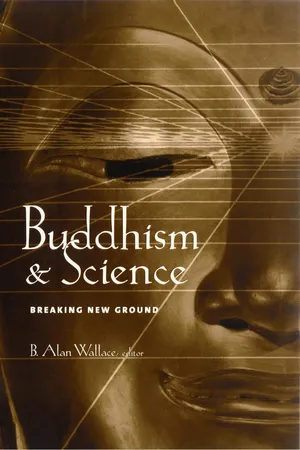
Buddhism and Science brings together distinguished philosophers, Buddhist scholars, physicists, and cognitive scientists to examine the contrasts and connections between the worlds of Western science and Eastern spirituality. This compilation was inspired by a suggestion made by His Holiness the Dalai Lama, himself one of the contributors, after one of a series of cross-cultural scientific dialogues in Dharamsala, India, sponsored by the Mind and Life Institute. Other contributors such as William L. Ames, Matthieu Ricard, and Stephen LaBerge assess not only the fruits of inquiry from East and West but also shed light on the underlying assumptions of these disparate worldviews. Their essays creatively address a broad range of topics: from quantum theory's surprising affinities with the Buddhist concept of emptiness, to the increasing need in the West for a more contemplative science attuned to the first-person investigation of the mind, to the important ways in which the psychological study of "lucid dreaming" maps similar terrain to the cultivation of the Tibetan Buddhist discipline of dream yoga.
Reflecting its wide variety of topics, Buddhism and Science is comprised of three sections. The first presents two historical overviews of the engagements between Buddhism and modern science or, rather, how Buddhism and modern science have defined, rivaled, or complemented one another. The second describes the ways Buddhism and the cognitive sciences inform each other; the third addresses points of intersection between Buddhism and the physical sciences. On the broadest level this work illuminates how different ways of exploring the nature of human identity, the mind, and the universe at large can enrich and enlighten one another.
- English
- ePUB (mobile friendly)
- Available on iOS & Android
eBook - ePub
About this book
Information
Topic
Theology & ReligionSubtopic
Eastern PhilosophyPART 1
Historical Context

In this opening essay, Buddhologist José Ignacio Cabezón presents an illuminating overview of the historical interface between Buddhism and science, emphasizing the structural and typological facets of this interrelationship. In first addressing the study of Buddhism and Buddhists as objects of scientific inquiry, he raises important ethical concerns. In what sense, for instance, can Buddhist meditators safely be regarded as “informed and consenting subjects” in such research? And to what degree might positive scientific findings inadvertently legitimize certain Buddhist orders or sects, thereby exacerbating social tensions that already exist within Buddhist communities?
As he questions the status of Buddhism as an object of inquiry in the history of science, Cabezón critiques familiar diagnoses that allegedly account for the rise of science in Europe and its failure to emerge in Asia. He then proceeds to analyze the relation between Buddhism and science interms of three models: conflict/ambivalence, compatibility/identity, and complementarity. In the third of these models, arguably the most interesting and provocative, he points out that Buddhism and science are presented as being able together to contribute epistemically to a more complete way of knowing a common subject. Whether the difference between them is identified principally in terms of content, method, or goal, the limitations of each is thought to be overcome by bringing them together in a harmonious way. But he goes on to point out the dangers of reifying metaphors for Buddhism and science in ways that silence their voices and insights into matters where they may be incompatible. In conclusion, Cabezón expresses his thoughts concerning the future of the conversation between Buddhism and science in ways that may well lead to deeper and richer dialogue and collaboration.
José Ignacio Cabezón
Buddhism and Science: On the Nature of the Dialogue
PREAMBLE
It is the purpose of this essay to consider some of the ways in which Buddhism and science have engaged each other: to take stock of the historical interaction of these two spheres, and to suggest, by way of conclusion, some directions for future engagement. Some caveats are in order at the outset, however. Although I use the terms Buddhism and science throughout, I am not unaware of the problems involved with the use of such generalities. Both Buddhism and science are of course highly internally differentiated categories. At times I will resort to evoking some of that internal structure (e.g., when I discuss the biological theory of evolution or Indian Buddhist views of matter). But I do not apologize for the fact that on other occasions I am painting a picture in broad strokes.
First of all, part of my goal in this essay is to consider the ways in which scientists and scholars of Buddhism have themselves depicted their mutual interaction. It is clear that, especially in their earliest encounters, that engagement was rhetorically constructed as one between Buddhism and science generally. To the extent that my remarks are a historical characterization of that encounter, then, it is fitting that I resort to the categories the participants in that encounter themselves utilize. Second, even more distinct categories, like evolution and Tibetan Buddhism, are themselves generalities. The point of course is that there is no escaping generality. A brush stroke is always broad by comparison to one that is finer. Finally, and more pragmatically, there is always a place for generalities as long as one remains mindful of the fact that in the process of resorting to them one is sacrificing detail.
Although I will be dealing here with many different time periods, this essay does not purport to be anything even remotely close to a complete historical overview of the interaction of Buddhism and science. If anything, I am more interested in characterizing this interaction in structural and typological, rather than in historical, terms, although even here the reader will find, as I have, the complexity of the real historical engagement of these two spheres evades even this form of categorization. This being said, it is my hope that this essay will be provocative, if only as a starting point for others who, like me, would seek to make some explanatory sense of the complex interactions of Buddhism and science and some normative suggestions for their future intercourse.
BUDDHISM AS THE OBJECT OF SCIENCE
The earliest encounters between Buddhism and science cast Buddhism not as the partner of science in a dialogue, but as the object of scientific inquiry. It was the Enlightenment penchant for modeling the humanities after the natural sciences that led to the rise of the “science of religion.” As Buddhism came within the purview of this new “science,” there emerged, on the one hand, the rise of Buddhist philology, perceived as the application of systematic scientific principles to the study of Buddhist texts, and, on the other, the rise of the social scientific study of Buddhist cultures. In this way Buddhist texts and societies became fodder for the “scientific inquiries” of figures like Max Mueller and Max Weber. That today we find Religionwissenschaft as a movement much less neutral, much less the disinterested and objective analysis of pure fact, and much more theory and theologically laden than did the founding fathers of the discipline does not belie the fact that for these late nineteenth-century scholars Buddhism was to be approached as the object of such a science.
More important, this early rhetoric, a rhetoric that cast Buddhism as the subject matter of scientific inquiry, has in many ways set the tone for one important strand in the encounter between Buddhism and science, even to the present day. Such a mode of interaction is presumed in a good deal of current sociological and anthropological work being done in regard to Buddhist cultures and societies. And it is of course the dominant model in much of the psychological and neuroscientific work currently being undertaken in regard to Buddhist meditation.
At the risk of digression, I consider this form of encounter—the objectification of Buddhism, and especially Buddhists, by science as part of a scientific research program—to be sufficiently important to warrant some further remarks at this point. There is, of course, an inherent danger in the scientific objectification of subjects in an experimental setting. The peril lies in the possibility that those being tested come to be considered mere objects and thus dehumanized. Such a problem becomes especially acute when subjects are separated from researcher not only by professional but also by cultural distance. One way to lessen the negative effects of scientific experimental objectification—a tack taken by a group of researchers, to which I myself belong, studying the effects of meditation in a group of Tibetan monks1—is to involve the subjects, to whatever extent possible, in the actual planning and execution of experiments, that is, to acknowledge them as intellectual equals and thus to give them a voice as colleagues. But even when this is done, casting Buddhists’ collective or individual behaviors, or their bodies, in the role of examined object is an enterprise fraught with ethical perils. My purpose in bringing this up is not to suggest that this form of encounter is to be avoided but only that it requires a great deal of forethought.
My own work as part of the research group mentioned above has made it clear to me that there are ethical issues involved in the cognitive scientific testing of Tibetan meditators that go beyond those traditionally covered and disposed of as part of traditional human subjects research screening.2 Some of these are the result of cultural/religious factors that are unique to a Buddhist (and especially a Tibetan Buddhist) setting. For example, in a tradition where the wishes of the spiritual master are considered almost sacrosanct, how much freedom of choice do potential subjects really have if they know, or even believe, that their teacher or mentor is in favor of the program of testing? Other issues concern the procedures and effects of testing. Does mere participation in such experiments have a negative impact on a retreatant’s meditative life? What responsibility does a researcher have to share the results of experiments with subjects? How might such results—both positive and negative—be interpreted by subjects, and what effects might such interpretations have on their personal practice? Even apart from the obvious interruption to a retreatant’s isolation, can we say with certainty that, as regards the actual testing, apparently noninvasive procedures like EEGs will have no negative effects on the subtle physiology that a monk relies upon and manipulates in the more advanced forms of meditation, to take just one example of a real-life concern that emerged from our conversation with monks? And even assuming that one could be certain of this, which I think arrogant, is it not possible that a mediator’s subsequent practice might be negatively affected by the mere belief that such testing might have negative consequences? How do we weigh the value of the knowledge gained from testing against the possible negative effects it might have on the subject being tested?
In addition, there are a host of ethical questions that have to do with the effects of research, not on the individual but on the society at large. When research is conducted on a specific sample of adepts from a particular religious tradition or from a particular subschool within a religious tradition—say, monks from a particular school of Buddhism—might “positive” results be socially interpreted as validating the meditative techniques or expertise of adepts of that school over others? Might this exacerbate already existing forms of interreligious rivalry or intrareligious sectarianism? Given that science is such an extremely powerful legitimizing force, how can such research avoid serving as a scientific imprimatur to social tensions that already exist between cultures or within a single society, or, worse, create new tensions? Can anonymity and confidentiality prevent this? What degree of anonymity, if any, should be required to assure that this does not occur?
Still other issues arise from the different presuppositions of Western science and Buddhism as worldviews. How can an intellectual rapprochement be achieved between the prevailing philosophical view of cognitive scientists, most of whom hold to strict mind-brain identity, and Buddhists, who, believing that the mind is nonmaterial, are dualists? It is true that one could envision such a rapprochement taking place on a ground where each side took a more nuanced position—the scientist eschewing materialist reductionism and the Buddhist granting the possibility that mental states could have physical, and therefore measurable, correlates. However, such conversations, and reconciliation of views, have rarely taken place prior to actual experimentation, and this once again raises ethical issues. Where a subject’s ignorance of the nature and presuppositions of an experimental design can lead to fear, how much agreement must exist as a prerequisite for conducting research? What responsibility does a scientific researcher have to establish such consensus prior to testing?
Again, I will reiterate that my purpose here is not to argue against the objectification of Buddhism, or of Buddhists, by science, but simply to note that when this becomes a dominant mode of interaction between the two spheres there arise ethical issues to be sorted out, ethical issues that are in many ways more weighty than those arising when the mode of interaction is one of conversation.3
BUDDHISM AS OBJECT OF INQUIRY IN THE HISTORY OF SCIENCE
Not surprisingly, historians of science have long been concerned with etiological questions. In particular, they have sought to identify those factors which, by their presence in European culture, and their absence elsewhere, have brought about the rise of science. In this regard, Asian cultures have served for them as a kind of control. Concerned to establish the historical circumstances that led to the emergence of science in Euro-Christian society, it becomes natural to construct the rest of the world, including Buddhist Asia, as the barren and infertile site out of which science failed to arise.4 It goes without saying that this kind of historiography begs to be subjected to the kind of literary critical analysis that weaves out the rhetorical construction of the other and its relationship to questions of race, gender, power, empire and its demise, but this of course is impossible here.5 Suffice it to say that in much of this writing, and despite the subsequent antagonism between science and Christianity, it is precisely the Christian worldview that comes to be characterized as the causal sine qua non to the rise of science. Hence, Jaki (1974, 1985) believes that he explains Western Europe as the unique historical locus of the rise of science by identifying those factors within its Christian worldview that permitted its emergence: a monotheism that, in contradistinction to pantheism, led to a deanimized view of nature, a notion of the will of God as ascertainable and compatible with the existence of physical laws, and a noncyclical view of time, epitomized by the event of the Incarnation. Jaki contrasts the Indian notion of cyclical time, as instantiated, for example, in the doctrine of world-cycles, or yugas, to the notion of linear time, which, because of its focus on the “uniqueness of events,” serves as a foundation for the kind of empirical observation that is necessary to the emergence of science.
Jaki’s work is by no means ill-informed about the views of the various religions he examines, nor does it lack nuance. Ultimately, however, it remains unconvincing as an explanation, not because of errors in details but for various other reasons. For one, it can be pointed out that India and China did give rise to forms of empirically derived sciences that can be recognized as such even in Western terms, that is, that can be recognized as science without altering the semantic range of the word to take into account its understanding in these different cultures.6 Moreover, neither cyclicality, nor pan- and polytheisms seem to have acted as deterrents to the acceptance of science in these various cultures since its movement east, something that ...
Table of contents
- Cover
- Half title
- Series List
- Title
- Copyright
- Dedication
- Contents
- List of Contributors
- Preface
- Introduction: Buddhism and Science—Breaking Down the Barriers
- Part 1. Historical Context
- Part 2. Buddhism and the Cognitive Sciences
- Part 3. Buddhism and the Physical Sciences
- Index
Trusted by 375,005 students
Access to over 1.5 million titles for a fair monthly price.
Study more efficiently using our study tools.
Frequently asked questions
Yes, you can cancel anytime from the Subscription tab in your account settings on the Perlego website. Your subscription will stay active until the end of your current billing period. Learn how to cancel your subscription
No, books cannot be downloaded as external files, such as PDFs, for use outside of Perlego. However, you can download books within the Perlego app for offline reading on mobile or tablet. Learn how to download books offline
Perlego offers two plans: Essential and Complete
- Essential is ideal for learners and professionals who enjoy exploring a wide range of subjects. Access the Essential Library with 800,000+ trusted titles and best-sellers across business, personal growth, and the humanities. Includes unlimited reading time and Standard Read Aloud voice.
- Complete: Perfect for advanced learners and researchers needing full, unrestricted access. Unlock 1.5M+ books across hundreds of subjects, including academic and specialized titles. The Complete Plan also includes advanced features like Premium Read Aloud and Research Assistant.
We are an online textbook subscription service, where you can get access to an entire online library for less than the price of a single book per month. With over 1.5 million books across 990+ topics, we’ve got you covered! Learn about our mission
Look out for the read-aloud symbol on your next book to see if you can listen to it. The read-aloud tool reads text aloud for you, highlighting the text as it is being read. You can pause it, speed it up and slow it down. Learn more about Read Aloud
Yes! You can use the Perlego app on both iOS and Android devices to read anytime, anywhere — even offline. Perfect for commutes or when you’re on the go.
Please note we cannot support devices running on iOS 13 and Android 7 or earlier. Learn more about using the app
Please note we cannot support devices running on iOS 13 and Android 7 or earlier. Learn more about using the app
Yes, you can access Buddhism and Science by B. Alan Wallace in PDF and/or ePUB format, as well as other popular books in Theology & Religion & Eastern Philosophy. We have over 1.5 million books available in our catalogue for you to explore.