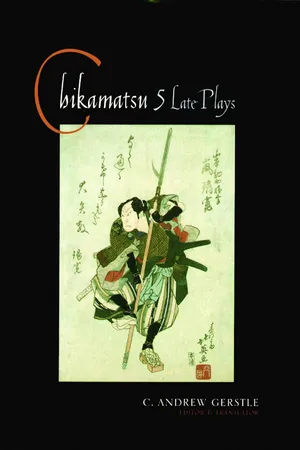
Chikamatsu Monzaemon (1653-1725), often referred to as "Japan's Shakespeare" and a "god of writers," was arguably the most famous playwright in Japanese history and wrote more than 100 plays for the kabuki and bunraku theaters. Today, the plays of this major literary figure are performed on kabuki and bunraku stages as well as in the modern theater, and forty-nine films of his plays have been made, thirty-one of them from the silent era.
Translations of Chikamatsu's plays are available, but we have few examples of his late work, in which he increasingly incorporated stylistic elements of his shorter, contemporary dramas into his longer period pieces. Translator C. Andrew Gerstle argues that in these mature history plays, Chikamatsu depicted the tension between the private and public spheres of society by combining the rich character development of his contemporary pieces with the larger political themes of his period pieces.
In this volume Gerstle translates five plays—four histories and one contemporary piece—never before available in English that complement other collections of Chikamatsu's work, revealing new dimensions to the work of this great Japanese playwright and artist.
- English
- ePUB (mobile friendly)
- Available on iOS & Android
eBook - ePub
About this book
Information
Subtopic
Ancient & Classical DramaIndex
LiteratureNotes
Notes to Chikamatsu: Five Late Plays, introduction
1. Chikamatsu zenshū (CZ), 17 vols. (Tokyo: Iwanami shoten, 1985–94).
2. Translated in Donald Keene, trans., Major Plays of Chikamatsu (New York: Columbia University Press, 1961).
3. This was told to the writer Ōta Nanpo (1749–1823) by Sorai’s disciple Usami Keisuke (Shinsui, 1710–76) and recorded in Nanpo’s 1788 essay “Zokuji kosui,” in Nihon zuihitsu taisei no. 3, vol. 4 (Tokyo: Yoshikawa kōbunkan, 1977), p. 146. In the same work, Nanpo comments on the beauty of particular lines from several of Chikamatsu’s other plays. I am grateful to Professor Hino Tatsuo for his clarification of the authenticity of Sorai’s comment.
4. We also have a translation of Chikamatsu’s short, one-act period play Goban Taiheiki (1710), translated by Jacqueline Mueller in the Harvard Journal of Asiatic Studies 46, no. 1 (1986), which is an early version of the “Chūshingura” story. Semimaru (1693) is translated in Susan Matisoff, The Legends of Semimaru: Blind Musician of Japan (New York: Columbia University Press, 1978). A translation of Love Suicides at Amijima (1720) is in Donald Shively, The Love Suicides at Amijima: A Study of a Japanese Domestic Tragedy by Chikamatsu Monzaemon (Cambridge, Mass.: Harvard University Press, 1953). There are some older prewar translations as well. Soga kaikeizan (1718) is translated in Frank Lombard, An Outline History of the Japanese Drama (London: Allen & Unwin, 1928). Six works are also translated in Asataro Miyamori, Masterpieces of Chikamatsu: The Japanese Shakespeare (London: Kegan Paul, 1926); three of those not translated in Keene, trans., Major Plays of Chikamatsu are The Almanac of Love (Koi hakke hashiragoyomi, a later version of Daikyōshi mukashi-goyomi, 1715); Fair Ladies at a Game of Poem-Cards (Kaoyo uta karuta, 1714); and a highly abridged version of The Tethered Steed (Kanhasshū tsunagi-uma, 1724). We have a translation of the kabuki version of Chikamatsu’s Shunkan (Kikaigashima) performed as a distinct play, but it was originally the second scene of act 2 of Heike nyogo no shima (1719), in Samuel Leiter, The Art of Kabuki: Famous Plays in Performance (Berkeley and Los Angeles: University of California Press, 1979).
5. See C. Andrew Gerstle, “Hero as Murderer in Chikamatsu,” Monumenta Nipponica 51, no. 3 (1996): 317–56; Gerstle, “Heroic Honor: Chikamatsu and the Samurai Ideal,” Harvard Journal of Asiatic Studies 57, no. 2 (1997): 307–81; and Gerstle, “Gidayū botsugo no Chikamatsu,” in Torigoe Bunzō et al., eds., Chikamatsu no jidai, Iwanami kōza: Kabuki, bunraku series (IKKB), vol. 8 (Tokyo: Iwanami shoten, 1998).
6. This distinction is discussed in some detail in C. Andrew Gerstle, Circles of Fantasy: Convention in the Plays of Chikamatsu (Cambridge, Mass.: Harvard University Press, 1986), chs. 4 and 5.
7. Translated in Keene, trans., Major Plays of Chikamatsu.
8. Imamukashi ayatsuri nendaiki (1727), in Nihon shomin bunka shiryō shūsei (NSBSS), vol. 7 (Tokyo: San’ichi shobō, 1977), p. 12, is the first to use the term “god of writers” (sakusha no ujigami), which is often repeated in some form or other throughout the Edo period in writings on jōruri or kabuki theater.
9. Naniwa miyage, in Shingunsho ruijū, vol. 5 (Tokyo: Daiichi shobō, 1906). This passage is discussed by Yoshinaga Takao, ed., Jōruri sakuhin yōsetsu (3): Chikamatsu Hanji-hen (Tokyo: Kokuritsu gekijo, 1984), p. 8. Ikan was the father of Chikamatsu Hanji (1725–83), another famous jōruri playwright, who took the name Chikamatsu.
10. Naniwa miyage, in Shingunsho ruiju, vol. 5, pp. 322–23.
11. About fifty are listed in the record of the Gidayū-bon kōso ikken (1833), along with hundreds of other plays, under copyright of the guild of shōhon (jōruri book) publishers in the three cities of Kyoto, Osaka, and Edo. See Gidayū-bon kōso ikken, in NSBSS, vol. 7, pp. 99–105. See also Yamane Tameo, “Fushizuke to hanpon” in Torigoe et al., eds., Chikamatsu no jidai, IKKB, vol. 8; and Nagatomo Chiyoji, “Jōruribon: sono juyō to kyōkyū” in Torigoe et al., eds., Ōgon jidai no jōruri to sono go, IKKB, vol. 9, for recent research on the history of jōruri books.
12. For some detail on the popularity of chanting, see C. Andrew Gerstle, “Amateurs and the Theater: The So-Called Demented Art of Gidayū,” Senri Ethnological Studies 46 (1995): 37–57.
13. Andrew Markus, The Willow in Autumn: Ryūtei Tanehiko 1783–1842 (Cambridge, Mass.: Harvard University Press, 1992), p. 109. This number was his current collection as of the fifth month, 1818.
14. Quoted in Markus, The Willow in Autumn, pp. 92–93. Tanehiko refers to a kabuki text, but it is clear that jōruri, with the chanter’s notation in the text, was read in a similar manner.
15. V. M. Golownin, Memoirs of a Captivity in Japan During the Years 1811, 1812, and 1813 (London: Henry Colburn, 1973), vol. 1, p. 303. Although this could possibly be a description of no drama chanting, it seems clear from the description of the content that it refers to jōruri narratives. Research done for a paper I have presented at conferences but not yet published shows that from the late eighteenth century, the chanting of jōruri plays as an amateur hobby became widespread among both commoners and samurai throughout Japan. Takadaya Kahei (1769–1827), the ship captain who helped negotiate Golovnin’s release after he was captured by the Russians, is known to have carried jōruri books with him on all his journeys. The point is that individuals commonly learned to “perform” dramatic texts as the process of learning to read them.
16. Andrew Markus discusses the extent of Ryūtei Tanehiko’s use of Chikamatsu and other playwrights’ works in his Willow in Autumn, pp. 72–95. He notes (p. 95) that nearly a third of Tanehiko’s titles “derive their subject matter entirely or primarily from the corpus of Chikamatsu’s works.” (I have seen in various libraries numerous Chikamatsu texts with Tanehiko’s notes written in them.)
17. Nakayama Mikio wrote a short “handout” for an exhibition in 1995 at the National Bunraku Theater in Osaka on the film and television dramatization of Chikamatsu which includes a list of the films to date. I received a copy of this from a friend, but it also should be available at the theater’s ...
Table of contents
- Cover
- Half title
- Title
- Copyright
- Contents
- Acknowledgments
- Abbreviations in the Bibliography and Notes
- Maps
- Introduction
- Twins at the Sumida River: (Futago sumidagawa, 1720)
- Lovers Pond in Settsu Province: (Tsu no kuni meoto ike, 1721)
- Battles at Kawa-nakajima: (Shinshū kawa-nakajima kassen, 1721)
- Love Suicides on the Eve of the Kōshin Festival: (Shinjū yoigōshin, 1722)
- Tethered Steed and the Eight Provinces of Kantō: (Kanhasshū tsunagi-uma, 1724)
- Notes
- Bibliography
- Glossary of Terms
- Series List
Trusted by 375,005 students
Access to over 1.5 million titles for a fair monthly price.
Study more efficiently using our study tools.
Frequently asked questions
Yes, you can cancel anytime from the Subscription tab in your account settings on the Perlego website. Your subscription will stay active until the end of your current billing period. Learn how to cancel your subscription
No, books cannot be downloaded as external files, such as PDFs, for use outside of Perlego. However, you can download books within the Perlego app for offline reading on mobile or tablet. Learn how to download books offline
Perlego offers two plans: Essential and Complete
- Essential is ideal for learners and professionals who enjoy exploring a wide range of subjects. Access the Essential Library with 800,000+ trusted titles and best-sellers across business, personal growth, and the humanities. Includes unlimited reading time and Standard Read Aloud voice.
- Complete: Perfect for advanced learners and researchers needing full, unrestricted access. Unlock 1.5M+ books across hundreds of subjects, including academic and specialized titles. The Complete Plan also includes advanced features like Premium Read Aloud and Research Assistant.
We are an online textbook subscription service, where you can get access to an entire online library for less than the price of a single book per month. With over 1.5 million books across 990+ topics, we’ve got you covered! Learn about our mission
Look out for the read-aloud symbol on your next book to see if you can listen to it. The read-aloud tool reads text aloud for you, highlighting the text as it is being read. You can pause it, speed it up and slow it down. Learn more about Read Aloud
Yes! You can use the Perlego app on both iOS and Android devices to read anytime, anywhere — even offline. Perfect for commutes or when you’re on the go.
Please note we cannot support devices running on iOS 13 and Android 7 or earlier. Learn more about using the app
Please note we cannot support devices running on iOS 13 and Android 7 or earlier. Learn more about using the app
Yes, you can access Chikamatsu by C. Andrew Gerstle,Chikamatsu, C. Andrew Gerstle in PDF and/or ePUB format, as well as other popular books in Literature & Ancient & Classical Drama. We have over 1.5 million books available in our catalogue for you to explore.