- English
- ePUB (mobile friendly)
- Available on iOS & Android
eBook - ePub
About this book
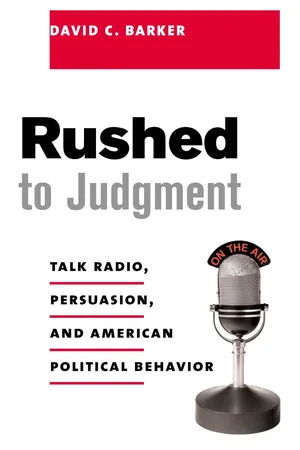
Convenient, entertaining, and provocative, talk radio today is unapologetically ideological. Focusing on Rush Limbaugh—the medium's most influential talk show—Rushed to Judgment systematically examines the politics of persuasion at play on our nation's radio airwaves and asks a series of important questions. Does listening to talk radio change the way people think about politics, or are listeners' attitudes a function of the self-selecting nature of the audience? Does talk radio enhance understanding of public issues or serve as a breeding ground for misunderstanding? Can talk radio serve as an agent of deliberative democracy, spurring Americans to open, public debate? Or will talk radio only aggravate the divisive partisanship many Americans decry in poll after poll? The time is ripe to evaluate the effects of a medium whose influence has yet to be fully reckoned with.
Information
Subtopic
Journalism1 | Introduction |
We Americans are changing the way we gather political information. Perhaps due to our increased access to information and due to changes in lifestyle, we increasingly seek information that can be obtained conveniently, that doubles as entertainment, or that provides a perspective with which we sympathize. Thus while millions of Americans still peruse a daily newspaper and/or religiously view the evening network news, millions more bookmark their preferred political websites, watch political news magazines on cable television, or tune in to talk radio during their daily commutes. Such growth in usage of “new media” (Davis and Owen 1998) may have substantial implications for democratic discourse in the “marketplace of ideas.” While the traditional media (e.g., newspapers, TV news, and major news magazines such as Time and Newsweek) attempt to uphold occupational norms of objectivity and equal time in their coverage of political events (Bennett 1988),1 the new media are not regulated by such canons. Therefore as more Americans receive information from sources whose primary objectives are to entertain and persuade, democratic dialogue may become more misinformed, contentious, and polarized—resulting in legislative gridlock and/or restricted policy alternatives.
For political scientists, social psychologists, and communication scholars, the new media may provide fresh opportunities to find evidence of persuasive media influence over audience members’ beliefs, opinions, and behavior. However, what analysis of the new media offers on one hand in terms of new opportunity, it takes away with the other, for the new media invite a notoriously self-selected audience. Cognitive dissonance theory posits that individuals may avoid messages that they find potentially distasteful, relying entirely on sources that appear kindred in spirit (Festinger 1957). Thus untangling the reciprocal causality between audience exposure to new media and political behavior poses a heavy analytical challenge.
Political talk radio typifies the new media. Convenient, entertaining, and provocative in its discourse, most political talk radio is unapologetically ideological in message. This book attempts to systematically and comprehensively examine the manner and extent to which listening to this popular medium may result in persuasion, broadly defined. Whereas persuasion may occur via a number of different processes, both within and beyond the context of talk radio, I apply a framework that conjoins framing and priming theory to explore how talk radio listening may make some considerations more accessible in memory, thus manipulating the relative salience of competing considerations as determinants of belief and choice (Zaller 1992; Nelson, Clawson, and Oxley 1997).
In examining the effects of persuasive efforts by talk radio hosts, much of my applied focus is on the medium’s ringleader—Rush Limbaugh. With the most identifiable message content and by far the largest audience of any political talk host, Limbaugh provides a straightforward opportunity for assessing talk radio as a vehicle for political persuasion.
Substantively, this book first considers the manner in which persuasion via talk radio may occur, using carefully controlled experiments to assess causality in a way that broad quasi-experimental designs cannot. In so doing, I examine whether there is any basis for expecting real-world effects and provide one model of how those effects might happen. Operationally, I break down the Limbaugh message into two distinct yet broad propaganda techniques: rhetoric, or the attempt to persuade by offering new information (which may be either rationally or emotionally charged), and value heresthetic,2 which prompts listeners to think in terms of higher-order values or principles, framing the issue in question around a particular value dimension, thus manipulating the salience of information already stored in memory.
After considering how opinion may be induced by talk radio hosts, this book goes beyond the lab to examine the extent to which talk radio listening is associated with opinion, activity, and belief. Chapters 4, 5, and the first part of chapter 6 focus on the relationship between what Rush Limbaugh says and the way listeners think or behave, measuring the persuasive utility of Limbaugh’s best efforts. The second part of chapter 6 and all of chapter 7 shift gears, contemplating whether characteristics of the medium more generally have consequences in terms of the political realities that audience members construct.
Therefore this book attempts to shed light on a number of theoretical and applied puzzles. First and foremost, this book seeks to understand how political persuasion occurs. If politics is the authoritative allocation of value (Easton 1965), or “who gets what, when and how” (Lasswell 1958), or the pursuit, organization, and consequences of power, then democratic politics is fundamentally about persuasion. How is power achieved in a democracy if not by persuading others to buy your “product” within the “marketplace of ideas?”
Second, this book seeks to understand, in as thorough a way as possible, what the possible effects are of one of the most conspicuous forms of new media: call-in talk radio. Some have asked whether this new medium can serve as an agent of deliberative democracy, spurring Americans to form pseudocommunities, where policy choices are debated in an open forum, thus bringing American politics closer to a democratic ideal (Page 1996). Others wonder whether talk radio has rekindled the partisan press of times past, when objective journalism was jettisoned for polemic. Now is a good time to evaluate the effects of political talk radio because the medium is no longer a fad and shows no signs of fading into oblivion. Furthermore, talk radio serves as a poster child for the new media—unabashedly subjective, entertaining, ubiquitous, and convenient. Given the prominent place of talk radio stations in most markets’ AM dials, we have now had the time to critically evaluate the effects of a medium that is not disappearing. Indeed, many young conservatives who do not remember Ronald Reagan have “grown up” with Rush Limbaugh. Does listening to talk radio change the way people think about politics, or are attitudes on the part of listeners purely a function of the nature of the audience? Does it inspire people to be more-active and more-committed democrats, or does it lead to cynicism and distrust? Does it enhance public understanding of public issues, or serve as a breeding ground for greater misunderstanding? How does this affect the way we talk and relate to each other—the quality and civility of discourse? Is there any turning back?
The remainder of this chapter introduces and summarizes the extant political communication literature as it pertains to political persuasion, propaganda, and media effects, laying a theoretical foundation for the substantive chapters that follow. Chapter 2 continues this effort, focusing specifically on talk radio—its scope, audience profile, and main message characteristics.
Political Persuasion, Propaganda, and Media Effects
At its root, politics is about how you “get people who start off on one side of the room to move to another” (Sniderman 1993). Whether in the form of the president “going public” (Kernell 1986), candidates standing before the camera in a thirty-second advertisement, or one voter trying to induce another to vote for the Democrats this time, persuasion lubricates democratic process (Mutz et al. 1996; Barber 1984; Dahl 1989; Fishkin 1995).
For the purposes of this book, I interpret persuasion broadly, to include any inducement of the beliefs, attitudes, or choices of an individual or collective body by another. Beliefs are what an individual considers to represent objective information, or “truth.” Attitudes are somewhat stable orientations of affect toward some object, person, or idea. Choices may include momentary opinions, policy preferences, candidate appraisals, vote selections, and participation decisions, among others.
Although the relative stability of attitudes may make them more difficult to manipulate than momentary choices, attitudes are no more relevant to democracy than the perhaps more-ephemeral choices that are reflected in public-opinion surveys, given the centrality of survey opinion to modern campaigning and governing (Zaller and Feldman 1992; Morris 1998). As such, this book concerns itself with persuasion, whether fleeting or persistent.
Persuasion has been of interest to scholars from a variety of disciplines since ancient Greece. In Rhetoric and Topics, Aristotle lectured on rhetorical devices—how to employ them for greater persuasive effect and how to guard against being manipulated by them. But it was Walter Lippmann’s seminal Public Opinion (1922) and The Phantom Public (1925) that kicked off modern efforts to understand the interplay between mass communications and individual choices. Lippmann wrote that individual opinions are “pieced together out of what others have reported and what we can imagine” (Lippmann 1922:53), and went on to argue that what others report determines, to some extent, what we can imagine.
Two world wars and a perceived communist threat prompted concerns about clandestine attempts to manipulate the ideas and opinions of the public through words. As a consequence, early empirical work focused on content-analyzing political messages to chronicle the devices of propaganda (e.g., Lasswell, Casey, and Smith 1935). In The Fine Art of Propaganda (1939), the Institute for Propaganda Analysis (IPA) described several notorious propaganda devices, such as name calling, testimonials, bandwagon appeals, and “card stacking”—the dispositional arranging of evidence in a particular way to advance an argument. Over the years, others refined and expanded the IPA’s efforts (e.g., Chase 1956).
But if communication research examines “who says what, to whom, with what effect” (Lasswell 1958), chronicling the incidence of propaganda in political messages did little to advance understanding of “what effect” messages have. Empirical exploration of persuasion effects exploded after World War II when Carl Hovland and his colleagues at Yale began systematically analyzing how persuasion occurs. The research produced by the Yale group remains definitive for many topics (e.g., Hovland, Janis, and Kelley 1953; Hovland and Rosenberg 1960; Sherif and Hovland 1961) and spawned volumes of work on the variables that influence persuasion and the processes through which those variables operate (e.g., Chaiken 1986; Petty and Cacioppo 1981).
The collective literature has concluded that there are two primary routes to persuasion. The first path, alternately labeled the “central” or “systematic” route, requires audience members to expend considerable amounts of cognitive energy. Audience members carefully and systematically consider the arguments placed to them and go through a process of self-suasion before making a choice that is perhaps in line with that of the message source. By contrast, the “peripheral” or “heuristic” route to persuasion requires relatively little mental effort on the part of the audience member. Audience members shirk cognitive responsibilities, relying instead on cognitive shortcuts (a.k.a. “heuristics”) to make up their minds. Some of the heuristics upon which people most often rely include emotions, party identification, social desirability, or core values. Peripheral persuasion processes encourage people to rely on heuristics and take advantage of our natural propensity toward being “cognitive misers” (Popkin 1991; Sniderman et al. 1991).
Neither route operates for all people all the time. But all things being equal, people tend to “satisfice” when confronted with political decisions. That is, we stop working when we reach an acceptable, but not necessarily optimal, level of understanding (Kinder 1998). And why not? As Lippmann pointed out, to expect ordinary people to become enthralled with public affairs would be to demand of them an almost pathological affinity for politics. No, Americans are “much more concerned with the business of buying and selling, earning and disposing of things, than they are with the ‘idle’ talk of politics” (Lane 1962:25). In the great circus of life, politics is but a “sideshow” (Dahl 1961:305). Therefore, controlling for contextual and audience characteristics, the messages of propagandists who attempt to persuade via the central or systematic route may fall on deaf ears more often than not. As will be explained in the pages that follow, this book posits that successful persuasion on the part of talk radio hosts depends to some extent on their traversing heuristic, rather than systematic, routes to persuasion.
Persuasion Variables
Four main categories of variables influence whether and how persuasion will occur: source, recipient, context, and message characteristics. Source variables refer to individual aspects of the message sender(s). Some of the source variables that have been shown to have a significant impact on persuasion are credibility (Hovland and Weiss 1951), including expertise (Petty and Cacioppo 1981) and trustworthiness (Hass 1981); physical attractiveness (Snyder and Rothbart 1971); likableness (Chaiken 1986); perceptions of source power or position (McGuire 1969); speed of speech (Miller et al. 1976); gender (Goldberg 1968); majority/minority status (Asch 1956); and similarity to the receiver, either real (Brock 1965) or perceived (Lupia and McCubbins 1998).
Recipient variables refer to specific characteristics of the message receiver(s). Some of the recipient variables that have been shown to mediate persuasion include attitudinal variables—such as whether attitudes are strong (Petty and Krosnick 1995), how accessible the attitude is in memory (Jamieson and Zanna 1989), and issue-relevant knowledge (Wood, Rhodes, and Biek 1995); demographic variables, such as gender (Cooper 1979) and age (Alwin, Cohen, and Newcomb 1991); intelligence (Rhodes and Wood 1992); self-esteem (McGuire 1968); sensitivity to social cues (DeBono 1987); need for cognition (Cacioppo, Petty, and Morris 1983); and mood (Petty et al. 1993).
Context refers to factors that involve the setting in which the communication takes place. Context variables that have been shown to affect the persuasion process include distractions (Festinger and Macoby 1964), audience reactions to the source (Petty and Brock 1976), forewarning of the source’s position (Freedman and Sears 1965), forewarning of persuasive intent (Hass and Grady 1975), anticipated discussion or interaction (Cialdini et al. 1976), and message modality (Chaiken and Eagly 1976).
Message characteristics refer to aspects of the communication itself. They are perhaps the most theoretically interesting variables, because these are the most readily controllable by a message sender. Among the message-content variables that have been studied extensively are the quantity of the information presented (Petty and Cacioppo 1984), the presence of a causal explanation within an argument (Slusher and Anderson 1996), the degree to which the consequences presented within an argument are likely and desirable (Areni and Lutz 1988), the positivity/ negativity of an argument (Meyerowitz and Chaiken 1987; Cobb and Kuklinski 1997), the degree of emotion versus reason in an argument (Olson and Zanna 1993), whether strongest arguments are placed at the beginning or the end of a message (Haugvelt and Wegener 1994), whether arguments are simple or complex (Cobb and Kuklinksi 1977, whether arguments are one sided or two sided (Allen 1991), and how consequences of a proposed policy are interpreted (Lau, Smith, and Fiske 1991).
However, although argument quality is one of the most manipulated variables in the contemporary social psychological literature on persuasion, relatively little is known about what makes a message persuasive (Petty and Wegener 1998). Perhaps this is related to the psychologists’ preference for considering arguments strictly as messages that try to change a recipient’s mind by presenting information that, it is argued, makes some consequence likely to occur (Petty and Wegener 1998). But such a focus primarily explores how the central or systematic route to persuasion is achieved and perhaps fails to consider the ways that message variables influence peripheral or heuristic routes. As already noted, heuristic processes rely on cognitive shortcuts for decision making. This means applying inferential reasoning to draw conclusions about what is unknown from what is known. Hence persuasion that occurs via the heuristic route does not succeed by making audience members believe something new; it merely tries to make some already-held beliefs or prejudices more salient than others.
Media Effects
“Media effects” research within polit...
Table of contents
- Cover
- Half title
- Title
- Copyright
- Dedication
- Contents
- List of Figures
- List of Tables
- Acknowledgments
- 1. Introduction
- 2. Political Talk Radio and Its Most Prominent Practitioner
- 3. Toward a Value Heresthetic Model of Political Persuasion
- 4. Talk Radio, Public Opinion, and Vote Choice: The “Limbaugh Effect,” 1994–96
- 5. Talk Radio, Opinion Leadership, and Presidential Nominations: Evidence from the 2000 Republican Primary Battle
- 6. The Talk Radio Community: Nontraditional Social Networks and Political Participation
- 7. Information, Misinformation, and Political Talk Radio
- 8. Conclusion
- Appendix A. The Limbaugh Message
- Appendix B. Excerpts from the Rhetoric Stimulus
- Appendix C. Excerpts from the Value Heresthetic Stimulus
- Notes
- References
- Index
Trusted by 375,005 students
Access to over 1.5 million titles for a fair monthly price.
Study more efficiently using our study tools.
Frequently asked questions
Yes, you can cancel anytime from the Subscription tab in your account settings on the Perlego website. Your subscription will stay active until the end of your current billing period. Learn how to cancel your subscription
No, books cannot be downloaded as external files, such as PDFs, for use outside of Perlego. However, you can download books within the Perlego app for offline reading on mobile or tablet. Learn how to download books offline
Perlego offers two plans: Essential and Complete
- Essential is ideal for learners and professionals who enjoy exploring a wide range of subjects. Access the Essential Library with 800,000+ trusted titles and best-sellers across business, personal growth, and the humanities. Includes unlimited reading time and Standard Read Aloud voice.
- Complete: Perfect for advanced learners and researchers needing full, unrestricted access. Unlock 1.5M+ books across hundreds of subjects, including academic and specialized titles. The Complete Plan also includes advanced features like Premium Read Aloud and Research Assistant.
We are an online textbook subscription service, where you can get access to an entire online library for less than the price of a single book per month. With over 1.5 million books across 990+ topics, we’ve got you covered! Learn about our mission
Look out for the read-aloud symbol on your next book to see if you can listen to it. The read-aloud tool reads text aloud for you, highlighting the text as it is being read. You can pause it, speed it up and slow it down. Learn more about Read Aloud
Yes! You can use the Perlego app on both iOS and Android devices to read anytime, anywhere — even offline. Perfect for commutes or when you’re on the go.
Please note we cannot support devices running on iOS 13 and Android 7 or earlier. Learn more about using the app
Please note we cannot support devices running on iOS 13 and Android 7 or earlier. Learn more about using the app
Yes, you can access Rushed to Judgment by David Barker in PDF and/or ePUB format, as well as other popular books in Politics & International Relations & Journalism. We have over 1.5 million books available in our catalogue for you to explore.