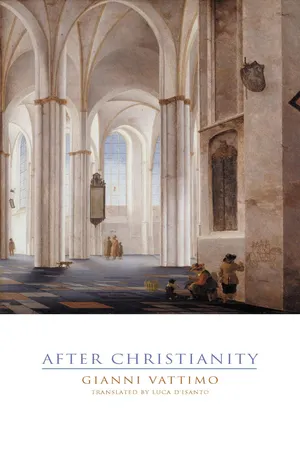
What has been the fate of Christianity since Nietzsche's famous announcement of the "death of God"? What is the possibility of religion, specifically Christianity, thriving in our postmodern era? In this provocative new book, Gianni Vattimo, leading Italian philosopher, politician, and framer of the European constitution, addresses these critical questions.
When Vattimo was asked by a former teacher if he still believed in God, his reply was, "Well, I believe that I believe." This paradoxical declaration of faith serves as the foundation for a brilliant exposition on Christianity in the new millennium—an age characterized by a deep uncertainty of opinion—and a personal account of how Vattimo himself recovered his faith through Nietzsche and Heidegger. He first argues that secularization is in fact the fulfillment of the central Christian message, and prepares us for a new mode of Christianity. He then explains that Nietzsche's thesis concerns only the "moral god" and leaves room for the emergence of "new gods." Third, Vattimo claims that the postmodern condition of fragmentation, anti-Eurocentrism, and postcolonialism can be usefully understood in light of Joachim of Fiore's thesis concerning the "Spiritual Age" of history. Finally, Vattimo argues for the idea of "weak thought." Because philosophy in the postmetaphysical age can only acknowledge that "all is interpretation," that the "real" is always relative and not the hard and fast "truth" we once thought it to be, contemporary thought must recognize itself and its claims as "weak" as opposed to "strong" foundationalist claims of the metaphysical past. Vattimo concludes that these factors make it possible for religion and God to become a serious topic for philosophy again, and that philosophy should now formally engage religion.
- English
- ePUB (mobile friendly)
- Available on iOS & Android
eBook - ePub
After Christianity
About this book
Information
Subtopic
Herméneutique philosophique1

The God Who Is Dead
IN ONE OF the long fragments on nihilism from the 1800s (which was first published in The Will to Power), Nietzsche asks whether nihilism is compatible with some form of faith in the divine and conceives of the possibility of a pantheistic religiosity, since “after all only the moral God is denied”1). After all, there are other, well-known passages in Nietzsche’s more mature work where he speaks of the creation of new gods. Let me remark that when announcing the death of God, Nietzsche anticipates that the latter’s shadow will continue to be cast upon our world for a long time. As with the emperor’s message in Kafka’s story, time is necessary so that the message will reach the most remote provinces of the empire, or the most secret corners of our consciousness. On the basis of these fragments, it is possible to draw not only the idea of the religious, Christian character of Nietzsche’s inspiration (on which there is an abundant literature, for example Karl Jaspers’s study) but also the impression that the announcement of the death of God does not definitely close off Nietzsche’s engagement with religion.
My aim here is not to explore the meaning of the possible “return” of religion in Nietzsche’s philosophy, which constitutes a problem (after all, still largely unresolved) for the Nietzsche-Forschung. Instead, I want to ask more generally whether and to what extent the end of all possible religious experience constitutes the implication of what Nietzsche calls the death of God (or the overcoming of the moral God), which in contemporary thought is described as the end of metaphysics.
I begin by explaining why I interpret the Nietzschean death of God as the end of metaphysics, which, as is well known, is Martin Heidegger’s idea. Here too I have no intention of providing a thematic or historical reconstruction of Heidegger’s thought. I argue instead that the Nietzschean announcement of the death of God and the Heideggerian announcement (let me stress the character of announcement: neither a theory nor a thesis) of the end of metaphysics can provide the general framework for characterizing late-modern experience. This is how I will discuss these thinkers (on the basis of historical analysis I have undertaken elsewhere).2
We are all aware of the meaning of Nietzsche’s announcement of the death of God. The belief in God was a powerful instrument of rationalization and discipline, which enabled man to leave the primitive state of the bellum omnium contra omnes, favoring the constitution of the “scientific” world view and paving the way for technology, with its reassuring effects that facilitate existence. For this reason, today’s “civilized” man no longer needs to believe in God. Now, those who were always commanded in the name of God not to lie have recognized that this belief is useless and obsolete. This is why Nietzsche argues that believers have killed God. However, this statement must be read beyond its literal meaning, in light of the general phenomenon of the lightening of existence brought about by the rationalization that was initially related to belief in God. This phenomenon has made useless and obsolete the radical hypothesis concerning the existence of a supreme Being as the ground and ultimate telos of the world.
Let me stress that the Nietzschean doctrine has only the character of an announcement: Nietzsche is not putting forward an atheistic metaphysics, which would imply the claim to describe reality correctly as something from which God is excluded. This claim, like the claim advanced by the faith in the truth discussed in The Gay Science, would still entail a form of faith in the moral God as the founder and guarantor of the objective world order. Only if we keep this in mind can we recognize the analogy, or close continuity, between the Nietzschean doctrine of the death of God and the end of metaphysics of which Heidegger speaks. It is not a matter of discovering a philosophical truth superior to that of past metaphysical philosophies. Like the death of God, the end of metaphysics is an event that cannot be ascertained objectively, one to which thought is called to respond. It is an event that transforms the existence of the person who receives the announcement—or which is entirely constituted by this transformation.
In Heidegger’s thought, the event of “the end of metaphysics” has basically the same meaning of the death of God: the moral God, in Nietzsche’s view, is “ueberwunden,” overcome, or put aside. Indeed, what Heidegger calls metaphysics is the belief in an objective world order, which must be recognized so that thought might conform with it its descriptions of reality and its moral choices. This belief in the objective world order evaporates when it is revealed to be untenable. Briefly, and provocatively, let me observe that this happens in the twentieth-century existentialism that is represented, more radically and more consistently, by Heidegger’s Being and Time (1927). Existentialism “coresponds” to the completion of metaphysics in the world of the incipient “total organization” of society, made possible by modern science, which has brought the premises of Greek metaphysics to their logical conclusion. Metaphysics endured only as long as it was a belief in the ideal world order—in a kingdom of essences that lay beyond empirical reality—which made knowledge and the critique of reality’s limits possible. Now metaphysics has come to deny itself, through a chain of events associated with the development of the modern sciences, where the truth of the Platonic ideas has become more and more identifiable with the objectivity of the statements of physics. Metaphysics has unmasked itself as an untenable and inefficacious belief insofar as the ideal order, to which it always in principle related itself, has become the de facto order of the rationalized world of modern technological society. This order makes it de facto impossible to think of existence as project, opening, unpredictability, or ultimately as freedom. If true being lies in the objectivity of the objects ascertained by the sciences and codified by the laws of physics, then human existence cannot be conceived of as being and thereby becomes theoretically unthinkable. Heidegger’s effort to move beyond metaphysics (which he describes as “the forgetting of being”) into beings reflects the theoretical impossibility of thinking about human existence with the concepts inherited from tradition, as well as the practical—ethical and political—rebellion against what Adorno called the world of the total organization.
However, the self-dissolution of metaphysics cannot be described in these terms only. It is not confined to the view of being as objectivity, which has become untenable for theoretical and ethical-political reasons. After Being and Time, during the years that he himself described as the “turning” point of his thought, Heidegger increasingly insisted on the nihilistic outcomes of modern techno-science. However, in addition to the total organization of society, what refutes metaphysics, thereby making the belief in an objective, stable, and instituted order of being untenable, is the inexorable proliferation of world “pictures.” The specialization of scientific languages, the proliferation of cultures (which are no longer hierarchically brought together under the Eurocentric myth of progress), the fragmentation of the life spheres, and the Babel-like pluralism of late-modern society have made the thought of a unified world order impossible to conceive. Now, all the metanarratives—to use Lyotard’s well-taken expression—that claimed to mirror the objective structure of being have been discredited. Thus, the end of metaphysics is not merely the discovery, by a philosopher or by a school of thought, that Being is not the objectivity to which science has reduced it. It is above all associated with a series of events that have transformed our existence, of which post-metaphysical philosophy gives an interpretation rather than an objective description (an interpretation is not neutral but engaged knowledge, because it is not placed at an ideal point that would claim to be external to the process).
In other words, it is precisely the Babelic world of late modernity that “verifies” the Nietzschean announcement of the death of God and the Heideggerian announcement of the end of metaphysics—which are identical in meaning—by legitimizing them. In a certain sense, which cannot be systematized, this is the world where “the moral God” as metaphysical ground is dead and buried. But the moral God is only what Pascal referred to as the God of the philosophers. There are many indications, therefore, that the death of the moral God has paved the way for the renewal of religious life.
This seems clear, at least for me, in the realm of theory. The decline of metaphysics as a systematic philosophy, which conferred a consistent, unified, and rigorously grounded representation of the stable structures of Being, has made the philosophical denial of God’s existence impossible. This was, after all, already one of the principles Kant had set for himself in the Critique of Pure Reason. To defend the possibility of religious experience, Kant had to show that reason couldn’t speak objectively of God and of the noumenal world. Thus, he grounded religious experience on practical reason only, against efforts to deny it on the basis of metaphysical arguments. Today, it seems that the main philosophical outcome of the death of the metaphysical God and of the almost general discrediting of philosophical foundationalism is the renewed possibility of religious experience. This possibility returns to philosophy in the guise of the liberation of metaphor.
It seems, then, that Nietzsche may have been right in forecasting the invention of new gods. Narratives proliferate without any stable center or hierarchy in the Babel-like pluralism of late-modern society. No master narrative or normative metanarrative is any longer capable of legitimizing or delegitimizing them. The social hierarchy among languages, of which the young Nietzsche spoke in the long fragment “Truth and Lies in an Extra-moral Sense,” has been overturned. In that fragment, Nietzsche asserted the metaphorical character of language: everybody associates freely a mental image with an object and a sound. Nietzsche illustrates how the obligation to “lie by following an instituted rule,” that is, by adopting the master’s metaphors as the only proper language, arose only through the institution of society and of a cast of masters. Consequently, the other languages were degraded to the realm of the poetic, namely to the status of purely metaphorical languages. But the pluralism without center of our postmetaphysical epoch has undermined the theoretical possibility of distinguishing between metaphorical and proper language. Wherever it survives, this distinction is revealed to be a pure effect of social power’s unequal distribution. This was, for example, the sense of Michel Foucault’s inquiry. To be sure, the liberation of metaphor from subordination to the proper sense has taken place in theory only. In practice, our pluralistic societies are still far from having achieved the perfect equality of the life forms (different cultures, groups, minorities of different kinds) embodied in the different metaphorical systems. The demise of hierarchical principles and norms is, at least, sufficiently clear in the theoretical discourse of philosophy, literary criticism, and several genres of writing. We have at our disposal not only the explicit theory of the end of metanarratives advanced by Lyotard but also the theories of redescription such as Rorty’s, who believes it is necessary for human culture to generate infinite redescriptions so that “the conversation might continue.” A symptom of metaphor’s liberation is visible in recent Italian philosophy and also in a lot of Continental philosophy in the flexible use, without any explicit justification, of mythological and religious terms. This began (following in Heidegger’s footsteps) with philosophy’s dialogue with poetry but went on as an autonomous phenomenon. Nowadays, it is more and more frequent for philosophers to speak of angels and redemption without providing an explicit justification for the use of these terms, or to refer to classical or preclassical mythologies extracted from the commentary of poetic, theological, or mythological texts. The distinction between philosophical and poetic—or creative—writing has been apparently erased.
The end of metaphysics and the death of the moral God have liquidated the philosophical basis of atheism. Contemporary philosophers seem to be mostly religious or irreligious as if out of inertia, rather than for strong theoretical reasons. In modernity, the theoretical reasons for being religious or not were associated with positivist or historicist metaphysics. God was denied either because his existence was not verifiable by scientific experiment or because he was a stage ineluctably overcome in the progressive enlightenment of reason. But the end of metaphysics has now discredited these metanarratives.
The revival of religion in late-industrial society corresponds, though without any direct causal link of dependence, to the liberation of metaphor and to the dismissal of the philosophical reasons of atheism. To be sure, many explanations have been advanced to explain this revival, which have to do in the end with the historical circumstances that have ushered in the end of metaphysics—for example, the demise of colonialism, which has de facto liberated “other” cultures, thereby making Eurocentric historicism itself impossible. The end of Western colonialism has also meant the possibility of developing a multiethnic society in most of the industrialized nations. Even though it has been less peaceful than the textual liberation of philosophy or of literary criticism, multiethnic pluralism can be treated as a phenomenon of the liberation of metaphor. The other cultures have made their voices heard in Western societies but have also brought with them their own theologies and religious beliefs. Perhaps the phenomenon of the rebirth of local religious traditions in Western societies is a mimetic and defensive reaction to this very pluralism. It is possible that the demise of proper language and of the hierarchy of world pictures has provoked a phenomenon of rejection, thus creating a need to return to some forms of belonging that are at the same time as reassuring and as dreadful as all forms of fatherhood. We may add to these phenomena, on the one hand, the popularity acquired by the Roman pope because of his contribution to the collapse of communist dictatorships; on the other hand, the seriousness of problems posed by developments in the life sciences, which cannot be resolved by the pure means of modern reason and thus may have driven people to seek deeper and “essential” truths.
I am sure that all of us could add to the list of reasons for the rebirth of religion and the forms that it is taking in our world. Now it is already possible to see, even in the brief outline drawn here, the configuration of a paradoxical situation: the return of religion, in all its theoretical, social, and historical aspects (like the fall of Eurocentrism and the political liberation of other cultures), seems to depend on the dissolution of metaphysics, that is, on the dismissal of all doctrines, which claimed absolute and definitive values as the true description of Being’s structures. Whereas the liberation of metaphor has allowed philosophers to speak of God, angels, and salvation once again, it is only the pluralism of late-modern societies that has conferred visibility to religion. In turn, though, the renewal of religion configures itself necessarily as the claim to an ultimate truth, which is indeed an object of faith rather than rational demonstration but which in the end tends to exclude the very pluralism of world pictures that has made it possible.
Once we acknowledge this paradox, we should ask whether the death of the moral-metaphysical God must necessarily lead us to the rebirth of the religious fundamentalism and of the ethnic-religious or religious-communitarian fundamentalism that are spreading around us. The same question, albeit slightly modified, can be raised at the philosophical level, too. It would seem paradoxical that the effect of the overcoming of metaphysics (which was theorized by Heidegger but also is central to a large part of twentieth-century philosophy) is the pure and simple legitimation of relativism and its shadow, fundamentalism, and communitarianism, its democratic version. Judging from the many signs, this is precisely what is happening—for example, Rorty’s relativism and the communitarianism of philosophers like MacIntyre and Charles Taylor.
To return to the theme of religion, which is my topic here, it seems clear that the return of religion in the discourse of philosophy and in our shared experience has acquired visibility through the liberation of metaphor from subordination to the proper sense. But the condition of such liberation is entirely bound up with the end of metaphysics. I am thinking of Christian philosophers in contemporary Italian and French thought, who declare themselves to be “postmetaphysical” insofar as they treat the end of metaphysics as a process that has undermined philosophical atheism, paving the way for a Pascalian wager or decision of faith. The theses that I and other Italian post-Heideggerian philosophers have called “weak thought” have become very popular in a certain part of Italian Catholic thought because they have been interpreted, though with a degree of partiality, as a pure and simple confession of reason’s weakness. True, the demise of the metanarratives is a recognition of weakness in this sense; just as “weak” is Nietzsche’s recognition that one cannot avoid speaking metaphorically, that is, in a nonobjective and non-descriptive manner, without mirroring a state of affairs. However, this is just a small part of the whole picture. To extract it from the whole is to reduce the end of metaphysics and the death of the moral God to a pure and simple legitimization of relativism and fundamentalism, whether communitarian or not.
Once we acknowledge that, at the end of metaphysics, we have no ground for unmasking the truth hidden in our myths and ideologies because we have discovered that the belief in an ultimate truth is a myth and that the very idea of the unmasking of ideologies is itself an ideology, shall we just return to placing our faith in myths and ideologies? My impression is that this is precisely what is happening in many aspects of contemporary culture, even though it is not explicitly acknowledged. When, for instance, post-metaphysical philosophy limits itself to the defense of pluralism for its own sake or to the legitimization of proliferating narratives without hierarchy or center, it ends up preaching a pure and simple return to myth and ideology without setting up any critical principle, apart from the important principle of tolerance. Are not tolerance and pluralism themselves ultimately myths and ideologies, which cannot claim the status of normative metadiscourses? For anyone who acknowledges the impossibility of judging the Babel-like pluralism of world pictures from an external point of view—a view from nowhere—the appeal to tolerance is insufficient. This, I believe, is the force of the communitarian objection to liberal relativism.
It seems, then, that only when we reflect on the difficulties emerging from the end of metaphysics and the death of God, philosophy meets religion, and not just as a possibility disclosed in “negative” fashion, that is, by recognizing philosophy’s defeat and weakness. The radical overcoming of metaphysics cannot be reduced to the pure and simple legitimization of myth, ideology, and the Pascalian leap of faith. Let me turn now to discussing Heidegger’s interpretation of the overcoming of metaphysics, since he is the philosopher who has theorized it more radically. The effort to think of Being—for the reasons mentioned at the outset—not as an objective structure projected by the mind to conform itself to in all its practical choices led Heidegger to practice philosophy as the recollection of the history of Being. The expression “history of Being” or “destiny of Being” (a word play on the German terms Geschichte and Geschick) is central to the later Heidegger. This is because, for Heidegger, only the thought that conceives of Being as event or as occurrence rather than objective structure is a nonmetaphysical and nonobjectifying way of recollecting Being. In other words, the objects of our experience are given only within a horizon; this horizon, like the light that makes things appear, is not in turn objectively visible. If we are capable of speaking of Being, we must conceive of Being as horizon and as light, rather than the general structure of objects. Since it is not an object, Being does not possess the stability assigned to it by the metaphysical tradition. Hence, the event of Being lies in the double sense of the genitive: the horizon is the opening belonging to Being...
Table of contents
- Cover
- Half title
- Series Page
- Title
- Copyright
- Contents
- Introduction: Believing That One Believes
- 1. The God Who Is Dead
- 2. The Teachings of Joachim of Fiore
- 3. God the Ornament
- 4. History of Salvation, History of Interpretation
- 5. The West or Christianity
- 6. The Death or Transfiguration of Religion
- 7. Christianity and Cultural Conflicts in Europe
- 8. The Christian Message and the Dissolution of Metaphysics
- 9. Violence, Metaphysics, and Christianity
- 10. Heidegger and Christian Existence
- Notes
- Index
Trusted by 375,005 students
Access to over 1.5 million titles for a fair monthly price.
Study more efficiently using our study tools.
Frequently asked questions
Yes, you can cancel anytime from the Subscription tab in your account settings on the Perlego website. Your subscription will stay active until the end of your current billing period. Learn how to cancel your subscription
No, books cannot be downloaded as external files, such as PDFs, for use outside of Perlego. However, you can download books within the Perlego app for offline reading on mobile or tablet. Learn how to download books offline
Perlego offers two plans: Essential and Complete
- Essential is ideal for learners and professionals who enjoy exploring a wide range of subjects. Access the Essential Library with 800,000+ trusted titles and best-sellers across business, personal growth, and the humanities. Includes unlimited reading time and Standard Read Aloud voice.
- Complete: Perfect for advanced learners and researchers needing full, unrestricted access. Unlock 1.5M+ books across hundreds of subjects, including academic and specialized titles. The Complete Plan also includes advanced features like Premium Read Aloud and Research Assistant.
We are an online textbook subscription service, where you can get access to an entire online library for less than the price of a single book per month. With over 1.5 million books across 990+ topics, we’ve got you covered! Learn about our mission
Look out for the read-aloud symbol on your next book to see if you can listen to it. The read-aloud tool reads text aloud for you, highlighting the text as it is being read. You can pause it, speed it up and slow it down. Learn more about Read Aloud
Yes! You can use the Perlego app on both iOS and Android devices to read anytime, anywhere — even offline. Perfect for commutes or when you’re on the go.
Please note we cannot support devices running on iOS 13 and Android 7 or earlier. Learn more about using the app
Please note we cannot support devices running on iOS 13 and Android 7 or earlier. Learn more about using the app
Yes, you can access After Christianity by Gianni Vattimo, Luca D'Isanto in PDF and/or ePUB format, as well as other popular books in Théologie et religion & Herméneutique philosophique. We have over 1.5 million books available in our catalogue for you to explore.