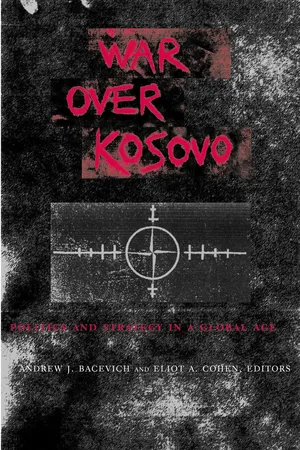
More than any other episode since the end of the Cold War, the conflict in Kosovo revealed the distinctive attributes of a new American "way of war." In so doing, Kosovo also brought into sharp focus the military, political, and moral dilemmas confronting a liberal democracy intent on wielding preeminent power on a global scale.
What are the moral implications posed by waging high-tech warfare for humanitarian purposes? Does the precedent set by intervention of this type point toward peace and stability or toward more war? How well suited are the United States military and American society as a whole to the security challenges of the age of globalization?
According to Bacevich and Cohen, gauging the "success" achieved in Kosovo yields important answers to these and related questions. The volume includes a well-crafted historical overview of the war and six essays that place it in a broader context. The contributors explore the conflict's relationship to U.S. grand strategy, the Revolution in Military Affairs, and American civil-military relations, among other topics.
Contributors: William A. Arkin, Andrew J. Bacevich, Eliot A. Cohen, Alberto R. Coll, James Kurth, Anatol Lieven, Michael Vickers
eBook - ePub
War Over Kosovo
Politics and Strategy in a Global Age
- English
- ePUB (mobile friendly)
- Available on iOS & Android
eBook - ePub
War Over Kosovo
Politics and Strategy in a Global Age
About this book
Information
1 | Operation Allied Force: “The Most Precise Application of Air Power in History” |
At two in the afternoon Washington time, 8:00 P.M. local time on March 24, 1999, the North Atlantic Treaty Organization (NATO) initiated offensive military operations against Yugoslavia. Thirteen (of 19) NATO members committed aircraft, and eight put their planes in action to bomb a sovereign nation that had attacked neither any alliance members nor its neighbors.1
Operation Allied Force came after more than a year’s effort by the six-nation Contact Group (including Russia) to find a negotiated solution to stop Serbian human-rights violations in Kosovo, one of four jurisdictions of the Federal Republic of Yugoslavia (FRY).2 In 1998, systematic violence against ethnic Kosovar Albanians erupted, and by the fall an estimated 250,000 Albanians had been driven from their homes by Yugoslav military and paramilitary forces. Intelligence agencies predicted that tens of thousands were threatened by approaching winter weather. The situation prompted the United Nations Security Council to adopt resolution 1199 (UNSCR 1199) on September 23, calling for a cease-fire and the return home of refugees and the internally displaced.3
Throughout the crisis, NATO had prepared and refined military options to amplify the diplomatic process. “Activation warnings” for two different air operations were issued the day after the Security Council passed UNSCR 1199. One operation was known as the Flexible Anvil “Limited Air Response” and the other as the Allied Force “Phased Air Campaign.”4 Flexible Anvil, relying predominantly on cruise missiles, “was designed as a quick-strike, limited-duration operation, primarily to be used in response to a specific event.”5
Richard Holbrooke, the Clinton administration’s chief Balkan troubleshooter, departed for Belgrade on October 5 to meet with Yugoslav President Slobodan Milosevic. To demonstrate allied resolve, NATO on October 13 issued a higher activation “order,” threatening air action. In the face of this threat, Milosevic seemingly gave way. He agreed to reduce Serbian security forces in Kosovo and to permit international verification missions in and over the province. The North Atlantic Council (NAC) agreed to a “pause” in its threats, and in late October it suspended execution permission for air operations.6
After a brief period when conditions in Kosovo seemingly stabilized, attacks against ethnic Albanians resumed. On January 15, 1999, a massacre of 45 civilians allegedly occurred in the village of Racak. The Contact Group called on both sides to end the cycle of violence, summoning representatives of the Belgrade government and Kosovar Albanians to Rambouillet, France, for direct discussions on how to end the violence in Kosovo. On January 30, the NAC authorized NATO Secretary General Javier Solana to commence air strikes against Yugoslav targets if an agreement was not reached.
But the Rambouillet talks ended unsuccessfully on March 19, and NATO began preparations to initiate bombing. Days before the talks broke down, Belgrade launched “Operation Horseshoe,” its methodical campaign of ethnic cleansing—Yugoslav troops and 300 tanks were massing in and around Kosovo.7 Holbrooke once again flew to Belgrade on March 22 in a last-ditch effort to bring Milosevic to terms. That same day, the NAC authorized Solana, subject to further consultations, to ready a broader range of air options.8 NATO planned initially to conduct a two-day demonstration strike hitting targets throughout Yugoslavia “in an attempt to convince Milosevic to withdraw his forces and cease hostilities.” Two escalating response options would back up the 48-hour plan: the first, a response to continued Yugoslav acts in Kosovo, and the second, a response to aggression against NATO.9
Many in the NATO leadership and member governments remained hopeful that a show of force would compel Milosevic to yield. “There was that abiding belief… that the campaign will last two nights and that after two nights, Mr. Milosevic would be compelled to come to the table,” said one senior U.S. general.10 After the fact, U.S. officials claimed that they had cautioned allied leaders not to initiate strikes unless they were willing to escalate and go all the way. But there is no evidence that the principal players—Solana, Holbrooke, and General Wesley Clark, the Supreme Allied Commander Europe (SACEUR), in particular—questioned expectations that limited strikes would succeed in coercing Milosevic.11
This chapter describes the 78-day air war that ensued—from its diffident beginning on March 24 until its abrupt conclusion on June 10. The focus is on the military dimensions of Operation Allied Force: the conduct and the evolution of the bombing campaign that became in the eyes of its proponents “the most precise application of air power in history.”
The Plan
Every military operation begins with a plan, and Operation Allied Force began life as NATO OPLAN 10601. The official history says that preparation of 10601 began in response to a NATO directive in June 1998. In reality General Wesley Clark, who was both SACEUR and commander in chief (CINC) of United States European Command, directed General John Jumper, commanding U.S. Air Forces in Europe, to begin developing options for an air war a month before, in May. In other words, U.S. planning for what would become Operation Allied Force began prior to and proceeded separately from the planning effort within NATO. This penchant for “U.S. only” planning reflected Washington’s greater propensity to use force, an assertion of American prerogatives as the dominant partner in the North Atlantic community, and the complicated relationship of Clark, as the theater CINC, with his air-warfare subordinates. As part of the American effort to portray the U.S. role as “supporting [and] not leading” the NATO effort, attempts were made to portray the separate track as existing only to the very limited extent that operational security demanded it.12 But even as the conflict began, separate NATO and “U.S. only” tracks continued, with alliance members denied the details of U.S. cruise-missile strikes and operations by B-2 and F-117 stealth aircraft.
Between the summer of 1998 and March 1999, NATO and U.S. planners examined an assortment of alternatives, from the limited air response to a robust “U.S. only” option called Nimble Lion, and even to “forced entry” ground campaigns. Planners found themselves responding to General Clark’s ever changing “commander’s intent,” which provided guidance on what targets would or would not be hit in Yugoslavia. First Clark asked for a plan that would focus on five key radio-relay nodes, then for an unlimited campaign, then for strikes limited to below the 44 degree north longitude, then for a campaign employing cruise missiles only, then for one executed exclusively by U.S. and British forces. Throughout, however, certain key requirements remained fixed: Minimize collateral damage, avoid any friendly losses, and preserve the Yugoslav civil infrastructure.13
According to General Clark, shifting military priorities reflected an absence of political consensus. “There simply was no consensus on the part of the nations to lay in place the full array of military options,” he would later testify.14 In some ways, then, from the very beginning the prospect of escalation was implicit in any “plan.” Alliance members who were determined to use force were willing to sacrifice military realism to secure political unity, believing that, once military action had begun, NATO would have no choice but to expand operations as conditions required. Should a mere show of force be unsuccessful, doubting parties would be lobbied to agree to do more.
By the time Allied Force commenced, NATO had gone through more than 40 iterations of the air-campaign plan. The version actually initiated on March 24 included three combat phases. Phase 1 would establish air superiority over Kosovo and degrade command and control throughout Yugoslavia. Phase 2 would attack military targets in Kosovo and those Yugoslav forces providing reinforcement into Kosovo south of 44 degrees north latitude. Phase 3 would expand air operations against a wide range of military and security-force targets throughout Yugoslavia, including the capital city Belgrade. If Phase 1 did not force the Serbian leadership to accede, Phase 2 and 3 would up the ante.15
Within each phase, significant disagreements existed inside both the U.S. and NATO militaries with regard to strategy and priorities. Those engaged in Nimble Lion planning wrestled with a host of constraints: targets within Montenegro were restricted, and critical command and control nodes—particularly telephone exchanges—remained off limits due to concerns about collateral damage, as did electrical-power generating plants and television transmitters. One effect of the restrictions was to preclude a concentrated effort in the initial 48 hours to neutralize Yugoslav air defenses. The ostensible priority at the outset of hostilities would be to establish air supremacy, but the constraints actually worked against that goal.
Looking beyond the 48-hour bombing “demonstration,” General Clark and his air-warfare commander, U.S. Air Force Lieutenant General Michael Short, disagreed fundamentally about the proper design of an extended campaign. Should it concentrate on “strategic” targets in Yugoslavia or on “tactical” targets throughout Kosovo? Short believed that “Body bags coming home from Kosovo didn’t bother Milosevic, and it didn’t bother the leadership elite.”16 Taking Desert Storm’s 1991 strikes on Iraq as his model, he argued for delivering a powerful strategic blow against the Serb leadership in Belgrade. “I believe[d] the way to stop ethnic cleansing was to go at the leadership… and put a dagger in that heart as rapidly and as decisively as possible,” he told Congress after the war.17
Clark, applying what Vice Admiral Daniel J. Murphy, commander of NATO naval forces, called “a ground commander’s perspective,” had other ideas.18 He wanted Yugoslav forces to bear the brunt of NATO’s attacks. His focus was not only the perpetrators of ethnic cleansing on the ground in Kosovo, but also special police and paramilitary forces throughout Yugoslavia.
Among army officers, a belief that wars are ultimately decided on the ground is an article of faith. But if Clark was affected by service bias, other matters also weighed heavily on his thinking. He, and not General Short, was directly responsible for translating political guidance into operational plans. He, not his air commander, appreciated how fragile and tentative was the consensus within the alliance in support of any military action. If commanders became too insistent in demanding a more aggressive approach to using force, they would undermine that consensus and—without a shot having been fired—hand Slobodan Milosevic a victory.
Thus, from his vantage point in Belgium, Clark concluded that his political masters would never agree to opening the war with a Desert Storm–style all-out air assault on Belgrade. Advocating only the most modest bombing campaign enabled Clark to reassure those alliance members hoping that Milosevic might yet have a rapid change of mind. Doing so also seemed to signal that NATO’s military chiefs saw no need even to consider mounting a ground invasion, a prospect that several members of the alliance were unwilling to countenance even as a theoretical possibility.
In short, NATO began the war without having achieved any consensus on what the alliance would do if the hostilities extended beyond 48 hours. Although the very fact that it was a “phased” campaign implied the possibility of escalation, the alliance had postponed any decision on what that escalation would entail. Clark and his civilian masters would play it by ear: if Milosevic did not quickly cave in during Phase 1, there would be opportunity to escalate and accommodate alternative approaches.
In practice, this was an invitat...
Table of contents
- Cover
- Half title
- Title
- Copyright
- Contents
- Dedication
- Acknowledgments
- Introduction: Strange Little War
- List of Contributors
- 1. Operation Allied Force: “The Most Precise Application of Air Power in History”
- 2. Kosovo and the New American Way of War
- 3. First War of the Global Era: Kosovo and U.S. Grand Strategy
- 4. Hubris and Nemesis: Kosovo and the Pattern of Western Military Ascendancy and Defeat
- 5. Kosovo and the Moral Burdens of Power
- 6. Neglected Trinity: Kosovo and the Crisis in U.S. Civil-Military Relations
- 7. Revolution Deferred: Kosovo and the Transformation of War
- Index
Trusted by 375,005 students
Access to over 1.5 million titles for a fair monthly price.
Study more efficiently using our study tools.
Frequently asked questions
Yes, you can cancel anytime from the Subscription tab in your account settings on the Perlego website. Your subscription will stay active until the end of your current billing period. Learn how to cancel your subscription
No, books cannot be downloaded as external files, such as PDFs, for use outside of Perlego. However, you can download books within the Perlego app for offline reading on mobile or tablet. Learn how to download books offline
Perlego offers two plans: Essential and Complete
- Essential is ideal for learners and professionals who enjoy exploring a wide range of subjects. Access the Essential Library with 800,000+ trusted titles and best-sellers across business, personal growth, and the humanities. Includes unlimited reading time and Standard Read Aloud voice.
- Complete: Perfect for advanced learners and researchers needing full, unrestricted access. Unlock 1.5M+ books across hundreds of subjects, including academic and specialized titles. The Complete Plan also includes advanced features like Premium Read Aloud and Research Assistant.
We are an online textbook subscription service, where you can get access to an entire online library for less than the price of a single book per month. With over 1.5 million books across 990+ topics, we’ve got you covered! Learn about our mission
Look out for the read-aloud symbol on your next book to see if you can listen to it. The read-aloud tool reads text aloud for you, highlighting the text as it is being read. You can pause it, speed it up and slow it down. Learn more about Read Aloud
Yes! You can use the Perlego app on both iOS and Android devices to read anytime, anywhere — even offline. Perfect for commutes or when you’re on the go.
Please note we cannot support devices running on iOS 13 and Android 7 or earlier. Learn more about using the app
Please note we cannot support devices running on iOS 13 and Android 7 or earlier. Learn more about using the app
Yes, you can access War Over Kosovo by Andrew J. Bacevich,Eliot A. Cohen, Andrew Bacevich, Eliot Cohen in PDF and/or ePUB format, as well as other popular books in Politics & International Relations & Eastern European History. We have over 1.5 million books available in our catalogue for you to explore.