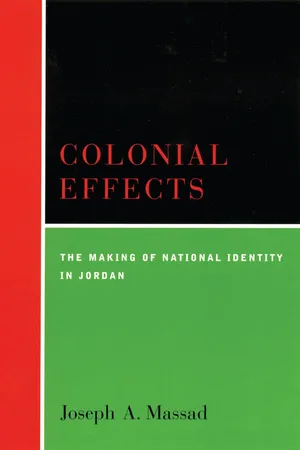
Colonial Effects analyzes the creation and definition of modern Jordanian identity. Massad studies two key institutions-- the law and the military--and uses them to create an original and precise analysis of the development of Jordanian national identity in the postcolonial period.
Joseph A. Massad engages recent scholarly debates on nationalism and richly fulfills the analytical promise of Michel Foucault's insight that modern institutions and their power to have productive, not merely repressive or coercive, capacities—though Massad also stresses their continued repressive function.
His argument is advanced by a consideration of evidence, including images produced by state tourist agencies aimed at attracting Western visitors, the changing and precarious position of women in the newly constructed national space, and such practices as soccer games, music, songs, food, clothing, and shifting accents and dialects.
- English
- ePUB (mobile friendly)
- Available on iOS & Android
eBook - ePub
About this book
Information
Subtopic
Middle Eastern HistoryIndex
History1 Codifying the Nation
Law and the Articulation of National Identity in Jordan
It has become commonplace to theorize nationalist discourses of the colonial and anticolonial varieties as aiming to produce national identities as essences that transcend time and space that are internalized by national subjects.1 This view, however, does not consider how these identities are codified in the laws of nation-states and is generally oblivious to the importance of the juridical in its constituting of nationalism. This chapter will explore the juridical dimension of national identities. Arguing that nationalist discourse and juridical discourse subsume each other while simultaneously maintaining a certain separateness, this chapter will attempt to demonstrate how the law produces juridical national subjects. Unlike nationalist discourses that posit national identities as anterior to them, as immutable essences of which nationalist discourse is a mere effect, the juridical discourse of the nation-state will be shown to enact nonessentialist national identities that are deployed, changed, and rescinded by the law. Whereas juridical discourse claims the status of the juridical subject as pre-discursive, and in that it is similar to nationalist discourse, unlike the latter it posits national identity as an effect of the law, not its precedent. All postcolonial national identities are anchored in the laws of nation-states. This chapter will demonstrate, however, that while the juridical secures the precepts of nationalism by interpellating subjects as nationals, it simultaneously reveals nationality as a fiction to be molded and remolded by the law.2 Moreover, this chapter will argue that the juridical is not a mere repressive manifestation of the political, but that it also plays a central productive, albeit regulatory, role: it produces and regulates identity.
The importance of laying down the law and applying it through enforcement is key to understanding how modern states operate internally vis-à-vis their subagencies, the bureaucracy, the military, and political institutions (the executive, the legislative, and the judicial), and externally vis-à-vis the territory over which the state reigns and the people this territory encompasses. As Louis Althusser has pointed out, however, the law is part of both the “repressive state apparatus” and the “ideological state apparatus”; it plays a unique double role.3 Althusser’s distinction is a variation roughly corresponding to what Antonio Gramsci calls “civil society” and “political society.” Gramsci’s civil society is where popular consent is produced noncoercively through what he termed hegemony.4 What is important in discussing the state in its national guise (i.e., the nation-state itself) is how the institution of law, as a repressive and ideological apparatus (or, as Gramsci would have it, one that produces conformity through hegemonic and coercive means), is needed to guarantee control over time and temporality more generally—not only time as present and future but, just as importantly, time as past—over space and spatiality more generally—not only of identifying territory as national or foreign but also rendering it juridically governable—and over people as normalized juridico-national subjects. In this vein, Jacques Derrida states that the “the founding and justifying moment that institutes law implies a performative force … not in the sense of law in the service of force, its docile instrument, servile and thus exterior to the dominant power but rather in the sense of law that would maintain a more internal, more complex relation with what one calls force, power or violence.”5 The law’s ability to structure the time and space of the nation-state, and to delimit the nature of the bodies of nationals, is therefore of utmost importance when discussing how nationalist discourses formulate national identities and how these identities are codified into law, whereby, following Derrida, the juridical is always internal to the national project and not an external manifestation servile to it. The very act of codification by the nation-state is part of the foundational moment of nationalization. Codification then is the productive act of identifying subjects as national.
Through juridical fiat, the law of nation-states defines and limits the time of the nation, its space, and its subjects. However, not only is the law interested in the identification of time as national time, space as national space, and the interpellation of subjects as nationals, but just as central to the definitional coherence of these categories (as we will see when we examine Jordanian laws of nationality later) is the law’s ability to identify time as non-national (as foreign, as colonial, and as postcolonial), space as non-national (as colonized, as occupied), and to interpellate and thus identify subjects as non-nationals (as foreigners). Sharing Derrida’s understanding that “[n]either identity nor non-identity is natural, but rather the effect of a juridical performative”6 is imperative in this context. Law, then, in a nation-state enacts the foundational differentiation of all the categories that it interpellates as binaries. It enacts not identity but difference tout court. However, the two components of this binary hold asymmetrical valences manifested in the law’s enumeration of rights and duties corresponding to them. To accommodate this asymmetry, which the law itself enacts, the two juridical subjects—the national and the foreigner—are inscribed through different categories of law. Juridical power in its ideological role, then, as Foucault has taught us, does not only repress and punish, it also produces the juridical subjects over whom its power is distributed. As a productive power, the law’s ideological instrumentality is the object of interest not only of state architects but just as importantly of the architects of nationality.
In the case of Transjordan, the first manifestation of a nationalist discourse propelled by the state was evidenced in the transformation of the state into one that rules juridically. This was accomplished through the enactment of a series of laws in the 1927 to 1928 period culminating in Transjordan’s Organic Law (al-Qanun al-Asasi, or the Basic/Foundational Law)7 in 1928. In the extra-juridical societal realm, this was preceded by several Transjordanian uprisings in the early 1920s asserting nativism against the non-native Mandatory-Hashemite state. Moreover, the time of the enactment of these laws by the Mandatory-Hashemite state coincided with a highly mobilized anticolonial nationalist movement whose identity was still in flux, but whose other (i.e., British colonialism) was clear. It was not until decades later, however, that a full-fledged Jordanian nationalism articulated itself (although the 1920s uprisings were renarrated by some Jordanian nationalists as nationalist moments) dialogically and in conjunction with the juridical discourse of nationality.
Crucial to this inquiry about the role of law in nation-building is the question of national identity and of nationalist agency, as they are differently constituted within nationalist discourse and in the laws of nation-states. Although the specifics of national identity and nationalist agency may differ according to the discourse within which they are formulated, they are constituted through similar operations. Whereas national identity is constituted through interpellation by nationalist discourse and the definitional fiat of nationality law, nationalist agency is produced through a combination of interpellation and performativity. By national identity, I mean the set of characteristics and markers (territorial origins, patrilineal or matrilineal ancestral origins, religion, race, gender, class, language) that nationalist thought sets as the prerequisites to having a certain national identity as that identity is defined by nationalist thought itself. Nationalist agency refers to the abilities and the will to perform a set of acts and practices aimed at achieving nationalist goals, as those (the abilities, the acts, the practices, and the goals) are defined by nationalist discourse and the laws of the nation-state. A national is someone who is identified by nationalist discourse, and its corollary, nationality law, as a “national” in a monological operation of interpellation. In this operation of interpellation, the national is the object of nationalist discourse and the subject of the law. The nationalist agent, however, is someone who identifies as, and who is identified by nationalist discourse as, part of the nation, and one whom nationalist discourse considers to be a possessor of the aforementioned abilities and will based on criteria set by nationalist discourse. Thus the agent functions as both object (interpellated) and subject (performer). Laws of the nation-state base themselves on this dialogical discursive identification to interpellate nationalist agents as performers. In this vein, Homi Bhabha8 states,
[The] people are not simply historical events or parts of a body politic. They are also a complex rhetorical strategy of social reference where the claim to be representative provokes a crisis within the process of signification and discursive address. We then have a contested cultural territory where the people must be thought in a double-time; the people are the historical “objects” of a nationalist pedagogy, giving the discourse an authority that is based on the pre-given or constituted historical origin or event; the people are also the “subjects” of a process of signification that must erase any prior or originary presence of the nation-people to demonstrate the prodigious, living principle of the people as that continual process by which the national life is redeemed and signified as a repeating and reproductive process.
The foundation of Transjordan as a state in 1921, although a hesitant act by its architects, the British and the Hashemites, was to be made permanent through the enactment of a series of laws culminating in the Organic Law of 1928 authorizing the new state in its territorial and temporal claims and in its control of the bodies over which it rules. This chapter will concern itself only with the Nationality Law,9 which was enacted alongside the Organic Law in 1928, and its juridical journey of amendments, nullifications, and reenactments through the present. Nationality Law is important not only for its foundational regulation of who is a national and who is not, but also for its ever-continuing role in reorganizing the nation’s temporal, spatial, and corporeal borders. Nationality Law is conscious of its very productivity of “the people.” “But this people does not exist … before this declaration, not as such.”10 Still, the very act of interpellation is a reproductive performance, of giving birth to the people as nation. Who is interpellated as a Jordanian, however, undergoes many variations in the journey of this law for the next eight decades. The occurrence of such variations is commensurate with the redefinition of Jordan spatially and of Jordanianness temporally. In this context, the role of law is not necessarily one that deals with questions of justice, but rather with the self-referential questions of legality, of juridicality. As Derrida asserts, “in the founding of law or in its institution, the … problem of justice will have been posed and violently resolved, that is to say buried, dissimulated, repressed. Here the best paradigm is the founding of the nation-states or the institutive act of a constitution that establishes what one calls in French l’état de droit.”11
The Prehistory of Juridical Postcoloniality
As anticolonial nationalism is derived from the European Enlightenment and post-Enlightenment Romantic thought, so are the laws demarcating nationhood in the now independent former colonies derived from the laws of European nations. Jordanian Nationality Law is hardly an exception in this regard. Jordan’s Ottoman and British colonial legacy, as will be demonstrated later, defined not only its legal system but also the juridical epistemology governing Jordanian nationality from the outset and through the present.
Whereas most legal experts and political historians trace Jordanian nationality laws to the Ottoman period and to the Treaty of Lausanne severing the country from its erstwhile sovereign, they have not, surprisingly, connected Jordanian nationality laws from the 1920s to the present with the laws of the British Empire; this is especially surprising as the articles on nationality in the Treaty of Lausanne itself are highly influenced by British nationality laws.12 The inhabitants of what became Transjordan were indeed governed before 1924, the effective application date of the Treaty of Lausanne (concluded in 1923 between the Ottomans and the Allies), by the Ottoman Nationality Law of 1869,13 itself the culmination of the 1839 Gülhane decree and the 1856 Hatt-i Humayun decree, which were attempts to Westernize Ottoman law as part of the Tanzimat Reform. Ottoman laws enacted during the Tanzimat period were influenced by and borrowed from the French and the Italian codes and judicial practice.14 The Treaty of Lausanne stipulated in its article 30 that “Turkish subjects habitually resident in territory which in accordance with the provisions of the present Treaty is detached from Turkey will become ipso facto, in the conditions laid down by the local law, nationals of the State to which such territory is transferred.”15 It should be emphasized that the Treaty of Lausanne gave the choice to those (over eighteen years of age) who desired to remain Turkish citizens to do so, to those who chose another nationality to have the right to reapply for the Turkish nationality within two years of the effective date of the Treaty, and to those who belong to a different “race” from the majority of the population of the territory of which they are resident to apply for the nationality of the country whose majority is of their same “race” in accordance with the laws of that country.16
As for the British Nationality Law (much of which was lifted verbatim into the Nationality Law of Transjordan) in existence at the time of the establishment of the British Mandate over and the creation of Transjordan, its modern form, which emerged in 1844 and was elaborated on in 1870,17 took shape in the British Nationality and Status of Aliens Act of 191418 and its amendments of 1918.19 As the forthcoming comparisons will show, almost everything that came to constitute juridical Jordanian national subjectivity was lifted verbatim from these British laws. This palimpsestic operation has been the most successful in concealing itself and in not being revealed by Jordanian nationalists to this very day. Whereas the influence of Islamic Ottoman judicial practice and of the Westernized Ottoman Tanzimat is readily accepted, insofar as the Ottomans are not conventionally considered culturally “other,” the “original sin” of British colonial contamination of what Jordanian juridical nationality constitutes, is conveniently erased out of the genealogy of juridical and nationalist memory.
It is interesting to note here that British colonial officials were not even certain that a separate Transjordanian nationality should be created at all. In 1922, a correspondence between several British colonial officials discussed the options of granting the people of “Trans Jordania” a separate nationality or simply, as Winston Churchill insisted, to consider them as “Transjordanian Palestinians.” The matter was ultimately settled in favor of the “separate Transjordan Nationality.”20 The very name of the territory had in fact already been debated a year earlier during British parliamentary debates in April 1921. Mr. David Ormsby-Gore, a former assistant secretary of the Middle Eastern Committee, suggested that the very name of the country be made “Belka.” It was explained to him that Belka “was the name of one district only. The whole territory was at present known officially as Trans Jordania.” 21 Even the Amir ‘Abdullah was not sure which name the territory should have—a national one, Sharq al-Urdunn or East of the Jordan, or a more inclusive Arab nationalist one. Upon setting up his government in 1921, he named it the Government of Mintaqat Al-Sharq Al-‘Arabi, or the Government of the Territory of the Arab East, a name that was used alongside Sharq al-Urdunn until the late 1920s.
The Nationality Law of 1928 was not the first attempt to define Jordanians juridically. The first attempt to do so had taken place a year earlier through the enactment of the Law of Foreigners (or Aliens).22 Following the 1914 British Nationality Law, the 1927 law defines Jordanians in similar terms to the 1928 law and defines a foreigner as “everyone who is not Jordanian.” However, there are a number of exclusions from the category of “foreigner” that the law insists upon, namely, those in the service of the Transjordanian Mandatory government, any individual in the service of His Majesty’s (Britain’s king) naval, land, or air forces, or anyone in the employ of British political, colonial, or consular agencies, and other nonhonorary consular employees. Whereas the Law of Foreigners will not apply to those excluded, it is unclear if laws dealing with nationals do, or indeed if those excluded can be juridical subjects of the Transjordanian state at all! In fact, the British government was so con...
Table of contents
- Cover
- Half title
- Title
- Copyright
- Dedication
- Contents
- Acknowledgments
- Introduction
- 1. Codifying the Nation: Law and the Articulation of National Identity in Jordan
- 2. Different Spaces as Different Times: Law and Geography in Jordanian Nationalism
- 3. Cultural Syncretism or Colonial Mimic Men: Jordan’s Bedouins and the Military Basis of National Identity
- 4. Nationalizing the Military: Colonial Legacy as National Heritage
- 5. The Nation as an Elastic Entity: The Expansion and Contraction of Jordan
- Concluding Remarks
- Notes
- Works Cited
- Index
Trusted by 375,005 students
Access to over 1.5 million titles for a fair monthly price.
Study more efficiently using our study tools.
Frequently asked questions
Yes, you can cancel anytime from the Subscription tab in your account settings on the Perlego website. Your subscription will stay active until the end of your current billing period. Learn how to cancel your subscription
No, books cannot be downloaded as external files, such as PDFs, for use outside of Perlego. However, you can download books within the Perlego app for offline reading on mobile or tablet. Learn how to download books offline
Perlego offers two plans: Essential and Complete
- Essential is ideal for learners and professionals who enjoy exploring a wide range of subjects. Access the Essential Library with 800,000+ trusted titles and best-sellers across business, personal growth, and the humanities. Includes unlimited reading time and Standard Read Aloud voice.
- Complete: Perfect for advanced learners and researchers needing full, unrestricted access. Unlock 1.5M+ books across hundreds of subjects, including academic and specialized titles. The Complete Plan also includes advanced features like Premium Read Aloud and Research Assistant.
We are an online textbook subscription service, where you can get access to an entire online library for less than the price of a single book per month. With over 1.5 million books across 990+ topics, we’ve got you covered! Learn about our mission
Look out for the read-aloud symbol on your next book to see if you can listen to it. The read-aloud tool reads text aloud for you, highlighting the text as it is being read. You can pause it, speed it up and slow it down. Learn more about Read Aloud
Yes! You can use the Perlego app on both iOS and Android devices to read anytime, anywhere — even offline. Perfect for commutes or when you’re on the go.
Please note we cannot support devices running on iOS 13 and Android 7 or earlier. Learn more about using the app
Please note we cannot support devices running on iOS 13 and Android 7 or earlier. Learn more about using the app
Yes, you can access Colonial Effects by Joseph A. Massad in PDF and/or ePUB format, as well as other popular books in History & Middle Eastern History. We have over 1.5 million books available in our catalogue for you to explore.