- English
- ePUB (mobile friendly)
- Available on iOS & Android
eBook - ePub
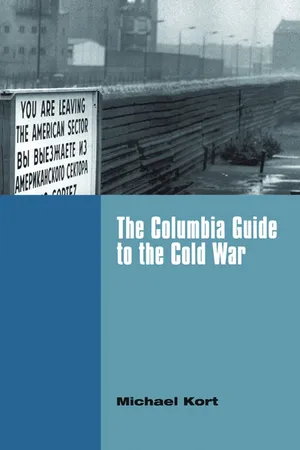
The Columbia Guide to the Cold War
About this book
The Cold War was the longest conflict in American history, and the defining event of the second half of the twentieth century. Since its recent and abrupt cessation, we have only begun to measure the effects of the Cold War on American, Soviet, post-Soviet, and international military strategy, economics, domestic policy, and popular culture. The Columbia Guide to the Cold War is the first in a series of guides to American history and culture that will offer a wealth of interpretive information in different formats to students, scholars, and general readers alike. This reference contains narrative essays on key events and issues, and also features an A-to-Z encyclopedia, a concise chronology, and an annotated resource section listing books, articles, films, novels, web sites, and CD-ROMs on Cold War themes.
Information
Subtopic
Military & Maritime HistoryIndex
HistoryPART I
Narrative Overview
CHAPTER ONE
The Cold War and Its Historians
The Cold War was the defining event of the second half of the twentieth century. It began as the guns of World War II, the most destructive war in human history, had barely fallen silent. It continued through a number of phases of varying intensity until the late 1980s and finally was formally declared over in 1990. The Cold War involved many nations and two major alliance systems. It spread from its point of origin in Europe to Asia, Africa, and even Latin America and divided not only Europe but also much of the world into two hostile camps. Yet through it all the Cold War had two main combatants: the United States and the Soviet Union.
The term “cold war” was first used to apply to the developing post–World War II Soviet-American confrontation by the journalist Walter Lippmann, whose book The Cold War appeared in 1947. However, the term has a much older lineage. It appears to have been first used by a Spanish political commentator named Don Juan Manuel, who in the fourteenth century wrote, “War that is very strong and very hot ends with either death or peace, whereas cold war neither brings peace nor gives honor to the one who makes it.” In the 1890s the German socialist thinker Eduard Bernstein, writing of the contemporary arms race in Europe, suggested that it had created a “cold war,” one in which there “is no shooting, but there is bleeding.” And just two years before Lippmann popularized the term, the prescient British author and journalist George Orwell, contemplating a world living in the shadow of nuclear war, warned of a “peace that is no peace,” which he called a permanent “cold war.”1
The Cold War was multidimensional. In one sense, it was a geopolitical conflict that arose from the aftermath of World War II, which had left Germany and Japan defeated and occupied, gravely weakened Great Britain and France, and turned the United States and the Soviet Union into the world’s dominant powers. In this respect the Cold War was a traditional power struggle between the two greatest military giants of the age, whose command of massive nuclear arsenals gave them destructive power that exponentially exceeded that of any other states in history. So great was their command of destructive technology that a new term, “superpower,” had to be coined to describe these military giants.
The Cold War, however, was at its core an ideological conflict, a struggle between two economic and social systems and radically different ways of life, totalitarian communism and democratic capitalism, represented, respectively, by the Soviet Union and the United States. In this sense, the roots of the Cold War stretch back to the Bolshevik Revolution of 1917 in Russia. It was this ideological core, the conflict between two ways of life in which each side, at least initially, saw the other as an illegitimate regime, that gave the Cold War what historian Arthur Schlesinger Jr. has called its “religious intensity.”2
Of course, in practice this black-and-white dichotomy of totalitarian communism and democratic capitalism was colored in multiple shades of gray. Both superpowers sought allies and proxies when and where they could find them, basing their decisions to render support on criteria of realpolitik that had nothing to do with promoting democracy or communism. Often this meant that the United States supported dictatorships in various parts of the world whose policies most Americans found repugnant. For its part, the Soviet Union frequently forged working relationships with non-Communist regimes that happened to be at odds with the United States or one or more of its allies. Still, these concessions to realpolitik abroad, no less than the deviations from principle that marked day-to-day life at home, did not negate the profound differences between the two competing ways of life, one based on Western democratic and free market traditions and the other on Russian autocratic and Marxist legacies, whose respective symbolic capitals were Washington and Moscow.
The Cold War also took on an apocalyptic dimension because of atomic weapons, another legacy of World War II. The existence of atomic weapons was what made the superpowers “super” and distinguished their rivalry from earlier ones. Their nuclear arsenals gave each of them, as physicist Robert Oppenheimer, quoting the Bhagavad-Gita, put it, the terrifying potential to be the “destroyer of worlds.” At the same time, these arsenals forced the superpowers to operate within strict limits, lest they cross the threshold of nuclear warfare and inevitably seal their mutual doom.
A massive worldwide conflict spanning almost half a century, the Cold War was laced with ironies. It began without a formal declaration—indeed, historians still debate its precise starting date—and ended with a suddenness that amazed virtually everyone. In the course of four and a half decades the Cold War was peppered with shooting (“hot”) wars, often between Soviet and American proxies, including three bitter conflicts—in Korea, Vietnam, and Afghanistan—that among them claimed over 100,000 American and at least 15,000 Soviet lives. Altogether, the small and not-so-small hot wars, some the outgrowths of the superpower conflict and others the result of extraneous local disputes, that flared in various parts of the world outside Europe during the Cold War took, according to one estimate, over 20 million lives.3 Yet aside from a few idiosyncratic incidents—most notably the clandestine (though not insignificant) combat activities of Soviet pilots in Korea and antiaircraft gunners in Korea and Vietnam—the United States and the Soviet Union never fired a shot in anger at each other. In fact, for the entire history of the Cold War the two superpowers were legally at peace. They had normal diplomatic relations, competed on friendly terms alongside each other in international sporting events, and exchanged visits by cultural, scholarly, and artistic individuals and groups. Their leaders met in a series of irregularly spaced “summit” meetings in usually unsuccessful attempts to improve relations and ease international tensions. In Europe, where the Cold War began and where it finally ended, and where the superpowers had their closest allies, hundreds of thousands of troops, and large arsenals of nuclear weapons, their soldiers never clashed on a battlefield. The greatest arms race in history, which gave each nuclear superpower the ability to destroy the world many times over, ended not with the dreaded unprecedented bang, but with an unanticipated proverbial whimper, and significant arms limitation treaties already in place.
Meanwhile, the apocalyptic power of their nuclear arsenals restrained rather than emboldened both superpowers. This technologically imposed restraint was inherently fragile and tenuous, as the Cuban Missile Crisis of 1962 so terrifyingly demonstrated. Still, restraint born of nuclear weapons contributed to the creation of a workable and reasonably predictable, albeit tense, international order. It helped prevent serious crises from escalating into the general war that would have destroyed civilization, confounding the predictions of distinguished observers who were understandably pessimistic about humanity’s ability to survive the combination of its newly developed destructive capacity and ancient penchant for violent conflict. All were unduly despairing, from the physics genius Albert Einstein, who wrote in the 1950s that “unless we are able, in the near future, to abolish the fear of mutual aggression, we are doomed”; to strategist Herman Kahn, who predicted in the 1960s that “we are not going to reach the year 2000—and maybe not the year 1965—without a cataclysm”; to political scientist Hans Morgenthau, who warned in the 1970s that “the world is moving ineluctably towards a third world war—a strategic nuclear war.”4 Instead of bringing on the end of the world as feared, the Cold War, at least as far as the two leading protagonists and their main allies were concerned, ushered in an era of tense stability and nuclear standoff that John Lewis Gaddis, one of the foremost historians of that struggle, has called the “Long Peace.”5 Although some might argue the many local wars that racked the Third World between 1945 and 1990 preclude calling that era a “long peace,” the fact remains that at center stage, where the superpowers stood and the potential for destruction was immeasurably greater than anywhere else, the guns remained silent from beginning to end.
SCHOLARS DEBATE THE COLD WAR
Most scholars and expert observers agree that World War II set the stage for the American-Soviet confrontation and, hence, for the Cold War. They concur that the United States and the Soviet Union, heirs to vastly different historical and cultural traditions and practitioners of radically divergent ways of life, were uneasy allies during the war. Several disputes and misunderstandings between 1941 and 1945 produced suspicion and mistrust that made it extremely difficult for them to establish a genuine peace once the fighting was over. By destroying the power of Germany and Japan and sharply reducing that of Britain and France, the war left it to the United States and the Soviet Union to determine the shape of the postwar order. Yet by war’s end each power saw the other through a glass darkly as a mortal threat: The United States viewed the Soviet Union as an expansionist power driven by its Communist ideology of world revolution and led by a ruthless and brutal dictator; the Soviet Union in turn viewed the United States as the fountainhead of international capitalism determined to strangle the Soviet system. Putting together a stable and peaceful postwar order from these incompatible and ill-fitting pieces promised to be very difficult at best.
It is at this point that students of the Cold War begin to disagree. Although any specific event related to the Cold War may provoke its own particular debate (Was the Truman Doctrine the proper response to the situation in Greece in 1947? Should United Nations forces have crossed the 38th parallel in Korea? Did President John F. Kennedy overreact to the presence of Soviet missiles in Cuba? Should the United States have committed hundreds of thousands of soldiers to preserve the government of South Vietnam?), the fundamental fault line in debates over the Cold War is about who was responsible for it, or how it began, in the first place.
Scholars and expert observers have answered this question in many ways, but their approaches and conclusions generally place most of them into three broad categories: traditionalists, revisionists, and postrevisionists. The “traditionalists,” who received that name because most of the early books on the Cold War were by American and British historians who took this approach, cited Soviet expansion in Europe as the cause of the conflict. The “revisionists,” so named because they pointedly disagreed with the traditionalists, generally blamed United States economic expansion and policies in support of that expansion for the outbreak of the Cold War. The revisionists in turn were challenged by the postrevisionists, who tended to shift the blame back toward the Soviet Union, although not as totally as the traditionalists.
It should be stressed that these categories are extremely wide-ranging and that each includes a great variety of scholars and works. Some of the historians, political scientists, and other specialists who have written about the Cold War do not fit neatly into any category. They may be placed in one category or another depending on who is doing the categorizing, what factors are being stressed, or what book or article by that particular historian is being considered. In addition, although the traditional, revisionist, and postrevisionist schools are sometimes viewed as following each other chronologically (the revisionists “revised” the traditionalists, and were in turn revised by the postrevisionists), in fact the three schools overlapped in time. Thus the first major revisionist tract, William Appleman Williams’s The Tragedy of American Diplomacy, appeared in 1959, eleven years before Herbert Feis’s From Trust to Terror: The Onset of the Cold War, 1945–1950, a classic statement of the traditionalist case. As for postrevisionism, John Lewis Gaddis’s The United States and the Origins of the Cold War, 1941–1947, appeared in 1972, at about the same time as many influential revisionist works. Since the 1970s all three tendencies have been well represented as books continue to pour off the presses. Finally, it should be noted that although the aforementioned categories are the most widely accepted, some commentators have suggested alternate systems of categorizing Cold War scholarship.6
Traditionalists
The traditionalist school (also called the “orthodox” school) dominated the scholarly discussion of the Cold War during the 1940s and 1950s. Traditionalist scholars generally supported the basic thrust of American postwar policy, known as “containment,” and the official defense of that policy, such as the analysis offered by George F. Kennan in his 1947 Foreign Affairs article “Sources of Soviet Conduct.” These scholars blamed the Cold War on Soviet expansionism in Europe, which they saw as motivated by either Communist ideology, traditional Russian great-power foreign policy goals, or, most often, a combination of the two. Soviet expansion was made possible by World War II, which by devastating large parts of Europe and destroying Ger-man power had created a power vacuum into which the Soviet Union could move. Traditionalists often cited Soviet policy in Poland as a key factor in initiating the Cold War. Joseph Stalin, they said, violated the Yalta agreements by forbidding free elections and installing a puppet Communist regime. Soviet expansion into eastern and central Europe not only violated the principle of self-determination, supposedly one of the cornerstones of the Allied war effort against Nazi Germany, but also created a threat to Western Europe, where physical destruction and psychological demoralization had created fertile ground for Communist subversion.
It was not only the Soviet Union’s policy in Europe, but its aggressive actions in the Near East during 1945 and 1946 vis-à-vis Iran and Turkey, that provided a clear picture of its menacing intentions. Therefore, the traditionalists maintained, the United States was responding to a palpable threat and genuine need when it intervened in European affairs, beginning with the Truman Doctrine and Marshall Plan. In fact, the United States had to overcome its historical reluctance to get involved in European affairs before it finally took decisive, and urgently necessary, measures to check Soviet expansion in 1947 and 1948 with the Truman Doctrine and Marshall Plan. Thus the United States was forced to intervene in European affairs to prevent a single aggressive power from dominating the continent, much as it did by entering World War II. The major difference was that during the war the menacing power was Nazi Germany and in the postwar era it was Soviet Russia.
Their basic areas of agreement notwithstanding, traditionalist scholars often differed regarding the most important cause of Soviet postwar expansionism. Thus Herbert Feis (From Trust to Terror, 1970) and André Fontaine (History of the Cold War from the October Revolution to the Korean War, 1968) stressed the role of Communist ideology, whereas Hans J. Morgenthau (In Defense of National Interest: A Critical Examination of American Foreign Policy, 1951) and Norman Graebner (Cold War Diplomacy: American Foreign Policy 1945–1950, 1962) focused on traditional Russian great power goals and national interests. Morgenthau, Graebner, and others who shared their point of view—including, within a few years after he wrote “Sources of Soviet Conduct,” George Kennan—often are classified in a distinct school of thought called “realism,” which is an analytical approach drawn from the field of pol...
Table of contents
- Cover
- Half title
- About the Author
- Title
- Copyright
- Dedication
- Contents
- Acknowledgments
- Introduction
- Part 1. Narrative Overview
- Part 2. The Cold War A to Z
- Part 3. Concise Chronology
- Part 4. Resources
- Appendix: The Costs of the Cold War
- Index
- Guides
Trusted by 375,005 students
Access to over 1.5 million titles for a fair monthly price.
Study more efficiently using our study tools.
Frequently asked questions
Yes, you can cancel anytime from the Subscription tab in your account settings on the Perlego website. Your subscription will stay active until the end of your current billing period. Learn how to cancel your subscription
No, books cannot be downloaded as external files, such as PDFs, for use outside of Perlego. However, you can download books within the Perlego app for offline reading on mobile or tablet. Learn how to download books offline
Perlego offers two plans: Essential and Complete
- Essential is ideal for learners and professionals who enjoy exploring a wide range of subjects. Access the Essential Library with 800,000+ trusted titles and best-sellers across business, personal growth, and the humanities. Includes unlimited reading time and Standard Read Aloud voice.
- Complete: Perfect for advanced learners and researchers needing full, unrestricted access. Unlock 1.5M+ books across hundreds of subjects, including academic and specialized titles. The Complete Plan also includes advanced features like Premium Read Aloud and Research Assistant.
We are an online textbook subscription service, where you can get access to an entire online library for less than the price of a single book per month. With over 1.5 million books across 990+ topics, we’ve got you covered! Learn about our mission
Look out for the read-aloud symbol on your next book to see if you can listen to it. The read-aloud tool reads text aloud for you, highlighting the text as it is being read. You can pause it, speed it up and slow it down. Learn more about Read Aloud
Yes! You can use the Perlego app on both iOS and Android devices to read anytime, anywhere — even offline. Perfect for commutes or when you’re on the go.
Please note we cannot support devices running on iOS 13 and Android 7 or earlier. Learn more about using the app
Please note we cannot support devices running on iOS 13 and Android 7 or earlier. Learn more about using the app
Yes, you can access The Columbia Guide to the Cold War by Michael Kort in PDF and/or ePUB format, as well as other popular books in History & Military & Maritime History. We have over 1.5 million books available in our catalogue for you to explore.