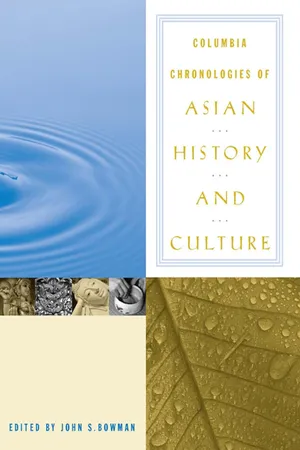
Containing more information on Asian culture than any other English-language reference work, Columbia Chronologies of Asian History and Culture is the first of its kind: a set of more than thirty chronologies for all the countries of Asia—East, South, Southeast, and Central—from the Paleolithic era through 1998. Each entry is clearly dated and, unlike most chronologies found in standard history texts, the entries are complete and detailed enough to provide virtually a sequential history of the vast and rich span of Asian cultures. The contributing writers and editors have ensured the book's usefulness to general readers by identifying individuals and groups, locating places and regions, explaining events and movements, and defining unfamiliar words and concepts.
The thirty-two chronologies on individual countries, in conjunction with a detailed index, allow readers to find specific information quickly and efficiently, whether they seek the date for the invention of the iron plow or gunpowder, the fall of the Han Dynasty in China, or Ho Chi Minh's declarations of Vietnamese independence. This invaluable reference culminates with three appendices: "National/Independence Days," "Scientific-Technological Achievements in Asia," and "Asia: A Chronological Overview," which provides an accessible summary of key events and developments in various fields of activity throughout the continent.
The Columbia Chronologies of Asian History and Culture features:
• three discrete chronologies on (1) Politics/History, (2) Art/Culture/Religion, and (3) Science/Economics/Everyday Life for each of Asia's three major cultures—China, India, and Japan—as well as a combined chronology for each of the other nations;
• detailed entries of thousands of historical events as well as important milestones in religion, philosophy, literature, and the arts;
• entries on technological developments and natural events (famines, floods, etc.) affecting the lives of ordinary people; and
• authoritative and accessibly written entries by a team of Asian scholars from Columbia, Harvard, and other major research universities.
Beyond its detailed accounting of Asia's political history, Columbia Chronologies of Asian History and Culture also gives full recognition to religious, intellectual, artistic, and general cultural achievements, as well as to scientific, technological, industrial, agricultural, and economic developments. Concise yet complete, it will stand as an indispensable reference work in the field of Asian studies.
- English
- ePUB (mobile friendly)
- Available on iOS & Android
eBook - ePub
Columbia Chronologies of Asian History and Culture
About this book
Information
Topic
HistoireSubtopic
Histoire de l'AsiePART ONE
East Asia
China
POLITICAL HISTORY
PREHISTORIC AND LEGENDARY CHINA: 1,960,000–2208 B.C.
Until the late 1980s, it was believed that the first hominid (Homo erectus) appears in China about 800,000 B.C.; excavations at the newly discovered site of Longgupo Cave, however, found fossils, dated to between 1.96 and 1.78 million years old, that some experts claim as hominids but other see as prehominid apes. In any case, this appears to be an isolated instance, and the main focus on early hominids in China remains on the fossils found at the Zhoukoudian caves near present-day Beijing. (The fossils are still popularly known as “Peking Man.”) During the next 500,000–600,000 years, this species disperses through much of central and northeastern China. Eventually this hominid species is replaced by the archaic Homo sapiens, which appears in China sometime after 250,000 B.C. By around 50,000 BP, Homo sapiens sapiens replaces previous hominids in China. By 12,000 BP, late Paleolithic people form a half dozen or more distinct cultures in China, and practices suggesting ideas of kinship, the arts, and religion develop.
China’s legendary history opens around 3,000 B.C. with the advent of a series of semidivine figures who instruct the nomadic Chinese in the activities of a more sedentary civilization: fishing, hunting, farming, and trading. In China’s traditional history, the Yellow Emperor of c. 2700 B.C., the first of the “Five Premier Emperors,” used force to create a unified state; his successors are said to build on his achievement. The story of these early reigns, however, is strictly legendary, with no archaeological confirmation of any of the individuals or events. But increasingly remains of the third millennium B.C. begin to confirm at least some of the later traditions of an emerging and perhaps already distinctive form of society.
1,960,000?–1,780,000? B.C.: Hominid remains (dental fragments) in association with primitive stone tools found at Longgupo Cave near the Yangtze River in south-central China signify that hominids entered China much earlier than long thought. This species has more in common with fossils (Homo ergaster and Homo habilis) found in East Africa and is not the same as the Homo erectus found in China a million years later.
800,000 B.C.: A cranium of a female found near Lantian in central China is the oldest known Homo erectus fossil found in China.
500,000–250,000 B.C.: Hominids of the species Homo erectus inhabit caves at Zhoukoudian, a limestone hill on the edge of China’s north-central plain about thirty miles southwest of present-day Beijing. These creatures have a brain capacity about two-thirds that of modern humans; they walk upright and make basic stone tools; whether they actually hunt animals or just scavenge for food is disputed. Similar hominids are living at numerous sites throughout eastern China during this period but little is known of their way of life except that they make crude stone tools.
250,000–50,000 B.C.: Sometime during this period, archaic Homo sapiens inhabit sites in various parts of China. Most modern scientists believe that fully evolved Homo sapiens came into China from their homeland in Africa; some believe that modern humans in China evolved from the previous Homo erectus living there.
50,000–12,000 B.C.: Truly modern people, Homo sapiens sapiens, begin to emerge and to form distinct cultures in China. They remain nomadic hunter-fisher-gatherers and depend mainly on their stone tools. During this period, these people probably evolve with many of the physical characteristics now associated with the Mongoloid people of Asia.
12,000–6000 B.C.: Scattered agricultural communities develop on the central plain of China. By 6000 B.C. at the latest, people in the Yellow River (Huang Ho) valley are cultivating millet, while people in southern China are probably beginning to cultivate rice.
5000–3000 B.C.: The Yangshao culture flourishes along the middle Yellow River. Settled communities also develop along the southeast coast and on the island of Taiwan.
In the settled farming areas below the south bend of the Yellow River, villagers live on a millet diet with supplements of game and fish. They hunt with bows and arrows, keep dogs and pigs, use hemp for fabrics.
By 5000 B.C. wet-rice cultivation is spreading along the lower Yangtze River valley, possibly introduced there from lands to the south.
4000–2000 B.C.: Perhaps overlapping and certainly ultimately succeeding the Yangshao culture, the Lungshan culture develops to the east of the Yangshao settlements. The Lungshan people exchange their goods, and this leads to some accumulation of wealth, which in turn leads to a society that appears to support more social classes, various rituals, and elaborate burials. Their towns are protected by walls of earth, suggesting some kind of conflict. At Erlitou, regarded as the first city in China, remains from about 2000 B.C. suggest an almost feudal society, possibly the basis for the Xia dynasty of Chinese myth and legend.
2852 B.C.: According to the tradition that begins in the Han dynasty, this is the date for the beginning of the legendary Age of Three Sovereigns.
2698–2599 B.C.: Han dynasty tradition claims that Xuanyuan Gongsun, the chieftain of a tribe in present-day central Henan, ascends as the Yellow Emperor, the first of those Confucius later calls the Five Premier Emperors. He is a semilegendary figure, although some historians regard him as having a historical basis.
Wherever under heaven there were people who disobeyed him, [the Yellow Emperor] would go after them; but as soon as they were pacified, he would leave them alone. He crossed mountains and opened roads, never stopping anywhere to rest for long.
Records of the Historian, by Sima Qian (145–90 B.C.?)
2514–2437 B.C.: Han dynasty tradition claims that Zhuanxu reigns as second of the Five Premier Emperors; he quells a rebellion of the Jiuli tribes to the south and claims dominion south of the Yangtze.
2436–2367 B.C.: Han dynasty tradition claims that Ku reigns, overseeing a period of general quiet and prosperity.
2357–2258 B.C.: Han dynasty tradition claims that Yao’s long reign is marked, toward the end (c. 2300? B.C.), by a legendary Great Flood that inundates vast areas of the Yellow and Yangtze river valleys and causes widespread famine and political disruption.
2255–2208 B.C.: Han tradition claims that Shun rises by virtue from humble origins to become the last of the Five Premier Emperors. During this era, the outlines of the ancient system of feudal land tenure emerge. Shun also reorganizes the bureaucracy, establishing government departments for agriculture, justice, education, public works, and other areas. Before his death, he appoints his trusted chief minister Yu as his successor.
2208 B.C.: Yu succeeds Shun and is honored as the founder of the Xia, the first dynasty of ancient China. By legend, Yu is a descendant of the Yellow Emperor.
THE THREE DYNASTIES (XIA, SHANG, ZHOU): 2208–249 B.C.
The Xia (c. 2200–1750 B.C.), established by the semilegendary Emperor Yu, is the first of the three ancient dynasties. Shang (c. 1750–1040 B.C.) and Zhou (1040–256 B.C.) follow. Historians are not entirely convinced the Xia dynasty actually exists; in any case, the three dynasties are probably not more than episodic hegemonies, historians suggest, and they likely overlap rather than succeed each other in direct line.
The Bronze Age Shang is the first of China’s historic dynasties, with its first capital near present Zhengzhou and a second, later, near Anyang north of the Yellow River. Though its domain encompasses a relatively small area (parts of today’s Henan, Anhui, Shandong, Hebei, and Shanxi provinces), Shang culture becomes widespread in North China and present Sichuan. A written language emerges. Royal palaces are built in the capital towns. Mansions of the wealthy class feature post and beam construction. A complex agricultural society develops. Political structures take root and society stratifies into a peasantry and an aristocracy of landowner-warriors. The first Chinese calendar comes into use. Shang artisans reach an advanced state of development in metalworking, pottery, and other crafts.
The third of the ancient dynasties, Zhou, shares a culture similar at its origins to Shang, though it develops in forms that would have been unrecognizable to rulers of the earlier dynasty. The Zhou era is the classical age of Confucius and Laozi (“the old master,” by tradition the founder of Daoism). Written laws and a money economy develop. Iron implements and ox-drawn plows appear.
Zhou is a period of general political disorder and turbulence. Zhou society evolves steadily from the feudal form, with its hereditary warrior nobility, toward an independent, centralized state with armies drawn from a landed peasantry, a unification process that reaches its fulfillment in Qin. Traditional Zhou subdivisions are the Spring and Autumn (722–481 B.C.) and Warring States (403–221 B.C.) periods.
2208–c. 2195 B.C.: By tradition, Yu reigns for a peaceful and prosperous thirteen years. He is succeeded by sixteen kings in a dynasty that survives for nearly five hundred years.
2000 B.C.: Humans are being buried under the foundations of important buildings on the North China plain—evidence (from modern archeological sources) of human sacrifice, probably of war captives.
1800 B.C.: The Xia dynasty comes to an end with the reign of a degenerate king. This will become a feature of Chinese historical presentation: the last ruler of a dynasty is por...
Table of contents
- Cover
- Half title
- Title
- Copyright
- Contents
- List of Consultants and Contributors
- Introduction
- Map of Asia
- Part One: East Asia
- Part Two: South Asia
- Part Three: Southeast Asia
- Part Four: Central Asia
- Appendix 1: National/Independence Days
- Appendix 2: Scientific-Technological Achievements in Asia
- Appendix 3: Asian History: A Chronological Overview
- Index
Trusted by 375,005 students
Access to over 1.5 million titles for a fair monthly price.
Study more efficiently using our study tools.
Frequently asked questions
Yes, you can cancel anytime from the Subscription tab in your account settings on the Perlego website. Your subscription will stay active until the end of your current billing period. Learn how to cancel your subscription
No, books cannot be downloaded as external files, such as PDFs, for use outside of Perlego. However, you can download books within the Perlego app for offline reading on mobile or tablet. Learn how to download books offline
Perlego offers two plans: Essential and Complete
- Essential is ideal for learners and professionals who enjoy exploring a wide range of subjects. Access the Essential Library with 800,000+ trusted titles and best-sellers across business, personal growth, and the humanities. Includes unlimited reading time and Standard Read Aloud voice.
- Complete: Perfect for advanced learners and researchers needing full, unrestricted access. Unlock 1.5M+ books across hundreds of subjects, including academic and specialized titles. The Complete Plan also includes advanced features like Premium Read Aloud and Research Assistant.
We are an online textbook subscription service, where you can get access to an entire online library for less than the price of a single book per month. With over 1.5 million books across 990+ topics, we’ve got you covered! Learn about our mission
Look out for the read-aloud symbol on your next book to see if you can listen to it. The read-aloud tool reads text aloud for you, highlighting the text as it is being read. You can pause it, speed it up and slow it down. Learn more about Read Aloud
Yes! You can use the Perlego app on both iOS and Android devices to read anytime, anywhere — even offline. Perfect for commutes or when you’re on the go.
Please note we cannot support devices running on iOS 13 and Android 7 or earlier. Learn more about using the app
Please note we cannot support devices running on iOS 13 and Android 7 or earlier. Learn more about using the app
Yes, you can access Columbia Chronologies of Asian History and Culture by John S. Bowman, John Bowman in PDF and/or ePUB format, as well as other popular books in Histoire & Histoire de l'Asie. We have over 1.5 million books available in our catalogue for you to explore.