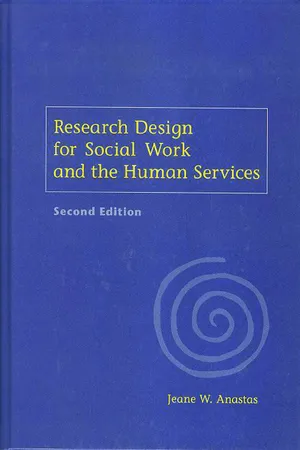
Research Design for Social Work and the Human Services integrates a range of research techniques into a single epistemological framework and presents a balanced approach to the teaching of research methods in the "helping professions." Jeane W. Anastas begins with a discussion of the different philosophical perspectives within which social research occurs and continues with problem formulation, research design, and methodological issues influencing data collection, analysis, and dissemination. She presents both fixed (quantitative) and flexible (qualitative) methods of research, granting legitimacy, value, utility, and relevance to both styles of inquiry.
Utilizing complete case studies to illustrate different methodological approaches, Research Design for Social Work and the Human Services integrates material on women and people of color, and draws attention to the ways racism, heterosexism, sexism, and classism affect the conceptualization and conduct of research. Anastas not only exposes these biases but actively addresses the experiences, needs, and concerns of clients of both genders and different races, ethnicities, sexual orientations, cultures, and classes.
- English
- ePUB (mobile friendly)
- Available on iOS & Android
eBook - ePub
Research Design for Social Work and the Human Services
About this book
Information
Part I
Research Design in Context
The context of any research design is set in two fundamental ways: by its guiding assumptions about how knowledge is developed and what constitutes useful knowledge and by how its methods are joined to a specific content area through the statement of a study question. Social work, the other human service professions, and the social sciences are all in the midst of a lively debate about epistemology, about how useful knowledge is generated. The epistemological framework used in this text is explained in chapter 1, which is essential reading for use of any part of this text. Chapter 1 also provides a brief introduction to the basic types of research designs most commonly used in social work and human services research, each of which is more fully described in the chapters that make up part II. Chapter 2 describes how to develop a plan for any specific type of research by identifying a content area in need of further study and linking it to a research design through the formal statement of a research question. Ways to reduce common sources of bias in research design are also discussed.
1
The Nature of Science in the Helping Professions
… scientific rationality certainly is not as monolithic or deterministic as many think…. It has been versatile and flexible enough throughout its history to permit constant reinterpretation of what should count as legitimate objects and processes of scientific research; it is itself shaped by cultural transformations and must struggle within them….
(Harding 1991:3)
All research expresses some position about effective ways of developing knowledge. The subject of how best to advance knowledge for practice in social work and the human services has been the subject of intense, sustained argument over the past half century. This is an exciting time for research in social work and the human services because the debate has now gone on long enough to clarify the differences in points of view on the issue, to identify areas of agreement and disagreement, and to support new efforts at synthesis. In order to read and properly understand a researcher’s work or to conduct research yourself, you must be able to identify the assumptions that guide it and understand the strengths and limitations of any model of research or any particular research design. A major aim of this book is to describe new ways to understand research that offer social work and the other helping professions a framework that embraces a variety of research methods previously seen as competing models.
The social work and human service professions have always had an ambivalent relationship with research. This ambivalence does not connote lukewarm but conflicted feelings, both strongly positive attitudes and quite negative ones. As a relatively young profession, social work has often sought to strengthen its knowledge base and its claims to legitimacy among competing professions through research. On the other hand, the profession has also asserted the importance of other sources of legitimacy for its methods and its goals, such as its mission of service, its sanction from the community, and its value base. In this stance, it is not unlike other clinical disciplines and helping professions. For example, medicine is a profession that flourished in some forms long before there was much scientific knowledge available on which to base its practice and in which conflicts between the injunction to serve the individual patient and the scientific imperative still frequently arise.
Unlike medicine, social work as a profession was born and has developed in an era in which science and technology have been dominant forces in Western culture. However, early in its history social work defined itself as different from sociology and the other social sciences in part because practice rather than scientific investigation was the primary interest of the profession (Zimbalist 1977). Social work deals with the whole person in context, with the interface of the person and the social environment, and with interventions designed to resolve individual, interpersonal, and social problems. It thus encompasses knowledge and fields of practice in which multiple factors and influences are routinely at work and in which the social and behavioral sciences currently offer probabilistic knowledge at best. Thus the drive to achieve a more exact science of social work has not been easily reconciled with the recognition of the primacy of practice goals on the one hand and the complexities of the problems addressed and the interventions used on the other.
One recent effect of this tension has been an intense debate within the profession about the nature of the scientific method itself and about the models of inquiry best suited for the development of knowledge for and about practice. Some have argued that if science and practice have been hard to reconcile, the profession should restrict its models of practice to methods that lend themselves to study using common and well-recognized research modes (Hudson 1978). In this paradigm, the experiment becomes the ideal model of research that other kinds of studies seek to approximate, and quantitative techniques predominate. Stemming from a logical positivist philosophy, the assumption is of a reality “out there” that can be similarly known by “objective” observers without contamination of the thing observed. The goal of investigation is to uncover the invariant regularities or “laws” of relationships among phenomena, which act on each other in repeatable, predictable ways. Much of the teaching of research in social work and in the social sciences in America today reflects this point of view (Fraser, Taylor, Jackson, & O’Jack 1991; Reamer 1993; Thyer 1993). In fact it is of interest to philosophers of science that this view has persisted as long as it has in the social sciences (Klee 1997).
In the past two decades, however, an argument has been made for constructivism as an epistemology and for the use of naturalistic and interpretive methods of inquiry in social work (Heineman 1981; Imre 1984; Riessman 1994; Ruckdeschel 1985). This argument has been based both on a critique of the failure of traditional methods to gain acceptance by practitioners and prove relevant to the practice situation and on an argument for a more relativistic view of reality and the process of knowing. What is available and relevant for study, it is argued, are the meanings, the constructions, that people, researchers and researched, place on events. According to this view, these meanings can best be uncovered and conveyed through flexible methods of inquiry, using unstructured observational or verbal data, and by acknowledging the investigator’s involvement and participation in shaping the data obtained. Thus the cases for and against various models of research have largely been made on epistemological grounds, by examining the assumptions about how we know what we know that underlie the various approaches to research.
This debate in social work and other human service professions simply echoes that occurring in all of the social sciences. In social work, as in other disciplines, the discussion has tended to produce polarized positions that favor one model of research while dismissing the utility of others. However, in reality, social workers who do research and social workers who read research over a lifetime often use and value research that arises from very different methods, finding research results of many kinds to be persuasive and useful. Given this reality, this book explores how such seemingly irreconcilable epistemological positions can both be embraced.
Gradually, a third position seems to be emerging in social work: what Fraser et al. have termed a “many ways” perspective (Fraser, Taylor, Jackson, & O’Jack 1991). In various ways, the argument has been made that there are “many ways of knowing” (Hartman 1990) that may be useful to the profession at different times and in different contexts (Heineman Pieper 1989; Piele 1988; Reid 1994; Tyson 1992). The “heuristic” approach (Heineman Pieper 1985, 1989; Tyson 1992, 1995) connotes “a strategy whose goal is utility rather than certainty” (Heineman Pieper 1989:11), essentially a “pragmatic” view. There are several tenets of the heuristic approach as explicated by Heineman Pieper: facts and theories are not distinct; no facts, methods of investigation, or forms of data are privileged; causality is itself a heuristic that cannot be determined from data alone; and the researcher cannot be viewed as invisible in the conduct or results of the research. In this paradigm, objectivity is understood as “a species of report in which there is agreement among researchers,” which could result from a common bias as well as from truth (Heineman Pieper 1989:17). From this perspective, “the heuristic researcher practices bias regulation through bias recognition rather than through the denial of bias” (Heineman Pieper 1989:18), just as the practitioner does. However, unlike in constructivist approaches, the heuristic approach does take the position that there is a “mind-independent reality to be known” (Tyson 1992).
This perspective is the one that best describes the scientific enterprise as many researchers understand it, although Heineman Pieper (1989) extends her definition of research beyond boundaries that most would recognize. In this text the definition of research is limited to empirical methods of knowing, including only those forms of the exercise of professional judgement that make explicit reference to some kind of observational activity addressing aspects of a mind-independent reality. It is within this emergent perspective that this text is located, but the perspective taken is identified for what it is: in the philosophical tradition of realism.
The other stream of argument that has affected the current ferment about research philosophies and methods in social work is, at bottom, political. Feminists (Davis 1986; Collins 1991; Swigonski 1994), antiracists (Akbar 1991; Bowman 1991; Hess 1995) and other critical theorists have pointed out that the claim of legitimacy for knowledge is at least in part a political one and that the methods and products of science are not apolitical or value-free. Science as an enterprise will tend to serve the needs of some people in society more than the needs of others. Practically speaking, the tools of traditional research as they are now used demonstrably do not serve well women and people of color (McMahon & Allen-Meares 1992). The debate about research methods, then, even when not explicitly addressing political issues, often takes on the tinge of an “establishment” versus “anti-establishment” contest.
In particular, the view of research and scientific methods taken in this book owes a great deal to feminist analysis and critiques of science as a social institution. There are, of course, many “feminisms” and many feminist critiques of science. The position taken here is similar to that of Sandra Harding (1991) who states several assumptions: “science is politics by other means, and it also generates reliable information about the empirical world” (p. 10); “science contains both [politically] progressive and regressive tendencies” (p. 10), and the challenge is “how to advance the progressive and inhibit the regressive ones” (p. 11) in any research situation; “the observer and the observed are in the same causal scientific plane” (p. 11); and “it is necessary to decenter white, middle-class, heterosexual, Western” thought and experiences in scientific and professional enterprises (p. 13). This last assumption may be the most difficult to work with, both because of the identities and experiences any author may participate (and not participate) in and because these problems are currently underrecognized and underanalyzed in social work research (Hill 1980; Jacobs & Bowles 1988; McMahon & Allen-Meares 1992). The general approach the book takes to science and the generation of knowledge for social work and the human services is an inclusive one in part because it acknowledges the need for multiple and particularly for underrepresented points of view and ways of knowing to be heard and legitimated.
Why Be Scientific?
Given the difficulty that social work has had in developing a tradition of doing science within the profession, why is research still considered such an important issue in social work, social work education, and in the human services in general? With current efforts to limit health care costs and public spending for human services, the helping professions, including social work, and those who manage and control the delivery of health and mental health care rely increasingly on what is termed outcomes research in choosing the treatments and services to provide and to pay for. Similarly, Congress is demanding that the federal agencies that fund innovative demonstration programs to address social problems, such as teen pregnancy and substance abuse, also produce research results to show which kinds of programs can produce the specific outcomes desired. Public scrutiny of federal medical research in such controversial areas as HIV disease and cancer has led to questioning about what problems draw funding when and about how protocols of study do or do not serve those who have the problem and those who participate in the research. Accountability for practice and for program design are major challenges for the helping professions. In the face of these complex problems and of finite resources to fund services, research is seen as a useful tool for helping policy makers and practitioners make hard choices. This argument for research and its usefulness is essentially a pragmatic one.
In addition to these practical problems, the ferment in other fields about epistemology and how scientific knowledge is and should be generated has affected social work as well, as has already been mentioned. This debate has opened up new possibilities for research both for individual practitioners and for program evaluators. But with new and expanded boundaries has come the need for greater clarity about the nature of research and science itself. What constitutes science as opposed to other ways of generating knowledge? And just exactly what do we mean when we speak of “research”?
In this book the terms science and research mean the enterprise of learning about the natural, psychological, or social world systematically and reflexively, both by using some kind of focussed observation of that world and by applying some system of conceptualization for organizing and attributing meaning to those observations either before or after the fact. In addition, all activities called scientific are undertaken in a spirit of skepticism, that is, by subjecting both the ideas received in framing the research and the ideas generated from it to questioning, to a search for alternative explanations, and to scrutiny by others in the field. Systematic investigation means that learning and observations are undertaken according to a plan and in a focussed way, guided by a specific question or hypothesis. Reflexiveness means self-observation and that both the process and the results of research are studied and examined in the spirit of skepticism.
But why should society turn to research to answer tough questions? Why should a profession be able to lay a claim to legitimacy for its activities by invoking science? One answer lies in the fact that scientific investigation seems to have evolved over the years as an important corrective to common errors of thinking that human beings are prone to. The psychologist Thomas Gilovich (1991) drew on research in social and cognitive psychology to explain why the scientific method can be so helpful. As he states:
Many of these imperfections in our cognitive and inferential tools might never surface under ideal conditions … but the world … presents us with messy data that are random, incomplete, unrepresentative, ambiguous, inconsistent, unpalatable, or secondhand…. [I]t is often our flawed attempts to cope with precisely these difficulties that lay bare our inferential shortcomings and produce the facts we know that just ain’t so (Gilovich 1991:3).
In his book, Gilovich uses examples and findings from numerous studies of how people think and what influences thinking to develop his arguments, which will be summarized here.
First of all, Gilovich observes that people prefer to see order rather than disorder in things and will tend to impose or invent order where it does not exist, including when phenomena are really random. For example, a “clustering illusion” (p. 16) creates streaks out of random variation in numbers, and a tendency to overvalue similarities and to expect representativeness even in small samples of events contributes as well. One thing science, especially social science, can contribute, then, is a true understanding of randomness, as well as an understanding of such statistical principles as regression to the mean. This knowledge can be an important safeguard against overinterpreting observations (Paulos 1988; Bernstein 1996). However, the cost of this knowledge is that we are forced to acknowledge those areas, which are many, in which our understanding and our ability to explain or to predict are in fact minimal or nonexistent.
Gilovich (1991) also points out that humans seem to have a tendency to attend sele...
Table of contents
- Cover
- Half title
- Title
- Copyright
- Contents
- Preface to the Second Edition
- Preface to the First Edition
- Acknowledgments
- About the Author
- Part I: Research Design in Context
- Part II: Types of Research Designs
- Part III: The Elements of Research Design
- Part IV: Methods of Data Collection
- Part V: Methods of Data Analysis and Dissemination
- Glossary
- References
- Index
Trusted by 375,005 students
Access to over 1.5 million titles for a fair monthly price.
Study more efficiently using our study tools.
Frequently asked questions
Yes, you can cancel anytime from the Subscription tab in your account settings on the Perlego website. Your subscription will stay active until the end of your current billing period. Learn how to cancel your subscription
No, books cannot be downloaded as external files, such as PDFs, for use outside of Perlego. However, you can download books within the Perlego app for offline reading on mobile or tablet. Learn how to download books offline
Perlego offers two plans: Essential and Complete
- Essential is ideal for learners and professionals who enjoy exploring a wide range of subjects. Access the Essential Library with 800,000+ trusted titles and best-sellers across business, personal growth, and the humanities. Includes unlimited reading time and Standard Read Aloud voice.
- Complete: Perfect for advanced learners and researchers needing full, unrestricted access. Unlock 1.5M+ books across hundreds of subjects, including academic and specialized titles. The Complete Plan also includes advanced features like Premium Read Aloud and Research Assistant.
We are an online textbook subscription service, where you can get access to an entire online library for less than the price of a single book per month. With over 1.5 million books across 990+ topics, we’ve got you covered! Learn about our mission
Look out for the read-aloud symbol on your next book to see if you can listen to it. The read-aloud tool reads text aloud for you, highlighting the text as it is being read. You can pause it, speed it up and slow it down. Learn more about Read Aloud
Yes! You can use the Perlego app on both iOS and Android devices to read anytime, anywhere — even offline. Perfect for commutes or when you’re on the go.
Please note we cannot support devices running on iOS 13 and Android 7 or earlier. Learn more about using the app
Please note we cannot support devices running on iOS 13 and Android 7 or earlier. Learn more about using the app
Yes, you can access Research Design for Social Work and the Human Services by Jeane W. Anastas in PDF and/or ePUB format, as well as other popular books in Sozialwissenschaften & Wissenschaftliche Forschung & Methodik. We have over 1.5 million books available in our catalogue for you to explore.