- English
- ePUB (mobile friendly)
- Available on iOS & Android
eBook - ePub
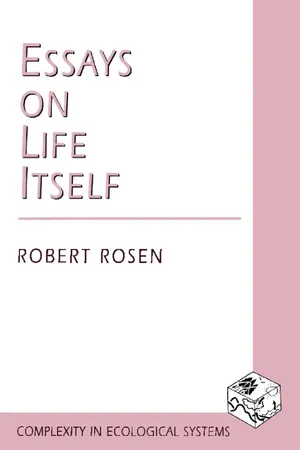
Essays on Life Itself
About this book
Compiling twenty articles on the nature of life and on the objective of the natural sciences, this remarkable book complements Robert Rosen's groundbreaking Life Itself—a work that influenced a wide range of philosophers, biologists, linguists, and social scientists. In Essays on Life Itself, Rosen takes to task the central objective of the natural sciences, calling into question the attempt to create objectivity in a subjective world and forcing us to reconsider where science can lead us in the years to come.
Information
Subtopic
EcologyIndex
Biological SciencesPart I

ON BIOLOGY AND PHYSICS
THE CHAPTERS in part I are essentially the text of a brief talk presented at a workshop on “Limits to Scientific Knowability,” held at the Santa Fe Institute (SFI) in 1994, May 24 to 26. As described to me, the workshop was intended to explore the impacts (if any) of the famous Gödel Incompleteness results in mathematics upon the sciences. The workshop’s tone was to be informal and exploratory, aimed at determining whether a more extensive effort by the Institute along these dimensions was warranted.
Accordingly, the workshop consisted primarily of roundtable discussion, with no formal papers delivered. However, the organizers requested a few participants to deliver brief position statements about the impacts of noncomputability results on their field. I was asked to do this for the field of biology. The following is, as best I recollect it, a reconstruction of what I said on this occasion. I have said it all before, but rarely so succinctly, rarely with such a feeling that I was saying exactly what I wanted to say. I include it here as a general introduction.
I was impressed by the general air of affability that pervaded this workshop. I had been rather critical of the SFI’s activities, and most particularly of their programs in “complexity” and in “artificial life.” My misgivings had arisen from a conviction that the future of graduate education and innovative basic science in this country rests on the development of private research institutes such as the SFI, and that limitless harm would be done if such a heavily promoted endeavor were to embark down unfruitful scientific paths. I do not want to see that happen—the situation is already fragile. However, my experience in this workshop reassured me that the SFI is basically healthy, that it has much to contribute, and that it should be supported by all those concerned with the principles involved.
To me, the basic question in biology, to which all others are subsidiary or collateral, is the one put most succinctly by the physicist Erwin Schrödinger: What is life?
Any question becomes unanswerable if we do not permit ourselves a universe large enough to deal with the question. Ax = B is generally unsolvable in a universe of positive integers. Likewise, generic angles become untrisectable, cubes unduplicatable, and so on, in a universe limited by rulers and compasses.
I claim that the Gödelian noncomputability results are a symptom, arising within mathematics itself, indicating that we are trying to solve problems in too limited a universe of discourse. The limits in question are imposed in mathematics by an excess of “rigor,” andin science by cognate limitations of “objectivity” and “context independence.” In both cases, our universes are limited, not by the demands of problems that need to be solved but by extraneous standards of rigor. The result, in both cases, is a mind-set of reductionism, of looking only downward toward subsystems, and never upward and outward.
In science, for instance, it seems patently obvious that, whatever living organisms are, they are material systems, special cases drawn from a larger, more generic class of nonliving inorganic ones. The game is thus to reduce, to express their novel properties in terms of those of inorganic subsystems, merely subject to a list of additional conditions and restrictions. Indeed, one manifestation of this claim to the objectivity of reduction is that one must never, ever, claim to learn anything new about matter from a study of organisms. This is but one of the many forms of the protean Central Dogma (Judson 1979), expressed here as a limitation on material nature itself.
Despite the profound differences between those material systems that are alive and those that are not, these differences have never been expressible in the form of a list—an explicit set of conditions that formally demarcate those material systems that are organisms from those that are not. Without such a list, Schrödinger’s question, and biology itself, become unanswerable at best, meaningless at worst. So we must probe more deeply into what the quest for such a list actually connotes.
No such list means there is no algorithm, no decision procedure, whereby we can find organisms in a presumably larger universe of inorganic systems. It has of course never been demonstrated that there is no such list. But no one has ever found one. I take seriously the possibility that there is no list, no algorithm, no decision procedure, that finds us the organisms in a presumptively larger universe of inorganic systems. This possibility is already a kind of noncomputability assertion, one that asserts that the world of lists and algorithms is too small to deal with the problem, too nongeneric.
Indeed, the absence of lists or algorithms is a generally recurring theme in science and mathematics, one that reveals the nongenericity of the world of algorithms itself, a world too unstable (in a technical sense) to solve the real problems. This was the upshot of the Gödel results from the very beginning.
It helps to recall the mathematical situation that Gödel inherited. It was a world still reeling from the discovery of non-Euclidean geometries almost a century earlier, geometries without number that were just as consistent as Euclid was. It was a world reeling from paradoxes within Cantorian set theory. There had to be something to blame for all of this; something to be expunged, to make everything right again; something not rigorous enough, which had to be found and eradicated.
Bertrand Russell, among others, argued that the fault lay in “impredicative” definitions and vicious circles, and he developed an elaborate and murky “theory of types” to replace them with predicative but equivalent counterparts. This was taken yet further by Hilbert and his school of formalists; they argued that rigor lay entirely in syntax, and that the difficulties at the foundations of mathematics arose entirely from un-extruded, semantic residues of meaning. For them, a mathematical term (e.g., triangle) was not to be allowed any vestige of meaning; rather, there were to be formal production rules for manipulating triangle from one proposition to another. This drastic extrusion of semantics constituted true rigor; mathematics itself would be suspect as long as there was any vestige of meaning or semantics left in it. Hilbert sought this kind of formalization of all of mathematics, the reduction of mathematics to algorithms or lists.
It was this program that Gödel’s results killed. Briefly, these results mean that a constructive universe, finitely generated, consisting of pure syntax, is too poor to do mathematics in. They mean that semantics and impredicativities and meanings are essential to mathematics; they cannot be replaced by more syntactic rules and more lists or algorithms. They mean that mathematical systems are generically unformalizable; hence it is the formalizable ones that are the rare special cases, and not the other way around. They mean that identifying rigor with formalizability makes most of mathematics unreachable.
I argue that biology teaches us that the same is true about the material world. Roughly, that contemporary physics is to biology as Number Theory is to a formalization of it. Rather than an organism being just a standard material system plus a list of special conditions, an organism is a repository of meanings and impredicativities; it is more generic than an inorganic system rather than less. If this is so, then the Schrödinger question, and indeed biology itself, is not exclusively, or even mainly, an empirical science; empirics is to it as accounting is to Number Theory.
If this is so, then organisms possess noncomputable, unformalizable models. Such systems are what I call complex. The worldof these systems is much larger and more generic than the simple world we inherit from reductionism.
The main lesson from all this is that computability, in any sense, is not itself a law of either nature or mathematics. The noncomputability results, of which Gödel’s was perhaps the first and most celebrated, are indicative of the troubles that arise when we try to make it such.
CHAPTER 1
The Schrödinger Question, What Is Life? Fifty-Five Years Later
Erwin Schrödinger’s essay What Is Life?, which first appeared in print in 1944, was based on a series of public lectures delivered the preceding year in Dublin. Much has happened, both in biology and in physics, during the half century since then. Hence, it might be appropriate to reappraise the status of Schrödinger’s question, from a contemporary perspective, at least as I see it today. This I shall attempt herein.
I wonder how many people actually read this essay nowadays. I know I have great difficulty in getting my students to read anything more than five years old, their approximate threshold separating contemporary from antiquarian, relevant from irrelevant. Of course, in the first decade or two of its existence, as H. F. Judson (1979) says, “everybody read Schrödinger,” and its impacts were wide indeed.
The very fact that everybody read Schrödinger is itself unusual, for his essay was a frank excursion into theoretical biology, and hence into something that most experimental biologists declare monumentally uninteresting to them. Actually, I believe it was mostly read for reassurance. And, at least if it is read superficially and selectively, the essay appears to provide that in abundance—it is today regarded as an utterly benign pillar of current orthodoxy.
But that is an illusion, an artifact of how Schrödinger’s exposition is crafted. Its true messages, subtly understated as they are, are heterodox in the extreme and always were. There is no reassurance in them; indeed, they are quite incompatible with the dogmas of today. By the stringent standard raised in the Schrödinger title question, following these dogmas has actually made it harder, rather than easier, to provide an adequate answer.
What Is Life?
Let us begin with the very question with which Schrödinger entitled his essay. Plainly, this is what he thought biology was about, its primary object of study. He thought that this “life” was exemplified by, or manifested in, specific organisms, but that at root, biology was not about them—it concerned rather whatever it was about these particular material systems that distinguished them, and their behaviors, from inert matter.
The very form of the question connotes that Schrödinger believed that “life” is in itself a legitimate object of scientific scrutiny. It connotes a noun, not merely an adjective, just as, say, rigidity, or turbulence, or (as we shall see later) openness does. Such properties are exemplified in the properties or behaviors of individual systems, but these are only specimens; the concepts themselves clearly have a far wider currency, not limited to any explicit list of such specimens. Indeed, we can ask a Schrödinger-type question, What is X? about any of them.
I daresay that, expressed in such terms, the Schrödinger question would be dismissed out of hand by today’s dogmatists as, at best, meaningless; at worst, simply fatuous. It seems absurd in principle to partition a living organism, say a hippopotamus, or a chrysanthemum, or a paramecium, into a part that is its “life,” and another part that is “everything else,” and even worse to claim that the “life” part is essentially the same from one such organism to another, while only the “everything else” will vary. In this view, it is simply outrageous to regard expressions like “hippopotamus life” or “chrysanthemum life” to be meaningful at all, let alone equivalent to the usual expressions “living hippopotamus” and “living chrysanthemum.” Yet it is precisely this interchange of noun and adjective that is tacit in Schrödinger’s question.
This approach represents a turnabout that experimentalists do not like. On the one hand, they are perfectly willing to believe (quite deeply, in fact) in some notion of surrogacy, which allows them to extrapolate their data to specimens unobserved; to believe, say, that their membrane’s properties are characteristic of membranes in general, or that the data from their rat can be extrapolated ad libitum to other species (Rosen 1983; see my Anticipatory Systems for fuller discussion). On the other hand, they find it most disquieting when their systems are treated as the surrogatees, and especially to be told something about their membrane by someone who has not looked at their membrane, but rather at what they regard as a physicomathematical “abstraction.” When pressed, experimentalists tend to devolve the notions of surrogacy they accept on evolution; surrogates “evolve” from each other, and, hence, what does not evolve cannot be a surrogate. One cannot have the issue both ways, and that is one of the primary Schrödinger unorthodoxies, tacit in the very question itself.
A typical empiricist (not just a biologist) will say that the Schrödinger question is a throwback to Platonic Idealism and hence completely outside the pale of science. The question itself can thus be entertained only in some vague metaphoric sense, regarded only as a façon de parler, and not taken seriously. On the other hand, Schrödinger gives no indication that he intends only such metaphoric imagery; I think (and his own subsequent arguments unmistakably indicate) that, to the contrary, he was perfectly serious. And Schrödinger knew, if anyone did, the difference between Platonism and science.
Schrödinger and “New Physics”
Erwin Schrödinger was one of the outstanding theoretical physicists of our century, perhaps of any century. He was a past master at all kinds of propagation phenomena, of statistical mechanics and thermodynamics, and of almost every other facet of his field. Moreover, he viewed physics itself as the ultimate science of material nature, including of course those material systems we call organisms. Yet one of the striking features of his essay is the constantly iterated apologies he makes, both for his physics and for himself personally. While repeatedly proclaiming the “universality” of contemporary physics, he equally repeatedly points out (quite rightly) the utter failure of its laws to say anything significant about the biosphere and what is in it.
What he was trying to say was stated a little later, perhaps even more vividly, by Albert Einstein. In a letter to Leo Szilard, Einstein said, “One can best feel in dealing with living things how primitive physics still is” (Clark 1972; emphasis added).
Schrödinger (and Einstein) were not just being modest; they were pointing to a conundrum about contemporary physics itself, and about its relation to life. Schrödinger’s answer to this conundrum was simple, and explicit, and repeated over and over in his essay. And it epitomized the heterodoxy I have alluded to before. Namely, Schrödinger concluded that organisms were repositories of what he called new physics. We shall turn a little later to his gentle hints and allusions regarding what that new physics would comprise.
Consider, by contrast, the words of Jacques Monod (1971), writing some three decades after the appearance of Schrödinger’s essay:
Biology is marginal because—the living world constituting but a tiny and very “special” part of the universe—it does not seem likely that the study of living things will ever uncover general laws applicable outside the biosphere. (emphasis added)
With these words Monod opens his book Chance and Necessity, which sets out the orthodox position. This idea of the “marginality” of biology, expressed as a denial of the possibility of learning anythin...
Table of contents
- Cover
- Half title
- Series Page
- Title
- Copyright
- Dedication
- Contents
- Preface
- Part I. On Biology and Physics
- Part II. On Biology and the Mind
- Part III. On Genericity
- Part IV. Similarity and Dissimilarity in Biology
- Part V. On Biology and Technology
- References
- Index
Trusted by 375,005 students
Access to over 1.5 million titles for a fair monthly price.
Study more efficiently using our study tools.
Frequently asked questions
Yes, you can cancel anytime from the Subscription tab in your account settings on the Perlego website. Your subscription will stay active until the end of your current billing period. Learn how to cancel your subscription
No, books cannot be downloaded as external files, such as PDFs, for use outside of Perlego. However, you can download books within the Perlego app for offline reading on mobile or tablet. Learn how to download books offline
Perlego offers two plans: Essential and Complete
- Essential is ideal for learners and professionals who enjoy exploring a wide range of subjects. Access the Essential Library with 800,000+ trusted titles and best-sellers across business, personal growth, and the humanities. Includes unlimited reading time and Standard Read Aloud voice.
- Complete: Perfect for advanced learners and researchers needing full, unrestricted access. Unlock 1.5M+ books across hundreds of subjects, including academic and specialized titles. The Complete Plan also includes advanced features like Premium Read Aloud and Research Assistant.
We are an online textbook subscription service, where you can get access to an entire online library for less than the price of a single book per month. With over 1.5 million books across 990+ topics, we’ve got you covered! Learn about our mission
Look out for the read-aloud symbol on your next book to see if you can listen to it. The read-aloud tool reads text aloud for you, highlighting the text as it is being read. You can pause it, speed it up and slow it down. Learn more about Read Aloud
Yes! You can use the Perlego app on both iOS and Android devices to read anytime, anywhere — even offline. Perfect for commutes or when you’re on the go.
Please note we cannot support devices running on iOS 13 and Android 7 or earlier. Learn more about using the app
Please note we cannot support devices running on iOS 13 and Android 7 or earlier. Learn more about using the app
Yes, you can access Essays on Life Itself by Robert Rosen in PDF and/or ePUB format, as well as other popular books in Biological Sciences & Ecology. We have over 1.5 million books available in our catalogue for you to explore.