Inequality has drastically increased in many countries around the globe over the past three decades. The widening gap between the very rich and everyone else is often portrayed as an unexpected outcome or as the tradeoff we must accept to achieve economic growth. In this book, three International Monetary Fund economists show that this increase in inequality has in fact been a political choice—and explain what policies we should choose instead to achieve a more inclusive economy.
Jonathan D. Ostry, Prakash Loungani, and Andrew Berg demonstrate that the extent of inequality depends on the policies governments choose—such as whether to let capital move unhindered across national boundaries, how much austerity to impose, and how much to deregulate markets. While these policies do often confer growth benefits, they have also been responsible for much of the increase in inequality. The book also shows that inequality leads to weaker economic performance and proposes alternative policies capable of delivering more inclusive growth. In addition to improving access to health care and quality education, they call for redistribution from the rich to the poor and present evidence showing that redistribution does not hurt growth. Accessible to scholars across disciplines as well as to students and policy makers, Confronting Inequality is a rigorous and empirically rich book that is crucial for a time when many fear a new Gilded Age.
eBook - ePub
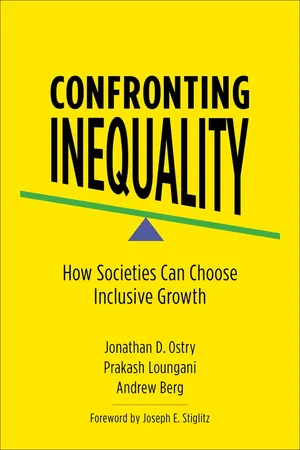
Confronting Inequality
How Societies Can Choose Inclusive Growth
- English
- ePUB (mobile friendly)
- Available on iOS & Android
eBook - ePub
Confronting Inequality
How Societies Can Choose Inclusive Growth
About this book
Information
Subtopic
Monetary PolicyIndex
EconomicsCHAPTER 1
INTRODUCTION
In 2014, Oxfam made headlines with a striking statistic: eighty-five of the world’s richest people had more of the world’s wealth than the poorest half of humankind—some 3.5 billion people. Former U.S. President Barack Obama called addressing such disparities “the defining challenge of our time.” In one of his speeches, Obama noted that “research has shown that countries with less inequality tend to have stronger and steadier economic growth over the long run” (2011).
The research that Obama cited came from the authors of this book and thus from an unlikely source, the International Monetary Fund (IMF). Traditionally, mainstream economists—including those at the IMF—have worried far more about whether average incomes are growing and much less about how that growth is distributed among people. In the jargon of the profession, economists have been more concerned with efficiency—making sure the size of the pie keeps getting larger—than with equity, the size of the slice that goes to each person.
In fact, economists generally frown on too much redistribution—that is, on transferring too much of the pie from the rich to the poor, say by taxing the rich at a much higher rate than the poor or by giving the poor excessive cash transfers and other social benefits (e.g., food stamps and welfare payments). The market, it is felt, gives people their just rewards, and tinkering with these outcomes too much is both unfair and costly over the longer term because it takes away people’s incentives to work hard. In other words, economists have argued that too much of a concern with equity would end up hurting efficiency. The IMF’s advice to countries on economic policies has generally adhered to this consensus, placing the institution at odds with organizations such as Oxfam that have long called for greater attention to inequality and its consequences.
Over the past decade, however, the research staff of the IMF has done—even in the eyes of its critics such as Oxfam—fundamental work on the costs and causes of inequality and on what can be done to cure excessive inequality. This book draws on this academic research, explaining it in such a way that the key findings can be understood by a broader audience.
There are three important results from our work. The first, the one cited by Obama, is that inequality in incomes is harmful for sustained economic growth. There has been much anguish expressed over inequality in recent years: some find extreme inequality morally repugnant, others worry about the social costs or about political capture by elites—that is, attempts to use their wealth to change rules and regulations in their favor. We do not deny the importance of these reasons to worry about inequality. Our finding of a direct economic cost provides an additional powerful reason to be concerned about inequality.
Second, virtually every policy touted by mainstream economists to raise average incomes also has an impact on inequality: it generates winners and losers within countries. Hence, economic policies pose what economists refer to in their jargon as a trade-off between efficiency and equity. Governments have to balance the efficiency gains of making the average person better off with the equity costs of increasing income gaps between the rich and the poor. Our first finding adds a double whammy: the increase in inequality ...
Table of contents
- Cover
- Title Page
- Copyright
- Dedication
- Contents
- Foreword
- Preface
- 1. Introduction
- 2. Inequality: Measures and Drivers
- 3. Inequality and Sustained Growth
- 4. Structural Policies and Inequality
- 5. Financial Globalization and Inequality
- 6. Austerity and Inequality
- 7. Central Banks and Inequality
- 8. Technology, Robots, and Inequality
- 9. Remedies for Inequality—Redistribution
- 10. Conclusions
- Data Appendix
- Technical Appendix
- Glossary
- References
- Index
Trusted by 375,005 students
Access to over 1.5 million titles for a fair monthly price.
Study more efficiently using our study tools.
Frequently asked questions
Yes, you can cancel anytime from the Subscription tab in your account settings on the Perlego website. Your subscription will stay active until the end of your current billing period. Learn how to cancel your subscription
No, books cannot be downloaded as external files, such as PDFs, for use outside of Perlego. However, you can download books within the Perlego app for offline reading on mobile or tablet. Learn how to download books offline
Perlego offers two plans: Essential and Complete
- Essential is ideal for learners and professionals who enjoy exploring a wide range of subjects. Access the Essential Library with 800,000+ trusted titles and best-sellers across business, personal growth, and the humanities. Includes unlimited reading time and Standard Read Aloud voice.
- Complete: Perfect for advanced learners and researchers needing full, unrestricted access. Unlock 1.5M+ books across hundreds of subjects, including academic and specialized titles. The Complete Plan also includes advanced features like Premium Read Aloud and Research Assistant.
We are an online textbook subscription service, where you can get access to an entire online library for less than the price of a single book per month. With over 1.5 million books across 990+ topics, we’ve got you covered! Learn about our mission
Look out for the read-aloud symbol on your next book to see if you can listen to it. The read-aloud tool reads text aloud for you, highlighting the text as it is being read. You can pause it, speed it up and slow it down. Learn more about Read Aloud
Yes! You can use the Perlego app on both iOS and Android devices to read anytime, anywhere — even offline. Perfect for commutes or when you’re on the go.
Please note we cannot support devices running on iOS 13 and Android 7 or earlier. Learn more about using the app
Please note we cannot support devices running on iOS 13 and Android 7 or earlier. Learn more about using the app
Yes, you can access Confronting Inequality by Jonathan D. Ostry,Prakash Loungani,Andrew Berg in PDF and/or ePUB format, as well as other popular books in Economics & Monetary Policy. We have over 1.5 million books available in our catalogue for you to explore.