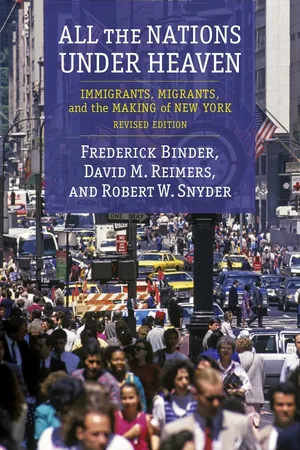
First published in 1996, All the Nations Under Heaven has earned praise and a wide readership for its unparalleled chronicle of the role of immigrants and migrants in shaping the history and culture of New York City. This updated edition of a classic text brings the story of the immigrant experience in New York City up to the present with vital new material on the city's revival as a global metropolis with deeply rooted racial and economic inequalities.
All the Nations Under Heaven explores New York City's history through the stories of people who moved there from countless places of origin and indelibly marked its hybrid popular culture, its contentious ethnic politics, and its relentlessly dynamic economy. From Dutch settlement to the extraordinary diversity of today's immigrants, the book chronicles successive waves of Irish, German, Jewish, and Italian immigrants and African American and Puerto Rican migrants, showing how immigration changes immigrants and immigrants change the city. In a compelling narrative synthesis, All the Nations Under Heaven considers the ongoing tensions between inclusion and exclusion, the pursuit of justice and the reality of inequality, and the evolving significance of race and ethnicity. In an era when immigration, inequality, and globalization are bitterly debated, this revised edition is a timely portrait of New York City through the lenses of migration and immigration.
eBook - ePub
All the Nations Under Heaven
Immigrants, Migrants, and the Making of New York, Revised Edition
- English
- ePUB (mobile friendly)
- Available on iOS & Android
eBook - ePub
All the Nations Under Heaven
Immigrants, Migrants, and the Making of New York, Revised Edition
About this book
Information
Subtopic
North American HistoryIndex
Social SciencesCHAPTER 1
A SEAPORT IN THE ATLANTIC WORLD: 1624–1820
In 1613, a Dutch ship bearing a free man of African descent named Juan Rodriguez sailed into the harbor of what would one day become New York City. Others on European vessels had arrived before him, first to explore—as Henry Hudson did in 1609—and later to exchange manufactured goods for furs with the native Lenape. All left except for Rodriguez, who stayed to trade that winter. And so begins the story of immigration in New York City.1
Rodriguez, who would today be thought of as either black or biracial, came from Hispaniola, a Spanish colony in the Caribbean. Once he was settled ashore, he seems to have decided to better his situation by switching patrons. By the time Rodriguez’s captain returned in 1614, Rodriguez was already working for another ship’s master who had arrived earlier. A clash followed. Rodriguez survived. He then vanished from history, but his life speaks volumes about the founding of New York as a colonial seaport in the Atlantic world.
Rodriguez’s appearance on the banks of the Hudson is a reminder that New York City, born in an age of ocean exploration and transatlantic trade, was from the start commercial and multiethnic. Its early commercial efforts embedded it in international patterns of trade, empire, and migration that spanned the Atlantic, reached south to the Caribbean, and made the city home to peoples from Western Europe, Africa, Asia, and Latin America.
Nevertheless, in the passage from the seventeenth to the nineteenth century, the city that emerged under Dutch, English, and eventually American rule was not modern-day New York writ small. Commercial purposes and human diversity may be constants in New York, but their influence on each other, their links to global economic patterns, and their impact on the city’s political order are difficult to predict. New York is a volatile place, and so was the early Dutch New Amsterdam. When profit-minded Dutch merchants established a settlement at the mouth of the Hudson River in 1624, its economic success, like its ability to include peoples from all around the world, was not guaranteed.2
✳ ✳ ✳
In 1624, the Netherlands was the great mercantile center of Europe, a vigorous seafaring power with an abundance of merchant vessels and warships. Amsterdam was a cosmopolitan city with a strong capitalist ethos, known for its stock exchange and banking, and it was headquarters for two great trading companies. The East India Company, chartered by the Estates General in 1602, held a monopoly over lucrative Dutch trade east of the Cape of Good Hope and west of the Strait of Magellan. The West India Company, chartered in 1621, held a twenty-four-year monopoly over Dutch trade with West Africa, the coast of Australia, the West Indies, and North and South America. Its commercial prospects appeared promising: slaves, gold, and ivory from West Africa; sugar from Brazil; salt from Venezuela; a wide variety of products from the West Indies; and furs from North America. Profitable trading ventures and competing English claims ultimately convinced the States General of the necessity of establishing a more secure presence in the land Henry Hudson had claimed for the Dutch nation.3
While Dutch commercial interests shaped the founding of New Netherland, the peopling of the colony was shaped by a need for labor and by Dutch notions of religious tolerance. The Netherlands was uniquely tolerant of religious refugees, ethnic and linguistic minorities, and political exiles, who flocked to Amsterdam and other Dutch cities and played significant commercial roles. Protestants fleeing oppressive Spanish rule in the southern Netherlands provinces—Dutch-speaking Flemings and French-speaking Walloons—were the largest group of refugees.4
And so, in May 1624, under the command of Cornelius Jacobsz May of Hoorn, thirty families—most of them Walloons from what is today Belgium—reached the Hudson River aboard the Nieu Nederlandt and dropped anchor north of Manhattan. The Walloons, who sought freedom in the New World from religious persecution at the hands of Roman Catholic Spain, became the colony’s first permanent community of settlers. The next year, a second expedition followed, under the leadership of Willem Verhulst, bringing approximately one hundred additional Walloons with livestock and provisions.5
While the Walloons sought security and religious freedom, the Dutch West India Company sought labor and commercial success. The Netherlands was sufficiently prosperous that relatively few Dutch wanted to emigrate to a new colony with uncertain commercial prospects. Indeed, in its early years the settlement at the mouth of the Hudson, New Amsterdam, was dogged by uncertainty: would it be a trading post serving a lucrative trade in furs with the native peoples or a port city with settlers populating its hinterlands?
To attract colonists, the company offered attractive terms. In return for a pledge to remain in New Netherland for six years, a male settler was granted the right to own and sell land, conduct trade within the colony for profit, hunt and fish, and search for precious metals and gems. While public conformity to the Dutch Reformed Church was required, freedom of conscience in private worship was guaranteed. A male settler, in turn, had to assist in the construction of military structures and public buildings and serve in the militia in times of war.6

1.1 The printmaker who created this engraving put stock images of English tobacco planters in the foreground but conveyed realities of New Amsterdam in the background: a seaport city with Dutch gabled roofs and enslaved Africans.
Source: New York Public Library.
Concern about Indian attacks and the need to establish a centrally located headquarters soon convinced the Dutch to consolidate the bulk of New Netherland’s population on Manhattan. Under the director-general Peter Minuit, the son of Walloon refugees from Westphalia, Germany, the town of New Amsterdam took shape on the southern tip of Manhattan. Minuit arrived in New Amsterdam in 1626 and soon began negotiations with the native Lenape to secure a claim to Manhattan. The Lenape, also sometimes called the Munsee, lived in small bands such as the Canarsee and the Rockaway in a region that today stretches from Connecticut to New Jersey. They called their territory “Lenapehoking,” the land of the people.7
Folklore has it that Minuit’s purchase of the island for sixty guilders, or roughly twenty-four dollars, has marked him as one of history’s shrewdest dealers, but the Lenape did not share European notions of private property. The Lenape used Manhattan as hunting and fishing grounds. In all likelihood, they thought they were accepting trade goods in exchange for allowing the newcomers to use a piece of Lenapehoking temporarily. In later years, as they sought to secure full land rights, the Dutch made additional land purchases from Native Americans living in the upper reaches of the island. Again and again, as the anthropologist Robert Grumet has argued, the Lenape negotiated these agreements “to buy time and protection” in the face of European encroachment. Once the company’s dubious title to the land was secured, Minuit gathered settlers onto Manhattan. Construction soon followed, resulting in thirty log houses, Fort New Amsterdam, a stone counting house, and a large mill whose upper loft would be used for church services.8
Significant numbers of the original Walloon settlers were ill at ease in the wilder reaches of northern New Netherland, on the site of present-day Albany, and headed south. By 1650, they constituted an estimated 20 percent of New Amsterdam’s increasingly heterogeneous population.9
✳ ✳ ✳
At first, settlers in New Amsterdam traded with Indians. But as the settlement’s population grew, settlers encroached on Lenape lands. Dutchmen came to see their Lenape neighbors as little more than a nuisance. Relations between settlers and natives deteriorated, especially under Governor-General Willem Kieft, who arrived in 1638 and displayed a total lack of understanding of Indian culture and sensitivities. A series of provocations beginning in 1639 culminated in the full-scale Kieft’s War of 1643–1645, which devastated outlying settlements and took many lives. Kieft’s War shook the confidence of settlers in New Amsterdam, but eventually the growth of the settlement resumed. As the historians Edwin G. Burrows and Mike Wallace observe, “With Europeans at their front door and Iroquois at their back, the Lenapes were doomed.” By the end of the seventeenth century, settlers outnumbered the Lenape by about one hundred to one.10
The settlers were a heterogeneous lot. In 1643, Father Isaac Jogues, a Jesuit missionary who had escaped from Mohawk captivity and journeyed to New Amsterdam, reported that as many as eighteen languages were spoken in the town of approximately a thousand residents. He was also struck by New Amsterdam’s religious diversity: “No religion is publicly exercised but the Calvinist, and orders are to admit none but Calvinists, but this is not observed, for besides the Calvinists there are in the colony Catholics, English Puritans, Lutherans, Anabaptists, here called Ministes [Mennonites], etc.” Father Jogues was by no means favorably impressed with what he observed: “The arrogance of Babel has done much harm to all men; the confusion of tongues has deprived them of great benefit.”11
The Dutch Reformed clergy of New Amsterdam undoubtedly shared Father Jogues’s antipathy to ethnic and religious diversity. When Manhattan’s first minister, Domine Jonas Michaelius, arrived in 1628, religious toleration was rare in Europe and its colonial outposts. But Michaelius aside, the Dutch nation was unique in these matters. The Dutch in old Amsterdam and New Amsterdam, marked by years of struggle with Catholic Spain, knew the value of religious freedom. Moreover, Dutch merchants recognized that religious bigotry limited one’s range of business partners and workers. The company continued policies in America that had proven so successful at home. The West India Company granted the Dutch Reformed Church in New Netherland and New Amsterdam official status and financial support. At the same time, it permitted freedom of conscience and opportunities to worship in private to nonconformists and Jews.12
Toleration and conformity were nearly undermined during the director-generalship of Peter Stuyvesant, which lasted from 1645 to 1664. An able administrator, although arrogant and authoritarian, Stuyvesant believed that maintaining the established church was an essential ingredient in creating an orderly community. Significant numbers of Lutherans from Germany and Scandinavia had moved to New Amsterdam, and in 1653 they petitioned Stuyvesant for permission to hold public services. The director-general, apparently fearing discord in the colony and a challenge to his church, passed the petition to the West India Company in Amsterdam. Its response reflected its overriding interest in attracting settlers to New Netherland regardless of their ethnic background or religious affiliation. The West India Company simply told Stuyvesant not to accept any more petitions of that sort but to reject them “in the most civil and least offensive way.”13 But the Lutherans did not leave New Amsterdam.
Three years later, Stuyvesant fined and imprisoned Lutherans on Long Island for holding public services without an approved Reformed minister. The company again ordered him to be less zealous and more flexible in his religious policy. The controversy ultimately ended when the company permitted the Lutherans to worship publicly in Reformed churches after making certain adjustments in their catechism. Neither the pastors in New Amsterdam nor Reformed Church leadership in the Netherlands were pleased with this compromise, but toleration—the company policy—won out in the end.14
Despite Stuyvesant’s reputation as a religious zealot, Dutch toleration outweighed his pronouncements and attracted settlers to New Netherland. When thirty-one English residents of the outlying hamlet of Flushing signed the Flushing Remonstrance, a document proclaiming their support of religious toleration, Stuyvesant had the leading signatories arrested and tried in New Amsterdam. One of the leaders who refused to recant was banished. When news of the dispute reached West India Company directors in 1663, they told Stuyvesant that while it would indeed be desirable to keep “sectarians” away, such efforts could impede the immigration the company wanted to encourage; therefore, it favored toleration.15
Quakers, with their expressive worship and rejection of the Dutch Reformed Church, also tested the boundaries of Dutch toleration. However, in heterogeneous New Amsterdam, Quakers also had friends. As early as 1639, Lady Deborah Moody and a group of dissenters opposed to uncompromising Puritan doctrines left Massachusetts to settle in Brooklyn. As an Anabaptist, she favored toleration of dissenters. In Brooklyn, she became the first woman to obtain a Dutch land grant. She urged cooperation between the Dutch and English and promoted “complete religious freedom.” When Quaker missionaries needed a refuge, Moody provided one.16
In 1657, several Quakers landed, among them two women w...
Table of contents
- Cover
- Title Page
- Copyright
- Contents
- Preface
- 1. A Seaport in the Atlantic World: 1624–1820
- 2. Becoming a City of the World: 1820–1860
- 3. Progress and Poverty: 1861–1900
- 4. Slums, Sweatshops, and Reform: 1880–1917
- 5. New Times and New Neighborhoods: 1917–1928
- 6. Times of Trial: 1929–1945
- 7. City of Hope, City of Fear: 1945–1997
- 8. Immigrants in a City Reborn: 1980–present
- Afterword
- Acknowledgments
- Notes
- Index
Trusted by 375,005 students
Access to over 1.5 million titles for a fair monthly price.
Study more efficiently using our study tools.
Frequently asked questions
Yes, you can cancel anytime from the Subscription tab in your account settings on the Perlego website. Your subscription will stay active until the end of your current billing period. Learn how to cancel your subscription
No, books cannot be downloaded as external files, such as PDFs, for use outside of Perlego. However, you can download books within the Perlego app for offline reading on mobile or tablet. Learn how to download books offline
Perlego offers two plans: Essential and Complete
- Essential is ideal for learners and professionals who enjoy exploring a wide range of subjects. Access the Essential Library with 800,000+ trusted titles and best-sellers across business, personal growth, and the humanities. Includes unlimited reading time and Standard Read Aloud voice.
- Complete: Perfect for advanced learners and researchers needing full, unrestricted access. Unlock 1.5M+ books across hundreds of subjects, including academic and specialized titles. The Complete Plan also includes advanced features like Premium Read Aloud and Research Assistant.
We are an online textbook subscription service, where you can get access to an entire online library for less than the price of a single book per month. With over 1.5 million books across 990+ topics, we’ve got you covered! Learn about our mission
Look out for the read-aloud symbol on your next book to see if you can listen to it. The read-aloud tool reads text aloud for you, highlighting the text as it is being read. You can pause it, speed it up and slow it down. Learn more about Read Aloud
Yes! You can use the Perlego app on both iOS and Android devices to read anytime, anywhere — even offline. Perfect for commutes or when you’re on the go.
Please note we cannot support devices running on iOS 13 and Android 7 or earlier. Learn more about using the app
Please note we cannot support devices running on iOS 13 and Android 7 or earlier. Learn more about using the app
Yes, you can access All the Nations Under Heaven by Robert W. Snyder in PDF and/or ePUB format, as well as other popular books in Social Sciences & North American History. We have over 1.5 million books available in our catalogue for you to explore.