eBook - ePub
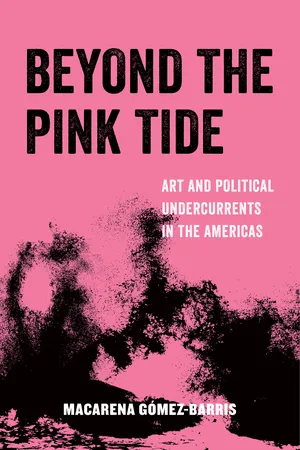
Beyond the Pink Tide
Art and Political Undercurrents in the Americas
- 160 pages
- English
- ePUB (mobile friendly)
- Available on iOS & Android
eBook - ePub
About this book
How can we create a model of politics that reaches beyond the nation-state, and beyond settler-colonialism, authoritarianism, and neoliberalism? In Beyond the Pink Tide, Macarena Gómez-Barris explores the alternatives of recent sonic, artistic, activist, visual, and embodied cultural production. By focusing on radical spaces of potential, including queer, youth, trans-feminist, Indigenous, and anticapitalist movements and artistic praxis, Gómez-Barris offers a timely call for a decolonial, transnational American Studies. She reveals the broad possibilities that emerge by refusing national borders in the Americas and by seeing and thinking beyond the frame of state-centered politics. Concrete social justice and transformation begin at the level of artistic, affective, and submerged political imaginaries—in Latin America and the United States, across South-South solidarities, and beyond.
Information
Publisher
University of California PressYear
2018Print ISBN
9780520296664
Edition
1eBook ISBN
9780520969063
ONE
Sounds Radical
Ana Tijoux, Student Protests, and Palestinian Solidarity
BEYOND SHOCK
In 2011, the Chilean mestiza singer and rapper Ana Tijoux became the sound of the student movement that reverberated throughout South America and beyond. Her song “Shock” gave a sound track to the massive student marches and collective street performances in which hundreds of thousands of students demanded a free education from then President Michelle Bachelet’s government. With rising tuition costs, students protested the ransom on their future: in class-stratified Chile, debt had made it untenable to access higher education and the elusive dream of upward mobility.
Tijoux wrote the lyrics to the song after reading Naomi Klein’s The Shock Doctrine: The Rise of Disaster Capitalism. In it, the author describes how “shock doctor” economists remade the world in their own image, disciplining the global economy through austerity policies that were implemented by military dictatorships. Chile was one key epicenter of the shock doctrine. On September 11, 1973, Augusto Pinochet overthrew Salvador Allende’s Socialist government in a bloody coup supported by then US President Richard Nixon and the CIA. As I have written elsewhere,1 the Pinochet regime (1973–89) used torture, disappearance, and exile against tens of thousands of those it deemed subversive to enable the Chicago Boys’ application of US economist Milton Friedman’s neoliberal experiment. As a precursor to counterinsurgency and the neoliberal turn that would take place throughout South America, Central America, Asia, and Africa, Chile became the testing ground for economic shock therapy. Using the rhetoric of a “doctrine of security,” military dictatorships turned against their own citizens, restructuring the global economy in part upon the broken and disappeared bodies of social activists.
Ana Tijoux’s song “Shock” references this history, noting how global marketization was literally built on the murder and pain of Socialists and Indigenous activists. The lyrics tell the story of a nation traumatized by a brutal authoritarian regime who left debt, deepening social resentments, and resource theft in its wake:
The poison of your colorless discourses
Don’t you see that we aren’t alone?
Millions from pole to pole
We will march with the tone
With the conviction
Of no more stealing
Your state of control
Your rotten throne of gold
Your rich man’s politics
And your treasury, no!
The time has come, the time has come
We will not permit anymore anymore of your
Doctrine of shock
No countries, only corporations
Who have more, more actions
Bellies fat, powerful
Decisions made by so few.
Pinochet’s Constitution
Rule of law, fascist book
Fascists disguised as a greedy elite.2
The lines “Your rotten thrones of gold, your rich man’s politics,” and “Bellies fat, powerful decisions made by so few” are a powerful reference to the increasing concentration of wealth that expanded social and economic inequality over the past forty years, notable in university tuition hikes at public institutions. Students were moved by Tijoux’s refrain, “No permiteremos más, más tu doctrina del shock,” or “We will not permit any more of your doctrine of shock,” reflecting student demand for a society not organized by insatiable greed and the social control mechanism of police and military violence.
In a nation where economic and political power remained in the hands of dominant elites, Tijoux’s song “Shock” resonated with working-class and working poor youth, who increasingly saw their futures ransomed by an economic model that catered to corporations, wealthy ministers, and foreign bankers. Fed up with state-led marketization and empty promises, students demanded alternatives to the consumer-oriented society that had impoverished education and public health systems while weakening the texture of social relations. Against the hypocrisy of the education system that hid the history of authoritarian violence, they demanded a fuller account of neoliberalism than the whitewashed triumphant narratives of the Chicago Boys and their technocratic masculinity that had been ubiquitous in their textbooks.
For a generation searching for new modes of living and imagining their own futures, Tijoux’s song became an anthem of political accountability and social transformation. As I discuss in the chapter, despite the economic system that had produced social crisis, through music, solidarity, social movements, and performances, young people instead forged deep connections to histories of diaspora, to each other and across the Global South, working to create a different, less market-oriented imaginary of a future society.
SOUNDS LIKE JUSTICE
On the album of the same title, the rap song “1977” refers to the year Tijoux was born. It makes several references to the utopic potential of the Socialist Allende period by repeating, “mil novicientos setenta, che,” or 1970, the year Salvador Allende was voted into power for a short-lived Socialist experiment that ignited the global imagination. By 1973, the conservative Right had pushed back against Allende’s nationalist platform, rolling back an economic agenda that had nationalized copper and the telecommunications industry while also expropriating the land of agrarian workers. The political violence that accompanied economic restructuring and that engulfed the nation was aimed at Allende supporters and in addition to mass murder and imprisonment led to the expulsion of one million Chileans, who were scattered between England, France, Spain, Australia, Canada, the United States, Venezuela, Cuba, and other nations around the world.
Born in exile in France, Tijoux returned with her family to Chile as an adolescent, forming part of the retornados, a multigenerational group that comprised about 260,000 people in a nation of 16 million. As Loreta Rebolledo’s research emphasizes, returning to an unknown nation during the 1980s and 1990s was confusing for the daughters and sons of exiles.3 For this generation, return had meant an extraordinary effort to access a nation that was wholly unfamiliar and had only been experienced and mediated through the traumas of their parents. In addition to a general feeling of estrangement, this generation found themselves in a militarized nation that had been wrought by the aftermath of the 1981 economic crisis. In the aftermath of the 1990 democratic transition, thousands of exiles returned to a vastly transformed country whose democracy and natural resources had been destroyed by shock capitalism. For Tijoux, this meant going to a nation that was foreign to her, mediated through the political perspectives of her mother’s generation.
In fact, Ana Tijoux’s mother, María Emilia Tijoux, was a formidable influence. A sociologist whose work on race and immigration is well known in Latin America and whose scholarship focuses on South-South migrations, María Emilia Tijoux has written extensively on social exclusion and the impact of poverty on street children in postindustrial geographies such as Santiago. Though Ana Tijoux defined her own perspectives on social, racial, and economic justice in her music and public interviews, marked by her own trajectory as an immigrant/exile, it is clear that her political economic analysis was also informed by her mother’s attunement to social injustice.
Ana Tijoux’s musicality was also influenced by her experience in exile, where rap created an important vehicle for expressing social discontent within a changing racially diverse envi...
Table of contents
- Title
- Copyright
- Dedication
- Contents
- Overview
- Preface
- Introduction
- 1. Sounds Radical
- 2. How Cuir Is Queer Recognition?
- 3. Art in the Shadow of Border Capitalism
- 4. An Archive of Starlight
- Conclusion
- Acknowledgments
- Notes
- Glossary
- Selected Bibliography
Trusted by 375,005 students
Access to over 1.5 million titles for a fair monthly price.
Study more efficiently using our study tools.
Frequently asked questions
Yes, you can cancel anytime from the Subscription tab in your account settings on the Perlego website. Your subscription will stay active until the end of your current billing period. Learn how to cancel your subscription
No, books cannot be downloaded as external files, such as PDFs, for use outside of Perlego. However, you can download books within the Perlego app for offline reading on mobile or tablet. Learn how to download books offline
Perlego offers two plans: Essential and Complete
- Essential is ideal for learners and professionals who enjoy exploring a wide range of subjects. Access the Essential Library with 800,000+ trusted titles and best-sellers across business, personal growth, and the humanities. Includes unlimited reading time and Standard Read Aloud voice.
- Complete: Perfect for advanced learners and researchers needing full, unrestricted access. Unlock 1.5M+ books across hundreds of subjects, including academic and specialized titles. The Complete Plan also includes advanced features like Premium Read Aloud and Research Assistant.
We are an online textbook subscription service, where you can get access to an entire online library for less than the price of a single book per month. With over 1.5 million books across 990+ topics, we’ve got you covered! Learn about our mission
Look out for the read-aloud symbol on your next book to see if you can listen to it. The read-aloud tool reads text aloud for you, highlighting the text as it is being read. You can pause it, speed it up and slow it down. Learn more about Read Aloud
Yes! You can use the Perlego app on both iOS and Android devices to read anytime, anywhere — even offline. Perfect for commutes or when you’re on the go.
Please note we cannot support devices running on iOS 13 and Android 7 or earlier. Learn more about using the app
Please note we cannot support devices running on iOS 13 and Android 7 or earlier. Learn more about using the app
Yes, you can access Beyond the Pink Tide by Macarena Gomez-Barris in PDF and/or ePUB format, as well as other popular books in History & Latin American & Caribbean History. We have over 1.5 million books available in our catalogue for you to explore.