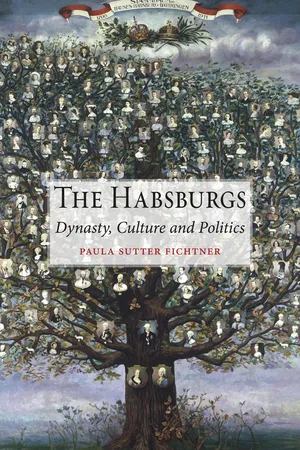
On 28 June 1914, in the Bosnian capital of Sarajevo, Archduke Franz Ferdinand of Habsburg-Lorraine-Este was shot dead. Known as the moment that sparked off the First World War, this incident also initiated another, lesser-known story: the beginning of the end of Habsburg rule, which came four years later. In this comprehensive account of the longest-lived European empire, Paula Sutter Fichtner explains how the dynasty came to play such a decisive role in the fate of the continent.
The Habsburgs: Dynasty, Culture and Politics traces the origins of house Habsburg and shows how it was able to hold together such a culturally diverse, polyglot and multi-ethnic state for more than 600 years, the cessation of which changed the shape of Europe forever. Taking account of the interpenetration of culture, politics and society, the book reveals the strategies that enabled the dynasty's extraordinarily long life – its dazzling mix of cultural propaganda, public performances and cunning political manoeuvring. It is one of the most striking ironies of this history that Ferdinand was killed while on his way to visit injured people in hospital – just the sort of crowd-pleasing performance that had enabled Habsburg success.
This incisive new history tells the story of the Habsburgs in an accessible yet authoritative fashion, revealing the intriguing principal characters in the drama and breathing fresh life into the story of the Habsburg reign. The book charts one of the pivotal foundation stories of modern Europe, and is essential reading for anyone interested in the history of the continent.
- English
- ePUB (mobile friendly)
- Available on iOS & Android
eBook - ePub
About this book
Information
References

Introduction
1 Geoffrey Wheatcroft, ‘Hello to All That’, New York Review of Books, LVIII/2 (2012), p. 32; obituary of Paul Fussell, New York Times, 24 May 2012, A29.
2 Alan Sked, The Decline and Fall of the Habsburg Empire, 2nd edn (Harlow, 2001), p. 3. The Spanish side of the Habsburg story is well told and illustrated in Andrew Wheatcroft, The Habsburgs: Embodying Empire (New York, 1995).
3 For example, Gary Cohen, ‘Nationalist Politics and the Dynamics of State and Society in the Habsburg Monarchy, 1867–1914’, Central European History, XL (2007), pp. 241–78; Peter Urbanitsch, ‘Pluralist Myth and Nationalist Realities: The Dynastic Myth of the Habsburg Monarchy – a Futile Exercise in the Creation of an Identity?’, Austrian History Yearbook, XXXV (2004), pp. 101–14; Ernst Bruckmüller, ‘Was There a “Habsburg Society” in Austria–Hungary?’, Austrian History Yearbook, XXXVII (2006), pp. 1–16; Pieter M. Judson, ‘L’Autriche-Hongrie était-elle un empire?’, Annales. Histoire, Sciences Sociales, LXIII/3(2008), pp. 164, 565–6, 583. See also, more generally, Pieter M. Judson, Guardians of the Nation: Activists on the Language Frontiers of Imperial Austria (Cambridge, MA, 2007) and Tara Zahra, Kidnapped Souls: National Indifference and the Battle for Children in the Bohemian Lands, 1900–1948 (Ithaca, NY, 2008). A good summary of these arguments is Pieter M. Judson and Tara Zahra, ‘Sites of Indifference to Nationhood’, Austrian History Yearbook, XLIII (2012), pp. 21–7.
4 Daniel L. Unowsky, The Pomp and Politics of Patriotism: Imperial Celebrations in Habsburg Austria, 1848–1916 (West Lafayette, IN, 2006), is exemplary. See also Nancy Wingfield, Flag Wars and Stone Saints: How the Bohemian Lands Became Czech (Cambridge, MA, 2007), pp. 108, 110–11, which has a vivid account of these occasions in nineteenth-century Bohemia.
5 See the commentaries in Jutta Schumann, Die Andere Sonne: Kaiserbild und Medienstrategien im Zeitalter Leopolds I (Berlin, 2003), pp. 16–17, 19–20, 25, 32, 34; Jan Assmann, Das kulturelle Gedächtnis: Schrift, Erinnerung und politische Identität in frühen Hochkulturen [1992] (Munich, 2007), pp. 17, 19–21, 29, 133, 141; Jan and Aleida Assmann, Schrift und Gedächtnis: Beiträge zur Archäologie der literarischen Kommunikation (Munich, 1983), pp. 265, 267, 270, 275–6; Jan and Aleida Assmann, ‘Schrift und Kultur’, in Zwischen Festtag und Alltag: Zehn Beiträge zum Thema ‘Mündlichkeit und Schriftlichkeit’, ed. Wolfgang Raible (Tübingen, 1988), pp. 29–33.
6 Larry Wolff, The Idea of Galicia: History and Fantasy in Habsburg Political Culture (Stanford, CA, 2010), pp. 1, 4.
1 Getting Started
1 Sabine Weiss, ‘Das Bildungswesen im spätmittelalterlichen Österreich. Ein Überblick’, in Die Österreichische Literatur: Ihr Profil von den Anfängen im Mittelalter bis ins 18. Jahrhundert (1050–1750), ed. Herbert Zeman (Graz, 1986), I/1, p. 228.
2 Friedrich Krieger, Rudolf von Habsburg (Darmstadt, 2003), pp. 32–7, 59, 63, 67–9, 78–9; Günther Hödl, Habsburg und Österreich, 1273–1493: Gestalten und Gestalt des österreichischen Mittelalters (Vienna, 1988), pp. 19–20.
3 Krieger, Rudolf, pp. 3–5, 55–8, 99; Thomas Ebendorfer, Chronicon Austriae, Scriptores Rerum Austriacarum, ed. R.D.P. Hieronymus Pez (Leipzig, 1725), II, col. 913.
4 Krieger, Rudolf, pp. 78, 99, 108; Jíří Kuthan, Premysl Ottokar II. König Bauherr und Mäzen: Höfische Kunst im 13. Jahrhundert, trans. Petronilla Cemus, Lenka Reinerová and Ursel Sedmidubská (Vienna, 1996), pp. 14, 16, 34–7.
5 Kuthan, Ottokar, p. 17.
6 Krieger, Rudolf, p. 99.
7 Kuthan, Ottokar, pp. 27, 56–87; Mario Schwarz, ‘Die Baukunst in Österreich zur Regierungszeit Ottokars II. Premysl (1251–1276)’, in Ottakar-Forschungen, ed. Max Weltin and Andreas Kusternig (Vienna, 1979), pp. 453–8; Heinrich Appelt, ‘Verfassungsgeschichtliche Grundlagen der Herrschaft König Ottokars von Böhmen über die österreichischen Länder’, in Ottokar-Forschungen, p. xiv.
8 Krieger, Rudolf, pp. 127–54.
9 Max Weltin, ‘König Rudolf und die österreichischen Landherren’, in Rudolf von Habsburg 1273–1291, ed. Egon Boshof and Franz-Reiner Erkens (Cologne, 1993), pp. 106–9.
10 Krieger, Rudolf, pp. 131–7, 143; Max Weltin, ‘Landesherr und Landherren: Zur Herrschaft Ottokars II. Přemysl in Österreich’, Ottokar-Forschungen, pp. 168, 186, 197, 215.
11 Krieger, Rudolf, pp. 145–6, 149–150. Cf. Maurice Keen, Chivalry [1984] (New Haven, CT, 2005), p. 169.
12 Krieger, Rudolf, pp. 151–3, 238, 254; Kuthan, Ottokar, pp. 7–8, 34.
13 Hödl, Habsburg, pp. 25–6.
14 Krieger, Rudolf, pp. 243–6.
15 Ernst Bruckmüller, Sozialgeschichte Österreichs, 2nd edn (Vienna, 2001), pp. 63–83, 72–4; Appelt, ‘Grundlagen’, pp. ix–xii; Weltin, ‘König Rudolf’, pp. 110–11, 113, 115.
16 Friedrich Polleross, ‘From the exemplum virtutis to the Apotheosis: Hercules as an Identification Figure in Portraiture: An Example of the Adoption of Classical Forms of Representation’, in Iconography, Propaganda, and Legitimation, ed. Allan Ellenius (Oxford, 1998), pp. 37–52; Fernando Checa Cremades, ‘Monarchic Liturgies and the “Hidden King”: The Function and Meaning of Spanish Royal Portraiture in the Sixteenth and Seventeenth Centuries’, in Iconography, p. 98
17 Thomas Brockmann, ‘Das Bild des Hauses Habsburg in der dynastienahen Historiographie um 1700’, in Bourbon-Habsburg-Oranien: Konkurrierende Modelle im dynastischen Europa um 1700, ed. Christoph Kampmann, Katharina Krause, Eva-Bettina Krems and Anuschka Tischer (Cologne, 2008), p. 30; Peter Burke, ‘The Demise of Mythologies’, in Iconography, pp. 245–54.
18 Krieger, Rudolf, pp. 229, 234, 236, 239–40, 250.
19 Marie Tanner, The Last Descendant of Aeneas: The Habsburgs and the Mythic Image of the Emperor (New Haven, CT, 1993), pp. 208, 222.
20 Krieger, Rudolf, pp. 3–5; Thomas M. Martin, ‘Das Bild Rudolfs von Habsburg als “Bürgerkönig” in Chronistik, Dichtung und moderner Historiographie’, in Blätter für deutsche Landesgeschichte, CXII (1976), p. 215.
21 Ibid., pp. 204, 207, 209 and n. 4, 210–11, 229, 250.
22 Ibid., pp. 216–20, 223–6.
23 Brockmann, ‘Bild’, pp. 30–34; Harald Kleinschmidt, ‘Das ostasienbild Maximilians I: Die Bedeutung Ostasiens in der Kaiserpropaganda um 15...
Table of contents
- Front Cover
- Half Title
- Title Page
- Copyright
- Contents
- Political Chronology
- Usage
- Introduction
- ONE Getting Started
- TWO The Habsburgs Regroup
- THREE Champions of Faith and Family
- FOUR New Tactics for New Times
- FIVE Revolution, Recovery, Revolution
- SIX Constructing Commitment
- SEVEN Alternative Narratives, Competing Visions
- EIGHT Bosnia and After
- NINE One Goodbye, Several Farewells
- Genealogy: The House of Habsburg
- References
- Select Bibliography
- List of Illustrations
- Acknowledgements
- Index
Trusted by 375,005 students
Access to over 1.5 million titles for a fair monthly price.
Study more efficiently using our study tools.
Frequently asked questions
Yes, you can cancel anytime from the Subscription tab in your account settings on the Perlego website. Your subscription will stay active until the end of your current billing period. Learn how to cancel your subscription
No, books cannot be downloaded as external files, such as PDFs, for use outside of Perlego. However, you can download books within the Perlego app for offline reading on mobile or tablet. Learn how to download books offline
Perlego offers two plans: Essential and Complete
- Essential is ideal for learners and professionals who enjoy exploring a wide range of subjects. Access the Essential Library with 800,000+ trusted titles and best-sellers across business, personal growth, and the humanities. Includes unlimited reading time and Standard Read Aloud voice.
- Complete: Perfect for advanced learners and researchers needing full, unrestricted access. Unlock 1.5M+ books across hundreds of subjects, including academic and specialized titles. The Complete Plan also includes advanced features like Premium Read Aloud and Research Assistant.
We are an online textbook subscription service, where you can get access to an entire online library for less than the price of a single book per month. With over 1.5 million books across 990+ topics, we’ve got you covered! Learn about our mission
Look out for the read-aloud symbol on your next book to see if you can listen to it. The read-aloud tool reads text aloud for you, highlighting the text as it is being read. You can pause it, speed it up and slow it down. Learn more about Read Aloud
Yes! You can use the Perlego app on both iOS and Android devices to read anytime, anywhere — even offline. Perfect for commutes or when you’re on the go.
Please note we cannot support devices running on iOS 13 and Android 7 or earlier. Learn more about using the app
Please note we cannot support devices running on iOS 13 and Android 7 or earlier. Learn more about using the app
Yes, you can access The Habsburgs by Paula Sutter Fichtner,Fichtner, Paula Sutter in PDF and/or ePUB format, as well as other popular books in History & German History. We have over 1.5 million books available in our catalogue for you to explore.