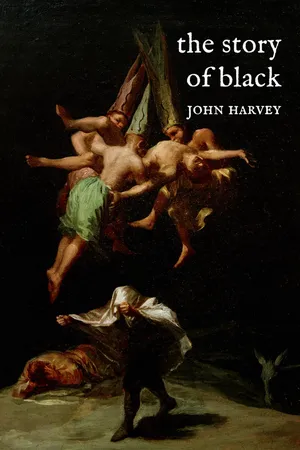
As a colour, black is a single hue. It comes in no other shades. It is pure darkness, absorber of all light. But despite its commonly accepted role as one half of a pair (black and white, dark and light), in symbolic terms black envelops the entire spectrum of meaning. The Story of Black explores the ambiguous relationship the world’s cultures have had with this often self-contradictory colour, examining how black has been used as a tool and a metaphor in a multitude of startling ways.
The Greek word melancholia (literally ‘black bile’) defines depression and dark moods, yet the little black dress is the epitome of chic. For the ancient Egyptians black was the colour of death and it has since become established as the sartorial hue of priests and puritans, witches and monarchs, intellectuals and artists. The colour’s innate austerity has made it the choice for both funereal dress and lawyers’ gowns, and of Goths and other subcultures today. This book also assesses black’s problematic association with race, observing how white Europeans exploited the negative associations of ‘black’ in enslaving millions of black Africans. And it looks at how artists and designers have applied the colour to their work, from Caravaggio to Turner, Reinhardt and Rothko.
How can this one colour embody such disparate values as evil, glamour, death and creativity? Not simply a history of a colour but a readable sketch of the history of culture and art in the West, The Story of Black skilfully unpicks the social, political, aesthetic and sexual nuances of black throughout the ages, unearthing the secrets behind black’s continuing power to fascinate, compel and divide.
eBook - ePub
The Story of Black
About this book
Information
REFERENCES
Introduction: How Black Is Black?
| 1 | ‘Black is not a colour’, A Treatise on Painting, trans. J. F. Rigaud (London, 1802), chap. 235, p. 132. Leonardo also said that black, ‘like a broken vessel, is not able to contain anything’ (chap. 222). But though he noted that ‘black and white are not reckoned among colours’, and called black ‘the representative of darkness’, he stated that he would ‘not omit mentioning them, because there is nothing in painting more useful and necessary; since painting is but an effect produced by lights and shadows’ (chap. 226). |
| 2 | Matisse had much to say on black. His assertion that ‘le noir c’est une force: je mets mon lest en noir pour simplifier la construction’ is quoted in the first number of Derrière le miroir, December 1946. For further remarks by Matisse on black (for instance at the opening of the exhibition ‘Black is a Colour’ at the Galerie Maeght, Paris, in December 1946. see Jack D. Flam, Matisse on Art (Berkeley, CA, 1995), p. 165ff; also Annie Mollard-Desfour, Le Noir (Paris, 2005), p. 20, n. 7 (which includes ‘Pissarro me disait . . . “Manet . . . fait de la lumière avec du noir”’). For the Renoir, see A. Vollard, Renoir: An Intimate Record, trans. H. L. Van Doren and R. T. Weaver [1925] (London, 1990), chap. 12, p. 52. On Tintoretto see for instance Eric Potter, ed., Painters on Painting (New York, 1971), pp. 53–4. On Aristotle and Goethe, see pp. 45, 227 below. On Beethoven and the black chord, see Michael C. Tusa, ‘Beethoven’s “C-Minor Mood”: Some Thoughts on the Structural Implications of Key Choice’, in Beethoven Forum, 2, ed. Christoph Reynolds (Lincoln, NE, 1993), p. 2, n. 3. |
| 3 | Michel Pastoureau, Black: The History of a Color (Princeton, NJ, 2009), p. 194; Ludwig Wittgenstein, Remarks on Colour, ed. G.E.M. Anscombe (Berkeley, CA, 1978), p. 37e, section 156, p. 46e, section 215. |
| 4 | Thomas Young, A Course of Lectures on Natural Philosophy and the Mechanical Arts (London, 1807), p. 345. |
| 5 | Hermann von Helmholtz, Helmholtz’s Treatise on Physiological Optics, trans. J.P.C. Southall (Menasha, WI, 1924), vol. II, p. 131. The first sentence is sometimes quoted without the article, ‘Black is real sensation’, but the German reads ‘Das Schwarz ist eine wirkliche Empfindung’. |
| 6 | Hodgkin is quoted in W. D. Wright, ‘The Nature of Blackness in Art and Visual Perception’, Leonardo, XIV (1981), pp. 236–7. I am grateful to Dr David Tolhurst for an explanation of the biochemistry of sight. |
| 7 | ‘I conclude, then, that the organ of colour and its impressions were but partially developed among the Greeks of the heroic age’: William Ewart Gladstone, Studies in Homer and the Homeric Age, vol. III (Oxford, 1858), p. 488; on ‘flauus’ and other elusive classical colour-words see Mark Bradley, Colour and Meaning in Ancient Rome (Cambridge, 2009), pp. 1–12; on colour and historical etymology see R. W. Casson, ‘Colour Shift: Evolution of English Color Terms from Brightness to Hue’, in Colour Categories in Thought and Language, ed. C. L. Hardin and L. Maffi (Cambridge, 1997), pp. 224–39. |
| 8 | Brent Berlin and Paul Kay, Basic Colour Terms: Their Universality and Evolution (Berkeley, CA, 1969); for an extended appraisal of many aspects of Basic Colour Terms see Hardin and Maffi, eds, Colour Categories in Thought and Language. |
| 9 | See Rudolf Steiner in Colour (Forest Row, East Sussex, 1992), p. 25. On the cultural associations of black see Victor Turner, The Forest of Symbols: Aspects of Ndembu Ritual (Ithaca, NY, 1967), especially chap. 3, ‘Color Classification in Ndembu Ritual’, pp. 59ff; C. Lévi-Strauss, The Raw and the Cooked, trans. J. Weightman and D. Weightman (London, 1970); Umberto Eco, ‘How Culture Conditions the Colours We See’, in On Signs, ed. M. Blonsky (Baltimore, MD, 1985), pp. 157–75. |
| 10 | See Jeremy Coote, ‘“Marvels of Everyday Vision”: The Anthropology of Aesthetics and the Cattle Keeping Nilotes’, in Anthropology and Aesthetics, ed. J. Coote and A. Shelton (Oxford, 1992), pp. 245–73; John Ryle is quoted on p. 251. |
ONE: The Oldest Colour
| 1 | The Elder Eddas of Saemund Sigfusson and the Younger Eddas of Snorre Sturleson, trans. I. A. Blackwell (Copenhagen, 1906), p. 260. |
| 2 | Andrew Marvell, ‘The First Anniversary of the Government under O.C.’ (1654), ll. 341–2. |
| 3 | To go from petals to stems, it would have been in plants’ interest if their stems and leaves could have been black, since they would then absorb – and use – more light in their photosynthetic processes. And plants’ leaves could have been black since, in the waterborne stage of their evolution, they made use of various photosynthetic bacteria and the different pigments that derived from them (known as bacteriochlorophylls and carotenoids). As matters turned out, however, the plant lineage which made it onto dry land was committed to chlorophyll, which had evolved with a red-blue absorption to avoid competition with other bacteriochlorophylls. And once established on land, it would have been too demanding evolutionarily to start again in another colour. I am indebted to Dr Julian Hibbard for these points about plants and their pigments. |
| 4 | On all-black birds, black male birds and piebald creatures, see Charles Darwin, The Descent of Man, and Selection in Relation to Sex [1871] (Princeton, NJ, 1981), Part II, chap. XVI, pp. 226–7. On the Gouldian finch see Jennifer J. Templeton, D. James Mountjoy, Sarah R. Pryke and Simon C. Griffith, ‘In the Eye of the Beholder: Visual Mate Choice Lateralization in a Polymorphic Songbird’, Biology Letters (3 October 2012), available at http://rsbl.royalsocietypublishing.org. On the inherited avoidance of warning colours, see Leena Lindström, Rauno V. Alatalo and Johanna Mappes, ‘Reaction of Hand-reared and Wild-caught Predators towards Warningly Colored, Gregarious, and Conspicuous Prey’, Behavioural Ecology, X/3 (1999), pp. 317–22. |
| 5 | ‘H’ (possibly Dr Harley), ‘Mr Ruskin’s Illness Described by Himself’, British Medical Journal (27 January 1900), p. 225. |
| 6 | See G. Bass, ‘A Bronze Age Shipwreck at Ulu Burun (Kas)’, American Journal of Archaeology, XC/3 (July 1986), pp. 269–96. |
| 7 | Pliny the Elder, Natural History, Book XVI, 40. |
| 8 | Herodotus, Histories, I, 98–9. |
| 9 | Ibid., 1, 179. |
| 10 | The Book of the Dead, trans. E. A. Wallis Budge, chap. 175, ‘The Chapter of Not Dying a Second Time’. |
| 11 | Plutarch, Moralia, V, 26, ‘On Isis and Osiris’, trans. F. C. Babbitt (London, 1936). |
| 12 | On Hindu beliefs see Wendy Doniger, The Hindus: An Alternative History (New York, 2009). I have also drawn especially on H. Krishna Sastri, South Indian Images of Gods and Goddesses (Madras, 1916), and on Alain Daniélou, Mythes et dieux de l’Inde: Le Polythéisme hindou (Paris, 1994) – see, for instance, ‘La Couleur sombre’, pp. 242ff; also on conversations with Eric Auzoux, Anita Desai and Simeran Gell. |
| 13 | In another myt... |
Table of contents
- Front Cover
- Half Title
- Title Page
- Copyright
- Contents
- Introduction: How Black Is Black?
- ONE The Oldest Colour
- TWO Classical Black
- THREE The Black of God
- FOUR Black in Society: Arabia, Europe
- FIVE Two Artists in Black
- SIX Black Choler
- SEVEN Servitude and Négritude
- EIGHT Black in the Enlightenment
- NINE Britain’s Black Century
- TEN Our Colour?
- A Note on Chessboards, Death and Whiteness
- REFERENCES
- SELECT BIBLIOGRAPHY
- ACKNOWLEDGEMENTS
- PHOTO ACKNOWLEDGEMENTS
- INDEX
Trusted by 375,005 students
Access to over 1.5 million titles for a fair monthly price.
Study more efficiently using our study tools.
Frequently asked questions
Yes, you can cancel anytime from the Subscription tab in your account settings on the Perlego website. Your subscription will stay active until the end of your current billing period. Learn how to cancel your subscription
No, books cannot be downloaded as external files, such as PDFs, for use outside of Perlego. However, you can download books within the Perlego app for offline reading on mobile or tablet. Learn how to download books offline
Perlego offers two plans: Essential and Complete
- Essential is ideal for learners and professionals who enjoy exploring a wide range of subjects. Access the Essential Library with 800,000+ trusted titles and best-sellers across business, personal growth, and the humanities. Includes unlimited reading time and Standard Read Aloud voice.
- Complete: Perfect for advanced learners and researchers needing full, unrestricted access. Unlock 1.5M+ books across hundreds of subjects, including academic and specialized titles. The Complete Plan also includes advanced features like Premium Read Aloud and Research Assistant.
We are an online textbook subscription service, where you can get access to an entire online library for less than the price of a single book per month. With over 1.5 million books across 990+ topics, we’ve got you covered! Learn about our mission
Look out for the read-aloud symbol on your next book to see if you can listen to it. The read-aloud tool reads text aloud for you, highlighting the text as it is being read. You can pause it, speed it up and slow it down. Learn more about Read Aloud
Yes! You can use the Perlego app on both iOS and Android devices to read anytime, anywhere — even offline. Perfect for commutes or when you’re on the go.
Please note we cannot support devices running on iOS 13 and Android 7 or earlier. Learn more about using the app
Please note we cannot support devices running on iOS 13 and Android 7 or earlier. Learn more about using the app
Yes, you can access The Story of Black by John Harvey in PDF and/or ePUB format, as well as other popular books in Social Sciences & Art Theory & Criticism. We have over 1.5 million books available in our catalogue for you to explore.