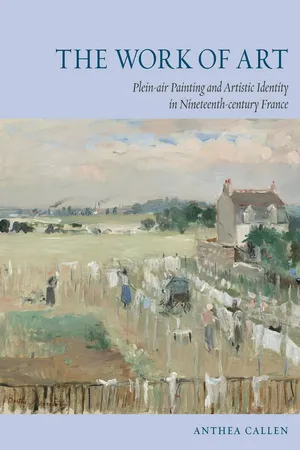
Plein-air painting became standard practice for French landscape artists early in the nineteenth century, and by the 1850s landscape was the most popular artistic genre. Landscape painting in general, Anthea Callen argues, and the ‘plein air’ oil sketch in particular were the key drivers of change in artistic practice in the nineteenth century – which led ultimately to the Impressionist revolution and beyond. In The Work of Art, Callen explores the emergence of new concepts of ‘the artist’ – modern artistic identity and its relation to the idea of creative ‘work’ – through analyzing painters’ self-portraits, studies of fellow artists, photographs, caricatures and prints.
The work of artists under the microscope includes landscapes by the Barbizon School, Gustave Courbet, Paul Cézanne, Camille Pissarro, Claude Monet, Gustave Caillebotte, Berthe Morisot, Georges Seurat and Vincent van Gogh. Callen examines artists’ methods and modes of self-presentation, paying particular attention to painters’ personal touch, paint matter and mark-making in oil on paper and canvas. Referring to contemporary treatises on landscape painting theory and practice, and to colour-merchants’ novel paints and specialized equipment for landscape painting, she provides new ways of understanding material practice at this historical moment and the cultural meanings it generates. Richly illustrated, The Work of Art offers fresh insights into the development of avant-garde French painting and the predominantly masculine concept of the modern artist.
eBook - ePub
The Work of Art
Plein Air Painting and Artistic Identity in Nineteenth-century France
- English
- ePUB (mobile friendly)
- Available on iOS & Android
eBook - ePub
The Work of Art
Plein Air Painting and Artistic Identity in Nineteenth-century France
About this book
Information
Topic
ArtSubtopic
Art GeneralReferences
Introduction
1 C.-J.-F. Lecarpentier, Essais de paysage . . . (Rouen, 1817), p. 36, my translation.
2 See especially the studies published on Courbet’s landscapes and Barbizon painting, in Andreas Burmester, Christoph Heilmann and Michael F. Zimmermann, Barbizon: Malerei der Natur – Natur der Malerei (Munich, 1999); on Impressionist paintings in David Bomford et al., Art in the Making: Impressionism, exh. cat., National Gallery, London (London, 1990); Iris Schaefer, Caroline von Saint-George and Katja Lewerentz, Painting Light: The Hidden Techniques of the Impressionists (Milan, 2008), and Iris Schaefer, Caroline von Saint-George and Katja Lewerentz, eds, ‘International Symposium at the Wallraf-Richartz-Museum & Fondation Corboud, Cologne: Latest Research into Painting Techniques of Impressionists and Postimpressionists’, in Zeitschrift für Kunsttechnologie und Konservierung, 22/2 (Munich, 2009); on Neo-Impressionism and Post-Impressionism: John Leighton and Richard Thomson, Seurat and The Bathers, exh. cat., National Gallery, London (1997), Robert Herbert, Seurat and the Making of ‘La Grande Jatte’, exh. cat., Art Institute of Chicago (2004), John House, Elizabeth Reissner and Barnaby Wright, The Courtauld Cézannes (London, 2008), Marije Vellekoop, Muriel Geldof, Ella Hendriks, Leo Jansen and Alberto de Tagle, Van Gogh’s Studio Practice (Amsterdam, 2013). There are numerous individual articles and essays cited elsewhere in this book.
3 See Marie Thérèse de Forges’ early studies Les Auto-portraits de Courbet (Paris, 1973), and on Courbet’s The Studio, in Gustave Courbet (Paris, 1977–8).
4 See Anthea Callen, The Art of Impressionism: Painting Technique and the Making of Modernity (London and New Haven, CT, 2000). James Rubin has recently addressed related issues in his important Impressionism and the Modern Landscape: Productivity, Technology, and Urbanization from Manet to Van Gogh (Los Angeles, CA, and London, 2008).
5 For the formation of the Société and the genesis of the first Impressionist exhibition, see Paul Tucker, ‘The First Impressionist Exhibition in Context’, in Charles S. Moffett, ed., The New Painting: Impressionism, 1874–1886, exh. cat., National Gallery of Art, Washington, DC, and Fine Art Museums, San Francisco (Washington, DC, 1986), pp. 92–117.
6 Roszika Parker and Griselda Pollock, The Old Mistresses: Women, Art and Ideology (New York and London, 1981), pp. 38 and 39.
7 See Séverine Sofio, ‘“L’art ne s’apprend pas aux dépens des mœurs!”. Construction du champ de l’art, genre et professionnalisation des artistes, 1789–1848’, thesis, Paris (2009), pp. 671–2ff and pp. 1–2: she notes, for example, that one in four painters exhibiting at the Salon during the July Monarchy were women. See also A. Corbin, J. Lalouette and M. Riot-Sarcey, Femmes dans la Cité, 1815–1871 (Paris, 2002), and Bonnie Smith, Ladies of the Leisure Class: The Bourgeoises of Northern France in the Nineteenth Century (Princeton, NJ, 1981), and S. Schweitzer, Les Femmes ont toujours travaillé: Une histoire du travaille des femmes aux XIXe et XXe siècles (Paris, 2002).
8 See Griselda Pollock’s important early intervention, ‘Modernity and the Spaces of Femininity’, in Vision and Difference: Femininity, Feminism and the Histories of Art (London and New York, 1988), chap. 3; and Nochlin’s key essay on Morisot and work, including Hanging the Laundry (illus. 177), in Ingrid Pfeiffer, Linda Nochlin, Sylvie Patry and Griselda Pollock, Women Impressionists: Berthe Morisot, Mary Cassatt, Eva Gonzalès, Marie Bracquemond, exh. cat., Schirn Kunsthalle, Frankfurt; Fine Arts Museums, San Francisco (2008), pp. 46–54 (first published in Nochlin’s Women, Art and Power and Other Essays, New York, 1988, pp. 37–56).
9 Linda Whiteley, ‘Art et commerce d’art en France avant l’epoque impressioniste’, Romantisme, XIII/40 (1983), p. 66.
10 On the association of colour/matter and the feminine in relation to landscape painting, see Anthea Callen, ‘Technique and Gender: Landscape, Ideology and the Art of Monet in the 1890s’, and see also Paul Smith’s ‘Cézanne’s Maternal Landscape and Its Gender’, both in Steven Adams and Anna Greutzner Robins, eds, Gendering Landscape Art (Manchester, 2000); in Adams’s essay in this volume, ‘Signs of Recovery: Landscape Painting and Masculinity in Nineteenth-century France’, he argues cogently for the formation of an ‘innocent’ man-child category of masculinity as the trope of the landscape artist and the success of landscape painting as an ‘apolitical’ genre especially post-1848. See also Steven Adams, ‘“The Fault of being purely French”: The Practice and Theory of Landscape Painting in Post-Revolutionary France’, Art History, XXXVI/4 (September 2013), pp. 740–67.
11 See Pollock, Vision and Difference, chap. 3, S. Hollis Clayson, Painted Love: Prostitution in French Art of the Impressionist Era (Los Angeles, CA, 1991), and Anthea Callen, The Spectacular Body: Science, Method and Meaning in the Work of Degas (London and New Haven, CT, 1995), esp. chap. 1.
12 Anne Higonnet, Berthe Morisot’s Images of Women (Cambridge, MA, and London, 1992), p. 9.
13 Her overbearing and envious husband Félix Bracquemond is considered the reason for this. See Jean-Paul Bouillon and Elizabeth Kane, ‘Marie Bracquemond’, Woman’s Art Journal, V/2 (Autumn 1984–Winter 1985), pp. 21–7.
14 For an analysis of the comparable situation in Britain, see Anthea Callen, ‘Sexual Division of Labor in the Arts and Crafts Movement’, Woman’s Art Journal, 5/2 (Autumn 1984–Winter 1985), pp. 1–6.
15 See Higonnet on this in Berthe Morisot’s Images of Women, pp. 2–3.
16 See Paul Duro, ‘The “Demoiselles à Copier” in the Second Empire’, Woman’s Art Journal, VII/1 (Spring–Summer 1986), pp. 1–7.
17 See Jean Renoir, Renoir (Paris, 1962), p. 388.
18 In the Diderot and d’Alembert Encyclopédie, pl. 6, under ‘Peinture’, see chap. 1 below; see also in P.-L. Bouvier, Manuel des jeunes artistes et amateurs en peinture (Paris, 1827), pl. 1; J. Adeline, Lexique des termes d’art (Paris, 1889), under ‘Mollete’, gives the information on enamel colours and illustrates both types of grinding equipment, pp. 290–91.
19 Natura Naturans, or ‘natural nature’, was used by Nicholas Green to denote ‘the social production of the countryside’, the terms for which he identifies as being set by ‘the material and cultural fabric of the metropolis’, in Green, The Spectacle of Nature: Landscape and Bourgeois Culture in Nineteenth-century France (Manchester, 1990), p. 11, and passim, especially his pt 2, ‘Natura Naturans: the Formation of an Urban Vision’, pp. 67ff.
20 See, for example, Charlotte Klonk, Science and the Perception of Nature: British Landscape Art in the Late Eighteenth and Early Nineteenth Centuries (New Haven, CT, and London, 1996).
21 See Stephen Oetterman, The Panorama: History of a Mass Medium (New York, 1997), pp. 6–7. Daguerre’s diorama consisted of large canvas painted on both sides. When illuminated from the front, the scene would be shown in one state and by switching to illumination from behind another phase or aspect would be seen. Scenes in daylight changed to moonlight, a train travelling on a track would crash, or an earthquake would be shown in before and after pictures. See also Erikki Huhtamo, Illusions in Motion: Media Archaeology of the Moving Panorama and Related Spectacles (Cambridge, MA, and London, 2013).
22 See Green, The Spectacle of Nature, and Anne Wagner, ‘Courbet’s Landscapes and their Market’ Art History, 4/4 (December 1981), pp. 410–31, and Petra ten-Doesschate Chu, The Most Arrogant Man in France: Gustave Courbet and the Nineteenth-century Media Culture (Princeton, NJ, 2007), and also Stéphane Guégan, Théophile Gautier, La critique en liberté (Paris, 1997).
23 See Rubin, Impressionism and the Modern Landscape (2008), for an important reappraisal of artists’ new painting motifs of sites of urban and suburban labour.
24 See the chapter ‘The Ideology of the Licked Surface: Official Art’, in Charles Rosen and Henri Zerner, Romantici...
Table of contents
- Front Cover
- Half Title
- Title Page
- Copyright
- Contents
- Introduction
- ONE The Origins of Plein-air Painting to 1850
- TWO Maître Courbet: The Worker–Painter
- THREE Cézanne, Pissarro and Knife Painting
- FOUR Colour: The Material and the Ephemeral
- References
- Bibliography
- Acknowledgements
- Photo Acknowledgements
- Index
Trusted by 375,005 students
Access to over 1.5 million titles for a fair monthly price.
Study more efficiently using our study tools.
Frequently asked questions
Yes, you can cancel anytime from the Subscription tab in your account settings on the Perlego website. Your subscription will stay active until the end of your current billing period. Learn how to cancel your subscription
No, books cannot be downloaded as external files, such as PDFs, for use outside of Perlego. However, you can download books within the Perlego app for offline reading on mobile or tablet. Learn how to download books offline
Perlego offers two plans: Essential and Complete
- Essential is ideal for learners and professionals who enjoy exploring a wide range of subjects. Access the Essential Library with 800,000+ trusted titles and best-sellers across business, personal growth, and the humanities. Includes unlimited reading time and Standard Read Aloud voice.
- Complete: Perfect for advanced learners and researchers needing full, unrestricted access. Unlock 1.5M+ books across hundreds of subjects, including academic and specialized titles. The Complete Plan also includes advanced features like Premium Read Aloud and Research Assistant.
We are an online textbook subscription service, where you can get access to an entire online library for less than the price of a single book per month. With over 1.5 million books across 990+ topics, we’ve got you covered! Learn about our mission
Look out for the read-aloud symbol on your next book to see if you can listen to it. The read-aloud tool reads text aloud for you, highlighting the text as it is being read. You can pause it, speed it up and slow it down. Learn more about Read Aloud
Yes! You can use the Perlego app on both iOS and Android devices to read anytime, anywhere — even offline. Perfect for commutes or when you’re on the go.
Please note we cannot support devices running on iOS 13 and Android 7 or earlier. Learn more about using the app
Please note we cannot support devices running on iOS 13 and Android 7 or earlier. Learn more about using the app
Yes, you can access The Work of Art by Anthea Callen,Callen, Anthea in PDF and/or ePUB format, as well as other popular books in Art & Art General. We have over 1.5 million books available in our catalogue for you to explore.