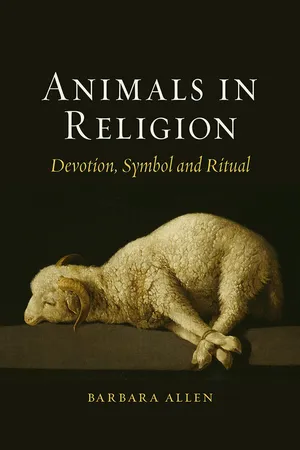
Animals in Religion explores the role and presence of animals within a wide range of religious traditions, from ensouled narratives within oral tradition to religious texts, myths and accompanying legends. Some of the material may have a familiar ring, such as the stories of St Francis of Assisi and Ganesha, but other, unusual facts also make an appearance.
This book proposes a deeper respect for our four-legged, finned and feathered brethren. From the principle of ahimsa (non-violence) in Jainism, Buddhism and Hinduism, to the laws which relate to tza’ar ba’alei chayim (avoiding the suffering/pain of living creatures) in Judaism, we encounter the interdependence of life. The Jainist notion of ‘reverence for life’, the pronouncement in Genesis that ‘it was good’ and the Islamic belief that all species are Muslim allow us to come to a realization, or a deeper appreciation, that non-human animals have value in our religious traditions, as well as in our hearts and homes. The book examines animals not only in all the major monotheistic religions but in the beliefs of the Egyptian, Mesoamerican and Indigenous peoples of North America and Australasia as well as of the Vikings and Druids.
- English
- ePUB (mobile friendly)
- Available on iOS & Android
eBook - ePub
About this book
Information
Print ISBN
9781780235691
Subtopic
ReligionReferences
Introduction
1 Walt Whitman, ‘Song of Myself’, The Complete Poems (Harmondsworth, 1975), p. 94.
2 Jay McDaniel, ‘Practicing the Presence of God: A Christian Approach to Animals’, in A Communion of Subjects: Animals in Religion, Science and Ethics, ed. Paul Waldau and Kimberley Patton (New York, 2006), p. 142.
3 The oldest-known cave art is located in Cueva de El Castillo, the ‘Cave of the Castle’, in Cantabria, Spain. It is 40,800 years old. Chauvet’s cave art covers two distinct periods, the Aurignacian (30,000–32,000 BP), and the Gravettian (28,000–23,000 BP). These dates are based on radiocarbon dating. At Lascaux, in southwest France, some of the best-known Upper Palaeolithic cave art can be found. Over 2,000 figures have been found, with more than 900 of them identifiable as animals. These paintings are 17,000 years old.
4 Kimberley Patton, ‘Caught with Ourselves in the Net of Life and Time’, in A Communion of Subjects, ed. Waldau and Patton, p. 29.
5 The oldest shrine, in Switzerland, is thought to be that of a bear.
6 Alistair Moffat, The Wildwood, in Graeme Gibson, The Bedside Book of Beasts: A Wildlife Miscellany (London, 2009), p. 316.
7 Susan Chernak McElroy, Animals as Teachers and Healers (London, 1996), p. 15.
8 Susan Chernak McElroy, Heart in the Wild (New York, 2002), p. xix.
9 A term we need to exercise with caution when using, for no one can really ‘own’ another living creature. I prefer the terms ‘animal companion’ and ‘guardian’. Figures from 2011 for rates of pet ownership: New Zealand: 68 per cent of households had a pet; Australia: 63 per cent; United States: 62 per cent (in 2013 statistics from the American Pet Products Manufacturers Association, the United States had increased pet ownership from 62 per cent to 63 per cent); and Britain: 48 per cent. ‘Pet Ownership in Australia – 2013’, at www.animalmedicinesaustralia.org.au.
10 ‘The Lord opened the mouth of the donkey, and it said to Balaam, “What have I done to you, that you have struck me these three times?”’ (Numbers 22:28).
11 It is interesting to note that there are only two instances of an animal speaking (and being understood by humans) in the Bible: Balaam’s donkey and the serpent in Genesis.
12 Gary Kowalski, The Souls of Animals (Walpole, NH, 1990), p. 140.
ONE: Animals in Tribal and First Peoples’ Religions
1 Chief Letakots-Lesa of the Pawnee Tribe, to Natalie Curtis, c. 1904, in Natalie Curtis, The Indians’ Book: An Offering by the American Indians of Indian Lore, Musical and Narrative, to Form a Record of the Songs and Legends of Their Race (New York, 1907), p. 96; cited in Joseph Campbell, Historical Atlas of World Mythology, vol. I: The Way of the Animal Powers (London, 1984), p. 8.
2 Hubert Howe Bancroft, ‘The Native Races’, Myths and Legends, vol. III (San Francisco, CA, 1883), p. 305, cited in Richard Erdoes and Alfonso Ortiz, American Indian Myths and Legends (New York, 1984), p. xiii.
3 N. Scott Momaday, ‘Foreword’, in Michael J. Caduto and Joseph Bruchac, The Native Stories from Keepers of the Earth (Saskatoon, SK, 1991).
4 Irving Hexham, Concise Dictionary of Religion (Downers Grove, IL, 1993), p. 187.
5 Warren Pohatu, Māori Animal Myths (Auckland, 2001), p. 22.
6 ‘First Peoples’ refers to indigenous peoples (the first people to live in a region). First Nation is a term used for Aboriginal peoples in Canada (who are neither Inuit nor Metis). A more recent trend is for First Peoples/Nations to refer to themselves by their tribal or national identity, for example, ‘I am Haida.’ Tribal identity is usually based upon cultural regions, geography and linguistics. Within this work I usually use the term ‘First Peoples’, which encompasses tribal/indigenous peoples of Africa, the Americas, the Arctic, Asia and Oceania. Occasionally I use the term ‘Native American’. I acknowledge that the terms used will be inadequate, and will date in time. This does not set out to be an exhaustive account, and the subject matter cannot be contained within the limits of one chapter. This chapter, given its scope, is more of an overview. If readers want to learn more, then the footnotes and Bibliography will guide them to additional information. The majority of this chapter will address the First Peoples/Nations of North America, but references will be made to other First Peoples/Nations.
7 Boria Sax, The Serpent and the Swan: The Animal Bride in Folklore and Literature (Blacksburg, VA, 1998), p. 220.
8 Evan T. Pritchard, Native American Stories of the Sacred (Woodstock, VT, 2005), p. xviii.
9 Ella E. Clark, Indian Legends of the Pacific Northwest (1953) (Los Angeles, CA, 2003), p. 8.
10 Ibid.
11 Northwest tribes include the Salish, the Chinook, the Tlingit and the Haida.
12 The Plains tribes include Blackfoot, North Cheyenne, Pawnee and Lakota (Sioux).
13 Southwest/Pueblo tribes include the West Apache, Hopi, Navajo and Apache.
14 Southeast and Woodlands tribes include the Cherokee, Shawnee, Iroquois and Huron.
15 Roy Willis, ed., World Mythology: The Illustrated Guide (London, 1993), p. 221.
16 William Bright, cited in David M. Guss, ed., The Language of Birds: Tales, Texts and Poems of Inters...
Table of contents
- Front Cover
- Half Title
- Title Page
- Copyright
- Contents
- Introduction
- ONE Animals in Tribal and First Peoples’ Religions
- TWO Animals in Ancient Egyptian Religion and Mythology
- THREE Animals in Celtic and Viking Myth and Ritual
- FOUR Animals in Judaism
- FIVE Animals in Christianity
- SIX Animals in Islam
- SEVEN Animals in Hinduism
- EIGHT Animals in Jainism
- NINE Animals in Buddhism
- TEN Animals in Religion in China and Japan
- Conclusion
- REFERENCES
- BIBLIOGRAPHY
- ACKNOWLEDGEMENTS
- PHOTO ACKNOWLEDGEMENTS
- INDEX
Trusted by 375,005 students
Access to over 1.5 million titles for a fair monthly price.
Study more efficiently using our study tools.
Frequently asked questions
Yes, you can cancel anytime from the Subscription tab in your account settings on the Perlego website. Your subscription will stay active until the end of your current billing period. Learn how to cancel your subscription
No, books cannot be downloaded as external files, such as PDFs, for use outside of Perlego. However, you can download books within the Perlego app for offline reading on mobile or tablet. Learn how to download books offline
We are an online textbook subscription service, where you can get access to an entire online library for less than the price of a single book per month. With over 1.5 million books across 990+ topics, we’ve got you covered! Learn about our mission
Look out for the read-aloud symbol on your next book to see if you can listen to it. The read-aloud tool reads text aloud for you, highlighting the text as it is being read. You can pause it, speed it up and slow it down. Learn more about Read Aloud
Yes! You can use the Perlego app on both iOS and Android devices to read anytime, anywhere — even offline. Perfect for commutes or when you’re on the go.
Please note we cannot support devices running on iOS 13 and Android 7 or earlier. Learn more about using the app
Please note we cannot support devices running on iOS 13 and Android 7 or earlier. Learn more about using the app
Yes, you can access Animals in Religion by Barbara Allen in PDF and/or ePUB format. We have over 1.5 million books available in our catalogue for you to explore.