Virtually every street in London was once filled with a cacophony of animal calls and noises. From cattle being herded through the streets surrounding Smithfield meat market, to the exotic residents of the Tower of London zoo.
Infested by pests, vermin and bedbugs, Londoner’s homes were also shared with pets or livestock, which were reared for food. Beasts from far-flung corners of the globe were imported through London’s docks for display in all manner of establishments, from private homes and estates, to zoos and parks. Londoners were entertained by ponies flying in hot air balloons, performing fleas, any number of animals baited by dogs and the ubiquitous horse, which plied the streets as an essential cog in the machine of London’s industry and transport. Over the last 30 years, however, Londoners have seemingly banished animals from their streets.
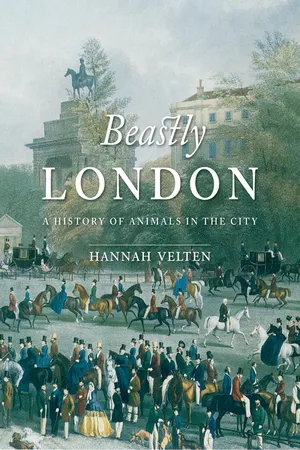
Using a wide range of primary sources Beastly London explores the complex and changing relationship between Londoners of all classes and their animal neighbours: from a mainly exploitative relationship, to London becoming the birthplace of animal welfare societies and animal rights’ campaigns. This appealing book, now available in paperback, shows how London’s animals have been central to its success, and will appeal to all those interested in animal history and welfare.
- English
- ePUB (mobile friendly)
- Available on iOS & Android
eBook - ePub
About this book
Information

It would not take much to have cattle rampaging through the Smithfield streets: Thomas Sidney Cooper, The Old Smithfield Market, 1887, oil on canvas.
one
Livestock: Londoners’ Nuisance Neighbours
The existence of large numbers of livestock in London had been an accepted part of city life since Roman times. Before railways and refrigeration, cattle, sheep, pigs and poultry were permanent fixtures in the metropolis and its suburbs. They were bred and reared by Londoners, and there was also a transient population for sale at London’s livestock markets that had been driven from all parts of Britain and Ireland. Livestock touched nearly every Londoner’s life; but it was not generally a pleasant experience for human or animal. The reason for the collision (quite literally in many cases) between man and beast was the seemingly insatiable demand for meat that Londoners became well known for.
London’s love of meat
Pigs were kept in abundance in Roman Londinium. The forested areas around the city, such as Highgate and Hampstead, provided pannage for large herds of pigs, and pork and bacon were the most common meats eaten by the more affluent, while the poor used scraps to flavour soups and stews. Pigs’ lard was part of a soldier’s daily ration, and blood and fat were also mixed into the sausages that made up the army’s iron rations when it was away fighting.1 Other meats arrived in Londinium on the hoof after being driven along the Roman road network from around the country: beef was the favoured meat of the army and the wealthy, although sheep and goats were also prized for their milk as well as their meat.2
By the Middle Ages the meat in Londoners’ diets was strictly rationed due to the Catholic Church’s observance of days when the meat of quadrupeds could not be eaten. Fish, chicken and goose were the main substitutes. Meatless days fell on Fridays, Wednesdays and Saturdays, plus other festival days, making it necessary to abstain from red meat for nearly half the year.3 But despite these restrictions, the demand for beef and mutton was strong enough to restart the droving trade established by the Romans. In 1562 Alessandro Magno, an Italian merchant, visited London and was astonished at the amount of meat eaten:
It is extraordinary to see the great quantity and quality of meat – beef and mutton – that comes every day from the slaughter-houses in this city . . . Truly, for those who cannot see it for themselves, it is almost impossible to believe that they could eat so much meat in one city alone. The beef is not expensive, and they roast it whole, in large pieces. They do not care as much for veal as we do. Apart from chickens and other birds which one finds everywhere, they have many swans, much game, and rabbits and deer in abundance.4
In Stuart times the Yeomen of the Guard, founded by Henry VII at the beginning of his reign in 1485 to act as his private bodyguard, became known as Beefeaters because of the size of the meat rations they were given: as late as 1813, the 30 yeomen at St James’s Palace received 24 pounds of beef, 18 pounds of mutton and 16 pounds of veal per day to share.5

M. Dubourg after James Pollard, Christmas at a London ‘Meat Stall’, from The London Markets (1822).
By the mid-1850s, Londoners’ appetite for red meat had not faltered: there were thousands of eating houses and coffee shops selling ‘juicy, well-trimmed [mutton] chops, crowned with a sprig of parsley’,6 whereas pork and bacon were still the main meats eaten by London’s working classes.
The demand for meat increased as London’s economic power and human population exploded: the population doubled between 1801 and 1841 to reach 2.3 million by 1850, and annual meat consumption doubled from 1750 to 1850, reaching 122–53 pounds per head; the large range presumably depending on social class.7 To supply this market about 140,000 cattle and 1 million sheep were needed in 1810; by 1828 this had risen to 150,000 cattle and 1.5 million sheep and by 1853, cattle numbers had risen to 277,000 head and sheep to 1.6 million head.8
All of these animals came into London to be sold and slaughtered, giving the metropolis the dubious honour of being the only city in Europe, and probably the world, with a livestock market – Smithfield – and thousands of slaughterhouses at its centre. This market coped with the greatest volume of domestic livestock destined for slaughter of any city in history.9
Animals destined for Smithfield Market
Smithfield was originally established as a market site in about AD 950 in a field immediately outside one of the gates in the London Wall. This field was chosen because animals could be conveniently watered at the old Horse Pool, which lay between the Moorfields (now EC2Y) and Smithfield.10
In about 1174 the site was described by William Fitzstephen (d. c. 1191), clerk to Thomas à Becket, as a ‘smooth’ field where a celebrated horse market was held every Friday. ‘In a separate part [of Smithfield] are located the goods that country folk are selling: agricultural implements, pigs with long flanks, cows with swollen udders, woolly flocks and bodies huge of kine [cattle].’11 Smithfield was also used as a common place of execution in the thirteenth century. In addition it was the home of the three-day Bartholomew Fair, which began as a cloth fair in the reign of Henry II (r. 1154–89), and was the site of jousting tournaments for the nobility in the fourteenth century and, in the sixteenth century, an arena for burnings at the stake.12 But Edward III (r. 1327–77) granted Smithfield formal market rights in 1327 and the market expanded. It was held on Mondays and Fridays, with cattle, calves, sheep, lambs and pigs sold on both days.
The market was further extended, and paved and drained for the first time, in 1614, and was described as ‘a most capacious market for [about 4,000] black cattle, sheep, horses, hay and straw, with pens or folds, so called of sheep there parted and penned up to be sold on market days’.13 Before the agrarian revolution in the eighteenth century, the market was not held after the autumn as livestock was killed before winter due to lack of forage after the autumn stubbles had been eaten. With the introduction of new winter crops, such as turnips, animals could be fattened over winter, and therefore Smithfield was supplied with livestock all year round. This meant that Londoners could eat fresh beef and mutton during the winter, instead of salted meat.14 With improvements not only in feedstuffs, but also in breeding stock, agricultural advances also directly increased the carcass weights of livestock: by 1795 the average carcass was twice as heavy as that produced in 1710.15
Before the advent of refrigeration, steamboats and railways, London’s supply of animals came from across Britain and Ireland on the hoof. Cattle from Scotland, Ireland and Wales would arrive at grazing pastures outside London wearing iron shoes or cues, secured with broad-headed nails.16 They had been driven by country drovers along drovers’ tracks which criss-crossed the country, travelling at about 2 mph for 12 hours a day – the trip from Wales would take 20–25 days – and staying overnight on pasture, often in fields called Halfpenny Field, because the charge was a halfpenny per head.17 After such a tremendous journey, the cattle arrived emaciated and were fattened up outside London on grazing grounds for two to three weeks. Daniel Defoe estimated in 1727 that Norfolk graziers bought up 40,000 Scottish cattle a year to fatten for sale at Smithfield;18 Welsh cattle were fattened on the salt marshes of Essex and Kent.19
Shorter distances were travelled by sheep, which came from Lincoln, Norfolk, Somerset and Devon. Pigs were very difficult to drive because of their obstinacy and greed – they were often muzzled during travel, and would only cover 6 to 10 miles a day. The 14,500 pigs driven to London from Ireland, via Wiltshire, in the 1830s undertook a journey which would have taken hundreds of days.20 However, they mainly came from East Anglia, Surrey and Buckinghamshire, sometimes wearing knitted woollen boots with leather soles to protect their feet.21
As for poultry, thousands of geese, the chosen bird of the poor at Christmas, were also driven from East Anglia from August onwards, so they could feed on the harvest stubbles as they travelled to London in time for Michaelmas in September.22 To protect their feet prior to the long journey, they were driven first through tar, then sawdust and grit.23 By the 1550s exotic New World (American) turkeys had been introduced from Spain and were reared in huge numbers in East Anglia.24 They were available in the London markets having been driven west during the run-up to Christmas – they were allowed to roost in the trees at night during the journey.25 The closer the poultry came to London, the more the roads deteriorated into muddy ruts, and the birds were usually transferred into wheeled vehicles and taken to the poulterers’ area of the City – particularly Leadenhall Market.
To visualize the number of animals coming into London – and hence the meat supply demanded – the report of the 1850 Royal Commission, which was set up to decide the future of Smithfield,26 used the analogy of climbing to the top of a mile-high tower made of beer barrels to see the beasts approaching the city from all directions:
Herefrom we might discover the Great Northern road stretching far away into the length and breadth of the land. Lo! as we look, a mighty herd of oxen, with loud bellowing, are beheld approaching from the north. For miles and miles the mass of horns is conspicuous winding along the road, ten abreast, and even thus the last animal of the herd would be 72 miles away, and the drover goading this shrinking flank considerably beyond Peterborough . . . as the clouds of dust clear away, we see the great Western road, as far as the eye can reach, thronged with a bleating mass of wool, and the shepherd at the end of the flock (ten abreast) and the dog that is worrying the last sheep are just leaving the environs of Bristol, 121 miles from our beer-built pillar. Along Piccadilly, Regent-street, the Strand, Fleet-street, Cheapside, and the eastward Mile-end-road line, for 7.5 miles, street and causeway are thronged with calves, still ten abreast; and in the great parallel thoroughfares of Bayswater-road, Oxford-street, and Holborn, we see nothing for nine long miles but a slowly-pacing, deeply-grunting herd of swine. As we watch this moving mass approaching from all points of the horizon, the air suddenly becomes dark – a black pall seems drawn over the sky – it is the great flock of birds – game, poultry, and wild-fowl, that . . . are come up to be killed: as they fly wing to wing and tail to beak they form a square whose superficies is not less than the whole enclosed portion of St. James’s Park, or 51 acres. No sooner does this huge flight clear away than we behold the park at our feet inundated with hares and rabbits. Feeding 2,000 abreast, they extend from the marble arch to the round pond in Kensington Gardens – at least a mile.27

Drovers resting their charges on the way to Smithfield at Highgate Archway tollgate and tavern, 1825.
Foreign animals were also imported into London to meet demand. The unfortunate cattle mostly came from Prague, Prussia and Bavaria, which meant that they had to travel for between seven and twelve days by land and sea to reach Smithfield.28 These animals deteriorated in appearance, and hence in value, during their arduous journeys and their meat usually ended up in the cheap East End markets, while British-and Irish-born animals went to the West End markets. That is not to say that the latter were in any better condition when they reached London on the hoof (unless they had been fattened outside London): it was estimated that when animals came by railway in the mid-nineteenth century, rather than being driven, each cow saved 40 pounds in body weight, sheep 8 pounds ...
Table of contents
- Front Cover
- Half Title
- Title Page
- Copyright
- Contents
- Introduction: Revealing the Beasts
- 1 Livestock: Londoners’ Nuisance Neighbours
- 2 Working Animals: Straining Every Muscle
- 3 Sporting Animals: Natural Instincts Exploited
- 4 Animals as Entertainers: Performance, Peculiarity and Pressure
- 5 Exotic Animals: The Allure of the Foreign and the Wild
- 6 Pampered Pets and Sad Strays
- 7 London Wildlife: The Persecuted and the Celebrated
- Final Thoughts: An Apology and a Pardon
- REFERENCES
- ACKNOWLEDGEMENTS
- PHOTO ACKNOWLEDGEMENTS
- INDEX
Trusted by 375,005 students
Access to over 1.5 million titles for a fair monthly price.
Study more efficiently using our study tools.
Frequently asked questions
Yes, you can cancel anytime from the Subscription tab in your account settings on the Perlego website. Your subscription will stay active until the end of your current billing period. Learn how to cancel your subscription
No, books cannot be downloaded as external files, such as PDFs, for use outside of Perlego. However, you can download books within the Perlego app for offline reading on mobile or tablet. Learn how to download books offline
Perlego offers two plans: Essential and Complete
- Essential is ideal for learners and professionals who enjoy exploring a wide range of subjects. Access the Essential Library with 800,000+ trusted titles and best-sellers across business, personal growth, and the humanities. Includes unlimited reading time and Standard Read Aloud voice.
- Complete: Perfect for advanced learners and researchers needing full, unrestricted access. Unlock 1.5M+ books across hundreds of subjects, including academic and specialized titles. The Complete Plan also includes advanced features like Premium Read Aloud and Research Assistant.
We are an online textbook subscription service, where you can get access to an entire online library for less than the price of a single book per month. With over 1.5 million books across 990+ topics, we’ve got you covered! Learn about our mission
Look out for the read-aloud symbol on your next book to see if you can listen to it. The read-aloud tool reads text aloud for you, highlighting the text as it is being read. You can pause it, speed it up and slow it down. Learn more about Read Aloud
Yes! You can use the Perlego app on both iOS and Android devices to read anytime, anywhere — even offline. Perfect for commutes or when you’re on the go.
Please note we cannot support devices running on iOS 13 and Android 7 or earlier. Learn more about using the app
Please note we cannot support devices running on iOS 13 and Android 7 or earlier. Learn more about using the app
Yes, you can access Beastly London by Hannah Velten in PDF and/or ePUB format, as well as other popular books in History & British History. We have over 1.5 million books available in our catalogue for you to explore.