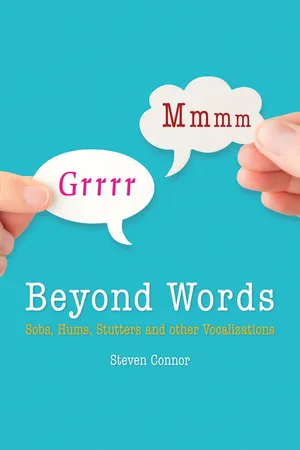
Aristotle defined voice as ‘a particular sound made by something with a soul; for nothing which does not have a soul has a voice’. Beyond Words encompasses human language outside words, the realm of the sounds of the mouth, controlled and automatic, which bring depth, meaning and confusion in equal measure to our communication as humans. Steven Connor takes in the phantasmal life of excitements, identifications and recoils associated with particular groups of vocal utterances – the guttural, the dental, the fricative and the sibilant – and reveals our beliefs, myths and responses to the growls, stutters, ums and ahs of everyday language and exchange.
From the moans, whimpers and sobs of human grief, to the playful linguistic twisting of nonsense, Beyond Words probes the fringes and limits of human language, and our definitions and notions of ‘voice’ and meaning, to challenge our basic assumptions about what it is to communicate and where meaning lies in language.
By engaging with the tics, utterances and vocal sounds usually marginalized, trivialized or ignored completely in phonetics and linguistics, Beyond Words presents the reader with a startling and fascinating new way to engage with language itself.
- English
- ePUB (mobile friendly)
- Available on iOS & Android
eBook - ePub
About this book
Information
References
ONE: Ahem
1 William James, The Principles of Psychology (New York, 1890), p. 488.
2 Steven Connor, Dumbstruck: A Cultural History of Ventriloquism (Oxford, 2000).
3 Aristotle, De Anima Books II and III (With Passages From Book I), ed. and trans. D. W. Hamlyn (Oxford, 1993), p. 32.
4 Ibid.
5 Ibid., p. 33.
6 Remke Kruk, ‘Pseudo-Aristotle: An Arabic Version of Problemata Physica X’, Isis, LXVII (1976), p. 253.
7 Afnan H. Fatani, ‘The Iconic-Cognitive Role of Fricatives and Plosives’, in Outside-In – Inside-Out: Iconicity in Language and Literature, 4, ed. Costantino Maeder, Olga Fischer and William J. Herlofsky (Amsterdam and Philadelphia, 2005), p. 176.
8 Charles S. Peirce, Collected Papers, ed. Charles Hartshorne and Paul Weiss, 8 vols (Cambridge, MA, 1931–58), vol. II, p. 277.
9 Connor, Dumbstruck (Oxford, 2000), pp. 35–43.
10 Gérard Genette, Mimologics, trans. Thaīs E. Morgan (Lincoln and London, 1995).
11 Samuel Taylor Coleridge, Poetical Works, ed. Ernest Hartley Coleridge (Oxford and New York, 1983), p. 297.
12 Plutarch, Plutarch’s Moralia, With an English Translation By Frank Cole Babbitt, vol. III: Sayings of Kings and Commanders. Sayings of Romans. Sayings of Spartans. The Ancient Customs of the Spartans. Sayings of Spartan Women. Bravery of Women (London and Cambridge, MA, 1949), p. 398.
TWO: St . . . st . . . st
1 Steven Connor, Dumbstruck: A Cultural History of Ventriloquism (Oxford, 2000).
2 Ibid., pp. 327–37.
3 Bartholomaeus Anglicus, Batman Uppon Bartholome his booke De proprietatibus Rerum (London, 1582), p. 46.
4 Bartolommeo della Rocca Cocles, A Brief and Most Pleasau[n]t Epitomye of the Whole Art of Phisiognomie, trans. Thomas Hill (London, 1556), sig. C3v.
5 Francis Bacon, Sylva Sylvarum: or A Naturall Historie (London, 1627), p. 103.
6 Alexander Ross, Arcana Microcosmi, or, The Hid Secrets of Man’s Body Discovered . . . (London, 1652), p. 250.
7 William Abbotts, Impediments of Speech: Stammering, Stuttering, Lisping, &c., Their Causes and Cure (London, 1879), p. 19.
8 ‘C. K.’ [Charles Kingsley], Hints to Stammerers, By a Minute Philosopher (London, 1864), p. 25.
9 Ibid.
10 Ibid., pp. 26, 27.
11 Otto Fenichel, ‘A Case of Stammering’, Psychoanalytic Quarterly, XV (1946), p. 540.
12 Otto Fenichel, ‘Outline of Clinical Psychoanalysis’, Psychoanalytic Quarterly, II (1933), pp. 96, 97.
13 Isador H. Coriat, Stammering: A Psychoanalytic Interpretation (New York, 1927).
14 Peter Glauber, ‘The Psychoanalysis of Stuttering: Some Fundamentals of Psychoanalysis Relevant to the Understanding of Stuttering’, in Stuttering: A Symposium, ed. John Eisenson (New York, 1958), p. 80.
15 Roger Ascham, Toxophilus the Schole of Shootinge (London, 1545), sigs xiv–xiir.
16 Marc Shell, Stutter (Cambridge, MA, and London, 2005), pp. 109–12.
17 Galfridus Grammaticus, The Promptorium Parvulorum: The First Anglo-Latin Dictionary, c. 1440 AD, ed. A. L. Mayhew (London, 1908), p. 472.
18 Sigmund Freud, Beyond the Pleasure Principle, in The Standard Edition of the Complete Psychological Works of Sigmund Freud, vol. XVIII: Beyond the Pleasure Principle, Group Psychology and Other Works, 1920–22, trans. James Strachey (London, 1964), p. 64.
19 Christopher G. Goetz, Michel Bonduelle and Toby Gelfand, Charcot: Constructing Neurology (New York and Oxford, 1995), p. 144.
20 Edwin Lee, On Stammering and Squinting, and On the Methods for their Removal (London, 1841).
21 J. F. Dieffenbach, Memoir on the Radical Cure of Stuttering, By a Surgical Operation, trans. Joseph Travers (London, 1841), pp. 11–12.
22 Abbotts, Impediments of Speech, p. 27.
23 Dieffenbach, Radical Cure of Stuttering, p. 13.
24 Ibid., p. 14.
25 Ibid., pp. 26–7.
26 Dwight N. Hopkins and George C. L. Cummings, eds, Cut Loose Your Stammering Tongue: Black Theology in the Slave Narratives, 2nd edn (Louisville, KY, 2003), p. v.
27 ‘John Lennon Talks with Marshall McLuhan’, In the Life of . . . The Beatles blog, 2009, online at http://lifeofthebeatles.blogspot.co.uk.
28 Lewis Carroll, Alice’s Adventures in Wonderland and Through the Looking Glass, ed. Roger Lancelyn Green (Oxford, 1971), p. 61.
29 Augustine of Hippo, St Augustine’s Confessions: With an English Translation By William Watts, 2 vols (London and Cambridge, MA, 1950), vol...
Table of contents
- Front Cover
- Half Title
- Title Page
- Copyright
- Contents
- ONE Ahem
- TWO St . . . st . . . st
- THREE Hiss
- FOUR Hic
- FIVE Mmmm
- SIX Grrr
- SEVEN Pprrpffrrppffff
- EIGHT Tittle-tattle
- NINE Zzzz
- EPILOGUE Blottybus in Blottis
- REFERENCES
- FURTHER READING
- ACKNOWLEDGEMENTS
- INDEX
Trusted by 375,005 students
Access to over 1.5 million titles for a fair monthly price.
Study more efficiently using our study tools.
Frequently asked questions
Yes, you can cancel anytime from the Subscription tab in your account settings on the Perlego website. Your subscription will stay active until the end of your current billing period. Learn how to cancel your subscription
No, books cannot be downloaded as external files, such as PDFs, for use outside of Perlego. However, you can download books within the Perlego app for offline reading on mobile or tablet. Learn how to download books offline
Perlego offers two plans: Essential and Complete
- Essential is ideal for learners and professionals who enjoy exploring a wide range of subjects. Access the Essential Library with 800,000+ trusted titles and best-sellers across business, personal growth, and the humanities. Includes unlimited reading time and Standard Read Aloud voice.
- Complete: Perfect for advanced learners and researchers needing full, unrestricted access. Unlock 1.5M+ books across hundreds of subjects, including academic and specialized titles. The Complete Plan also includes advanced features like Premium Read Aloud and Research Assistant.
We are an online textbook subscription service, where you can get access to an entire online library for less than the price of a single book per month. With over 1.5 million books across 990+ topics, we’ve got you covered! Learn about our mission
Look out for the read-aloud symbol on your next book to see if you can listen to it. The read-aloud tool reads text aloud for you, highlighting the text as it is being read. You can pause it, speed it up and slow it down. Learn more about Read Aloud
Yes! You can use the Perlego app on both iOS and Android devices to read anytime, anywhere — even offline. Perfect for commutes or when you’re on the go.
Please note we cannot support devices running on iOS 13 and Android 7 or earlier. Learn more about using the app
Please note we cannot support devices running on iOS 13 and Android 7 or earlier. Learn more about using the app
Yes, you can access Beyond Words by Steven Connor in PDF and/or ePUB format, as well as other popular books in Languages & Linguistics & Cultural & Social Anthropology. We have over 1.5 million books available in our catalogue for you to explore.