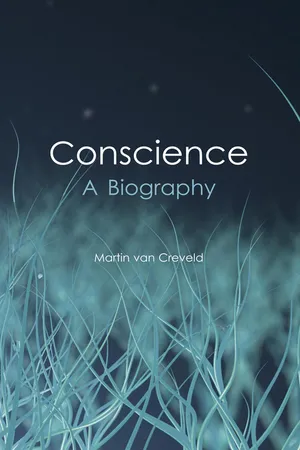
Many of us consider conscience one of the most important – if not the fundamental – quality that makes us human, distinguishing us from animals, on the one hand, and machines on the other. But what is conscience, exactly? Is it a product of our biological roots, as Darwin thought, or is it a purely social invention? If the latter, how did it come into the world?
In this biography of that most elusive human element, Martin van Creveld explores conscience throughout history, ranging across numerous subjects, from human rights to health to the environment. Along the way he considers the evolution of conscience in its myriad, occasionally strange and ever-surprising permutations. The Old Testament – erroneously, it turns out – is normally seen as the fountainhead from which the Western idea of conscience has sprung, while Antigone was the first person on record to explicitly speak of conscience. The story of conscience involves the philosophers Zeno, Cicero and Seneca; Christian thinkers such as Paul, Augustine, Aquinas and, above all, Martin Luther; and modern intellectual giants such as Machiavelli, Rousseau, Kant, Hegel, Nietzsche and Freud. Individual chapters are devoted to Japan, China and even the Nazis, as well as the most recent discoveries in robotics and neuroscience and how they have contributed to the ways we think about our own morality. Ultimately, van Creveld shows that conscience remains as elusive as ever, a continuously mysterious voice that guides how we think about right and wrong.
- English
- ePUB (mobile friendly)
- Available on iOS & Android
eBook - ePub
About this book
Information
References
Introduction
1 David Hume, A Treatise of Human Nature [1739–40], book 3, § 1. The text is available at www.gutenberg.org.
2 Charles Darwin, The Descent of Man [1871], n.p., Digireads (2009), p. 85.
3 Richard Dawkins, The Selfish Gene [1976] (New York, 1999).
4 Frans de Waal, Our Inner Ape: The Best and Worst of Human Nature (New York, 2005) pp. 201–19; also, more recently, Frans de Waal, The Bonobo and the Atheist: In Search of Humanism among the Primates (New York, 2013).
5 De Waal, The Bonobo and the Atheist, locs 2246 and 2649.
6 Paul Mellars, ‘Why Did Modern Human Populations Disperse from Africa 60,000 Years Ago?’, Proceedings of the National Academy of Science (PNAS), CIII/25 (2006), pp. 9381–6.
I. At the Beginning
1 Hermann Rauschning, Gespräche mit Hitler [1938] (Vienna, 1988), p. 189.
2 J. Milgrom, Cult and Conscience: The Asham and the Priestly Doctrine of Repentance (Leiden, 1976), pp. 3, 84, 117–20, 123–4.
3 See A. Olman, ‘Did King David Have a Conscience?’ (Jerusalem, 2012), at http://levinsky.academia.edu/AryeOlman/Papers/117518.
4 See John Barton, Understanding Old Testament Ethics: Approaches and Explorations (Louisville, KY, 2003), pp. 66–7.
5 For this aspect of Judaism, see O. Hempel, Das Ethos des Alten Testaments (Berlin, 1938), pp. 189–92.
6 Maimonides, Royal Ways [Hebrew], 8:11. The English translation is by Marvin Fox, Interpreting Maimonides: Studies in Methodology, Metaphysics and Moral Philosophy (Chicago, IL, 1990), p. 132.
7 A. Schopenhauer, ‘Preisschrift über die Grundlage der Moral’, in J. Frauenstaedt, ed., Saemtliche Werke (Leipzig, 1922), vol. IV, p. 192.
8 See L. R. Saslow et al., ‘My Brother’s Keeper? Compassion Predicts Generosity More among Less Religious Individuals’, Social Psychology and Personality Science, IV (2013), pp. 31–8.
9 See, for what follows, F. Nietzsche, On the Genealogy of Morals [1887] (New York, 1966), pp. 12, 13, 15, 22, 25, 44.
10 The most succinct account is F. Nietzsche, The Anti-christ [1895] (Harmondsworth, 1969), p. 116.
11 Homer, The Iliad (I, 40–100).
12 Ibid. (XIX, 287–300); Homer, The Odyssey (VI, 196–210, XIII, 4–15).
13 See, on feminine aidos in general, Gloria Ferrari, ‘Figures of Speech: The Picture of Aidos’, Metis, V (1990), pp. 185–204 (pp. 186–7); for pudicitia, see R. Langlands, Sexual Morality in Ancient Rome (Cambridge, 2006), pp. 37–77, 186, 346.
14 Odyssey, VI, lines 127–37.
15 See, for the history of the concept, D. L. Cairns, Aidos (Oxford, 1993).
16 Suetonius, The Life of Caligula, chap. 29.
17 Iliad (X, 237).
18 Ibid. (XII, 93 and XVII, 95).
19 Ibid. (XIX, 243–314).
20 Ibid. (V, 787 and VIII, 228).
21 Ibid. (VI, 493).
22 Hesiod, Works and Days, 317–19.
23 Plutarch, Parallel Lives, ‘The Life of Solon’, vol. II/1.
24 Solon, fragment no. 32, in Elegy and Iambus, vol. II, p. 146.
25 Cairns, Aidos, p. 167.
26 Aeschylus, The Persians, lines 699–704; Book of Esther, 4:5–5:3.
27 Sophocles, Antigone, 511.
28 See, for women’s timidity, C. R. Post, ‘The Dramatic Art of Sophocles’, Harvard Studies in Classical Philology, XXIII (1912), p. 79. Antigone putting her own judgement first: Ursula Stebler, Entstehung und Entwicklung des Gewissens im Spiegel des Griechischen Tragödie (Berne, 1971), vol. V, p. 69.
29 Euripides, Electra, 43–6.
30 Euripides, Orestes, 396–7.
31 Euripides, The Suppliants, 909–17.
32 Euripides, Iphigenia at Aulis, 563–68; see also Cairns, Aidos, pp. 342–3.
33 Democritus, in The Atomists: Leucippus and Democritus, Fragments, ed. and trans. C.C.W. Taylor (Toronto, 2010), fragment B 181.
34 Ibid., fragment B 262.
35 Ibid., fragment B 215.
36 Plato, Apology, 30a.
37 Plato, Seventh Letter, §328d.
38 Plato, The Republic, Book 4, §439e–440a, and 548c.
39 See John M. Cooper, ‘Plato’s Theory of Human Motivation’, History of Philosophy Quarterly, I/1 (1989), pp. 3–21 (pp. 14–15).
40 Aristotle, Nicomachean Ethics (IX, ch. 1).
41 Ibid., Rhetoric, b12–14.
42 Antiphon, quoted in Stobaeus, Florilegium, 2.d.11–2 and 3.24.7.
43 J. M. Rist, Stoic Philosophy (Cambridge, 1969), p. 92.
44 Isocrates, Orationes (I, 16 and II, 59).
45 See Martin Revermann, ‘The Competence of ...
Table of contents
- Front Cover
- Half Title
- Title Page
- Copyright
- Contents
- Introduction
- I. At the Beginning
- II. The Christian Centuries
- III. From Machiavelli to Nietzsche
- IV. Life without God
- V. Conscience in the Third Reich
- VI. Idols Old and New
- VII. The Man-machine
- Conclusion: At Journey’s End
- References
- Acknowledgements
- Index
Trusted by 375,005 students
Access to over 1.5 million titles for a fair monthly price.
Study more efficiently using our study tools.
Frequently asked questions
Yes, you can cancel anytime from the Subscription tab in your account settings on the Perlego website. Your subscription will stay active until the end of your current billing period. Learn how to cancel your subscription
No, books cannot be downloaded as external files, such as PDFs, for use outside of Perlego. However, you can download books within the Perlego app for offline reading on mobile or tablet. Learn how to download books offline
Perlego offers two plans: Essential and Complete
- Essential is ideal for learners and professionals who enjoy exploring a wide range of subjects. Access the Essential Library with 800,000+ trusted titles and best-sellers across business, personal growth, and the humanities. Includes unlimited reading time and Standard Read Aloud voice.
- Complete: Perfect for advanced learners and researchers needing full, unrestricted access. Unlock 1.5M+ books across hundreds of subjects, including academic and specialized titles. The Complete Plan also includes advanced features like Premium Read Aloud and Research Assistant.
We are an online textbook subscription service, where you can get access to an entire online library for less than the price of a single book per month. With over 1.5 million books across 990+ topics, we’ve got you covered! Learn about our mission
Look out for the read-aloud symbol on your next book to see if you can listen to it. The read-aloud tool reads text aloud for you, highlighting the text as it is being read. You can pause it, speed it up and slow it down. Learn more about Read Aloud
Yes! You can use the Perlego app on both iOS and Android devices to read anytime, anywhere — even offline. Perfect for commutes or when you’re on the go.
Please note we cannot support devices running on iOS 13 and Android 7 or earlier. Learn more about using the app
Please note we cannot support devices running on iOS 13 and Android 7 or earlier. Learn more about using the app
Yes, you can access Conscience by Martin van Creveld in PDF and/or ePUB format, as well as other popular books in History & Social History. We have over 1.5 million books available in our catalogue for you to explore.