Over the last two centuries, the world’s cities have undergone dramatic vertical, above-ground transformations. But at the same time, they have sunk themselves into the ground, in the form of sprawling tendons of tunnels, caverns and bunkers – conduits for transport, utilities and communication or spaces of shelter and storage. Global Undergrounds charts the global reach of urban underground spaces, collecting 80 stories of subterranean sites around the world to reveal the profound – but often unseen – ways they have changed our lives.
Illustrated with breath-taking photographs, this book exposes the remarkable diversity of manmade underground environments, from their astonishing range of architectural approaches to the many cultural meanings they carry, whether as places of hope, fear, memory, labour or political resistance. Undergrounds are places that can tell a city’s oldest stories or foresee its most distant futures; they are places ultimately of both incredible depth and breadth, serving city dwellers not just with the logistics of day-to-day life but as crucial parts of a city’s mythology.
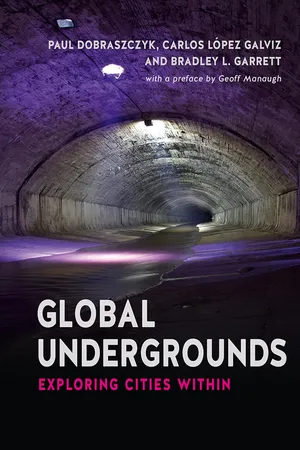
eBook - ePub
Global Undergrounds
Exploring Cities Within
- English
- ePUB (mobile friendly)
- Available on iOS & Android
eBook - ePub
Global Undergrounds
Exploring Cities Within
About this book
Information
Topic
ArchitectureSubtopic
Architecture GeneralREFERENCES
INTRODUCTION
1 See Bradley L. Garrett, Subterranean London: Cracking the Capital (London, 2014).
2 Rosalind Williams, Notes on the Underground: An Essay on Technology, Society and the Imagination (Cambridge, MA, 1990).
3 Stephen Graham and Lucy Hewitt, ‘Getting Off the Ground: On the Politics of Urban Verticality’, Progress in Human Geography, XXXVII/1 (2013), pp. 71–2.
4 Stephen Graham, ‘Super-tall and Ultra-deep: The Cultural Politics of the Elevator’, Theory, Culture and Society, XXXI/7–8 (2014), pp. 239–65.
5 Eyal Weizman, Hollow Land: Israel’s Architecture of Occupation (London, 2007; revd edn 2012).
6 See, for example, Peter Adey, ‘Vertical Security in the Megacity: Legibility, Mobility and Aerial Politics’, Theory, Culture and Society, XXVII/6 (2010), pp. 51–67; and Stuart Elden, ‘Secure the Volume: Vertical Geopolitics and the Depth of Power’, Political Geography, XXXIV/6 (May 2013), pp. 35–51.
7 Gavin Bridge, ‘Territory, Now in 3D!’, Political Geography, XXXIV/6 (May 2013), p. 55.
8 See, for example, C. López Galviz, ‘Mobilities at a Standstill: Regulating Circulation in London, c. 1863–1870’, Journal of Historical Geography, XLII/1 (October 2013), pp. 62–76. On communications and networks, see Richard Dennis, Cities in Modernity: Representations and Productions of Metropolitan Space, 1840–1930 (Cambridge, 2008); Simon Guy, Simon Marvin and Timothy Moss, eds., Urban Infrastructure in Transition: Networks, Buildings, Plans (London, 2001); Joel A. Tarr and Gabriel Dupuy, eds, Technology and the Rise of the Networked City in Europe and America (Philadelphia, 1988).
9 Peter Sloterdijk, Sphären III: Schäume (Frankfurt, 1999).
10 Williams, Notes on the Underground, pp. 212–13.
11 Kristian H. Nielsen, Henry Nielsen and Janet Martin-Nielsen, ‘City under the Ice: The Closed World of Camp Century in Cold War Culture’, Science as Culture, XXIII/4 (2014), pp. 443–64; also quoted in ‘Under the Ice: Polar Undergrounds’, below.
12 Austin Zeiderman, ‘Securing Bogotá’, Open Democracy, 14 February 2013, www.opendemocracy.net. See also an interview with Alberto Granada, former sewer-dweller, in ‘Sewers of Bogota’, 23 April 2007, www.vice.com.
13 See, for example, Sarah Cant, ‘“The Tug of Danger with the Magnetism of Mystery”: Descents into “the Comprehensive Poetic-Sensuous Appeal of Caves”’, Tourist Studies, III/1 (2003), pp. 67–81; and Maria Alejandra Pérez, ‘Exploring the Vertical: Science and Sociality in the Field among Cavers in Venezuela’, Social and Cultural Geography, XVI/2 (2015), pp. 226–7.
14 Not least, our global search for underground spaces has practical limitations of, for example, language. The References include websites that we came across and that readers might find worth checking. Among these, we highlight the superb collection of photographs and descriptions of underground spaces in Córdoba, Argentina, available at www.speleotunel.com.ar. See also the publications of the Association Française des Tunnels et de L’Espace Souterrain, www.aftes.asso.fr.
15 The French translation from Latin reads: ‘Cette clarté nocturne vient du Firmament, qui n’est autre chose que le revers de la surface de la Terre, dont l’hémisphère donne une lumière pareille à celle, que la Lune rend chez nous; de sorte qu’à ne considérer que cela, on peut bien dire, que sur le globe en question les nuits diffèrent peu des jours, si ce n’est que pendant la nuit le Soleil est absent, & que cette absence rend les soirées un peu plus fraîches.’ Ludvig Holberg, Voyage de Nicolas Klimius dans le monde souterrain, contenant une nouvelle téorie de la terre, et l’histoire d’une cinquiême monarchie inconnu jusqu’à-present (Copenhagen, 1753), p. 16.
ORIGINS
1 David R. Olson and Ellen Bialystok, Spatial Cognition: The Structure and Development of Mental Representations (New York, 2014), pp. 69–71.
2 Edward Soja, ‘Cities and States in Geohistory’, Theory and Society, XXXIX/3–4 (2010), pp. 361–76.
3 Ruth Whitehouse, The First Cities (London, 1977), pp. 71–2.
4 Anthony Clayton, Subterranean City:Beneath the Streets of London (London, 2000); and David L. Pike, Subterranean Cities: The World Beneath Paris and London, 1800–1945 (Ithaca, NY, 2005).
5 See R. Chudley and R. Greeno, Advanced Construction Technology (New Jersey, 2006), p. 179; and see Richard Trench and Ellis Hillman, London Under London: A Subterranean Guide (London, 1993), pp. 105–15.
6 See A.E.J. Morris, History of Urban Form before the Industrial Revolution (London, 2013), pp. 17, 60–61.
7 See John Hopkins, ‘The “Sacred Sewer”: Tradition and Religion in the Cloaca Maxima’, in Rome, Pollution and Propriety: Dirt, Disease and Hygiene in the Eternal City from Antiquity to Modernity, ed. Mark Bradley (Cambridge, 2012), pp. 81–102.
8 On the history and legacy of the Cloaca Maxima, see Hopkins, ‘The “Sacred Sewer”’, and Emily Gowers, ‘The Anatomy of Rome from Capitol to Cloaca’, Journal of Roman Studies, LXXXV (1995), pp. 23–32.
9 See, for example, L. Volloresi, ‘Roma Sotteranea’, National Geographic Italia, XVIII/1 (2006), pp. 2–25.
10 Pliny the Elder, Natural History, Books 36–37, trans. D. I. Fichholz (Cambridge, MA, 1989), pp. 104–8.
11 Victor Cunrui Xiong, Sui-Tang Chang’an: A Study in the Urban History of Medieval China (Ann Arbor, MI, 2000).
12 See ‘Going Underground’, in Neal Bedford and Simon Sellars, The Netherlands (London, 2007), p. 281.
13 Information on these tours can be found at www.maastrichtunderground.nl.
14 Steve Pile, Real Cities: Modernity, Space and the Phantasmagorias of City Life (London, 2005), p. 8.
15 Petrus Gyllius, The Antiquities of Constantinople. With a Descript...
Table of contents
- Front Cover
- Half Title
- Title Page
- Copyright
- CONTENTS
- PREFACE Global Undergrounds Geoff Manaugh
- INTRODUCTION Exploring Cities Within Paul Dobraszczyk, Carlos López Galviz and Bradley L. Garrett
- ORIGINS
- LABOUR
- DWELLING
- REFUSE
- MEMORY
- GHOSTS
- FEAR
- SECURITY
- RESISTANCE
- RENDERINGS
- EXPOSURE
- EDGES
- FUTURES
- References
- Notes on Contributors
- Photo Acknowledgements
Trusted by 375,005 students
Access to over 1.5 million titles for a fair monthly price.
Study more efficiently using our study tools.
Frequently asked questions
Yes, you can cancel anytime from the Subscription tab in your account settings on the Perlego website. Your subscription will stay active until the end of your current billing period. Learn how to cancel your subscription
No, books cannot be downloaded as external files, such as PDFs, for use outside of Perlego. However, you can download books within the Perlego app for offline reading on mobile or tablet. Learn how to download books offline
We are an online textbook subscription service, where you can get access to an entire online library for less than the price of a single book per month. With over 1.5 million books across 990+ topics, we’ve got you covered! Learn about our mission
Look out for the read-aloud symbol on your next book to see if you can listen to it. The read-aloud tool reads text aloud for you, highlighting the text as it is being read. You can pause it, speed it up and slow it down. Learn more about Read Aloud
Yes! You can use the Perlego app on both iOS and Android devices to read anytime, anywhere — even offline. Perfect for commutes or when you’re on the go.
Please note we cannot support devices running on iOS 13 and Android 7 or earlier. Learn more about using the app
Please note we cannot support devices running on iOS 13 and Android 7 or earlier. Learn more about using the app
Yes, you can access Global Undergrounds by Carlos López Galviz, Paul Dobraszczyk, Bradley L. Garrett, Carlos López Galviz,Paul Dobraszczyk,Bradley L. Garrett,Carlos López Galvis in PDF and/or ePUB format, as well as other popular books in Architecture & Architecture General. We have over 1.5 million books available in our catalogue for you to explore.