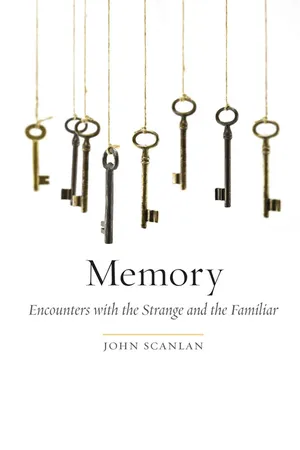
We know that as we get older, we may slowly lose more and more of our memory, and that this can impair our sense of where we belong and how we connect to others. We might relax a little if we consider the improvements in computer data storage, which may lead us to a future in which the limits of our memories become less constricting. In this book, John Scanlan explores the nature of memory and how we have come to live both with and within it, as well as what it might mean for memory to become a process as simple as retrieving and reading data.
Probing the ways various philospohers have looked at memory, John Scanlan revals that some argue being human means having the ability to remember, in order to see oneself as a being in time, with a past and future. At the same time, he shows that our memories can undo our present sense of time and place by confronting us with our past lives. And in this digital age we are immersed in a vast archive of data that not only colours our every day experiences but also suppies us with information on anything we might otherwise have forgotten, breaking down the distinction between the memories of the individual and the collective. Drawing on history, philosophy and technology, Memory: Encounters with the Strange and the Familiar offers an engaging investigation of how the phenomenon of memory continually remakes everyday life.
- English
- ePUB (mobile friendly)
- Available on iOS & Android
eBook - ePub
About this book
Information
Topic
FilosofíaSubtopic
Historia y teoría filosóficasREFERENCES
Introduction
1 Clive Thompson, ‘Clive Thompson on Memory Engineering’, Wired (27 September 2011).
2 Carolyn Kellogg, ‘Scientists Write First Book in DNA’, Los Angeles Times (20 August 2012).
3 Marcel Proust, In Search of Lost Time, vol. I: Swann’s Way, trans. C. K. Scott Moncrieff and Terence Kilmartin, revd D. J. Enright (London, 1996), p. 6.
4 Novalis, Philosophical Writings, trans. and ed. Margaret Mahony Stoljar (Albany, NY, 1995), p. 135.
5 Friedrich Nietzsche, Beyond Good and Evil, trans. R. Hollingdale (London, 2003), §20, p. 50.
6 Eric L. Santner, On Creaturely Life: Rilke, Benjamin, Sebald (Chicago, 2006), p. 5.
7 Walter Benjamin, The Arcades Project, trans. Howard Eiland and Kevin McLaughlin (Cambridge, MA, 1999), p. 416.
8 Ibid., p. 471.
9 Jean-Pierre Vernant, Myth and Thought among the Greeks, trans. Janet Lloyd and Jeff Fort (New York, 2006), p. 435.
10 Aristotle, Posterior Analytics, in The Complete Works of Aristotle: The Revised Oxford Translation, ed. Jonathan Barnes (Princeton, NJ, 1991), vol. I, 100a, 4–9.
11 See Martin Jay, Songs of Experience: Modern American and European Variations on a Universal Theme (Berkeley, CA, 2006), pp. 15–16.
12 Ibid., pp. 15–16.
13 Jan Goldstein, ‘Mutations of the Self’, in Biographies of Scientific Objects, ed. Lorraine Daston (Chicago, 2000), p. 94.
14 Quoted in Sylvana Tomaselli, ‘The Death and Rebirth of Character in the Eighteenth Century’, in Rewriting the Self: Histories from the Renaissance to the Present, ed. Roy Porter (London, 1997), p. 91.
15 Jerrold Seigel, The Idea of the Self: Thought and Experience in Western Europe since the Seventeenth Century (Cambridge, 2005), pp. 191–2.
16 Philip Fisher, The Vehement Passions (Princeton, NJ, 2003), p. 44.
17 Ibid.
18 See the story of ‘EP’ in Joshua Foer, ‘Remember This: In the Archives of the Brain’, National Geographic (November 2007), pp. 32–57.
19 Aristotle, On Memory, in The Complete Works of Aristotle, The Revised Oxford Translation, ed. Jonathan Barnes (Princeton, NJ, 1991), vol. I, 449b24–449b30.
20 Ian Hacking, Rewriting the Soul: Multiple Personality and the Sciences of Memory (Princeton, NJ, 1995), pp. 199–201.
21 Matthew Rampley, Nietzsche, Aesthetics and Modernity (Cambridge, 2000), p. 140.
22 Vernant, Myth and Thought among the Greeks, p. 122.
23 Ibid.
24 Paul Ricoeur, Memory, History, Forgetting, trans. Kathleen Blamey and David Pellauer (Chicago, 2004), p. 284.
25 Matt K. Matsuda, The Memory of the Modern (New York and London, 1996), p. vi.
26 Kerwin Lee Klein, ‘On the Emergence of Memory in Historical Discourse’, Representations, 69, Special Issue: ‘Grounds for Remembering’ (2006), p. 129.
I Pasts
1 Robert Pogue Harrison, The Dominion of the Dead (Chicago, 2003), p. xi.
2 Ibid.
3 Martin Heidegger, Being and Time, trans. John Macquarrie and Edward Robinson (Oxford, 1962), §329, p. 377.
4 Martin Heidegger, The Fundamental Concepts of Metaphysics: World, Finitude, Solitude, trans. William McNeill and Nicholas Walker (Bloomington, IN, 2001), p. 6; Novalis, Philosophical Writings, trans. and ed. Margaret Mahony Stoljar (Albany, NY, 1997), p. 135.
5 Martin Heidegger, Early Greek Thinking, trans. D. F. Krell and A. F. Capuzzi (New York, 1984), p. 108.
6 Friedrich Nietzsche, Beyond Good and Evil, trans. R. Hollingdale (London, 2003), §20, p. 50.
7 Fredric Jameson, The Seeds of Time (New York, 1994), p. 84.
8 The quotation is from Heidegger, Early Greek Thinking, p. 108.
9 The recollection of divine memory is anamnesis which, according to Angus Nicholls and Martin Leibscher, Thinking the Unconscious: Nineteenth-century German Thought (Cambridge, 2010), may be thought of as an early variant of ‘the unconscious’, see p. 4.
10 In myth, memory is anamnesis – this is what pre-dates philosophy. See also Eric Voeglin, Order and History (Columbia, MI, 2001).
11 Edith Hall, The Return of Ulysses: A Cultural History of Homer’s Odyssey (London, 2008), p. 164.
12 Homer, The Odyssey, trans. E. V. Rieu and D.C.H. Rieu (London, 1991), p. 72, Book 5, ll. 80ff.
13 See Theodor Adorno and Max Horkheimer, Dialectic of Enlightenment, trans. John Cumming (London, 1997); J. M. ...
Table of contents
- Front Cover
- Half Title
- Title Page
- Copyright
- Contents
- INTRODUCTION
- I Pasts
- II Presences
- III Ecologies
- CONCLUSION
- REFERENCES
- SELECT BIBLIOGRAPHY
- ACKNOWLEDGEMENTS
- PHOTO ACKNOWLEDGEMENTS
- INDEX
Trusted by 375,005 students
Access to over 1.5 million titles for a fair monthly price.
Study more efficiently using our study tools.
Frequently asked questions
Yes, you can cancel anytime from the Subscription tab in your account settings on the Perlego website. Your subscription will stay active until the end of your current billing period. Learn how to cancel your subscription
No, books cannot be downloaded as external files, such as PDFs, for use outside of Perlego. However, you can download books within the Perlego app for offline reading on mobile or tablet. Learn how to download books offline
We are an online textbook subscription service, where you can get access to an entire online library for less than the price of a single book per month. With over 1.5 million books across 990+ topics, we’ve got you covered! Learn about our mission
Look out for the read-aloud symbol on your next book to see if you can listen to it. The read-aloud tool reads text aloud for you, highlighting the text as it is being read. You can pause it, speed it up and slow it down. Learn more about Read Aloud
Yes! You can use the Perlego app on both iOS and Android devices to read anytime, anywhere — even offline. Perfect for commutes or when you’re on the go.
Please note we cannot support devices running on iOS 13 and Android 7 or earlier. Learn more about using the app
Please note we cannot support devices running on iOS 13 and Android 7 or earlier. Learn more about using the app
Yes, you can access Memory by John Scanlan in PDF and/or ePUB format, as well as other popular books in Filosofía & Historia y teoría filosóficas. We have over 1.5 million books available in our catalogue for you to explore.