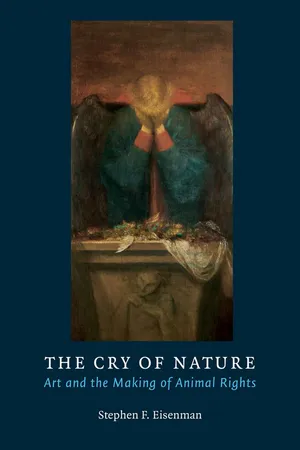
The Cry of Nature reveals how humans engaged in the struggle for animal emancipation and examines for the first time the role of visual art in the growth of animal rights. Artists from Hogarth to Soutine, and Géricault to Picasso, represented animals’ suffering and death, as well as their pleasure and individuality. Embracing the lessons of Montaigne, Rousseau, Blake, Darwin, Freud and many others, they proposed that humans and animals have a shared evolutionary heritage of sentience, intelligence and empathy, and deserve equal access to the domain of moral rights.
From the mid-18th century, a new and more sympathetic understanding of animals began to challenge prevailing views. Witnessing the pain and hearing the outcry of the animals massed together in the great cities of Europe, sympathetic writers and artists argued that animals were neither slaves nor automata, and possessed the capacity to feel and even think. Refuting the biblical dispensation of humans’ dominion over animals, they contended that animals possessed inalienable rights. Thus was born a global movement that fundamentally changed how we understand our relationship to the natural world. Animal rights has become one of the preeminent liberation movements of our time.
Illuminating and provocative, The Cry of Nature documents and explores the making of animal rights over the course of 300 years. Engaging the fields of biology, ethnology, anthropology, economics, philosophy and art history, it is both a survey and a closely argued examination of a deeply important but misunderstood epoch in the long history of human and animal relationships.
Stephen F. Eisenman lecturing at the Chicago Humanities Festival 2013.
- English
- ePUB (mobile friendly)
- Available on iOS & Android
eBook - ePub
About this book
Information
Topic
ArteSubtopic
Arte generaleTable of contents
- Front Cover
- Half Title
- Title Page
- Copyright
- Contents
- Introduction
- One: What is an Animal?
- Two: Animals into Meat
- Three: The Cry of Nature
- Four: Counter-revolution
- Five: Primal Scenes
- Conclusion: Art and Animals Right Now
- References
- Further Reading
- Acknowledgements
- Photo Acknowledgements
- Index
Trusted by 375,005 students
Access to over 1.5 million titles for a fair monthly price.
Study more efficiently using our study tools.
Frequently asked questions
Yes, you can cancel anytime from the Subscription tab in your account settings on the Perlego website. Your subscription will stay active until the end of your current billing period. Learn how to cancel your subscription
No, books cannot be downloaded as external files, such as PDFs, for use outside of Perlego. However, you can download books within the Perlego app for offline reading on mobile or tablet. Learn how to download books offline
Perlego offers two plans: Essential and Complete
- Essential is ideal for learners and professionals who enjoy exploring a wide range of subjects. Access the Essential Library with 800,000+ trusted titles and best-sellers across business, personal growth, and the humanities. Includes unlimited reading time and Standard Read Aloud voice.
- Complete: Perfect for advanced learners and researchers needing full, unrestricted access. Unlock 1.5M+ books across hundreds of subjects, including academic and specialized titles. The Complete Plan also includes advanced features like Premium Read Aloud and Research Assistant.
We are an online textbook subscription service, where you can get access to an entire online library for less than the price of a single book per month. With over 1.5 million books across 990+ topics, we’ve got you covered! Learn about our mission
Look out for the read-aloud symbol on your next book to see if you can listen to it. The read-aloud tool reads text aloud for you, highlighting the text as it is being read. You can pause it, speed it up and slow it down. Learn more about Read Aloud
Yes! You can use the Perlego app on both iOS and Android devices to read anytime, anywhere — even offline. Perfect for commutes or when you’re on the go.
Please note we cannot support devices running on iOS 13 and Android 7 or earlier. Learn more about using the app
Please note we cannot support devices running on iOS 13 and Android 7 or earlier. Learn more about using the app
Yes, you can access The Cry of Nature by Stephen F. Eisenman in PDF and/or ePUB format, as well as other popular books in Arte & Arte generale. We have over 1.5 million books available in our catalogue for you to explore.