- English
- ePUB (mobile friendly)
- Available on iOS & Android
eBook - ePub
About this book
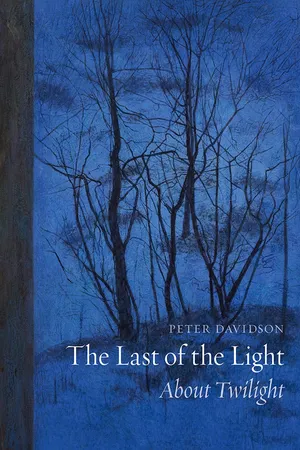
This ambitious account of the arts of the evening, now available in paperback, deftly combines prose-poetry, memoir, philosophy and art history. Intertwining personal, cultural and artistic histories, it is a richly rewarding book written in a unique voice.
Information
1
ABOUT SHADOWS AND GARDENS
Dama de noche, night-blooming jessamine, stand at the gate of the darkening garden. Sweetness of jasmine, syrup in the mouth; black Havana tobacco, fog in the throat. The scented air is thickened beyond bearing, dense with thunder on the August evening that rises in memory. The days of murderous heat before the feast of the Assumption, before the first crack in the hideous summer. Not a breath of wind off the Mediterranean, insects thronging under the burdened olive trees beyond the garden walls. The echo of a shot, of shots, from the foothills to the north. A momentary silence in the conversation on the terrace, and then the fountain loud out of the dimness of the cypresses. Pulses of sound, pauses in the fall of water from the lion’s mouth into the pool between the mirroring curves of the stairs, dropping in the cadence of Lorca’s lines:
Agua y sombra, sombra y agua,
por Jerez de la Frontera.1
Shadow and water, water and shadow, at Jerez de la Frontera.
The conversation resumes, a weighty silver lighter rasps and flares, and more smoke from black tobacco drifts up to where I stand alone on the roof terrace watching the advance of the twilight over the clifftop olive groves and the sea. Already the mountains to the north are darkening on their eastern sides, blurred by the heat of the day. The garden of the villa is in shadow, the last sunlight shooting rays through the red-earthed olive groves beyond. Beyond the whitewashed garden wall to the west lies the unknown territory of the other garden: an abandoned parterre of straggling once-clipped trees and stagnant canals behind iron gates locked by my grandfather’s orders before I was born. His study (which I entered only once in my life, on sufferance and under supervision) takes up the whole of the tower at the eastern end of the villa. Questions are neither encouraged nor answered in this shuttered house.
I turn back to the south to look over the sea, hearing again the fountain below the terrace falling in counterpoint with the single jet in the long pool at the dead centre of the villa garden.
El día se va despacio,
la tarde colgada a un hombro,
dando una larga torera
sobre el mar y los arroyos.2
Day goes out slowly, Evening hangs on the shoulder of the hill, Sweeping a long feint of its cloak Over sea and rivers.
The rivers are dry in this terrible August. I walked out with my father on some days, after my five o’clock bread and chocolate, over the thymy scrubland behind the house, walked in migraine heat as far as the gully of sand, which is a watercourse in winter. Bright oleanders with their rattling leaves grow in the parched riverbed. My father’s mind travelled then, I think, to his cold mountains, plumes of slow-drifting mist over pine trees, fast brown torrents pitted by rain. Standing on the arid bank, his right hand sketched the cast of a fishing line over the dust then, slowly and silently, we went back together to the locked villa. Purple dusk advances through the haze:
Las aceitunas aguardan
la noche de Capricornio,
y una corta brisa, ecuestre,
salta los montes de plomo.3
The olive trees wait the night of Capricorn, and a small breeze, mounted, jumps the hills of lead like a horseman.
But in these days before the first August thunder, nothing can stir the leaden air. Everything is locked down, everything is hot and immobile until the first storm breaks after the feast of the Assumption. The memory of these breathless days runs them together into one continual stifling twilight, a memory of roaming the villa and gardens, bored and apprehensive and alone: cellars smelling of oil and vine must, ink-shadowed cypress avenues paved with white dust, dark ramparts of clipped trees, moon-white boundary walls. And under everything ran the stress of season and evening and weather and history. This was an era that was itself an infinitely protracted twilight, lasting through many unnatural years. Before the resorts were developed on the coastal scrub and olive groves, Andalusia was locked in the modes and beliefs of the late 1930s by the fiat of the dictator.
That southern society of the 1960s would still have been recognizable to the early twentieth-century novelist Ronald Firbank (1886–1926), whose last completed fiction, Concerning the Eccentricities of Cardinal Pirelli, published in the year of his death, is set in ‘white Andalucia’. Firbank is a complex and virtuosic writer, infinitely skilled in omission, elision and allusion; pointed indirection; sparse evocation. His fictions were issued in small editions, half-privately, with the bold discretion born of a prudent flamboyance. Their influence has been, and is, remarkable. One of Firbank’s crucial areas of indirection is a camp focus on the extravagant externals of Catholicism, the religion to which he had converted in his early twenties. This serves to some degree to divert the casual reader: as is so often the case, camp coexists with absolute seriousness, with disquiet, even with despair. The essence of Firbank’s fiction is relentlessly crepuscular, not only in many scenes set at nightfall and at summer evening parties, but also in its weary sophistication, its undertow of menace and apprehension, its sense of the hovering presence of (sometimes literal) demons. In this world at nightfall, the Church is a constant and paradoxical element – at once a cabaret of outrageous grandeurs and the only source of hope or light in the approaching darkness.
This all comes to focus in his last book, which, behind veils of indirection and exoticism, is acute in its observations of southern Spain and its Church. Concerning the Eccentricities of Cardinal Pirelli conveys Firbank’s hard and weary sense of evil in the world – the only counterpoise being the Catholic Church, which is depicted in a twilight condition, in painfully fragile hands, like those of the eponymous hero, with his stark conflict of mystical piety and devouring sensuality.
The book is remarkably clear and accurate on Spain, its evocations going far beyond the well-worn espagnolisme of the nineteenth century. It is precise in its summoning of the terrible evenings of the ripening summer of the far south. The second chapter is an epitome of the whole, covering a broad range of experience and narration in its sure-footed, impressionistic progress through one hot twilight in the hanging garden of the Cardinal’s palace overlooking the city:
From the Calle de la Pasion, beneath the blue-tiled mirador of the garden wall, came the soft brooding sound of a seguidilla. It was a twilight planned for wooing, unbending, consent … pacing a cloistered walk, laden with the odour of sun-tired flowers, the Cardinal could not but feel the insidious influences astir.4
At once the struggle that is the sombre undercurrent of the apparently luxuriant camp of the Cardinal’s surroundings becomes apparent,
Morality. Poise! For without temperance and equilibrium – The Cardinal halted. But in the shifting underlight about him the flushed camellias and the sweet night-jasmines suggested none; neither did the shape of a garden-Eros pointing radiantly the dusk.
‘For unless we have balance –’ the Cardinal murmured, distraught, admiring against the elusive nuances of the afterglow the cupid’s voluptuous hams.5
As so often in Firbank, the aspirations of his characters, expressed when they are alone, are sombre and authentic, but aestheticism, the sensual beauty of things, is omnipresent and powerful. The Cardinal’s housekeeper comes forth with a silver stole to enwrap and imprison him as the twilight gives way to moonlight. Outside the voluptuous garden, the city is darkened by sepsis, epidemic disease, and the suggestion of malign influences, stirrings of evil magic practised by the very bored, be they grandees or ecclesiastics:
‘Such nights breed fever, Don Alvaro, and there is mischief in the air.’
‘Mischief?’
‘In certain quarters of the city, you would take almost it for some sortilege.’ …
The tones of the seguidilla had deepened and from the remote recesses of the garden arose a bedlam of nightingales and frogs. It was certainly incredible how he felt immured.6
And the Cardinal’s sad recourse is to put the oppression of season and evil from his mind by sensual diversion, by setting forth from his scented prison in disguise, perhaps in drag, and to go out into the hot, infected city, to cruise for a lover of either sex. The Cardinal’s passionate regrets are themselves enactments of Firbank’s own sombre dilemma about the apparent freedoms of the south, social and devotional. Later in the novel (the final scenes of the Cardinal’s exile, disgrace and death are strangely interspersed with what seem moments of mystical visitation, authentic illumination) once more in a twilight garden, Pirelli is shown resisting, or trying to resist, the temptation to go down into the infected city:
Already the blue pushing shadows were beguiling from the shelter of the cloister eaves the rueful owls. A few flittermice, too, were revolving around the long apricot chimneys of the Palace …
Kneeling before an altar raised to the cult of Our Lady of Dew, Cardinal Pirelli was plunged in prayer.
‘Salve. Salve Regina …’ Above the tree-tops a bird was singing.7
A more innocent and tender evocation of the evening villas of the south and their gardens is found in the works of the short-lived Turin poet Guido Gozzano (1883–1916), who found his solace in unfashionable things, provincial elegances, forgotten but beloved places. He was drawn inevitably to the evening, to dim stillness, to quiet and humble things and people, in sharp contrast to the bright audacity of his contemporary D’Annunzio. He was associated with a group of poets – the Crepuscolari, or ‘Twilightists’ – who were, like him, elegists for things lost and superseded in the modernizations of the new century, a group who would have wished only to prolong the lingering evening of the past. His description of his native Turin makes it most real at nightfall, with the streets and valleys in shadow and all the sunlight gone to the high hills:
vedo al tramonto, il cielo subalpino …
. . .
ardono l’Alpi tra le nube accese …8
I see at evening, the sky between the Alps … Shining mountains between blazing clouds
A trope that will reappear, desolatingly, at the end of his longest work, ‘La Signorina Felicita’, is that of his living contemporaries seen at one particular moment as if they were figures in an engraving of the mid-nineteenth century – distanced and aestheticized, the present (in this case an aristocratic evening party) perceived as though it were an illustration to a long-forgotten album:
Ed il poeta, tacito ed assente
si gode quell’accolita di gente
ch’à la tristezza d’una stampa antica9
And the poet, silent and absent-minded, enjoys this assembly of people, which has the sadness of an old print.
The only real moments of pleasure in these poems are those in which he can imagine his sickly twentieth-century self safe in hiding in the past, perhaps the past of two generations back in time, safe in the half-light, the time out of time, of an old engraving or sepia photograph. Gozzano’s school were identified as crepuscolari because of a contemporary perception that Italian literature was fading away into a gentle and infinitely extended twilight.10 The morning of Dante and Petrarch, the noontide of Tasso and Ariosto, the bright day of the eighteenth century, followed by the mellowing late afternoon of the romantics, Foscolo and Leopardi, had all given way, or s...
Table of contents
- Front Cover
- Half Title
- Title Page
- Copyright
- Contents
- Introduction
- 1 About Shadows and Gardens
- 2 English Melancholy
- 3 Cities of Evening
- 4 Dark Corners
- 5 Hesperides
- Epilogue: Fireworks and Reflected Lights
- REFERENCES
- ACKNOWLEDGEMENTS
- PHOTO ACKNOWLEDGEMENTS
- INDEX
Trusted by 375,005 students
Access to over 1.5 million titles for a fair monthly price.
Study more efficiently using our study tools.
Frequently asked questions
Yes, you can cancel anytime from the Subscription tab in your account settings on the Perlego website. Your subscription will stay active until the end of your current billing period. Learn how to cancel your subscription
No, books cannot be downloaded as external files, such as PDFs, for use outside of Perlego. However, you can download books within the Perlego app for offline reading on mobile or tablet. Learn how to download books offline
Perlego offers two plans: Essential and Complete
- Essential is ideal for learners and professionals who enjoy exploring a wide range of subjects. Access the Essential Library with 800,000+ trusted titles and best-sellers across business, personal growth, and the humanities. Includes unlimited reading time and Standard Read Aloud voice.
- Complete: Perfect for advanced learners and researchers needing full, unrestricted access. Unlock 1.5M+ books across hundreds of subjects, including academic and specialized titles. The Complete Plan also includes advanced features like Premium Read Aloud and Research Assistant.
We are an online textbook subscription service, where you can get access to an entire online library for less than the price of a single book per month. With over 1.5 million books across 990+ topics, we’ve got you covered! Learn about our mission
Look out for the read-aloud symbol on your next book to see if you can listen to it. The read-aloud tool reads text aloud for you, highlighting the text as it is being read. You can pause it, speed it up and slow it down. Learn more about Read Aloud
Yes! You can use the Perlego app on both iOS and Android devices to read anytime, anywhere — even offline. Perfect for commutes or when you’re on the go.
Please note we cannot support devices running on iOS 13 and Android 7 or earlier. Learn more about using the app
Please note we cannot support devices running on iOS 13 and Android 7 or earlier. Learn more about using the app
Yes, you can access The Last of the Light by Peter Davidson in PDF and/or ePUB format, as well as other popular books in History & Historical Theory & Criticism. We have over 1.5 million books available in our catalogue for you to explore.